Vein in Mining is one of the most fundamental concepts in economic geology and underground mining engineering that every mining student, geologist, and mine professional must clearly understand from the very beginning of their technical education.
From gold and silver deposits to copper, lead, and zinc mines, the Vein in Mining concept forms the geological backbone of hard rock mining operations all over the world, including across India’s most important mineral-producing regions.
In this complete guide by MiningGyan, we cover everything about Vein in Mining – from its clear definition and geological formation to its types, characteristics, wall rock alteration, the difference between Vein and Lode, Gold Vein mining, underground extraction methods, and competitive exam MCQs.
By the end of this article, you will have a thorough, structured, and exam-ready understanding of Vein in Mining and every related concept that accompanies it in textbooks and examinations.
What is Vein in Mining?
A Vein in Mining is a distinct, sheet-like body of crystallised minerals that has been deposited within a fracture, crack, or fissure in a host rock by mineral-bearing aqueous solutions that circulated through the rock under heat and pressure over geological time.
The Vein in Mining is always found within solid bedrock in its original position of formation, and it is characterised by well-defined wall rock contacts on both sides – the Hanging Wall above and the Footwall below – that separate the mineralised vein from the surrounding waste rock.
| Key Term | Definition |
|---|---|
| Vein in Mining | Sheet-like mineral deposit formed by hydrothermal fluids filling rock fractures |
| Mineral Vein | A vein containing economically valuable mineral concentrations |
| Gangue | Worthless minerals such as quartz or calcite that accompany the ore in a vein |
| Hydrothermal Fluid | Hot, mineral-rich water that deposits minerals as it cools inside rock fractures |
| Wall Rock | The host rock on both sides of the vein – Hanging Wall above and Footwall below |
| Vein Shoot | A rich, concentrated portion of a vein where ore grade is highest |
| Bonanza | An exceptionally rich and high-grade section of a mineral vein |
| Selvage | A thin clay or altered mineral zone at the contact between vein and wall rock |
Vein in Mining – Origin and History of the Term
The term “Vein in Mining” draws its meaning from a direct anatomical analogy – just as blood veins carry fluid through the human body in narrow channels, a mineral vein carries mineralised fluid through the rock body in narrow fractures and deposits its mineral content as it travels and cools.
The geological study of veins began formally in the 16th century with the work of Georgius Agricola, whose landmark book “De Re Metallica” published in 1556 first systematically described the occurrence, types, and characteristics of mineral veins in European mining districts.
| Era | Development in Vein Mining Understanding | Key Contribution |
|---|---|---|
| 1556 | Georgius Agricola publishes “De Re Metallica” | First systematic classification of mineral veins |
| 1700s | Werner develops Neptunism – veins as water deposits | Established hydrothermal origin concept |
| 1800s | Industrial revolution drives deep vein mining in Britain and Europe | Mechanised shaft sinking and stoping developed |
| 1848–1900 | California and Australian gold rushes expose large quartz vein systems | Hard rock vein mining becomes global industry |
| 1900–Present | Modern geochemistry confirms hydrothermal vein formation | Grade estimation, resource modelling, deep vein mining |
Vein in Mining – Formation Process
Understanding how a Vein in Mining forms is critically important for geologists searching for new deposits and for mining engineers who need to predict where the richest and most continuous sections of an ore vein will be found at depth.
Vein in Mining formation is primarily controlled by hydrothermal processes, though metamorphic, magmatic, and sedimentary processes each contribute to vein formation in specific geological settings worldwide.
Hydrothermal Vein Formation in Mining
The most economically significant process of Vein in Mining formation is the hydrothermal process, where hot water carrying dissolved metals and minerals circulates upward through pre-existing fractures in the Earth’s crust under the influence of heat from underlying magma bodies or geothermal gradients.
As these hot hydrothermal fluids rise and cool within the fracture system, the dissolved minerals precipitate out of solution and are deposited layer by layer on the fracture walls, progressively building up the mineralised vein body that miners ultimately target for extraction.
Metamorphic Vein Formation in Mining
Metamorphic veins form when rocks deep in the Earth’s crust are subjected to extreme heat and pressure during mountain-building events, causing mineral-bearing fluids to be expelled from the rock mass and driven into fractures where they crystallise and deposit as vein minerals.
Many of the world’s great orogenic gold vein systems, including those of Western Australia, the Canadian Shield, and the Dharwar Craton of India, were formed by metamorphic fluid expulsion during ancient tectonic events.
Open Space Filling vs Crack Seal Vein Formation
In shallow crustal environments, Vein in Mining can form by the simple filling of open fracture spaces with mineral material – this is known as open space filling and produces veins with well-developed crystal forms and banded mineral textures that are visible in mined vein samples.
At greater depths where open spaces cannot be maintained under pressure, veins grow by the “crack-seal” mechanism where the fracture repeatedly opens slightly, is immediately sealed by mineral precipitation, and then reopens again – producing very thin, layered veins that gradually thicken over millions of years of repeated opening and sealing cycles.
| Formation Type | Mechanism | Typical Depth | Resulting Vein Texture |
|---|---|---|---|
| Hydrothermal Open Space | Hot fluids fill open fractures as they cool | Shallow – near surface | Well-formed crystals, cavity fill textures |
| Hydrothermal Crack-Seal | Repeated micro-fracturing and sealing by minerals | Deep – several km | Fine-grained, banded, laminated texture |
| Metamorphic Fluid Expulsion | Pressure expels fluids into fractures during mountain building | Mid to deep crust | Coarse crystalline, foliation-parallel |
| Magmatic Hydrothermal | Fluids from crystallising magma enter country rock fractures | Moderate to deep | Massive to banded with sulphide minerals |
Types of Vein in Mining – Complete Classification
Vein in Mining is classified into several distinct types based on the geometry of the fracture system, the relationship between adjacent veins, and the structural controls that localised the mineralising fluids into specific zones within the rock mass.
Understanding all major types of Vein in Mining is essential because the vein type directly determines the appropriate exploration strategy, resource estimation approach, stope design, and underground mining method used to extract it economically.
Fissure Vein in Mining
A Fissure Vein in Mining is the most common and economically important type, formed when a single, clearly defined fracture or fissure in the host rock is filled with mineralised material deposited by hydrothermal fluids – it has two clearly defined parallel wall rock contacts and a tabular geometry with two large dimensions and one small one.
Fissure veins are the classic gold and silver-bearing quartz veins that most people picture when they think of hard rock vein mining – they are long and deep but relatively narrow, typically ranging from a few centimetres to several metres in true width.
Ladder Vein in Mining
A Ladder Vein in Mining consists of a series of short, closely spaced, regularly arranged, roughly parallel fractures that cross a dike or igneous intrusion from wall to wall, creating a pattern that resembles the rungs of a ladder when seen in cross-section.
Ladder veins in Mining are less common and generally less economically significant than fissure veins, but they are important structural indicators in mining geology because their presence confirms that the host dike was a conduit for hydrothermal fluid flow.
Sheeted Vein in Mining
A Sheeted Vein in Mining system consists of several distinct, closely spaced, roughly parallel vein fractures within a zone of rock that has been repeatedly fractured – rather than a single vein, there is a zone of multiple parallel veins that together make up the total mineralised width.
Sheeted vein systems are commonly associated with large porphyry copper and gold deposits where the stockwork of small veins collectively carries a minable grade even though no single vein is individually wide enough to mine selectively.
Composite Vein in Mining
A Composite Vein in Mining consists of several roughly parallel vein fractures connected by diagonal cross-fractures, with the rock between the veins being partially or completely replaced by ore minerals, creating a complex interconnected mineralised zone that is wider and more irregular than a simple single fissure vein.
Composite veins require careful geological mapping and sampling to accurately define their true ore boundaries, as the grade distribution is more variable than in a simple fissure vein.
Lenticular Vein in Mining
A Lenticular Vein in Mining has a lens-shaped geometry where the vein is thickest at the centre and tapers progressively to thin edges at both ends along its strike, rather than maintaining a consistent parallel width throughout its entire length like a simple fissure vein.
Lenticular veins commonly occur in metamorphic or folded terrains where the vein opened preferentially in zones of maximum extension, and they often occur in echelon arrays of multiple overlapping lens-shaped vein segments.
| Vein Type | Geometry | Width Range | Typical Minerals | Mining Method |
|---|---|---|---|---|
| Fissure Vein | Single tabular fracture fill, two parallel walls | 0.05 m – 4 m+ | Gold, Silver, Quartz | Cut and Fill, Shrinkage Stoping |
| Ladder Vein | Short parallel fractures crossing a dike | 0.01 m – 0.3 m | Gold, Quartz | Selective hand mining |
| Sheeted Vein | Multiple parallel veins in a fractured zone | Zone 1 m – 20 m | Copper, Gold, Molybdenum | Open Pit, Sub-level Stoping |
| Composite Vein | Multiple parallel veins with diagonal connections | 1 m – 10 m | Gold, Silver, Base Metals | Cut and Fill, Open Stoping |
| Lenticular Vein | Lens-shaped, thick centre tapering to ends | Variable – pinches and swells | Gold, Quartz, Sulphides | Cut and Fill, Selective Stoping |
Vein in Mining – Key Characteristics
Every Vein in Mining has a set of physical and geological characteristics that define its nature, control its geometry, and determine how it should be explored, sampled, and extracted – and a thorough understanding of these characteristics is essential for both geologists and underground mining engineers.
The most important characteristics of a Vein in Mining include its strike, dip, true width, continuity, grade shoots, wall rock alteration pattern, and the nature of the contact zone between the vein and the surrounding host rock.
| Characteristic | Definition | Significance in Mining |
|---|---|---|
| Strike of Vein | Horizontal compass direction along which the vein extends | Guides drive and tunnel orientation underground |
| Dip of Vein | Angle of inclination of the vein from horizontal | Controls underground mining method selection |
| True Width | Perpendicular distance across the vein between wall rock contacts | Determines stope dimensions and dilution control |
| Apparent Width | Width measured at an angle – always larger than true width | Must be corrected to true width for resource estimation |
| Grade Shoot | A high-grade zone within the vein where ore is richest | Primary production target in underground mining operations |
| Pinch and Swell | Natural variation in vein width along its length | Affects stope design and ore recovery planning |
| Wall Rock Alteration | Chemical changes in host rock immediately adjacent to vein | Used as a pathfinder guide during exploration drilling |
| Selvage | Thin clay or gouge zone at vein-wall rock contact | Weak zone that affects Hanging Wall stability |
Vein in Mining – Wall Rock Alteration
Wall rock alteration is one of the most important concepts associated with Vein in Mining – it refers to the chemical and mineralogical changes that occur in the host rock immediately surrounding a vein as a result of interaction with the hot hydrothermal fluids that deposited the vein minerals.
Understanding wall rock alteration patterns around a Vein in Mining is critically important for exploration geologists because the alteration halo is typically much wider than the vein itself and can be detected through systematic sampling and mapping even where the vein is not directly exposed at the surface.
| Alteration Type | Minerals Produced | Associated Vein Type | Exploration Significance |
|---|---|---|---|
| Silicification | Quartz flooding of host rock | Epithermal gold veins | Strong guide to gold-bearing vein systems |
| Sericitisation | Sericite (fine white mica) replaces feldspars | Mesothermal gold and copper veins | Important pathfinder for deeper vein systems |
| Argillic Alteration | Clay minerals replace feldspars near surface | Shallow epithermal veins | Indicates proximity to vein system |
| Potassic Alteration | K-feldspar and biotite enrichment | Deep porphyry-related veins | Core zone of porphyry and skarn systems |
| Propylitic Alteration | Chlorite, epidote, calcite | Outer zone of all hydrothermal veins | Outer margin of hydrothermal system |
Vein vs Lode in Mining – Key Difference
The difference between Vein and Lode in Mining is a topic that frequently confuses both students and professionals because the two terms are often used interchangeably in geological and mining literature, but there is a subtle and important distinction between them.
In the strictest technical sense, a Vein in Mining describes a single, well-defined, sheet-like mineralised fracture fill, while a Lode in Mining is a broader term that encompasses the entire mineralised zone including the vein, any associated parallel veins, and the altered wall rock between them.
| Parameter | Vein in Mining | Lode in Mining |
|---|---|---|
| Scale | A single mineralised fracture fill | An entire mineralised zone – may contain multiple veins |
| Boundaries | Sharp, clearly defined wall rock contacts | May have diffuse or gradational boundaries |
| Width | Typically centimetres to a few metres | Can be metres to tens of metres wide |
| Used By | Geologists describing individual fracture fills | Miners describing the complete mineralised ore zone |
| Relationship | A vein is always a component of a lode | A lode may contain one or many veins |
| Legal Use | Not a legal mining term in most jurisdictions | Used legally in lode mining claims and titles |
| Grade Implication | Refers specifically to the mineralised fill | May include mineralised wall rock in the grade calculation |
Gold Vein in Mining
Gold Vein in Mining is the most historically celebrated and commercially important category of mineral vein deposit, responsible for the vast majority of the world’s hard rock gold production from ancient times right through to the largest commercial gold mines operating today.
A Gold Vein in Mining typically consists of quartz as the primary gangue mineral with gold occurring either as visible native gold grains or as microscopic particles locked within sulphide minerals such as pyrite, arsenopyrite, and chalcopyrite that require chemical processing to liberate the gold.
| Gold Vein Type | Host Environment | Gold Occurrence | Grade Range | Processing Method |
|---|---|---|---|---|
| Orogenic Quartz Vein | Greenstone and metamorphic belts | Free gold in quartz with sulphides | 2 – 20 g/t Au | Gravity + Cyanidation |
| Epithermal Vein | Volcanic rocks, near surface | Fine gold with silver and electrum | 1 – 10 g/t Au | Heap Leach Cyanidation |
| Mesothermal Vein | Moderate depth, mixed rock types | Gold with quartz and sulphides | 3 – 15 g/t Au | Flotation + CIL Circuit |
| Hypothermal Vein | Deep, high temperature environment | Gold with tungsten, bismuth minerals | 5 – 30 g/t Au | Complex multi-stage processing |
Vein in Mining – Underground Extraction Methods
The underground mining method selected to extract a Vein in Mining depends primarily on the true width of the vein, the dip angle, the strength of both the ore and the surrounding wall rock, and the grade distribution within the vein system.
Because most veins are relatively narrow compared to massive ore bodies, selective underground mining methods that minimise dilution from waste wall rock are almost always preferred over bulk mining approaches for vein extraction.
Cut and Fill Stoping for Vein in Mining
Cut and Fill Stoping is the most widely used underground method for extracting moderate to steeply dipping Vein in Mining deposits because it provides excellent control over the ore boundary, minimises dilution from the Hanging Wall and Footwall, and allows the mining direction to be continuously adjusted to follow the vein as it changes dip or strike at depth.
After each horizontal cut of ore is extracted from the stope, the mined-out space is filled with waste rock, sand fill, or cemented paste fill before the next cut above is started, providing continuous support to the Hanging Wall and preventing large-scale collapse.
Shrinkage Stoping for Vein in Mining
Shrinkage Stoping is a traditional and still-used underground method for steeply dipping Vein in Mining deposits where the ore is competent and strong enough to support itself without continuous fill as mining proceeds upward from level to level.
In Shrinkage Stoping, broken ore is left in the stope to support the Hanging Wall temporarily while approximately 40% of the ore volume is drawn off progressively as mining advances, with the remaining ore drawn at the end of the stope life.
| Mining Method | Best Vein Characteristics | Key Advantage | Key Limitation |
|---|---|---|---|
| Cut and Fill Stoping | Moderate to steep dip, irregular grade | Best dilution control, flexible | Higher cost due to fill requirement |
| Shrinkage Stoping | Steep dip, competent ore and walls | Simple, low capital cost | Slow ore recovery, limited to strong ore |
| Sub-level Stoping | Wide, competent, regular geometry veins | Highly mechanised, high production | Higher dilution than selective methods |
| Longhole Stoping | Wide, regular geometry, steep dip | Remote drilling, high tonnage rate | Less suited to narrow irregular veins |
| Square Set Stoping | Very weak ore and wall rock, any dip | Maximum support in weak ground | Very high cost and labour intensive |
Vein in Mining – Advantages and Disadvantages
Vein in Mining operations offer distinct advantages in terms of ore grade and geological predictability, but they also come with significant challenges related to the narrow width of the ore zone, the complexity of the underground working environment, and the ever-present risk of Hanging Wall instability.
A clear understanding of both the advantages and disadvantages of Vein in Mining is essential at the feasibility study stage when decisions about method selection, capital expenditure, and project economics are being finalised.
| Advantages of Vein in Mining | Disadvantages of Vein in Mining |
|---|---|
| Typically high grade ore – better economics per tonne | Narrow width makes mechanisation difficult |
| Well-defined ore boundaries minimise dilution | Hanging Wall instability is a constant safety risk |
| Ore continuity at depth allows long mine life | Grade shoots are irregular – production can be variable |
| Wall rock alteration guides ongoing exploration | Pinch and swell of vein width complicates stope design |
| Selective mining maximises ore recovery and grade | Labour intensive compared to bulk mining methods |
| Long historical track record – methods well understood | High cost per tonne of ore mined in narrow veins |
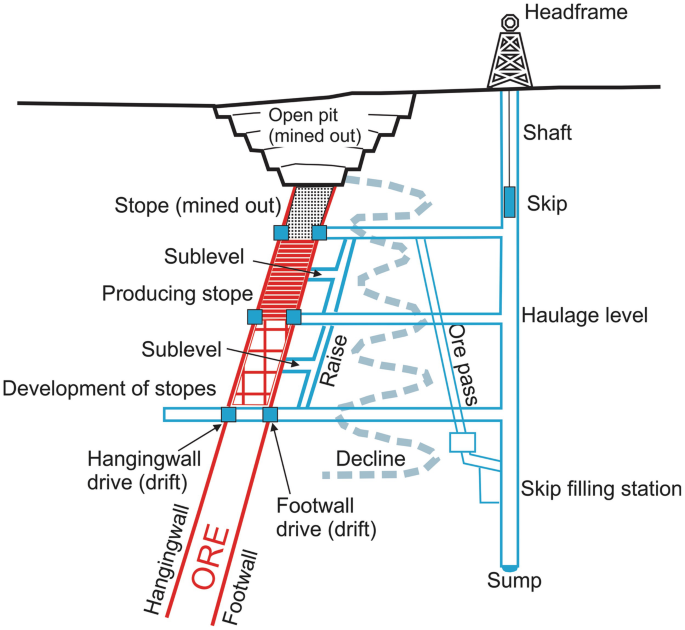
Vein in Mining – Diagram Explanation
A standard Vein in Mining diagram shows the complete cross-sectional geometry of a typical mineralised vein system including the vein itself, the surrounding host rock, the Hanging Wall and Footwall contacts, wall rock alteration zones, and the underground stope workings used to extract the ore.
The table below explains each key element that appears in a standard Vein in Mining diagram as used in mining geology and underground mining engineering textbooks and training materials worldwide.
| Diagram Label | Position | Description |
|---|---|---|
| Vein / Mineral Vein | Central mineralised zone | Ore-bearing fracture fill containing valuable metals in quartz or sulphide gangue |
| Hanging Wall | Above the vein | Upper host rock forming the ceiling of the stope |
| Footwall | Below the vein | Lower host rock forming the floor of the stope |
| True Width | Perpendicular across vein | Actual thickness of mineralised zone used in resource estimation |
| Wall Rock Alteration Halo | Adjacent to vein on both sides | Chemically altered host rock used as exploration pathfinder |
| Selvage / Gouge Zone | At vein-wall rock contact | Thin clay or fractured zone marking the precise ore boundary |
| Grade Shoot | Richest section along vein | High-grade plunging zone targeted for priority mining |
| Stope Excavation | Within vein width | Underground void created by ore extraction during mining |
| Footwall Drive | Tunnel in Footwall rock | Stable access tunnel parallel to vein in competent Footwall rock |
Vein in Mining – Important for Competitive Exams
The topic of Vein in Mining is regularly and frequently tested in GATE Mining, DGMS examinations, Mining Foreman, Overman, Mine Surveyor, and Junior Mining Engineer competitive examinations across India, as well as in mining engineering university courses at both undergraduate and diploma levels.
The MCQ table below contains the most important and most frequently asked exam-ready facts about Vein in Mining that will directly and immediately help you perform better in your next competitive examination.
| Exam Question Pattern | Correct Answer |
|---|---|
| What is a Vein in Mining? | A sheet-like body of crystallised minerals deposited by hydrothermal fluids within a rock fracture |
| What is Vein in Mining called in Hindi? | Nas or Shira |
| What is the most common process that forms a Vein in Mining? | Hydrothermal process – hot mineral-rich fluids depositing minerals in rock fractures as they cool |
| What is a Fissure Vein in Mining? | A vein formed by filling of a single well-defined fracture with mineralised material from hydrothermal fluids |
| What is a Ladder Vein in Mining? | Short regularly spaced parallel fractures crossing a dike from wall to wall, resembling ladder rungs |
| What is the difference between Vein and Lode in Mining? | A Vein is a single fracture fill; a Lode is the complete mineralised zone that may contain multiple veins |
| What is wall rock alteration in Vein Mining? | Chemical changes in host rock adjacent to the vein caused by hydrothermal fluid interaction |
| What is a Grade Shoot in Vein Mining? | A high-grade plunging zone within the vein where ore concentration is richest |
| Which underground method is best for narrow high-grade veins? | Cut and Fill Stoping – provides best grade control and minimum dilution |
| What is a Selvage in Vein Mining? | A thin clay or gouge zone at the contact between the vein and the surrounding wall rock |
| What is Pinch and Swell in Vein Mining? | Natural variation in vein width along its length – narrows at pinches and widens at swells |
| What gangue mineral is most commonly found in Gold Veins? | Quartz – gold-bearing quartz veins are the most common type of gold lode deposit |
MiningGyan – Your Trusted Mining Education Platform
MiningGyan is a dedicated mining education platform built specifically for mining engineering students, diploma candidates, working mine professionals, and competitive exam aspirants across India who need accurate, complete, and well-structured technical knowledge delivered in clear and readable English.
At MiningGyan, every complex topic like Vein in Mining is broken down into simple definitions, geological formation explanations, type-by-type classifications, detailed comparison tables, diagram label descriptions, and ready-to-use competitive exam MCQ notes – all in one place.
MiningGyan covers the complete spectrum of mining engineering and geology topics – from underground mining methods and ore body types to mine safety regulations, ventilation engineering, mining equipment, and mineral exploration – making it the single most comprehensive free resource for mining education in India.
Every article on MiningGyan is carefully researched and structured to connect textbook theory directly with real-world underground mining practice, ensuring that students preparing for exams and professionals working in mines both get maximum practical value from every article they read on the platform.
| What MiningGyan Covers | Who It Is Most Helpful For |
|---|---|
| Vein in Mining, Lode, Ore Body and Geological Deposit Types | Mining Engineering and Geology Students |
| Underground Mining Methods – Complete Step-by-Step Guides | B.Tech and Diploma Mining Engineering Students |
| Mining Equipment Working Principles and Operational Details | Junior Mining Engineers and Graduate Trainees |
| Mine Safety, Legislation, and Ventilation Engineering Topics | Supervisors, Overmen, Safety Officers, and Managers |
| Competitive Exam Notes, MCQ Tables, and Revision Guides | GATE, DGMS, Foreman, Overman, and Surveyor Aspirants |
| Fault Geology, Vein Geometry, and Structural Mining Concepts | Exploration Geologists and Mine Planning Engineers |
MiningGyan’s mission is simple and unwavering – “To deliver accurate, complete, and accessible mining knowledge to every mining student and professional in India, completely free of charge.”
If you are building a career in mining engineering, exploration geology, or mine management, MiningGyan is the most reliable, well-structured, and student-friendly educational platform available to you today.
Frequently Asked Questions – Vein in Mining
A Vein in Mining is a sheet-like body of valuable minerals that has been naturally deposited by hot mineral-rich fluids (hydrothermal fluids) within a fracture or crack in solid bedrock. It has defined contacts against the surrounding rock on both sides and is the primary target of hard rock underground mining operations worldwide.
The main types of Vein in Mining are Fissure Vein, Ladder Vein, Sheeted Vein, Composite Vein, and Lenticular Vein. Each type has a different geometry and structural setting that determines which underground mining method is most appropriate for its extraction.
A Vein in Mining is a single, well-defined fracture fill of mineralised material, while a Lode in Mining is the broader complete mineralised zone that may include one or more veins along with the adjacent mineralised and altered wall rock. In practical mining use, the two terms are often used interchangeably.
A Gold Vein in Mining is a quartz-dominated mineralised fracture fill that contains gold either as visible native gold grains or as microscopic particles within sulphide minerals. Gold veins are the primary source of most of the world’s commercially mined gold and are extracted using selective underground hard rock mining methods.
Cut and Fill Stoping is generally considered the best underground mining method for Vein in Mining because it provides the best control over ore boundaries, minimises dilution from the Hanging Wall and Footwall, and allows mining to follow the vein as its geometry changes at depth.
Conclusion – Vein in Mining
Vein in Mining is a foundational concept that lies at the heart of economic geology, mineral exploration, and underground hard rock mining engineering – without understanding veins, it is impossible to fully understand how ore deposits form, how they are found, or how they are safely and efficiently extracted from the Earth.
From the simple hydrothermal quartz gold vein mined by a small underground operation to the vast sheeted vein systems of a large porphyry copper mine, the Vein in Mining concept in all its forms is the geological framework within which the global mining industry operates every single day.
This complete guide by MiningGyan has covered all major aspects of Vein in Mining – from its definition and history to its formation processes, complete type classification, key characteristics, wall rock alteration, Gold Vein types, underground extraction methods, advantages and disadvantages, diagram label explanations, and a comprehensive competitive exam MCQ table.
Explore more such free, detailed, and exam-ready mining guides on MiningGyan and continue building the strong technical foundation that every successful mining career requires.