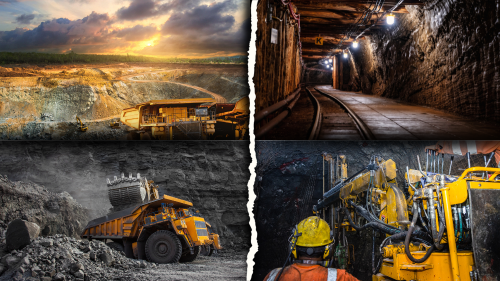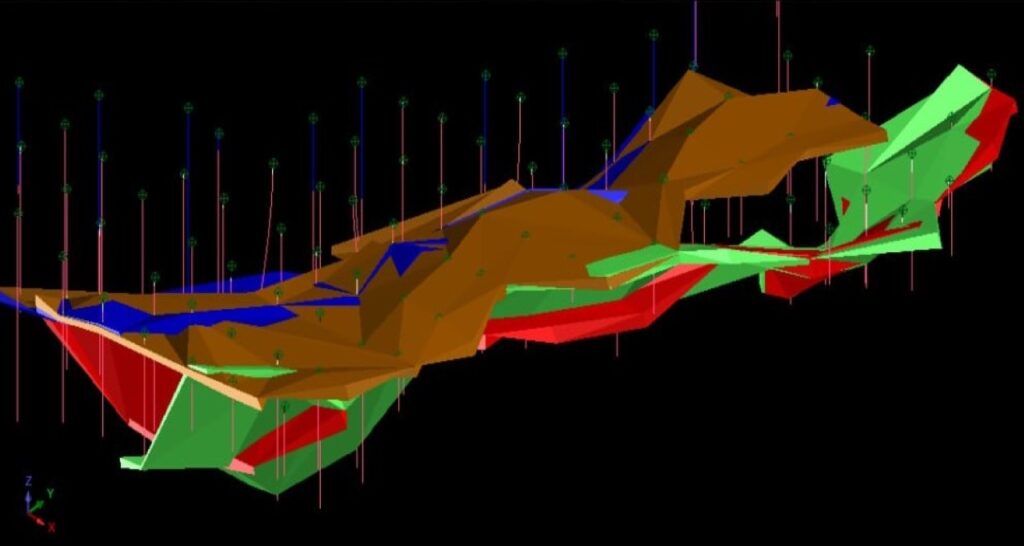
Ore Body in Mining is one of the most fundamental concepts in mining engineering and economic geology that every mining student, geologist, and mine planner must thoroughly understand before stepping into any aspect of the mining industry.
Without a clear understanding of what an Ore Body in Mining is, how it forms, what shapes it takes, and how it is estimated and extracted, no mining project can be properly planned or executed.
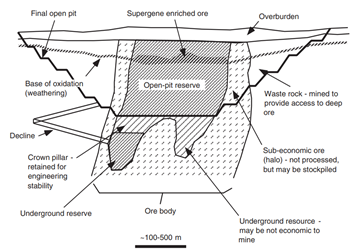
In this complete guide by MiningGyan, we cover everything about Ore Body in Mining – from its basic definition and geological formation to its types, geometry, grade, reserve estimation, and competitive exam MCQs – all in one structured and detailed article.
Whether you are a mining engineering student preparing for GATE or DGMS exams, or a working professional looking to strengthen your technical knowledge, this guide on Ore Body in Mining is written specifically for you.
What is Ore Body in Mining?
An Ore Body in Mining is a naturally occurring concentration of one or more valuable minerals within the Earth’s crust that is large enough, rich enough, and accessible enough to be extracted economically under current market and technological conditions.
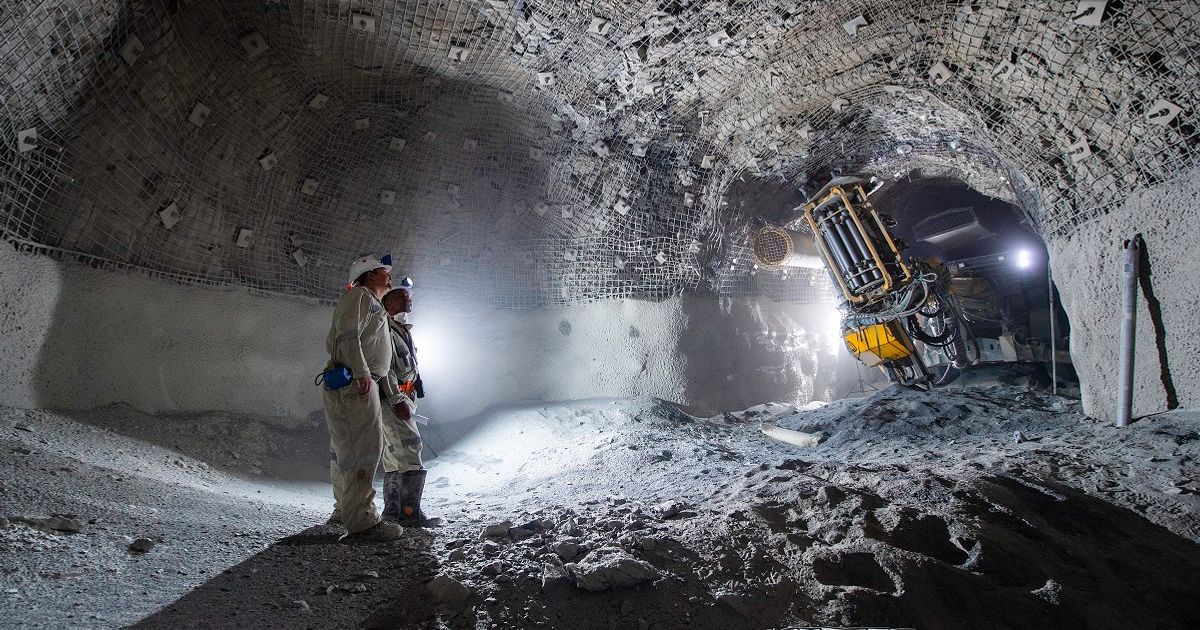
Not every rock that contains a mineral qualifies as an Ore Body in Mining – it must meet specific criteria of grade, size, shape, depth, and economic viability before it can be classified and developed as a mineable ore body.
| Key Term | Definition |
|---|---|
| Ore Body in Mining | A mineable mass of rock containing valuable minerals at economic concentrations |
| Ore | Rock from which a valuable mineral can be profitably extracted |
| Gangue | Worthless rock or mineral material surrounding the ore |
| Grade | The concentration of valuable mineral in the ore body expressed as percentage or g/t |
| Cut-off Grade | Minimum grade below which ore is not economic to mine |
| Ore Reserve | The portion of the ore body that has been proven to be economically mineable |
Ore Body vs Ore Deposit – What is the Difference?
Many mining students confuse the terms Ore Body and Ore Deposit, but there is a clear and important difference between the two that must be understood for both examinations and practical mine planning.
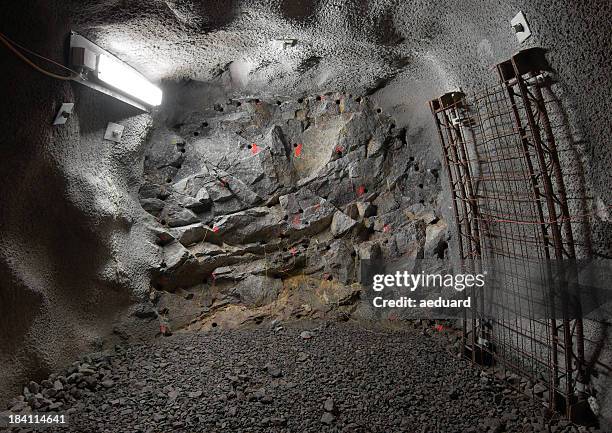
An Ore Deposit is a broader geological term referring to any accumulation of valuable minerals, while an Ore Body in Mining is a specific, well-defined, and economically mineable portion of that deposit.
| Parameter | Ore Body in Mining | Ore Deposit |
|---|---|---|
| Definition | A specific mineable mass with defined boundaries | Any natural accumulation of valuable minerals |
| Economic Viability | Must be economically extractable now | May or may not be currently economic |
| Boundaries | Clearly defined by grade and geology | Broadly defined by mineral occurrence |
| Size Requirement | Must be large enough to mine profitably | No minimum size requirement |
| Used By | Mining engineers and mine planners | Geologists and exploration scientists |
| Market Dependency | Changes with commodity price changes | Remains fixed as a geological feature |
| Classification | Resource then Reserve classification applies | Classified only as an occurrence or deposit |
Ore Body Formation in Mining – How Does an Ore Body Form?
Understanding Ore Body formation in Mining helps geologists predict where new ore bodies might be found and helps mining engineers understand the structural characteristics of the deposit they are working with.
Ore bodies form through several distinct geological processes, and the process of formation directly controls the shape, size, grade distribution, and mineralogy of the resulting ore body.
Magmatic Ore Body Formation
Magmatic ore bodies form when molten rock cools and crystallises underground, causing heavy ore minerals to settle and concentrate at the base of the magma chamber through a process called magmatic segregation.
Chromite, platinum group elements, and nickel sulphide ore bodies are classic examples of magmatic ore body formation found in layered igneous intrusions worldwide.
Hydrothermal Ore Body Formation
Hydrothermal ore bodies form when hot mineral-rich fluids circulate through fractures and faults in the Earth’s crust, depositing valuable minerals as the fluids cool and their chemistry changes.
Gold, silver, copper, lead, and zinc ore bodies are most commonly formed by hydrothermal processes, and they are responsible for the world’s most economically significant mineral deposits.
Sedimentary Ore Body Formation
Sedimentary ore bodies form through the accumulation and chemical precipitation of minerals in ancient sea beds, lake floors, and river systems over millions of years of geological time.
Iron ore deposits like Banded Iron Formations (BIF), phosphate deposits, and evaporite deposits such as potash and salt are classic examples of sedimentary ore body formation.
Metamorphic Ore Body Formation
Metamorphic ore bodies form when existing mineral deposits are transformed by intense heat and pressure deep within the Earth’s crust, which can upgrade and reconcentrate existing mineralisation into higher-grade ore bodies.
Many of India’s iron ore and graphite deposits owe their current economic significance to metamorphic processes that upgraded originally low-grade sedimentary precursors.
| Formation Type | Geological Process | Example Minerals | Example Location |
|---|---|---|---|
| Magmatic | Crystallisation and settling from magma | Chromite, Nickel, PGE | Bushveld Complex, South Africa |
| Hydrothermal | Hot fluid deposition in fractures | Gold, Silver, Copper, Zinc | Kolar Gold Fields, India |
| Sedimentary | Chemical precipitation in water bodies | Iron Ore, Phosphate, Potash | Jharkhand, Odisha (Iron Ore) |
| Metamorphic | Recrystallisation under heat and pressure | Iron Ore, Graphite, Marble | Eastern Ghats, India |
Ore Body Types in Mining – Complete List
Ore Body types in Mining are classified primarily based on their shape and geometry, and this classification is critically important because the shape of an Ore Body in Mining directly determines which mining method is most suitable for extraction.
Understanding all major Ore Body types in Mining is essential for mine planning, method selection, stope design, and cost estimation at every stage of the mining project lifecycle.
Tabular Ore Body in Mining
A Tabular Ore Body in Mining is a flat, sheet-like ore body that has two large dimensions (length and width) and one small dimension (thickness), resembling a table top or a flat slab of rock.
Coal seams, many gold reef deposits, and flat-lying sedimentary mineral deposits are classic examples of tabular ore bodies that are widely mined using longwall or room and pillar methods.
Massive Ore Body in Mining
A Massive Ore Body in Mining is a large, three-dimensionally equidimensional deposit where the ore occurs in a solid, continuous mass without a clearly defined flat or elongated shape.
Massive sulphide copper and zinc deposits, as well as large iron ore hills, are typical examples of massive ore bodies that are often mined using open pit methods or block caving underground techniques.
Lenticular Ore Body in Mining
A Lenticular Ore Body in Mining has a lens-shaped geometry – it is thick in the middle and tapers to a thin edge at both ends, resembling the shape of a convex lens or a flattened ellipse.
Many gold and base metal deposits formed by hydrothermal processes display lenticular ore body geometry and are typically mined using sub-level open stoping or cut and fill methods.
Disseminated Ore Body in Mining
A Disseminated Ore Body in Mining is one where valuable mineral grains are scattered or disseminated throughout a large volume of rock at low but economically mineable concentrations, rather than being concentrated in a distinct vein or massive zone.
Porphyry copper deposits are the world’s most important example of disseminated ore bodies, and they are almost always extracted using large-scale open pit mining operations.
Vein Type Ore Body in Mining
A Vein Type Ore Body in Mining is a narrow, tabular body of mineralised rock that fills a fracture or fault in the host rock, typically with a sharp contact against the surrounding wall rocks on both sides.
Many gold, silver, and quartz-hosted mineral deposits occur as vein type ore bodies and are traditionally mined using selective underground methods such as shrinkage stoping or cut and fill stoping.
Stockwork Ore Body in Mining
A Stockwork Ore Body in Mining consists of a three-dimensional network of closely spaced, intersecting mineralised veinlets that permeate a large volume of host rock in all directions simultaneously.
Stockwork ore bodies are commonly associated with porphyry copper and molybdenum deposits, and their irregular geometry typically makes bulk open pit mining the most efficient extraction method.
| Ore Body Type | Shape | Example Mineral | Preferred Mining Method |
|---|---|---|---|
| Tabular | Flat and sheet-like, large length and width | Coal, Gold Reef | Longwall, Room and Pillar |
| Massive | Large equidimensional solid mass | Iron Ore, Massive Sulphides | Open Pit, Block Caving |
| Lenticular | Lens-shaped, thick centre tapering to edges | Gold, Base Metals | Sub-level Stoping, Cut and Fill |
| Disseminated | Mineral scattered throughout large rock volume | Porphyry Copper | Large Scale Open Pit |
| Vein Type | Narrow, fracture-filling tabular body | Gold, Silver, Quartz | Shrinkage Stoping, Cut and Fill |
| Stockwork | Network of intersecting mineralised veinlets | Copper, Molybdenum | Open Pit, Block Caving |
Ore Body Geometry in Mining
Ore Body geometry in Mining refers to the complete set of spatial parameters that describe the three-dimensional form, orientation, and extent of an ore body within the Earth’s crust.
Accurate knowledge of Ore Body geometry in Mining is the foundation of all mine planning activities including method selection, shaft positioning, level spacing, stope design, and production scheduling.
Ore Body Strike in Mining
The strike of an Ore Body in Mining is the horizontal direction of the longest dimension of the ore body, measured as a compass bearing from North – it tells mine planners in which direction the ore body extends laterally through the ground.
Strike direction is used to orient underground drives, open pit ramps, and drilling programs to follow the ore body most efficiently.
Ore Body Dip in Mining
The dip of an Ore Body in Mining is the angle at which the ore body inclines downward from the horizontal, measured in degrees – and it is one of the most critical geometric parameters in determining the appropriate underground mining method.
Ore bodies with a steep dip above 55 degrees are generally suited to methods like shrinkage stoping, while gently dipping ore bodies below 30 degrees are more suited to room and pillar or longwall mining.
Ore Body Thickness in Mining
Ore Body thickness in Mining refers to the perpendicular distance between the Footwall contact and the Hanging Wall contact of the ore body, and it directly controls the height of underground stopes and the type of equipment that can operate within them.
Very thin ore bodies below one metre require highly selective and labour-intensive mining methods, while thick ore bodies above ten metres allow for highly mechanised bulk mining approaches.
Ore Body Depth in Mining
Ore Body depth in Mining refers to how far below the surface the ore body is located, and it is one of the primary factors determining whether open pit or underground mining will be used to extract the deposit.
Ore bodies at shallow depths up to 300 metres are typically accessed by open pit mining, while deeper ore bodies require underground access through shafts, declines, or adits.
| Geometry Parameter | Definition | Importance in Mine Planning |
|---|---|---|
| Strike | Horizontal direction of ore body extension | Guides orientation of drives and drill programs |
| Dip | Angle of inclination from horizontal | Controls mining method selection |
| Thickness | Distance between Footwall and Hanging Wall | Determines stope height and equipment choice |
| Depth | Distance of ore body below surface | Decides open pit vs underground approach |
| Continuity | How consistently the ore body extends along strike and dip | Affects resource confidence and production planning |
| Plunge | Direction in which the ore body descends along its longest axis | Used to project ore body into unexplored ground |
Ore Body Grade in Mining
Ore Body grade in Mining refers to the concentration of valuable mineral or metal within the ore body, and it is the single most important economic parameter that determines whether an ore body is worth mining or not.
Ore Body grade in Mining is expressed differently depending on the commodity – gold grade is given in grams per tonne (g/t), copper grade as a percentage (%), and iron ore grade as a percentage of iron content (Fe%).
| Grade Category | Definition | Economic Significance | Example |
|---|---|---|---|
| High Grade Ore Body | Metal concentration well above the cut-off grade | Highly profitable, priority for early mining | Gold above 5 g/t |
| Low Grade Ore Body | Metal concentration near or just above cut-off grade | Marginal profitability, sensitive to price changes | Copper below 0.3% |
| Cut-off Grade | Minimum grade at which ore is economic to mine | Defines the economic boundary of the ore body | Gold at 0.5 g/t cut-off |
| Average Grade | Weighted average grade across the entire ore body | Used in revenue and feasibility calculations | Iron ore at 62% Fe |
| Grade Tonnage Relationship | Higher cut-off grade = less tonnage but higher average grade | Used to optimise mining selectivity and profitability | Applied in all feasibility studies |
Ore Body Exploration in Mining
Ore Body exploration in Mining is the systematic process by which geologists search for, locate, and define ore bodies within a prospective area of ground using a combination of geological, geophysical, geochemical, and drilling techniques.
Successful Ore Body exploration in Mining requires a deep understanding of the geological environment, the ore-forming processes that were active in that region, and the structural controls that focused mineralisation into economically mineable concentrations.
Geological Mapping in Ore Body Exploration
Geological mapping involves systematically recording the rock types, structures, alteration zones, and mineralisation visible at the surface or in underground exposures to build a three-dimensional picture of the ore body’s likely extent and geometry.
Surface geological maps are the starting point of every ore body exploration program and guide all subsequent drilling and sampling decisions.
Ore Body Drilling in Mining
Ore Body drilling in Mining involves using diamond core drill rigs to extract cylindrical samples of rock from depth so that geologists can directly observe, sample, and analyse the mineralisation at various points within the potential ore body.
Diamond drilling is the most reliable and widely used method for defining the boundaries, grade distribution, and structural geometry of an ore body at depth.
Ore Body Sampling in Mining
Ore Body sampling in Mining is the systematic collection of representative rock, soil, or drill core samples from across the ore body so that laboratory analysis can determine the grade and mineralogy of the deposit at each sampled point.
The quality and representativeness of ore body sampling directly controls the accuracy of all subsequent resource and reserve estimates.
Ore Body Delineation in Mining
Ore Body delineation in Mining is the process of defining the precise three-dimensional boundaries of the ore body using all available geological, drilling, and sampling data to establish where the ore ends and the waste rock begins.
Accurate delineation of the ore body is essential for calculating the total mineral resource and for designing the underground or open pit extraction layout.
| Exploration Stage | Method Used | Purpose |
|---|---|---|
| Reconnaissance | Satellite imagery, regional mapping | Identify prospective areas for detailed investigation |
| Prospecting | Geological mapping, rock chip sampling | Locate surface expressions of mineralisation |
| Infill Drilling | Diamond core drilling on close-spaced grid | Define grade and geometry in three dimensions |
| Resource Definition | Sampling, assaying, geological modelling | Calculate total mineral resource tonnage and grade |
| Reserve Definition | Feasibility studies, mine design, scheduling | Determine economically mineable ore body volume |
Ore Body Reserve and Resource Estimation
Ore Body reserve estimation and resource estimation are two closely related but distinctly different processes that together determine how much valuable mineral an ore body contains and how much of it can be profitably extracted.
The internationally recognised JORC Code in Australia and the NI 43-101 standard in Canada both provide standardised frameworks for classifying and publicly reporting ore body resources and reserves.
| Parameter | Mineral Resource | Ore Reserve |
|---|---|---|
| Definition | Total mineralisation identified with reasonable geological confidence | Portion of resource that is economically mineable after all modifying factors |
| Economic Consideration | May or may not be currently economic | Must be currently economic to extract |
| Confidence Levels | Inferred, Indicated, Measured | Probable, Proven |
| Modifying Factors | Not applied | Mining, metallurgical, economic, legal factors applied |
| Who Estimates | Competent Person – Geologist | Competent Person – Mining Engineer |
| Reporting Standard | JORC Code, NI 43-101 | JORC Code, NI 43-101 |
Ore Body in Underground Mining
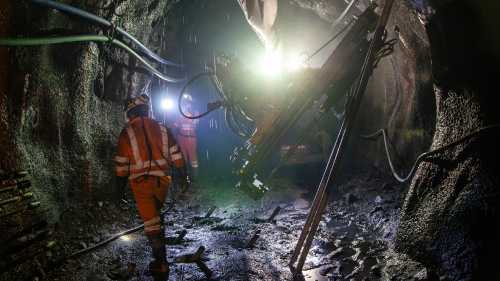
When an Ore Body in Mining is located at significant depth or has a geometry that makes open pit extraction uneconomical, underground mining methods are used to access and extract the ore body from below the surface.
The specific underground mining method chosen depends on the size, shape, dip, grade, and rock strength characteristics of the ore body and the surrounding host rock.
| Ore Body Type | Underground Mining Method | Reason for Selection |
|---|---|---|
| Tabular – Flat Dipping | Room and Pillar, Longwall | Flat geometry suits horizontal mechanised equipment |
| Tabular – Steeply Dipping | Shrinkage Stoping, Cut and Fill | Steep dip allows gravity-assisted ore movement |
| Massive – Large | Block Caving, Sub-level Caving | Bulk method suits very large ore bodies |
| Lenticular | Sub-level Open Stoping | Flexible method suits irregular lens geometry |
| Vein Type – Narrow | Cut and Fill, Shrinkage Stoping | Selective method minimises dilution in narrow veins |
Ore Body in Open Pit Mining
Open pit mining is used to extract an Ore Body in Mining when the ore body is located close to the surface and the economics of stripping the overlying waste rock are favourable compared to underground access costs.
The stripping ratio – the ratio of waste rock removed to ore extracted – is the key economic parameter that determines the depth to which an open pit can be economically extended to follow a deepening ore body.
| Ore Body Type | Open Pit Suitability | Key Advantage |
|---|---|---|
| Massive – Large Volume | Highly suitable | Large footprint matches open pit geometry |
| Disseminated – Porphyry | Highly suitable | Low grade offset by very high volume bulk mining |
| Tabular – Shallow Dip | Suitable | Flat geometry creates stable pit walls |
| Stockwork | Suitable | Irregular geometry best handled by bulk excavation |
| Vein Type – Narrow | Less suitable | Too much waste dilution in bulk open pit operation |
Ore Body in Different Commodities
The characteristics of an Ore Body in Mining vary significantly depending on the commodity being extracted, and understanding these differences helps mine planners and geologists apply the right exploration and extraction approach for each deposit type.
The four most commonly studied commodity-specific ore body types in mining education are coal, gold, iron ore, and copper.
| Commodity | Ore Body Type | Typical Shape | Common Mining Method |
|---|---|---|---|
| Coal Mining | Sedimentary seam | Tabular, flat to gently dipping | Longwall, Room and Pillar |
| Gold Mining | Vein, lenticular, disseminated | Narrow vein to large disseminated | Cut and Fill, Open Pit |
| Iron Ore Mining | Massive BIF, sedimentary | Large massive to tabular | Open Pit, mostly surface mining |
| Copper Mining | Porphyry, massive sulphide | Large disseminated to massive | Open Pit, Block Caving |
Primary and Secondary Ore Body in Mining
A Primary Ore Body in Mining is the original mineralised rock mass formed directly by the geological processes that created the deposit – it represents the ore in its primary, unweathered, and unaltered state deep beneath the surface.
A Secondary Ore Body in Mining forms when surface weathering processes chemically alter and reconcentrate minerals from a primary ore body, often creating higher-grade zones near the surface known as secondary enrichment or supergene enrichment zones.
| Parameter | Primary Ore Body in Mining | Secondary Ore Body in Mining |
|---|---|---|
| Formation Process | Original geological ore-forming process | Surface weathering and chemical reconcentration |
| Location | At depth below the weathering zone | Near surface within the oxidised zone |
| Typical Grade | Original primary grade of the deposit | Often higher grade due to enrichment |
| Mineralogy | Primary sulphide or oxide minerals | Secondary oxides, carbonates, native metals |
| Example | Chalcopyrite (primary copper mineral) | Malachite, Azurite (secondary copper minerals) |
| Mining Priority | Long-term mining target | Often mined first due to near-surface access |
Ore Body in Mining – Important for Competitive Exams
The topic of Ore Body in Mining is regularly tested in GATE Mining, DGMS examinations, Mining Foreman, Overman, Mine Surveyor, and Junior Mining Engineer competitive exams conducted across India every year.
The table below contains the most important and frequently asked MCQ-oriented facts on Ore Body in Mining that will directly help you score better in your next examination.
| Exam Question Pattern | Correct Answer |
|---|---|
| What is an Ore Body in Mining? | A naturally occurring economically mineable concentration of valuable minerals |
| What is Ore Body called in Hindi? | Dhatu Pind or Ayask Samuh |
| Which Ore Body type is mined by Longwall method? | Tabular Ore Body (coal seams) |
| Which Ore Body type is mined by Block Caving? | Massive Ore Body |
| What is the difference between Ore Body and Ore Deposit? | Ore Body is economically mineable; Ore Deposit is any mineral accumulation |
| What is cut-off grade in Ore Body in Mining? | Minimum grade below which the ore body is not economic to mine |
| Which Ore Body type has minerals scattered throughout the rock? | Disseminated Ore Body |
| What does Ore Body strike mean in Mining? | The horizontal compass direction of the ore body’s longest dimension |
| What is a Vein Type Ore Body in Mining? | A narrow tabular ore body filling a fracture or fault in the host rock |
| What is a secondary ore body in Mining? | An ore body formed by surface weathering and supergene enrichment of a primary deposit |
| What is Ore Body thickness in Mining? | Perpendicular distance between Footwall and Hanging Wall contacts |
| Which Ore Body type is associated with porphyry copper deposits? | Disseminated and Stockwork Ore Body |
MiningGyan – Your Trusted Mining Education Platform
MiningGyan is a dedicated mining education platform built specifically for mining engineering students, diploma candidates, working mine professionals, and competitive exam aspirants across India who need clear, complete, and accurate technical knowledge.
At MiningGyan, complex topics like Ore Body in Mining are explained in simple, well-structured English so that every reader – from a first-year student to an experienced mining engineer – can fully understand the concept in a single, focused reading.
MiningGyan does not stop at definitions – every article includes formation processes, type classifications, geometry explanations, real-world examples, detailed comparison tables, diagram descriptions, and exam-ready MCQ notes.
Every topic on MiningGyan is written with a clear purpose – to bridge the gap between textbook theory and practical underground mining application so that students and professionals are equally well served.
| What MiningGyan Covers | Who It Is Most Helpful For |
|---|---|
| Underground Mining Methods – Complete Step-by-Step Guides | Mining Engineering Students (B.Tech and Diploma) |
| Ore Body Types, Formation, and Geometry | Geology and Exploration Students |
| Mining Equipment Working Principles and Types | Junior Mining Engineers and Graduate Trainees |
| Mine Safety, Legislation, and Ventilation Topics | Mine Supervisors, Overmen, and Safety Officers |
| Competitive Exam Notes, MCQs, and Revision Tables | Foreman, Overman, Surveyor, and Manager Exam Candidates |
| Ore Body Reserve and Resource Estimation Concepts | Mine Planning and Feasibility Study Professionals |
MiningGyan’s mission is clear – “To deliver accurate, complete, and accessible mining knowledge to every mining student and professional in India, completely free of charge.”
If you are serious about building a strong technical foundation for your career in mining engineering, exploration geology, or mine management, MiningGyan is your most reliable and comprehensive learning platform.
Frequently Asked Questions – Ore Body in Mining
An Ore Body in Mining is a naturally occurring concentration of valuable minerals within the Earth’s crust that is large enough, rich enough, and accessible enough to be extracted profitably under current market and technological conditions.
The main types of Ore Body in Mining are Tabular, Massive, Lenticular, Disseminated, Vein Type, and Stockwork ore bodies. Each type has a distinct shape and geometry that directly determines which mining method is most suitable for its extraction.
An Ore Deposit is any natural accumulation of valuable minerals, while an Ore Body in Mining is a specific, well-defined portion of that deposit that has been proven to be economically mineable under current conditions. All ore bodies are ore deposits, but not all ore deposits qualify as ore bodies.
Ore Body grade in Mining is the concentration of valuable mineral or metal within the ore body, expressed as grams per tonne (g/t) for gold, as a percentage (%) for copper and iron ore, and similar units for other commodities. It is the most critical economic parameter for any mining project.
Ore Body reserve estimation in Mining involves combining geological modelling, grade interpolation from drill hole data, and the application of economic modifying factors such as mining costs, metallurgical recovery, and commodity prices to determine how much of the total mineral resource can be profitably extracted.
Conclusion – Ore Body in Mining
Ore Body in Mining is the foundation of the entire mining industry – without identifying, defining, and understanding an ore body, no mine can be planned, no method can be selected, and no production can begin.
From its geological formation and three-dimensional geometry to its grade, size, type, and economic classification, every aspect of an Ore Body in Mining has a direct and critical impact on how a mine is designed, operated, and ultimately closed.
This complete guide by MiningGyan has covered all major aspects of Ore Body in Mining – definition, Hindi meaning, formation processes, ore body types, geometry parameters, grade concepts, exploration methods, reserve estimation, underground and open pit applications, commodity-specific examples, primary versus secondary ore bodies, and competitive exam MCQs.
Explore more such free, detailed, and exam-ready mining guides on MiningGyan and continue building the strong technical foundation that your mining career truly deserves.