
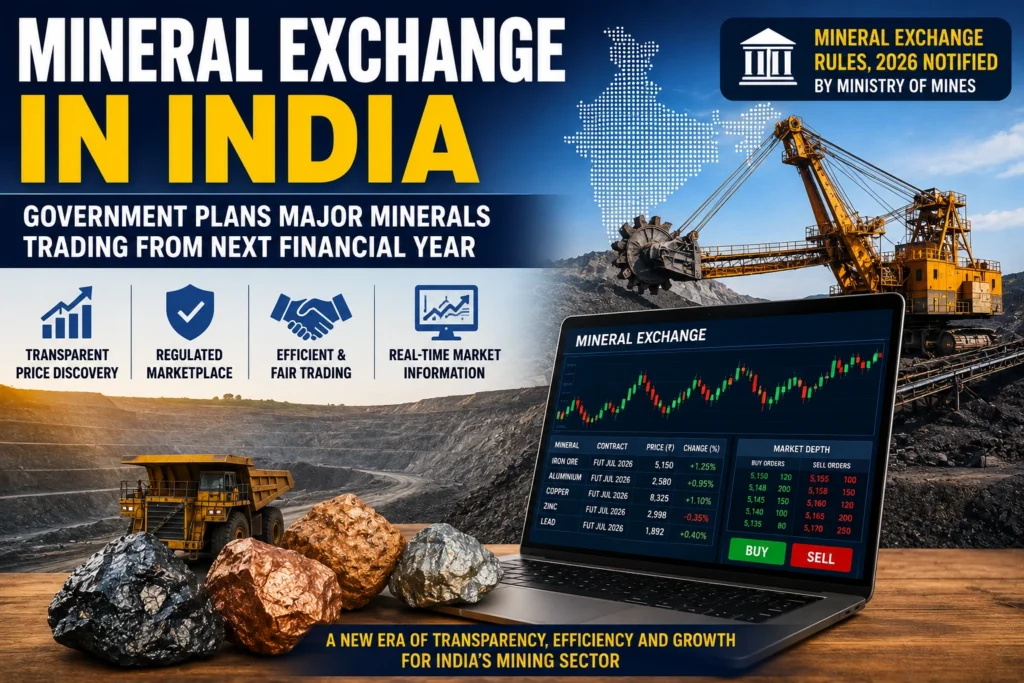
India is preparing for a major change in the way minerals are bought and sold. The government plans to allow trading of major minerals through a dedicated exchange from the next financial year, creating a more organised market for mineral commodities.
The development comes after the Ministry of Mines notified the Mineral Exchange Rules, 2026 on June 30. The rules provide a regulatory framework for establishing and operating mineral exchanges in India.
The proposed Mineral Exchange in India is expected to improve transparency, support market-based price discovery and provide a structured electronic platform where eligible buyers and sellers can conduct mineral transactions.
This is an important development for India’s mining sector because mineral trading has traditionally involved auctions, long-term contracts and other procurement arrangements rather than a dedicated exchange mechanism covering a wider range of minerals.
What Is the Mineral Exchange in India?
A mineral exchange is an electronic marketplace where buyers and sellers can trade minerals and, where permitted, their processed forms.
The concept was introduced through amendments to the Mines and Minerals (Development and Regulation) Act, 1957. The MMDR Amendment Act, 2025 introduced provisions allowing the Central Government to promote a mineral market, including trading of minerals, concentrates and processed forms such as metals through mineral exchanges.
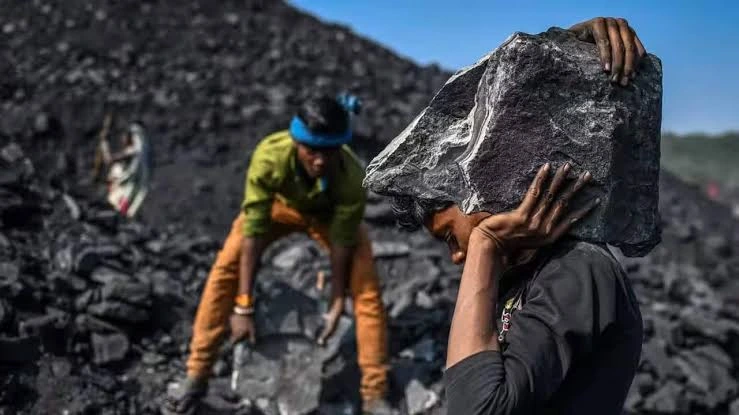
The Mineral Exchange in India is therefore intended to function as an organised marketplace rather than an informal trading arrangement.
The system is expected to bring together:
- Mineral producers
- Mining companies
- Traders
- Industrial consumers
- Other eligible market participants
The exact commodities and contracts available for trading will depend on the applicable regulatory framework.
Why Is India Creating a Mineral Exchange?
One of the main reasons behind the initiative is the need for better price discovery.
Mineral prices can vary depending on grade, quality, location, transportation costs, supply conditions and demand from industries.
A regulated electronic marketplace can provide a more transparent mechanism for buyers and sellers to discover market prices.
The government’s objective is to improve transparency and price discovery in mineral trading.
A functioning mineral exchange could also make market information more accessible and help participants understand prevailing prices.
The major objectives include:
- Improving transparency in mineral trading
- Creating a market-based price discovery mechanism
- Increasing efficiency in mineral transactions
- Providing a regulated electronic marketplace
- Improving market surveillance
- Reducing opportunities for market manipulation
- Supporting more organised mineral supply chains
Mineral Exchange Rules 2026: What Has Changed?
The Mineral Exchange Rules, 2026 establish the regulatory framework required for mineral exchanges.
The rules were notified by the Ministry of Mines on June 30, 2026, and came into force shortly afterward.
The framework includes requirements relating to registration, governance, risk management, trading systems and regulatory supervision.
An exchange will not simply operate as an unrestricted marketplace. It will have to meet specified eligibility and governance requirements.
The rules also provide mechanisms intended to protect the integrity of the market.
Who Will Regulate Mineral Exchanges?
The Indian Bureau of Mines (IBM) has an important regulatory role under the mineral exchange framework.
The regulator’s responsibilities include functions such as:
- Registration of mineral exchanges
- Regulatory supervision
- Market oversight
- Inspection
- Approval of certain contracts
- Monitoring trading activity
- Action against specified violations
- Intervention during abnormal market conditions
The framework also provides powers to address market practices such as manipulation and other forms of market abuse.
This regulatory structure is important because an exchange can only provide reliable price discovery if trading activity is properly monitored.
How Will Mineral Trading Work?
The basic structure of an exchange-based mineral market can be understood in a simple way.
A seller lists an eligible mineral or mineral product on the electronic platform.
A buyer submits an offer based on the available contract and specifications.
The exchange’s trading and settlement systems then facilitate the transaction according to the applicable rules.
In simplified form:
Mineral Producer → Mineral Exchange → Buyer or Industrial Consumer
The exchange can provide a central platform for transactions instead of requiring every buyer and seller to negotiate independently.
However, the exact contract structures, eligible commodities and trading mechanisms will depend on the operational framework adopted by individual exchanges and regulators.
What Are the Benefits of a Mineral Exchange?
1. Better Price Discovery
One of the biggest potential benefits of the Mineral Exchange in India is transparent price discovery.
When multiple buyers and sellers participate in a regulated marketplace, prices can reflect prevailing supply and demand conditions more efficiently.
This could help companies make better purchasing and production decisions.
2. Greater Transparency
An electronic exchange can generate transaction and market data.
Greater availability of market information can help participants understand pricing trends and improve decision-making.
3. More Efficient Trading
A centralised digital marketplace could reduce the time and effort required to connect buyers and sellers.
This can become increasingly important as India’s mineral consumption grows.
4. Stronger Market Monitoring
The regulatory framework includes surveillance and risk-management mechanisms.
The Mineral Exchange Rules provide for measures addressing abnormal price volatility, market manipulation and other risks.
5. Better Supply-Chain Visibility
A structured trading platform could provide additional information about mineral availability, demand and transaction activity.
This could eventually improve planning across the mining and manufacturing sectors.
Which Minerals Could Be Traded?
The broader mineral exchange framework is designed for minerals and their eligible processed forms, although specific exclusions and separate arrangements apply.
The original Draft Mineral Exchange Rules released for consultation in March 2026 proposed a framework for trading minerals other than coal, lignite and atomic minerals.
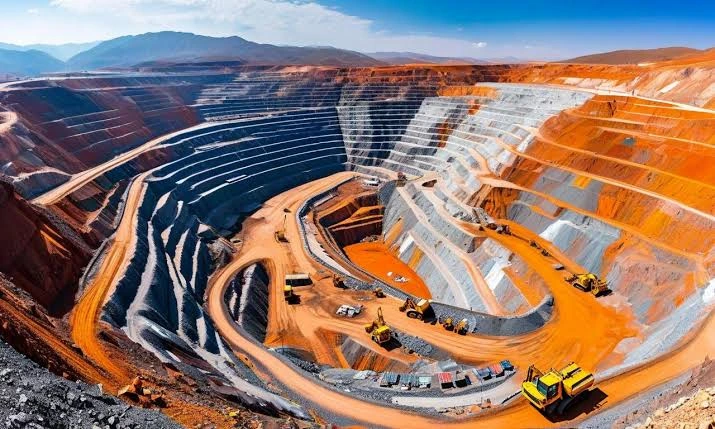
Coal has subsequently received its own regulatory framework.
The Ministry of Coal notified the Coal Exchange Rules, 2026 in June, while the Coal Controller Organisation has been designated as the authority responsible for registering and regulating coal exchanges.
This means India’s exchange-based mineral market is developing through separate but connected regulatory frameworks.
Mineral Exchange vs Traditional Mineral Auctions
It is important to understand that a mineral exchange is not the same thing as a mineral auction.
A mineral auction is generally used by the government to allocate mineral concessions or mining rights.
A mineral exchange, on the other hand, is designed as a marketplace where eligible participants can trade minerals or permitted mineral products.
In simple terms:
Mineral Auction: Allocation of mining rights
Mineral Exchange: Trading of minerals and mineral products
Both systems can therefore exist together.
A company may obtain mining rights through the applicable government process and later participate in mineral markets subject to the exchange rules and other regulations.
What About Coal Exchanges?
Coal provides an early example of how the broader exchange model is being implemented.
The government has already notified the Coal Exchange Rules, 2026. The rules provide for an electronic platform where buyers and sellers can trade coal and enter into delivery-based contracts approved by the regulatory authority.
In July 2026, the Ministry of Coal also launched an online portal for applications to register coal exchanges.
The government described this as a transition from the policy stage toward operational readiness for coal exchanges.
The experience gained from coal exchanges could be relevant as India develops the wider mineral exchange ecosystem.
What Does the Mineral Exchange Mean for Mining Companies?
The development could have an impact on both producers and consumers of minerals.
Mining companies may benefit from a more organised market through which they can reach potential buyers.
Industrial consumers could potentially gain access to a broader marketplace and better information about prices and supply.
The exchange could also encourage companies to pay greater attention to the quality and specifications of mineral products because standardised contracts and trading requirements can make product characteristics more important.
Potential benefits for mining companies include:
- Wider access to buyers
- More transparent pricing
- Better market information
- More efficient transactions
- Improved supply planning
- Potentially greater market participation
However, the actual benefits will depend on how widely the exchange is adopted and how much trading volume develops after launch.
Role of Mineral Quality and Grading
Mineral trading is more complicated than trading a standard manufactured product.
The value of a mineral often depends heavily on its grade and quality.
For example, different grades of iron ore, limestone, bauxite or other minerals can have significantly different economic values.
Therefore, a successful Mineral Exchange in India will require reliable systems for:
- Sampling
- Quality assessment
- Mineral grading
- Certification
- Contract specifications
- Delivery verification
Without reliable quality standards, price comparison between different mineral products can become difficult.
This makes standardisation an important part of the exchange ecosystem.
Risk Management in Mineral Exchanges
Commodity exchanges require strong risk-management systems because prices can change rapidly.
The Mineral Exchange Rules include requirements related to risk assessment and management, settlement systems and mechanisms for handling defaults.
The framework also provides for a Settlement Guarantee Fund, which can help manage settlement-related risks.
Other safeguards include:
- Clearing and settlement mechanisms
- Risk-management committees
- Grievance redressal mechanisms
- Market surveillance
- Procedures for defaults
- Exit planning
These measures are designed to make the market more reliable for participants.
How Could This Affect Mineral Prices?
The introduction of an exchange does not automatically mean mineral prices will fall or rise.
Instead, the primary objective is to make price formation more transparent and market-driven.
Prices will continue to depend on factors such as:
- Domestic demand
- Global commodity prices
- Mineral grade
- Transportation costs
- Production levels
- Imports and exports
- Industrial consumption
- Government policies
An exchange can provide a mechanism through which these market forces are reflected more visibly in transactions.
What Does This Mean for Mining Students and Engineers?
The emergence of mineral exchanges also creates a new area of knowledge for mining professionals.
Mining engineers traditionally focus on exploration, mine planning, production, safety and mineral processing.
However, modern mining increasingly overlaps with economics, finance, technology and supply-chain management.
Students and professionals may benefit from understanding:
- Mineral economics
- Commodity markets
- Mineral pricing
- Mining contracts
- Quality specifications
- Supply-chain management
- Mineral policy
- Market regulations
For mining engineering students, the Mineral Exchange in India could therefore become an important example of how mining is connected with the broader economy.
Challenges Before Mineral Exchanges Become Successful
Although the proposed system has significant potential, several challenges remain.
Building Sufficient Trading Volume
An exchange needs enough buyers and sellers to create a liquid market.
Standardising Mineral Products
Different mineral grades and specifications need to be clearly defined.
Ensuring Reliable Quality Testing
Trust in the marketplace will depend on accurate sampling and quality verification.
Managing Price Volatility
Mineral prices can change because of domestic and international market conditions.
Adoption by Industry
Mining companies and industrial consumers will need to actively participate for the exchange to become successful.
Regulatory Coordination
The system will involve multiple institutions, regulators, mining companies and government agencies.
When Will Major Mineral Trading Begin?
The government has indicated that trading of major minerals through an exchange is planned from the next financial year.
This makes the current period important for developing the required infrastructure, registration systems and market framework.
The transition is likely to happen gradually rather than immediately transforming the entire mineral market.
The success of the system will depend on how quickly eligible exchanges are established and how actively producers and consumers use them.
The Bigger Picture for India’s Mining Sector
The development of a Mineral Exchange in India is part of a broader effort to modernise the country’s mineral sector.
India is simultaneously working on:
- Critical mineral exploration
- Mineral auctions
- Overseas mineral partnerships
- Mineral processing
- Recycling of critical minerals
- Digital mining systems
- Coal exchanges
- Regulatory reforms
These initiatives indicate that India’s mining sector is moving toward a more organised, technology-driven and market-oriented structure.
A mineral exchange could become an important piece of this larger transformation.
Conclusion
The planned Mineral Exchange in India could significantly change how mineral commodities are traded in the country.
With the Mineral Exchange Rules, 2026 now notified, India has established a regulatory framework for creating and supervising mineral exchanges. The government has also indicated plans to allow trading of major minerals through an exchange from the next financial year.
The proposed system aims to improve transparency, strengthen price discovery, increase market efficiency and create a regulated electronic marketplace for mineral transactions.
The development should not be confused with mineral auctions. Auctions primarily deal with allocation of mining rights, while exchanges are intended to facilitate the trading of minerals and eligible mineral products.
The introduction of coal exchanges provides an early example of how exchange-based mineral markets are being developed in India.
The real test will come when actual trading begins. The exchange will need sufficient participation, reliable quality standards, strong regulation and effective settlement systems to become a successful part of India’s mining economy.
If implemented effectively, the Mineral Exchange in India could provide mining companies and industrial consumers with a more transparent and efficient marketplace while supporting the country’s broader goal of modernising its mineral sector.
SEO Details
Focus Keyword: Mineral Exchange in India
SEO Title: Mineral Exchange in India: Government Plans Major Minerals Trading From Next Financial Year
Meta Description: Mineral Exchange in India is set to transform mineral trading with transparent price discovery, regulated transactions and better market efficiency from the next financial year.
Suggested URL Slug: mineral-exchange-in-india-major-minerals-trading
Secondary Keywords: Mineral Exchange Rules 2026, mineral trading in India, major minerals trading, Indian mining sector, mineral market India, Indian Bureau of Mines, mineral price discovery


One Response