Coal India Limited is preparing for one of the biggest strategic shifts in its history as the company looks beyond coal and moves deeper into the global critical minerals market.
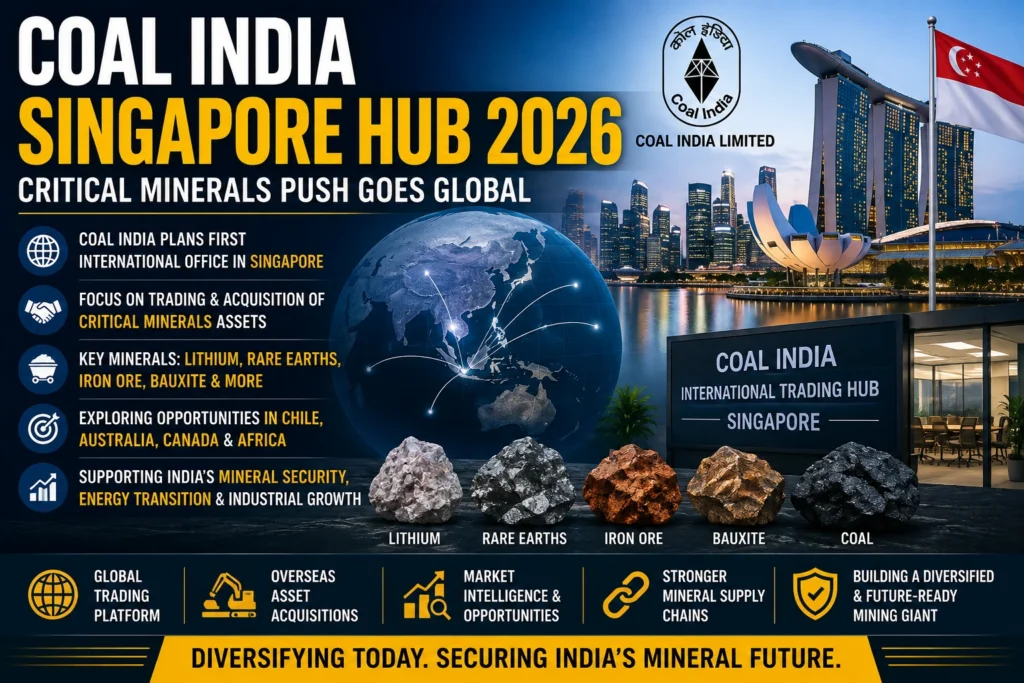
The state-owned mining giant is planning to establish its first international trading office in Singapore. The proposed hub is expected to support the trading of minerals and help Coal India identify and pursue overseas mining assets in commodities such as lithium, rare earth elements, iron ore and bauxite.
The Coal India Singapore Hub 2026 is significant because Coal India has traditionally been associated almost entirely with domestic coal production. An international mineral trading and acquisition hub would represent a major step toward transforming the company into a more diversified mining organisation.
The development also fits into India’s broader strategy of strengthening access to critical minerals required for electric vehicles, renewable energy, electronics, advanced manufacturing and other strategic industries.
What Is the Coal India Singapore Hub?
Coal India is planning to establish an international office in Singapore that could serve as a centre for mineral trading and overseas acquisitions.
Instead of limiting its operations to coal production in India, the company is increasingly exploring opportunities across different minerals and countries.
The proposed Singapore operation could support Coal India’s activities in areas such as:
- Critical mineral trading
- Overseas mining acquisitions
- International mineral partnerships
- Identification of new mining assets
- Mineral supply-chain development
The plan represents an important change in Coal India’s long-term business strategy.
Why Is Coal India Expanding Beyond Coal?
Coal India is the world’s largest coal-producing company and plays a central role in India’s energy sector.
However, the global mining industry is changing.
Minerals that previously received relatively limited attention have become strategically important because of their use in modern technologies.
Lithium is required for rechargeable batteries. Rare earth elements are used in electronics, electric motors and several advanced technologies. Bauxite is the primary raw material for aluminium, while iron ore remains essential for steel production.
India’s future mineral requirements will therefore extend far beyond coal.
Coal India’s diversification can help the company participate in this changing mineral economy.
Why Singapore for Coal India’s International Hub?
Singapore is one of Asia’s major international trading and financial centres.
Its location provides strong connectivity with mineral-producing countries in Asia-Pacific and other international markets.
For a mining company looking to expand internationally, a trading hub can help connect mineral producers, buyers, financial institutions and potential investment opportunities.
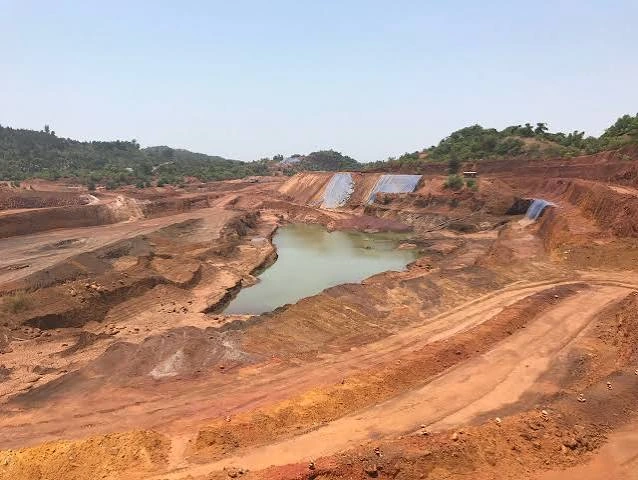
The proposed Coal India Singapore Hub could therefore function as a base for evaluating international mining opportunities.
Instead of managing every overseas opportunity directly from India, Coal India could use Singapore as a strategic location for its global mineral activities.
Critical Minerals Are Becoming Strategically Important
Critical minerals have become one of the most important areas of global mining investment.
These minerals are considered strategically important because they are essential for major industries but can face supply risks.
Important critical and strategic minerals include:
- Lithium
- Graphite
- Nickel
- Cobalt
- Rare earth elements
- Copper
- Vanadium
- Titanium
Demand for many of these minerals is connected with electric vehicles, renewable energy, batteries, electronics, defence equipment and advanced manufacturing.
Countries around the world are therefore trying to secure reliable mineral supply chains.
India is following the same strategy.
Coal India’s Search for Overseas Mineral Assets
Coal India has already started examining mineral opportunities outside India.
The company is reportedly exploring opportunities across several countries, including Chile, Canada, Australia and countries in Africa.
These regions contain important mineral resources.
Chile, for example, is globally significant for copper and lithium resources. Australia is a major producer of several minerals, including lithium, iron ore and bauxite.
Africa also contains substantial deposits of minerals required for industrial and clean-energy technologies.
By exploring multiple countries, Coal India could reduce dependence on any single mineral-producing region.
Coal India and Chile Lithium Opportunity
Coal India’s international mineral strategy has already become visible through its interest in Chile.
The company has been evaluating opportunities connected with lithium assets in the country.
Coal India has also been linked with discussions involving the Chile-focused lithium business of Canada’s Wealth Minerals.
This is important because lithium is one of the most strategically significant battery minerals.
Lithium-ion batteries are widely used in:
- Electric vehicles
- Smartphones
- Laptops
- Battery energy storage systems
- Industrial equipment
- Renewable energy storage
Securing access to lithium resources could therefore support India’s rapidly developing battery ecosystem.
Coal India Has Entered Iron Ore Mining
Coal India’s diversification is not limited to international projects.
The company has also moved into iron ore mining within India.
Coal India recently secured an iron ore block in Odisha through the mineral auction process.
This represents an important milestone because iron ore is completely different from Coal India’s traditional coal operations.
Iron ore is the primary raw material used for producing steel.
Entering iron ore mining demonstrates that Coal India is gradually building a multi-mineral portfolio rather than remaining exclusively dependent on coal.
Why Is India Focusing on Critical Minerals?
India’s industrial ambitions require increasing quantities of strategic minerals.
The country is expanding several industries that depend heavily on mineral resources.
These include:
- Electric vehicles
- Renewable energy
- Battery manufacturing
- Electronics
- Steel
- Aluminium
- Defence manufacturing
- Advanced engineering
The problem is that India does not currently produce sufficient quantities of every mineral required by these industries.
This creates import dependence.
Heavy dependence on imported minerals can create economic and strategic risks when international supply chains are disrupted.
Developing domestic mines and acquiring overseas mineral assets can help reduce these risks.
National Critical Mineral Mission and India’s Mining Strategy
India has also launched the National Critical Mineral Mission to strengthen the country’s mineral security.
The strategy includes several important areas such as domestic exploration, mineral auctions, overseas asset acquisition, recycling and processing.
India has already accelerated auctions of critical and strategic mineral blocks.
Minerals such as graphite, rare earth elements, vanadium, titanium and other strategic resources have been included in recent auction programmes.
The objective is to create a stronger domestic mineral supply chain while simultaneously developing international partnerships.
Coal India’s overseas expansion fits directly into this broader strategy.
How Could the Singapore Hub Work?
The exact operational structure of Coal India’s Singapore office will become clearer as the plan progresses.
However, an international mineral hub could potentially perform several functions.
Mineral Trading
Coal India could participate in international mineral transactions and connect suppliers with Indian demand.
Overseas Acquisitions
The office could help identify mining companies or mineral projects that may be suitable for acquisition or investment.
Market Intelligence
Global mineral markets change rapidly.
Having an international presence could help Coal India monitor commodity prices, supply trends and new investment opportunities.
International Partnerships
The company could develop relationships with governments, mining companies and mineral traders.
Supply-Chain Development
Coal India could help establish reliable mineral supply routes between international producers and Indian industries.
What Does This Mean for Coal India’s Future?
Coal India has traditionally been known for one commodity: coal.
That could gradually change.
If its diversification strategy succeeds, the company could eventually operate across multiple mineral categories.
Its future portfolio could potentially include:
Coal + Iron Ore + Lithium + Bauxite + Critical Minerals
Such diversification could reduce the company’s long-term dependence on a single commodity.
It could also allow Coal India to use its mining experience, financial strength and project-development capabilities in new mineral sectors.
Challenges of International Mining Expansion
International mining is not simple.
Coal India will face several challenges while expanding overseas.
Different Mining Regulations
Every country has its own mining laws, environmental regulations and taxation systems.
Geological Risk
A mineral deposit may appear promising during early exploration but later prove commercially unattractive.
Commodity Price Volatility
Mineral prices can rise or fall significantly depending on global supply and demand.
Political Risk
Changes in government policy can affect mining licences, taxation and project development.
Environmental Requirements
Modern mining projects face increasingly strict environmental and sustainability requirements.
Coal India will therefore need strong technical, financial and regulatory expertise when evaluating international projects.
Why Overseas Mining Assets Matter for India
Buying minerals from international markets is different from owning or participating in mining assets.
Imports provide access to minerals, but supply can be affected by market conditions.
Participation in overseas mining projects could potentially provide greater long-term control over mineral supply.
For example, an Indian company participating in a lithium project could potentially secure a more stable source of material for India’s battery industry.
This is why countries increasingly treat mineral assets as strategically important investments.
Opportunities for Mining Engineers
Coal India’s diversification could also create new opportunities for mining professionals.
Traditional Coal India careers have primarily focused on coal mining.
A multi-mineral strategy could require professionals with expertise in:
- Mineral exploration
- Economic geology
- Mine planning
- Mineral processing
- Resource estimation
- International mining regulations
- Environmental management
- Mining economics
- Project evaluation
- Critical mineral geology
Mining engineers may also need stronger knowledge of international mining practices.
Understanding different commodities will become increasingly valuable.
Mineral Processing Will Become More Important
Mining the mineral is only the first stage.
Critical minerals often require complicated processing before they can be used by manufacturers.
The complete mineral supply chain can include:
Exploration → Mining → Crushing → Beneficiation → Concentration → Refining → Manufacturing
Different minerals require different processing technologies.
For example, processing lithium-bearing minerals is very different from processing coal or iron ore.
Coal India’s diversification will therefore require expertise beyond traditional coal mining operations.
Could Coal India Become a Global Mining Company?
Coal India already operates at an enormous scale within India.
However, becoming a global diversified mining company would require a different business model.
International mining companies often operate across several commodities and countries.
They continuously evaluate mineral deposits based on:
- Resource quality
- Mining costs
- Infrastructure
- Political stability
- Environmental requirements
- Commodity demand
- Project economics
Coal India’s Singapore office could provide a platform for developing similar international capabilities.
The transformation would take time, but the strategic direction is becoming increasingly visible.
Impact on India’s Mineral Security
The biggest potential benefit of Coal India’s international expansion is stronger mineral security for India.
Future economic growth will require access to a much wider range of minerals than the country traditionally consumed.
Electric mobility needs battery minerals.
Renewable energy needs copper, aluminium and several critical minerals.
Advanced manufacturing requires rare earth elements and specialised metals.
Infrastructure growth requires enormous quantities of steel and aluminium.
Securing these materials will therefore become an important part of India’s economic strategy.
The Bigger Picture for India’s Mining Industry
Coal India’s Singapore plan is part of a much broader transformation happening across India’s mining sector.
India is simultaneously pursuing:
- Critical mineral auctions
- Commercial coal mining
- Overseas mineral acquisitions
- Mineral exploration
- Mineral exchanges
- Mining law reforms
- Coal gasification
- Digital mining technologies
- Mineral recycling
Together, these developments show that the Indian mining sector is becoming more diversified and internationally connected.
Mining companies will increasingly operate across different commodities, technologies and markets.
Conclusion
The Coal India Singapore Hub 2026 could mark a major turning point in the evolution of India’s largest coal producer.
Coal India is planning its first international trading office in Singapore as it expands its focus beyond coal into minerals such as lithium, rare earth elements, iron ore and bauxite.
The proposed hub could support mineral trading, overseas acquisitions, international partnerships and identification of new mining opportunities.
Coal India’s diversification has already started. The company has entered iron ore mining in India and is examining critical mineral opportunities in international markets.
The strategy also supports India’s wider effort to strengthen critical mineral security and reduce excessive dependence on imported resources.
However, international mining brings geological, financial, regulatory and political risks. Coal India will need to develop specialised capabilities to successfully operate across different commodities and countries.
If the strategy succeeds, Coal India could gradually transform from primarily a domestic coal producer into a diversified global mining company.
For India’s mining industry, the development sends an important signal: the next phase of growth will not be limited to coal. Critical minerals, international mining assets and global supply chains are becoming increasingly important parts of the country’s mining future.