Efficient material transportation is one of the most important aspects of any mining operation. Every day, thousands of tonnes of coal, ore, overburden, and waste rock must be moved safely and economically from one location to another. Modern mines achieve this efficiently through the Mine Conveyor System, which has become one of the most reliable and cost-effective transportation methods in the mining industry.
Download Mining Gyan AppA Mine Conveyor System transports bulk materials continuously using moving conveyor belts driven by electric motors. These systems reduce manual handling, improve production efficiency, minimize transportation costs, and support automated mining operations. Conveyor systems are extensively used in underground coal mines, opencast mines, coal handling plants, crusher stations, and mineral processing plants.
For GATE Mining, Mining Sirdar, Overman, DGMS, PSU recruitment, and Mining Engineering examinations, the Mine Conveyor System is one of the most important technical topics because it combines mine transportation, mechanical engineering, material handling, automation, and mine safety.
What Is a Mine Conveyor System?
A Mine Conveyor System is a continuous material handling system used to transport coal, ore, waste rock, and other bulk materials from one location to another using an endless moving belt supported by rollers and driven by powered pulleys.
Unlike trucks or locomotives, conveyor systems provide uninterrupted transportation with minimal human intervention. They can operate continuously over long distances and are capable of handling very high production rates.
The primary objectives of a Mine Conveyor System include:
- Continuous material transportation
- High production capacity
- Reduced transportation cost
- Improved operational efficiency
- Safe material handling
- Reduced manual labour
Modern conveyor systems form the backbone of automated mining operations.
Why Is a Mine Conveyor System Important?
Material transportation directly influences mine productivity. Delays in transportation can reduce production, increase operating costs, and create bottlenecks throughout the mining process.
Mine Conveyor Systems provide a reliable and continuous method of transporting bulk materials while reducing fuel consumption and equipment maintenance costs.
Major benefits include:
- Continuous operation
- High transportation capacity
- Lower operating cost
- Reduced manpower
- Energy-efficient operation
- Improved workplace safety
- Lower maintenance requirements
- Increased productivity
These advantages make conveyor systems the preferred transportation method in modern mines.
Working Principle of a Mine Conveyor System
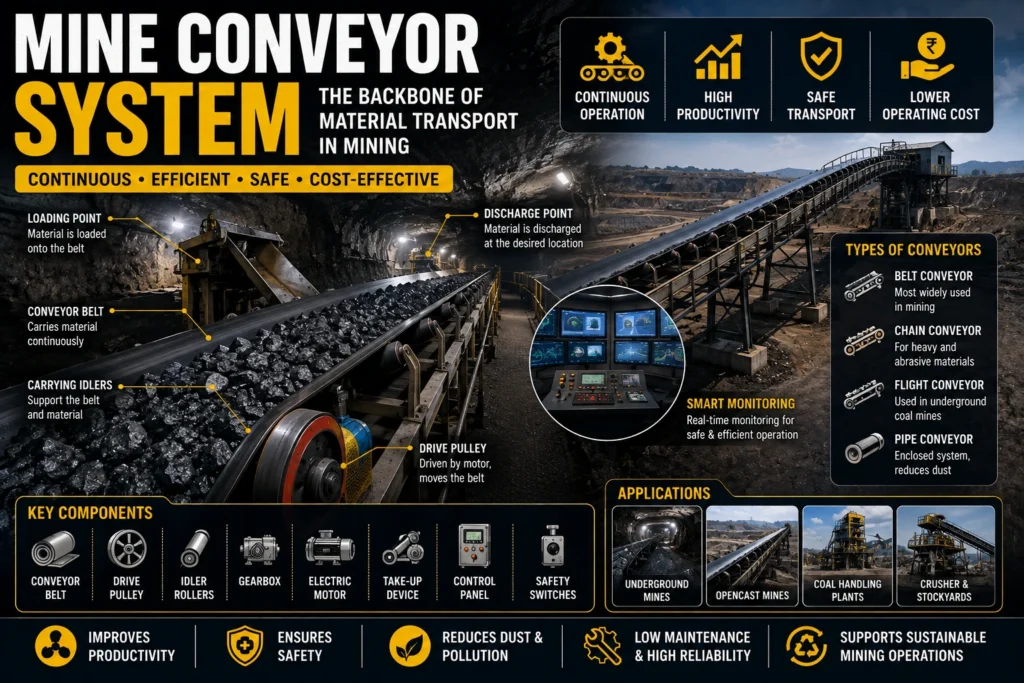
A Mine Conveyor System operates by rotating a drive pulley using an electric motor. The drive pulley moves the endless conveyor belt, which carries bulk material from the loading point to the discharge point.
The belt travels over carrying idlers on the upper side and returns over return idlers on the lower side. Tensioning devices maintain proper belt tension, while cleaners remove material sticking to the belt.
The basic working cycle includes:
- Material loading
- Belt movement
- Continuous transportation
- Material discharge
- Belt return
- Continuous operation
Modern conveyor systems use automatic monitoring to ensure safe and efficient operation.
Components of a Mine Conveyor System
A Mine Conveyor System consists of several mechanical and electrical components working together.
Major components include:
- Conveyor Belt
- Drive Pulley
- Tail Pulley
- Electric Motor
- Gearbox
- Carrying Idlers
- Return Idlers
- Belt Cleaner
- Belt Take-up Device
- Conveyor Frame
- Loading Chute
- Discharge Chute
- Safety Switches
- Control Panel
Each component contributes to smooth and reliable material transportation.
Types of Mine Conveyor Systems
Different mining conditions require different conveyor arrangements.
Belt Conveyor
The belt conveyor is the most widely used conveyor system in mining. It transports bulk materials over long distances with high efficiency.
Chain Conveyor
Chain conveyors use chains instead of belts and are suitable for heavy-duty applications involving coarse materials.
Flight Conveyor
Flight conveyors move material using flights attached to chains and are commonly used in underground coal mines.
Pipe Conveyor
Pipe conveyors completely enclose the transported material inside the belt, reducing dust generation and environmental pollution.
Overland Conveyor
Overland conveyors transport materials over several kilometres and are commonly used in large opencast mines.
Conveyor Belt Types
Different belt materials are selected according to mining conditions.
Common conveyor belts include:
- Fabric Belt
- Steel Cord Belt
- Heat Resistant Belt
- Fire Resistant Belt
- Oil Resistant Belt
- Flame Retardant Belt
Flame-resistant belts are mandatory in many underground coal mines for improved safety.
Applications of Mine Conveyor System
Mine Conveyor Systems are widely used throughout mining operations.
Major applications include:
- Underground coal mines
- Opencast mines
- Coal handling plants
- Crusher plants
- Mineral processing plants
- Loading stations
- Stockyards
- Port terminals
- Cement plants
- Power plants
Conveyor systems provide uninterrupted material flow across the mining value chain.
Advantages of Mine Conveyor System
Modern conveyor systems provide several operational benefits.
Major advantages include:
- Continuous transportation
- High carrying capacity
- Low operating cost
- Energy-efficient operation
- Reduced labour requirement
- Lower environmental impact
- Improved safety
- Reliable performance
These advantages significantly improve mine productivity and profitability.
Challenges in Mine Conveyor Systems
Despite their advantages, conveyor systems face several operational challenges.
Common issues include:
- Belt wear
- Belt misalignment
- Roller failure
- Material spillage
- Dust generation
- Belt slippage
- Pulley damage
- Power interruptions
Routine inspection and preventive maintenance improve conveyor reliability.
Maintenance of Mine Conveyor System
Regular maintenance ensures efficient conveyor operation.
Important maintenance practices include:
- Belt inspection
- Idler replacement
- Pulley alignment
- Belt tension adjustment
- Cleaning belt surfaces
- Lubricating bearings
- Checking safety switches
- Monitoring motor performance
Preventive maintenance reduces downtime and extends equipment life.
Safety Devices in Mine Conveyor System
Several safety devices protect workers and equipment.
Important safety devices include:
- Pull Cord Switch
- Belt Sway Switch
- Zero Speed Switch
- Emergency Stop Switch
- Overload Protection
- Fire Detection System
- Belt Rip Detector
- Interlocking System
These safety systems minimize accidents and equipment damage.
Future of Mine Conveyor Systems
Modern Mine Conveyor Systems are becoming increasingly automated.
Emerging technologies include:
- AI-based predictive maintenance
- IoT-enabled belt monitoring
- Smart conveyor diagnostics
- Automated alignment systems
- Energy-efficient drives
- Digital twin technology
- Drone-based inspection
- Remote conveyor monitoring
These technologies improve reliability, reduce maintenance costs, and increase productivity.
Conclusion
A Mine Conveyor System is one of the most efficient and reliable material transportation systems used in modern mining. It enables continuous movement of coal, ore, and other bulk materials while reducing operating costs and improving productivity.
From conventional belt conveyors to AI-powered smart conveyor systems, mining transportation technology continues to advance rapidly. Every Mining Engineer, Mining Sirdar, Overman, DGMS candidate, and GATE aspirant should understand the principles and applications of the Mine Conveyor System, as it is one of the most important topics in mining machinery and mine transportation.
Frequently Asked Questions
What is a Mine Conveyor System?
A Mine Conveyor System is a continuous material handling system that transports coal, ore, and other bulk materials using a moving conveyor belt.
Which conveyor is most commonly used in mining?
The Belt Conveyor is the most widely used conveyor system because it is efficient, reliable, and suitable for long-distance transportation.
Why are conveyor systems important in mining?
They reduce transportation costs, improve productivity, provide continuous material flow, and minimize manual handling.
What are the major components of a conveyor system?
Major components include the conveyor belt, pulleys, electric motor, gearbox, idlers, take-up device, frame, and safety switches.
What is the future of Mine Conveyor Systems?
The future includes AI-based predictive maintenance, IoT monitoring, smart diagnostics, digital twins, automated inspection, and energy-efficient conveyor drives.