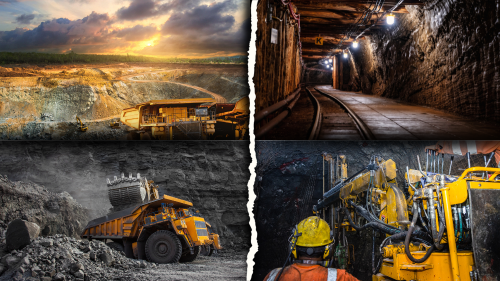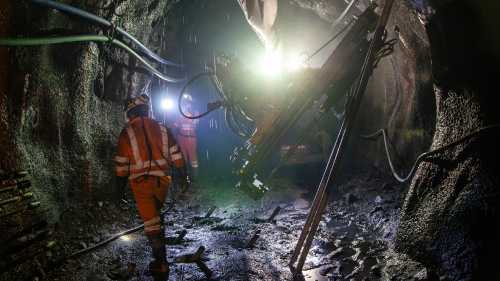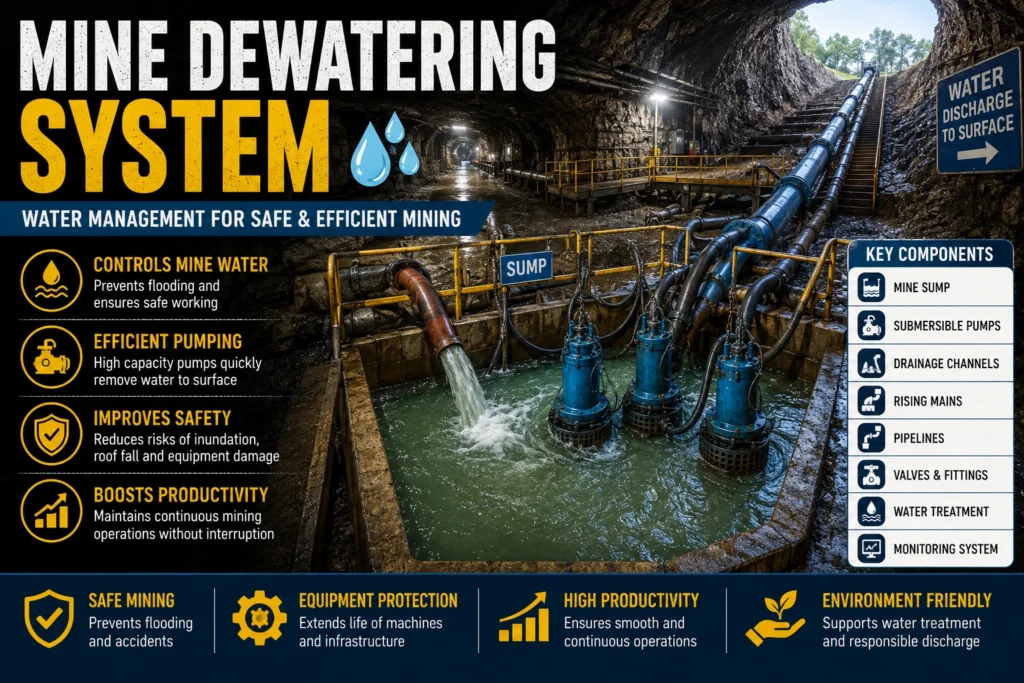
Water is one of the biggest operational challenges in mining. Rainfall, groundwater seepage, aquifers, and surface runoff can flood mine workings, reduce production, damage equipment, and create serious safety hazards. To overcome these problems, every modern mine relies on an efficient Mine Dewatering System.
A Mine Dewatering System removes unwanted water from underground and opencast mines, ensuring safe working conditions and uninterrupted production. Proper dewatering not only protects workers and machinery but also improves slope stability, reduces haul road damage, and minimizes operational delays.
For Mining Engineering students, GATE Mining aspirants, Mining Sirdar, Overman, DGMS, and PSU examinations, the Mine Dewatering System is an important topic because it combines mine planning, safety, hydrogeology, pumping technology, and environmental management.
What Is a Mine Dewatering System?
A Mine Dewatering System is a planned arrangement of pumps, pipelines, drains, sumps, boreholes, and water-treatment facilities used to collect, control, and remove water from mining areas.
The primary objective is to maintain a dry and safe working environment while preventing flooding and equipment damage. Water collected from mine workings is pumped to the surface, treated if required, and discharged or reused according to environmental regulations.
The system is designed based on rainfall intensity, groundwater inflow, mine depth, geological conditions, and production requirements.
Why Is a Mine Dewatering System Important?
An efficient Mine Dewatering System directly affects mine safety, productivity, and operating costs. Excess water can weaken the roof, reduce floor stability, increase the risk of inundation, and interrupt mining operations.
Major benefits include:
- Safe working environment
- Reduced inundation risk
- Protection of mining machinery
- Improved haul road conditions
- Better slope and roof stability
- Continuous production
- Reduced maintenance costs
- Improved environmental compliance
Proper water management is therefore a critical part of every mining operation.
Working Principle of a Mine Dewatering System
The Mine Dewatering System works by collecting water from different parts of the mine and transporting it to designated sumps through drainage channels.
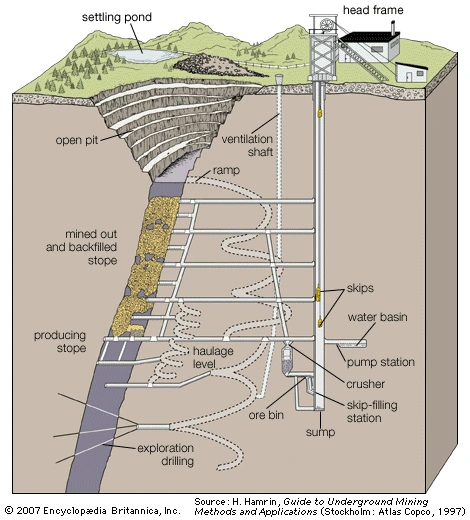
From the sump, high-capacity pumps transfer the water through pipelines to the surface. In many mines, sedimentation tanks are used before discharge to remove suspended solids.
The basic sequence includes:
- Collection of mine water
- Drainage through channels
- Storage in mine sump
- Pumping through pipelines
- Water treatment (if required)
- Safe discharge or recycling
Modern mines also use automatic sensors to monitor water levels and pump operation continuously.
Equipment Used in a Mine Dewatering System
A reliable Mine Dewatering System consists of several interconnected components.
Major equipment includes:
- Centrifugal pumps
- Submersible pumps
- Multi-stage pumps
- Mine sumps
- Drainage channels
- Rising mains
- Pipelines
- Valves
- Boreholes
- Water level sensors
- Sedimentation ponds
- Water treatment units
Selection of equipment depends on mine depth, water inflow, pumping head, and discharge capacity.
Methods of Mine Dewatering System
Different mining conditions require different Mine Dewatering System techniques.
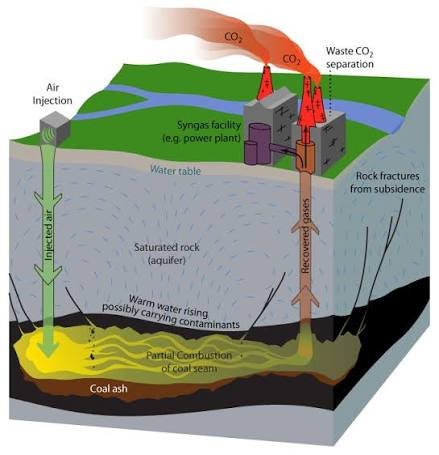
The commonly used methods are:
Surface Drainage
Surface drains divert rainwater away from the mining area before it enters the pit.
Sump Pumping
Water naturally flows into underground or pit sumps where pumps remove it continuously.
Borehole Dewatering
Deep boreholes lower the groundwater table before mining begins.
Well Point System
A series of shallow wells connected to vacuum pumps removes groundwater in loose formations.
Horizontal Drainage
Horizontal boreholes drain water from surrounding rock formations and improve stability.
The appropriate method depends on geology, mine layout, groundwater conditions, and production plans.
Advantages of a Mine Dewatering System
A properly designed Mine Dewatering System provides several operational benefits.
Key advantages include:
- Prevents mine flooding
- Improves worker safety
- Increases equipment life
- Maintains production targets
- Reduces maintenance costs
- Enhances slope stability
- Supports efficient mine planning
- Improves environmental performance
These advantages make dewatering one of the most essential mine support services.
Challenges in Mine Dewatering System
Although highly effective, a Mine Dewatering System also faces operational challenges.
Common problems include:
- High groundwater inflow
- Pump failure
- Blocked drainage channels
- Power interruptions
- Sediment accumulation
- Corrosion of pipelines
- High pumping costs
- Environmental discharge regulations
Regular inspection and preventive maintenance help minimize these issues.
Future of Mine Dewatering System
Modern Mine Dewatering System technology is becoming increasingly automated. Smart sensors, IoT-enabled pumps, remote monitoring, and predictive maintenance are improving system reliability and reducing operating costs.
Future developments include:
- AI-based pump scheduling
- Remote-controlled pumping stations
- Real-time groundwater monitoring
- Energy-efficient variable-speed pumps
- Digital mine water management systems
These technologies will make mine water control safer, more economical, and environmentally sustainable.
Conclusion
A Mine Dewatering System is one of the most critical support systems in mining. By efficiently collecting, pumping, and managing mine water, it ensures safe working conditions, protects equipment, and supports uninterrupted production.
Roof Bolting System: Complete Guide to Underground Mine Roof Support
Whether in underground coal mines or large opencast projects, an effective Mine Dewatering System is essential for maintaining operational efficiency and meeting environmental standards. Understanding its principles, equipment, and methods is important for mining professionals as well as candidates preparing for GATE Mining, DGMS, Mining Sirdar, and Overman examinations.
Frequently Asked Questions
What is a Mine Dewatering System?
A Mine Dewatering System is a water management system used to remove groundwater and surface water from mining operations.
Why is a Mine Dewatering System necessary?
It prevents flooding, improves safety, protects equipment, and ensures uninterrupted mining operations.
Which pumps are commonly used in a Mine Dewatering System?
Centrifugal pumps, submersible pumps, and multi-stage pumps are commonly used.
Where is a Mine Dewatering System used?
It is used in both underground mines and opencast mines.
What is the main purpose of a Mine Dewatering System?
Its main purpose is to keep the mine dry, safe, and productive by removing excess water.