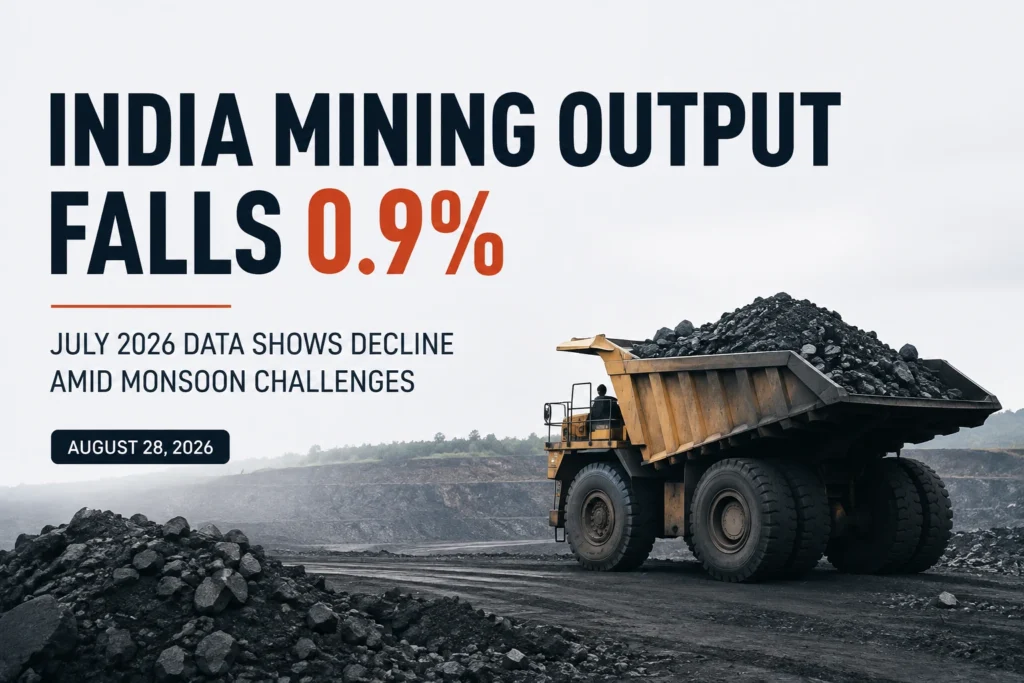
India’s mining sector recorded a decline in production during July 2026, even as the country’s broader industrial economy continued to expand.
According to the latest industrial production data released on August 28, India’s mining output contracted by 0.9% year-on-year in July 2026. At the same time, the country’s overall industrial production increased by 6.7%, supported mainly by growth in manufacturing and electricity generation.
The India Mining Output July 2026 data presents an interesting picture of the country’s industrial economy. Manufacturing continued to grow strongly, but mining activity faced pressure during the month.
The decline is particularly important because mining supplies essential raw materials to industries including steel, cement, power generation, construction, aluminium and manufacturing.
Understanding why mining output can decline even when industrial production is growing provides useful insight into the relationship between mineral production, weather conditions, demand, logistics and India’s wider economy.
India Mining Output July 2026: Key Numbers
India’s Index of Industrial Production data shows that overall industrial activity remained positive during July.
However, performance differed significantly between the three major industrial sectors.
The key year-on-year figures were:
- Overall industrial production growth: 6.7%
- Manufacturing growth: 7.3%
- Electricity generation growth: 8.7%
- Mining output growth: -0.9%
The numbers show that manufacturing and electricity remained major contributors to industrial growth.
Mining, however, moved in the opposite direction.
This does not necessarily mean India’s mining industry is entering a long-term decline. Monthly mining production can change because of seasonal conditions, transportation problems, operational issues and temporary disruptions.
Why Did India’s Mining Output Decline?
Mining production is affected by factors that are very different from those influencing factory production.
One of the most important factors during the July-August period is the monsoon season.
India’s major mineral-producing states experience significant rainfall during this period.
Heavy rainfall can affect open-cast mines by creating operational challenges related to:
- Mine haul roads
- Pit drainage
- Equipment movement
- Overburden removal
- Drilling and blasting
- Mineral transportation
- Railway loading
- Stockyard operations
Even a mine with strong annual production capacity may temporarily reduce output when weather conditions affect daily operations.
How Monsoon Conditions Affect Open-Cast Mining
A large share of India’s coal and major mineral production comes from open-cast mines.
These mines operate directly at the surface and therefore remain highly exposed to weather conditions.
During heavy rainfall, water can accumulate inside mine pits.
Mining companies need pumping and drainage systems to remove this water before normal operations can continue safely.
Rain can also affect haul roads used by heavy mining equipment.
Dump trucks carrying hundreds of tonnes of material require stable roads with adequate traction.
Poor road conditions can reduce equipment speed and increase cycle times.
This directly affects mine productivity.
Mine Productivity Depends on Equipment Cycle Time
Modern open-cast mines operate through a carefully planned production cycle.
A simplified production process can be represented as:
Drilling → Blasting → Loading → Hauling → Crushing or Processing → Dispatch
Every stage depends on the previous stage working efficiently.
For example, if haul roads become difficult to operate because of heavy rainfall, trucks may take longer to transport material.
This increases truck cycle time.
Higher cycle time means fewer trips during a shift.
Fewer trips eventually mean lower production.
This demonstrates why seemingly small operational disruptions can affect monthly mine output.
Coal Mining Can Be Particularly Affected During Monsoon
Coal remains one of India’s largest mined commodities.
Large quantities of coal are produced from open-cast mines located in states such as:
- Odisha
- Jharkhand
- Chhattisgarh
- Madhya Pradesh
- Telangana
- Maharashtra
Several major coal-producing regions receive substantial monsoon rainfall.
Mining companies normally prepare for seasonal conditions through drainage planning, coal stock management and transportation arrangements.
However, unusually heavy rainfall can still reduce production or dispatch.
This is one reason monthly coal output can fluctuate even when annual production targets continue to increase.
Mining Production and Coal Transportation Are Connected
Producing a mineral is only part of the supply chain.
The material also needs to reach the customer.
For coal, this often means transportation from the mine to thermal power plants and industrial consumers.
The coal supply chain can involve:
Mine → Coal Handling Plant → Railway Siding → Train → Power Plant
A disruption anywhere in this chain can affect supply.
Railway availability is particularly important because large quantities of coal are transported across India by rail.
Road transportation and conveyor systems also play important roles in specific mining regions.
Why Mining Output Matters for India’s Economy
Mining is often described as a primary industry because it provides raw materials to other sectors.
Iron ore supports steel production.
Limestone supports cement manufacturing.
Bauxite supports aluminium production.
Coal supports electricity generation, steelmaking and several industrial processes.
Copper is important for electrical equipment and infrastructure.
The mining sector therefore has strong connections with downstream industries.
A prolonged decline in mineral production could eventually create pressure on industrial supply chains.
However, a single month of negative growth should be interpreted carefully.
Mining Declined While Manufacturing Grew 7.3%
One of the most interesting parts of the July data is the difference between mining and manufacturing.
Manufacturing output increased by approximately 7.3% year-on-year.
This suggests industrial demand remained relatively strong even while mining production declined during the month.
Manufacturers can sometimes continue production despite short-term mining fluctuations because they may have access to:
- Existing mineral inventories
- Imported raw materials
- Long-term supply contracts
- Stockpiles
- Alternative domestic suppliers
Therefore, mining and manufacturing output do not always move in exactly the same direction every month.
Electricity Generation Increased 8.7%
Electricity generation also recorded strong growth during July 2026.
Electricity output increased approximately 8.7% year-on-year.
This is significant because coal remains an important fuel for India’s electricity sector.
Power plants normally maintain coal inventories to ensure that short-term changes in mine production do not immediately interrupt electricity generation.
The relationship between mine production, coal dispatch and power-plant inventories therefore becomes extremely important.
Coal Inventories Become Important During Production Disruptions
Stockpiles act as buffers throughout the mining supply chain.
Coal can be stored at mines, railway facilities and thermal power stations.
If mine production temporarily falls, consumers can draw material from existing inventories.
However, inventory levels need to be monitored carefully.
If production and transportation remain disrupted for an extended period, stock levels can decline.
This is why coal-stock data is closely watched during periods of high electricity demand or difficult weather conditions.
Mining Output Does Not Equal Mineral Demand
Another important distinction is the difference between production and demand.
Mining output measures how much mineral is produced.
Demand measures how much consumers want or require.
Production can temporarily decline even while demand remains strong.
For example, a steel plant may continue requiring iron ore even when mining output falls because of rainfall.
In that situation, the plant may use inventory or obtain material from another supplier.
Understanding this distinction is important when interpreting monthly mining statistics.
India Is Still Expanding Mining Capacity
The July contraction also needs to be viewed against India’s broader mining strategy.
India is actively expanding domestic mineral production capacity.
Recent initiatives include:
- Commercial coal mine auctions
- Critical mineral auctions
- Exploration reforms
- Mineral Exchange development
- Overseas mineral acquisitions
- Private-sector participation
- Digital exploration programmes
The government is also trying to reduce import dependence for several important minerals.
Therefore, a monthly production decline does not necessarily indicate a change in India’s long-term mining expansion strategy.
Critical Mineral Exploration Is Increasing
India is simultaneously expanding exploration for critical and strategic minerals.
These include minerals such as:
- Lithium
- Graphite
- Rare Earth Elements
- Vanadium
- Tungsten
- Titanium
- Gallium
These resources are important for electric vehicles, batteries, renewable energy, electronics and advanced manufacturing.
The government has increased the number of mineral blocks offered through auctions and is encouraging exploration companies to participate in mineral development.
This could gradually diversify India’s mining sector beyond traditional bulk commodities.
Technology Can Reduce Seasonal Mining Disruptions
Mining companies cannot control rainfall, but technology can help reduce its operational impact.
Modern mines can use digital systems to monitor conditions and improve planning.
Useful technologies include:
- Real-time weather monitoring
- Drone surveys
- Fleet management systems
- GPS equipment tracking
- Digital mine planning
- Automated pumping systems
- Remote equipment monitoring
Weather forecasting can help mine managers plan drilling, blasting and transportation activities around expected rainfall.
Drone surveys can identify water accumulation and changes in haul-road conditions.
Fleet-management systems can help operators adjust equipment deployment when parts of a mine become difficult to access.
Mine Drainage Is Critical During Monsoon
Mine drainage is one of the most important engineering activities during the rainy season.
Open-cast mines are often located below the surrounding ground level.
Rainwater and surface runoff can therefore flow toward the mine excavation.
Engineers need to design systems that safely manage this water.
Mine-water management can include:
- Surface drains
- Catch drains
- Sumps
- Pumps
- Settling ponds
- Water-treatment systems
Poor drainage can reduce productivity and create safety risks.
For mining engineers, monsoon planning is therefore an important part of mine operations.
Haul Road Management Also Becomes Important
Haul roads are among the most important pieces of infrastructure inside a surface mine.
Large dump trucks continuously travel between loading areas and dumping or processing locations.
Road conditions affect:
- Equipment speed
- Fuel consumption
- Tyre life
- Cycle time
- Safety
- Production
During rainfall, road maintenance becomes more challenging.
Good drainage, proper road gradients and regular maintenance can help mines maintain safer and more efficient transportation.
What Does the Mining Decline Mean for Mining Companies?
For mining companies, monthly production changes can influence operational and financial performance.
Lower production can reduce sales volumes if inventory is insufficient.
At the same time, difficult operating conditions may increase costs.
Companies may face additional expenditure related to:
- Dewatering
- Road maintenance
- Equipment maintenance
- Material handling
- Stockpile management
- Transportation
However, large mining companies normally incorporate seasonal production patterns into annual planning.
A temporary decline can therefore sometimes be recovered through stronger production during later months.
Why Annual Data Matters More Than One Month
Monthly mining data is useful for identifying short-term trends.
However, annual and cumulative production figures provide a better understanding of the industry’s overall direction.
Mining production naturally fluctuates during the year.
Some months may record strong growth while others experience weather-related or operational disruptions.
Therefore, analysts generally examine:
- Monthly production
- Quarterly production
- Year-to-date production
- Annual production
- Commodity-specific output
Looking at these indicators together provides a more accurate picture of mining-sector performance.
What Should the Mining Industry Watch Next?
The next few months will be important for determining whether July’s decline was primarily seasonal or part of a broader slowdown.
Important indicators to monitor include:
- Coal production
- Iron ore production
- Limestone production
- Coal dispatch
- Railway availability
- Power-plant coal stocks
- Industrial demand
- Monsoon conditions
Production often improves as weather conditions become more favourable after the peak monsoon period.
However, actual performance will depend on commodity-specific conditions and mine operations.
Opportunities for Mining Engineers
Seasonal production challenges highlight why mining engineering requires much more than simply extracting minerals.
Mining engineers need to manage complex operating systems involving equipment, geology, water, transportation and safety.
Important skills include:
- Production planning
- Mine drainage
- Haul-road design
- Equipment management
- Mine surveying
- Safety management
- Digital mine planning
- Environmental management
Understanding how weather affects mining operations is especially important in Indian conditions.
A technically efficient mine needs to remain productive while also maintaining safety during changing environmental conditions.
Future Outlook for India’s Mining Sector
India’s long-term mineral requirements remain substantial.
Infrastructure development, electricity generation, manufacturing, steel production and emerging technologies will continue to require large quantities of minerals.
At the same time, India is trying to increase domestic production and reduce dependence on imports.
This means mining capacity, exploration and technology investment are likely to remain important priorities.
Short-term production fluctuations will continue because mining is affected by weather, geology, equipment availability and logistics.
The industry’s long-term performance will depend on its ability to manage these challenges while increasing productivity and maintaining environmental and safety standards.
Conclusion
The India Mining Output July 2026 data shows that mining production contracted by approximately 0.9% year-on-year, even as India’s overall industrial production grew by 6.7%.
Manufacturing output increased by approximately 7.3%, while electricity generation rose by around 8.7%.
The difference highlights the unique operational challenges faced by the mining industry.
Seasonal rainfall, mine drainage, haul-road conditions, equipment productivity and transportation can all influence monthly mineral production.
However, one month of declining mining output does not automatically indicate a long-term downturn.
India continues to expand coal mining, mineral exploration, critical mineral auctions and private-sector participation.
The coming months will provide a clearer picture of whether mining production rebounds as seasonal conditions improve.
For mining companies and engineers, the July figures also demonstrate an important lesson: successful mining depends not only on mineral reserves but also on efficient planning, infrastructure, water management, equipment utilisation and logistics.