India is taking another major step toward modernising its mineral exploration ecosystem with the launch of the Critical Minerals Innovation Hackathon 2026.
The initiative has been launched by the Ministry of Mines to encourage students, researchers, start-ups, academic institutions and technology innovators to develop new solutions for challenges associated with critical minerals.
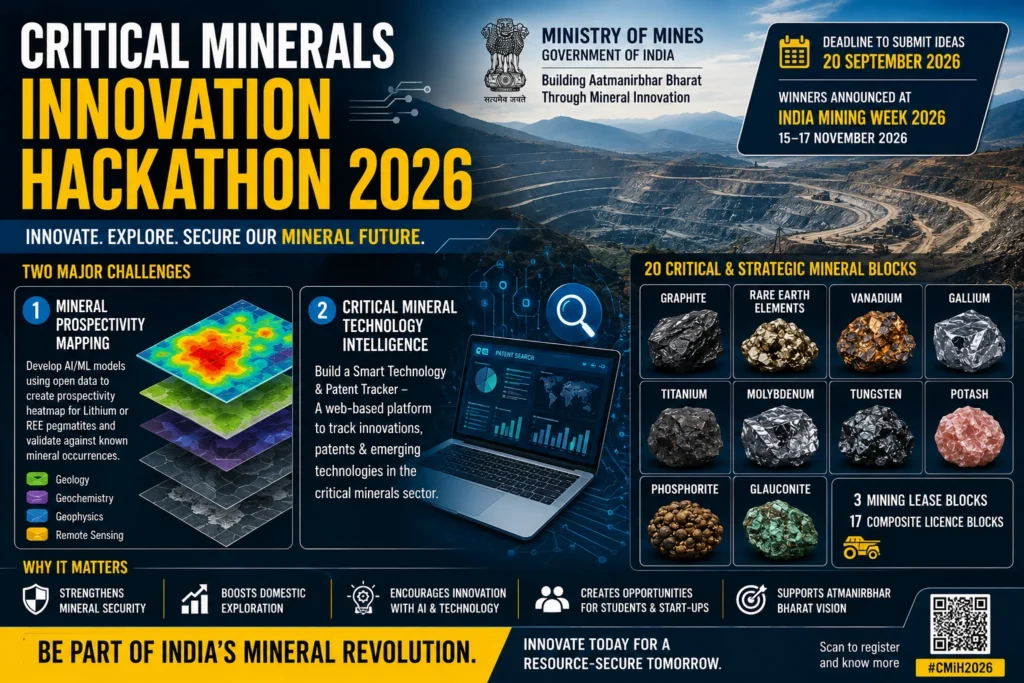
The Critical Minerals Innovation Hackathon 2026, also known as CMiH 2026, focuses particularly on mineral prospectivity mapping and technology intelligence.
The development is important because India is rapidly expanding its critical mineral programme. The country has already increased auctions of critical and strategic mineral blocks, promoted private exploration and invested in technologies such as artificial intelligence, machine learning, drones and advanced mineral processing.
However, discovering mineral resources remains one of the biggest challenges.
Modern exploration generates enormous amounts of geological, geochemical, geophysical and satellite data. Technologies such as artificial intelligence can potentially help geologists analyse this information faster and identify areas that deserve further investigation.
The new hackathon aims to bring mining, geology, data science and technology together to solve some of these challenges.
What Is the Critical Minerals Innovation Hackathon 2026?
The Critical Minerals Innovation Hackathon 2026 is an innovation programme focused on developing technological solutions for India’s critical mineral sector.
It invites participation from:
- Students
- Researchers
- Start-ups
- Academic institutions
- Research and development organisations
- Technology innovators
Participants will work on specific technical challenges connected with mineral exploration and technology intelligence.
The programme is being organised and hosted by the Jawaharlal Nehru Aluminium Research Development and Design Centre, commonly known as JNARDDC, Nagpur.
The broader objective is to encourage innovation that can strengthen India’s critical mineral ecosystem.
Why Is India Focusing on Critical Mineral Technology?
Critical minerals are increasingly important for modern industries.
They are required for technologies associated with:
- Electric vehicles
- Battery manufacturing
- Renewable energy
- Electronics
- Telecommunications
- Advanced manufacturing
- Aerospace
- Strategic industries
India currently depends on international supply chains for several important minerals and processed materials.
Developing domestic resources could reduce some of this dependence.
But before a mineral can be mined, it must first be discovered and evaluated.
This makes exploration one of the most important stages of mineral development.
First Challenge: Mineral Prospectivity Mapping
One of the two major problem statements in the Critical Minerals Innovation Hackathon 2026 focuses on Mineral Prospectivity Mapping from Open Data.
Mineral prospectivity mapping attempts to identify geological areas that may have a higher probability of containing particular mineral deposits.
Instead of exploring huge regions without sufficient direction, geologists can combine different datasets to identify more promising zones.
Participants in the hackathon are expected to develop a prospectivity heatmap focusing on lithium or Rare Earth Element pegmatites.
The model also needs to be validated against known mineral occurrences.
What Is a Mineral Prospectivity Map?
A mineral prospectivity map identifies areas where geological conditions appear favourable for particular mineral deposits.
Think of it as a geological priority map.
It does not prove that a commercially viable mineral deposit exists.
Instead, it helps exploration teams decide which locations deserve additional investigation.
A prospectivity model can potentially analyse information such as:
- Geological maps
- Structural geology
- Geochemical information
- Geophysical data
- Known mineral occurrences
- Satellite imagery
- Remote sensing information
- Historical exploration records
Combining these datasets can help identify patterns that may not be obvious when each dataset is analysed separately.
Why AI Can Transform Mineral Exploration
Traditional mineral exploration requires significant geological expertise and fieldwork.
These remain essential.
However, artificial intelligence and machine learning can provide additional analytical tools.
An exploration region may contain thousands or even millions of individual data points.
Machine learning systems can analyse relationships between these datasets and highlight geological patterns associated with known mineralisation.
A simplified modern exploration workflow could look like:
Geological Data → Geochemical Data → Geophysical Data → AI Analysis → Prospectivity Map → Field Investigation → Drilling
The technology does not replace geologists.
Instead, it can help them prioritise exploration targets more efficiently.
AI Does Not Automatically Discover a Mine
There is an important distinction between identifying a promising geological target and discovering an economically viable mineral deposit.
A computer model might indicate that a particular area has geological characteristics associated with lithium mineralisation.
That area still needs physical exploration.
Further work could involve:
- Geological mapping
- Rock sampling
- Soil sampling
- Geophysical surveys
- Trenching
- Exploratory drilling
- Core logging
- Laboratory analysis
Only after sufficient geological information has been collected can the size, grade and continuity of mineralisation be evaluated.
AI is therefore a tool within the exploration process rather than a replacement for exploration itself.
Why Lithium Is Included in the Hackathon
Lithium has become one of the world’s most discussed critical minerals because of its importance in rechargeable batteries.
Lithium-ion batteries are used extensively in:
- Electric vehicles
- Smartphones
- Laptops
- Battery energy storage
- Consumer electronics
As electric mobility and renewable energy storage expand, lithium supply has become strategically important.
India is therefore increasing efforts to identify potential domestic lithium resources while also exploring overseas mineral partnerships.
Better prospectivity mapping could help identify geological areas that deserve further lithium exploration.
Why Rare Earth Elements Matter
Rare Earth Elements, commonly called REEs, are another focus area of the hackathon.
REEs are used in several advanced technologies.
Important applications include:
- Permanent magnets
- Electric motors
- Wind turbines
- Electronics
- Communication equipment
- Advanced manufacturing
The challenge with rare earth elements is not simply finding them.
Mining, beneficiation, separation and refining can also be technically complex.
Building an effective REE supply chain therefore requires expertise across geology, mining and mineral processing.
Second Challenge: Critical Mineral Technology and Patent Tracker
The second problem statement under CMiH 2026 focuses on developing a Smart Technology and Patent Tracker for Critical Minerals.
The objective is to create a web-based system capable of tracking technological developments and intellectual property associated with critical minerals.
This could help researchers understand where new technologies are developing.
For example, innovation could occur in:
- Mineral exploration
- Beneficiation
- Extraction
- Separation
- Refining
- Recycling
- Recovery from mining waste
A technology intelligence platform could make this information easier to analyse.
Why Patent Tracking Matters in Mining
Mining technology changes continuously.
Companies and research organisations develop new methods for recovering minerals from difficult ores, processing lower-grade deposits and recycling minerals from waste.
Patent information can provide clues about these technological trends.
Analysing patent activity could help identify:
- Emerging technologies
- Active research areas
- Important organisations
- New processing methods
- Technology gaps
- Potential research opportunities
This information can be valuable for researchers, mining companies and policymakers.
Critical Minerals Are Also a Processing Challenge
One important lesson from India’s critical mineral programme is that mineral security cannot be achieved through mining alone.
The complete supply chain includes:
Exploration → Mining → Beneficiation → Concentration → Refining → Manufacturing → Recycling
A country may have mineral resources but still depend on another country for refining or processing.
For this reason, India is increasingly focusing on technology development across the entire mineral value chain.
Research into beneficiation, extraction and recycling could become just as important as discovering new deposits.
Technology Can Help Recover Minerals From Mining Waste
Another emerging area is the recovery of valuable minerals from materials previously considered waste.
These materials can include:
- Mine tailings
- Waste rock
- Processing residues
- Slags
- Fly ash
- Spent batteries
Improved analytical and processing technologies may make it possible to recover valuable elements from some of these secondary resources.
This approach can potentially improve resource efficiency while reducing waste.
However, commercial viability depends on mineral concentration, processing costs, technology and environmental requirements.
India’s Exploration Ecosystem Is Becoming More Technology Driven
India has already been promoting advanced exploration technologies through government programmes.
Modern exploration increasingly uses:
- Drone surveys
- Remote sensing
- GIS
- Artificial intelligence
- Machine learning
- Advanced geophysical techniques
- Digital geological databases
These technologies can improve the speed at which geological information is collected and analysed.
For large exploration regions, this can be particularly valuable.
Instead of treating every square kilometre equally, exploration teams can prioritise areas showing stronger geological potential.
Role of NMEDT in Critical Mineral Exploration
The National Mineral Exploration and Development Trust has also become an important part of India’s exploration strategy.
NMEDT supports mineral exploration projects and initiatives designed to improve the country’s geological knowledge.
During FY 2025-26, dozens of projects related to critical mineral exploration were sanctioned.
India is also encouraging private exploration companies and start-ups to participate more actively in the sector.
The combination of government geological data, private investment and new technologies could help accelerate mineral discoveries.
Opportunities for Mining and Geology Students
The Critical Minerals Innovation Hackathon 2026 is particularly relevant for students because modern mining is becoming increasingly interdisciplinary.
A mining professional of the future may need knowledge beyond conventional mine planning and production.
Useful skills could include:
- GIS
- Remote sensing
- Data analysis
- Python and programming
- Artificial intelligence
- Geological modelling
- Mineral economics
- Resource estimation
Geology students can also benefit from learning how computational tools can support traditional geological interpretation.
The strongest future exploration teams may combine geological expertise with data science.
Opportunities for Mining Technology Start-Ups
India’s critical mineral push could create opportunities for technology start-ups as well.
Potential start-up areas include:
- AI-based exploration software
- Geological data platforms
- Drone survey services
- Core analysis technologies
- Mineral processing solutions
- Mine waste recovery
- Digital mine planning
- Environmental monitoring
Mining has traditionally been considered a heavy industrial sector.
However, software and data technologies are becoming increasingly important throughout the mining lifecycle.
This creates opportunities for entrepreneurs who understand both technology and mineral development.
CMiH 2026 Submission Deadline and Prizes
The Critical Minerals Innovation Hackathon 2026 has established a clear timeline for participants.
The last date for submitting ideas is 20 September 2026.
Winners are expected to be announced during India Mining Week 2026, scheduled for 15 to 17 November 2026.
For each problem statement, two winning teams will be selected.
The first prize is Rs. 1.50 lakh, while the second prize is Rs. 1.00 lakh.
Beyond the prize money, participants can gain exposure to experts and institutions working in India’s mineral sector.
India Mining Week 2026 Could Become an Important Industry Platform
The announcement of winners during India Mining Week gives the hackathon broader industry relevance.
Mining Week can bring together government agencies, mining companies, technology providers, researchers and investors.
Innovation programmes associated with such industry events can help move ideas beyond academic projects.
Promising technologies may eventually receive opportunities for further testing, development or industry collaboration.
That connection between research and commercial mining is important.
Challenges of Using AI in Mineral Exploration
AI has significant potential, but it also has limitations.
The quality of an AI model depends heavily on the quality of its data.
Incomplete geological information can produce unreliable predictions.
Some exploration regions may also have limited historical datasets.
Another challenge is geological complexity.
Two mineral deposits of the same commodity may form under different geological conditions.
Therefore, an AI model trained on one geological environment may not automatically work equally well elsewhere.
Human geological interpretation remains essential.
The Future of Mineral Exploration in India
The future of exploration is likely to combine traditional field geology with advanced digital technologies.
Geologists will continue to examine rocks, structures and mineralisation directly.
But they will increasingly have access to powerful tools for analysing larger datasets.
The exploration process could increasingly involve:
Field Geology + Geophysics + Geochemistry + Remote Sensing + AI + Drilling
This integrated approach could help improve exploration efficiency and reduce the risk associated with drilling poorly selected targets.
Conclusion
The Critical Minerals Innovation Hackathon 2026 represents another important step in India’s effort to modernise mineral exploration and strengthen critical mineral security.
The initiative brings together students, researchers, start-ups, academic institutions and innovators to work on two important challenges: mineral prospectivity mapping and critical mineral technology intelligence.
The first challenge focuses on using open data to develop prospectivity maps for lithium or Rare Earth Element pegmatites.
The second focuses on developing a smart technology and patent tracking platform for the critical mineral sector.
Both challenges demonstrate how mining is becoming increasingly connected with artificial intelligence, data science and digital technology.
For India, finding critical minerals is only one part of the challenge. The country also needs technologies for exploration, processing, refining, recycling and resource recovery.
Initiatives such as CMiH 2026 can encourage a new generation of mining professionals, geologists, researchers and technology developers to work on these problems.
As India’s critical mineral programme expands, the combination of geological knowledge and advanced technology could become one of the most important factors determining the success of future mineral discoveries.