Coal quality plays a crucial role in mining, power generation, steel manufacturing, cement production, and other coal-consuming industries. Since the value of coal depends on its quality, it is essential that every coal transaction is supported by accurate and unbiased sampling. This makes Coal Sampling one of the most important activities in the mining industry.
A representative coal sample helps determine important quality parameters such as ash content, moisture, calorific value, volatile matter, fixed carbon, sulphur, and size distribution. These results directly influence coal pricing, customer confidence, operational efficiency, and regulatory compliance.
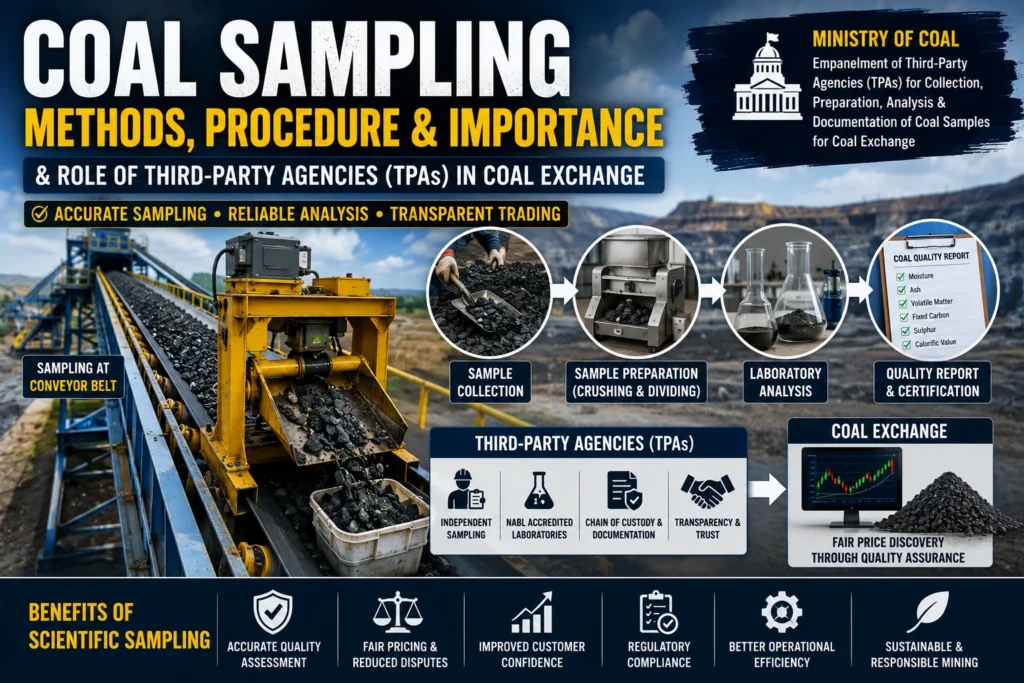
With the Government of India’s initiative to establish a Coal Exchange, the importance of scientific coal sampling has increased significantly. The Ministry of Coal has recently invited the empanelment of Third-Party Agencies (TPAs) to carry out the collection, preparation, analysis, and documentation of coal samples, ensuring transparent and reliable quality assessment for coal trading.
For GATE Mining, Mining Sirdar, Overman, DGMS, PSU recruitment, and Mining Engineering examinations, Coal Sampling is an important topic because it combines coal quality, mine operations, laboratory testing, and coal marketing.
What Is Coal Sampling?
Coal Sampling is the scientific process of collecting a small but representative quantity of coal from a larger lot so that its physical and chemical properties can be accurately determined.
Since every coal seam and stockpile may contain variations in quality, collecting a proper representative sample is essential. An incorrect sampling procedure may lead to inaccurate laboratory results, causing disputes between buyers and sellers.
The primary objectives of Coal Sampling include:
- Determining coal quality
- Grade verification
- Pricing of coal
- Quality assurance
- Customer confidence
- Regulatory compliance
Why Is Coal Sampling Important?
Coal quality directly affects industrial performance. Power plants require consistent calorific value, steel plants need controlled ash content, and cement industries depend on uniform fuel quality.
Proper Coal Sampling ensures that the laboratory analysis truly represents the entire coal lot. It minimizes commercial disputes and improves transparency in coal transactions.
Major benefits include:
- Accurate quality assessment
- Fair coal pricing
- Improved customer confidence
- Better combustion efficiency
- Reduced commercial disputes
- Standardized quality control
- Transparent coal trading
- Regulatory compliance
Working Principle of Coal Sampling
The basic principle of Coal Sampling is that the collected sample should represent the complete lot without bias.
The sampling process begins by collecting increments from different locations of a coal lot. These increments are combined to form a gross sample. The sample is then crushed, mixed, reduced, and prepared before laboratory testing.
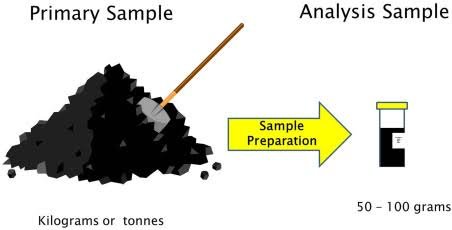
The general sequence includes:
- Sample collection
- Gross sample preparation
- Crushing
- Mixing
- Sample reduction
- Laboratory analysis
- Quality reporting
Every stage follows standard procedures to ensure accuracy and repeatability.
Types of Coal Sampling
Different mining and handling systems require different sampling methods.
Run-of-Mine (ROM) Sampling
Samples are collected directly from freshly mined coal before processing. ROM sampling helps evaluate the quality of coal produced from the mine.
Conveyor Belt Sampling
Automatic or manual samples are collected from moving conveyor belts. This method provides highly representative samples and is widely used in coal handling plants.
Wagon Sampling
Coal samples are collected from railway wagons before dispatch or after receipt. It is commonly used during commercial coal transactions.
Stockpile Sampling
Samples are collected from different locations of a coal stockpile to determine average quality.
Channel Sampling
A continuous channel of coal is cut across the exposed coal seam. This method is mainly used during exploration and reserve evaluation.
Auger Sampling
An auger drill is used to collect samples from deeper portions of stockpiles or exposed coal seams.
Equipment Used for Coal Sampling
Several specialized tools are used to ensure accurate sample collection.
Common equipment includes:
- Mechanical Sampler
- Sample Cutter
- Auger Sampler
- Shovel
- Hammer
- Crusher
- Sample Divider
- Pulverizer
- Moisture Container
- Sample Bags
- Digital Weighing Balance
Modern coal handling plants often use fully automatic sampling systems integrated with conveyor belts.
Sample Preparation and Laboratory Analysis
After collection, the sample undergoes preparation before laboratory testing.
The preparation process generally includes:
- Drying (where applicable)
- Crushing
- Mixing
- Quartering or sample division
- Pulverizing
- Packing
- Laboratory testing
Laboratories analyze several important quality parameters, including:
- Moisture
- Ash
- Volatile Matter
- Fixed Carbon
- Gross Calorific Value (GCV)
- Sulphur
- Size Analysis
These parameters determine the commercial value of coal.
Role of Third-Party Agencies (TPAs)
With the introduction of the Coal Exchange, the Ministry of Coal has proposed empaneling Third-Party Agencies (TPAs) for scientific coal sampling and analysis.
These agencies will independently:
- Collect coal samples
- Prepare representative samples
- Conduct laboratory analysis
- Maintain chain of custody
- Prepare quality documentation
- Issue certified reports
Independent TPAs improve transparency and increase trust between buyers and sellers.
Importance of Coal Sampling in Coal Exchange
The proposed Coal Exchange aims to establish transparent and market-driven coal trading.
Coal Sampling will become one of the most critical activities because the price of coal depends on certified quality parameters.
Proper sampling helps:
- Ensure fair pricing
- Reduce quality disputes
- Improve buyer confidence
- Standardize quality assessment
- Increase transparency
- Strengthen market credibility
Without scientific sampling, an efficient coal exchange cannot function effectively.
Advantages of Scientific Coal Sampling
Modern sampling techniques provide several operational and commercial advantages.
Major advantages include:
- Reliable quality assessment
- Better pricing accuracy
- Reduced disputes
- Standardized procedures
- Faster quality certification
- Increased customer confidence
- Improved regulatory compliance
- Enhanced transparency
Challenges in Coal Sampling
Despite standardized procedures, several practical challenges remain.
Common challenges include:
- Non-representative sampling
- Human errors
- Moisture loss
- Sample contamination
- Improper sample preparation
- Equipment calibration issues
- Transportation delays
- Documentation errors
Following standard operating procedures and regular equipment calibration helps overcome these challenges.
Future of Coal Sampling
Coal sampling technology is rapidly becoming more automated and digital.
Emerging developments include:
- AI-assisted quality prediction
- Automatic mechanical samplers
- IoT-enabled monitoring
- Online ash analyzers
- Real-time coal quality monitoring
- Robotic sample collection
- Digital chain of custody
- Cloud-based laboratory reporting
These innovations will improve speed, transparency, and reliability in coal quality assessment.
Conclusion
Coal Sampling is the foundation of accurate coal quality assessment and transparent coal trading. It ensures that laboratory results truly represent the quality of coal being produced, transported, or sold.
With India’s upcoming Coal Exchange and the involvement of Third-Party Agencies (TPAs), scientific sampling will play an even greater role in establishing confidence between coal producers and consumers. Modern sampling technologies, automated systems, and standardized laboratory procedures are expected to transform coal quality management in the coming years.
Every Mining Engineer, Mining Sirdar, Overman, DGMS candidate, and GATE aspirant should understand Coal Sampling because it is a key topic in mining operations, coal preparation, and mineral quality management.
Frequently Asked Questions
What is Coal Sampling?
Coal Sampling is the process of collecting a representative portion of coal to determine its physical and chemical properties.
Why is Coal Sampling important?
It ensures accurate quality assessment, fair pricing, transparency, and customer confidence in coal transactions.
What are Third-Party Agencies (TPAs)?
TPAs are independent agencies responsible for collecting, preparing, analyzing, and documenting coal samples for transparent quality assessment.
Which laboratory tests are performed on coal samples?
Common tests include moisture, ash, volatile matter, fixed carbon, sulphur, calorific value, and size analysis.
Why is Coal Sampling important for the Coal Exchange?
Scientific sampling ensures certified coal quality, fair pricing, reduced disputes, and transparent coal trading.