Winze in Mining is one of the most important underground development terms that every mining engineering student, mine planner, and underground mine professional must clearly understand as part of their core technical vocabulary.
From connecting two underground levels for ventilation and access to serving as an internal ore pass or exploration opening, the Winze in Mining plays a critical role in the efficient and safe development of underground hard rock mines worldwide.
In this complete guide by MiningGyan, we cover everything about Winze in Mining – from its precise definition and historical origin to its types, construction methods, the key difference between Winze and Raise, Winze and Shaft, its uses in underground mining, ventilation role, safety requirements, lining, and competitive exam MCQs – all in one structured and detailed article.
By the end of this guide, you will have a thorough, structured, and exam-ready understanding of Winze in Mining and every related concept that accompanies it in underground mining textbooks and competitive examinations across India.
What is Winze in Mining?
A Winze in Mining is a vertical or steeply inclined internal shaft that is driven downward from an upper level of an underground mine to connect it with a lower level, and it is entirely located within the underground workings of the mine with no connection to the surface whatsoever.
The defining characteristic of a Winze in Mining is that it starts underground – the collar of a Winze is located on an underground level and it is sunk downward through solid rock to reach the level below, making it fundamentally different from a main shaft which starts at the surface and descends to the mine.
| Key Term | Definition |
|---|---|
| Winze in Mining | Internal underground shaft driven downward from an upper level to connect with a lower level |
| Collar of Winze | The opening at the top of a Winze located on the upper underground level |
| Sump of Winze | The bottom of a Winze – also called a sump when used for water collection |
| Way Shaft | Another name for a Winze used in some mining regions – an internal subsidiary shaft |
| Internal Shaft | A shaft that exists entirely underground – synonymous with Winze in Mining |
| Raise | A vertical or inclined opening driven upward from a lower level – opposite direction to a Winze |
| Ore Pass | A Winze used specifically for gravity transfer of broken ore from an upper to a lower level |
| Manway | A Winze fitted with ladders used specifically for personnel access between levels |
Winze in Mining – Origin and History of the Term
The term Winze in Mining has its origins in Cornish mining vocabulary – the word derives from the Cornish word “winza” meaning a mine or pit, and its usage has been recorded in mining literature as far back as the late 17th century when Cornish tin and copper miners began systematically developing multi-level underground operations in the deep mines of Cornwall, England.
As Cornish miners and their distinctive mining terminology spread across the world during the 18th and 19th century mining booms in Australia, South Africa, North America, and India, the term Winze in Mining became established as a standard part of the international underground mining vocabulary used in English-speaking mining regions worldwide.
| Era | Development of Winze in Mining | Key Region |
|---|---|---|
| Late 1600s | Winze first used in Cornish tin and copper mines as internal connections | Cornwall, England |
| 1700s–1800s | Winze sinking becomes standard practice in multi-level hard rock mines globally | Europe, Americas |
| 1850s–1900s | Winze construction mechanised with compressed air drills – rates reach 30–40 m/month | Australia, South Africa |
| 1950s–1970s | Raise boring machines introduced – Winzes driven from below upward mechanically | Worldwide |
| 2000s–Present | Automated monitoring systems track Winze structural integrity in deep mines | Canada, South Africa, India |
Winze in Mining – Purpose and Uses
A Winze in Mining serves multiple critical functions within an underground mine, and understanding all of its uses is essential for appreciating why Winzes are such an important and frequently constructed underground development feature in hard rock mines worldwide.
The primary reason a Winze in Mining is constructed rather than extending the main shaft is economy – sinking a full main shaft from the surface to access a lower level is far more expensive and time-consuming than sinking an internal Winze from an existing underground level to reach the target zone below it.
Winze as a Level Connection in Mining
The most fundamental use of a Winze in Mining is to provide a vertical or steeply inclined connection between two existing underground levels, allowing miners, materials, and ore to move between the upper and lower levels without returning to the surface and re-entering through the main shaft.
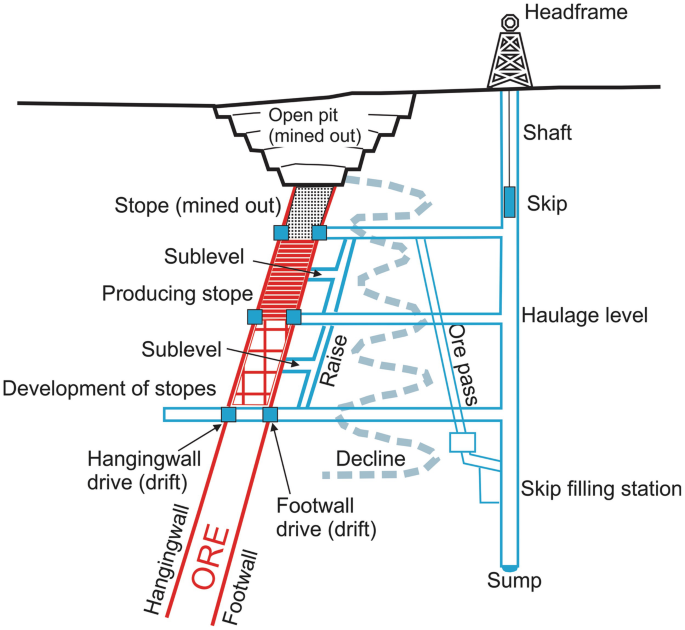
Internal Winze connections between levels significantly reduce travel time for underground workers and equipment, improving overall mining efficiency and reducing the cost of moving people and materials between different working areas of the mine.
Winze as a Ventilation Opening in Mining
Winze ventilation in Mining is one of the most important and widely used applications – a Winze provides a vertical connection through which fresh air can be directed from an upper level intake airway down to a lower level working face, or through which return contaminated air can travel upward from lower workings to the main return airway on an upper level.
Effective Winze ventilation in Mining is critical for maintaining safe and breathable air quality in deeper levels of underground mines, particularly in gold and hard rock mines where blasting fumes, diesel exhaust from equipment, and naturally occurring gases must be continuously diluted and removed from working areas.
Winze as an Ore Pass in Mining
When a Winze in Mining is specifically designed and used for the gravity transfer of broken ore from a higher level to a lower level where it can be loaded onto underground haulage equipment for transport to the main shaft, it is called an ore pass – and this is one of the most economically important uses of a Winze in any underground hard rock mine operation.
Ore pass Winzes in Mining are typically lined with steel or concrete to resist the abrasive wear caused by the continuous passage of blasted rock, and they are fitted with control gates at the bottom to regulate the flow of ore into the loading pocket or haulage level below.
Winze as an Exploration Opening in Mining
Winze exploration in Mining involves sinking a Winze downward from an existing level to test and evaluate the continuation of an ore body below the current lowest working level of the mine – this is a much faster and more economical way to explore the down-dip extension of an ore body than drilling from the surface or sinking a new main shaft.
Exploration Winzes in Mining provide direct access to the exploration target at depth, allowing geologists to map the ore body walls, collect systematic channel samples, and assess the rock conditions that will need to be managed if the mine is extended to that depth in the future.
| Use of Winze in Mining | Purpose | Benefit to Mine Operations |
|---|---|---|
| Level Connection | Connects upper and lower underground levels | Faster personnel and material movement between levels |
| Ventilation | Provides vertical airway between levels | Maintains safe air quality in lower level workings |
| Ore Pass | Gravity transfer of broken ore to lower haulage level | Eliminates costly ore trucking between levels |
| Exploration | Tests ore body extension below existing workings | Faster and cheaper than drilling or new shaft sinking |
| Drainage | Collects and channels groundwater to sump for pumping | Controls water inflow in lower mine workings |
| Emergency Egress | Secondary escape route between levels | Critical safety feature under mining regulations |
| Waste Pass | Gravity transfer of waste rock to lower fill level | Efficient waste rock distribution in fill mining |
Winze vs Raise in Mining – Key Difference
The difference between Winze and Raise in Mining is one of the most frequently asked distinctions in underground mining examinations, and it is important to understand precisely because both a Winze and a Raise are vertical or steeply inclined underground openings connecting two levels – the fundamental difference between them is only the direction in which they are constructed.
A Winze in Mining is always driven downward from an upper level to a lower level, while a Raise in Mining is always driven upward from a lower level to an upper level – and when a completed connection is viewed, whether it is called a Winze or a Raise depends entirely on which level you are standing on when you look at it.
| Parameter | Winze in Mining | Raise in Mining |
|---|---|---|
| Direction of Construction | Driven downward from upper level to lower level | Driven upward from lower level to upper level |
| Starting Point | Starts on upper underground level | Starts on lower underground level |
| Working Conditions | Miners work at the bottom of the excavation | Miners work at the top of the excavation |
| Mucking Method | Broken rock falls to working level – easier mucking | Broken rock must be hand-loaded at the top – harder |
| Safety Risk | Loose rock falls away from miners below | Loose rock falls toward miners – higher risk |
| Construction Speed | Generally slower due to manual mucking required | Faster with raise boring or Alimak raise climber |
| Cost | Generally higher cost than raise | Generally lower cost – especially with raise boring |
| Perspective | Called Winze when standing at the top looking down | Called Raise when standing at the bottom looking up |
| Hindi Name | Antrik Koop – Neeche ki taraf khoda jaata hai | Raise – Upar ki taraf khoda jaata hai |
Winze vs Shaft in Mining – Key Difference
The difference between Winze and Shaft in Mining is another fundamental distinction that every mining student and professional must understand clearly, as both are vertical or near-vertical underground openings but they differ critically in their starting point, purpose, scale, and equipment.
A Shaft in Mining starts at the surface and descends to the underground workings, while a Winze in Mining starts on an underground level and descends to a lower level – a Winze is essentially an internal subsidiary shaft that never reaches the surface.
| Parameter | Winze in Mining | Shaft in Mining |
|---|---|---|
| Starting Location | Starts on an underground level | Starts at the surface |
| Surface Connection | No surface connection – entirely underground | Directly connected to the surface |
| Winding Gear | Not equipped with permanent winding gear | Fitted with permanent winding gear and headframe |
| Access Method | Ladder, cage, or skip – usually ladder | Cage, skip, or lift – permanent hoisting system |
| Depth | Connects adjacent levels – typically shallower | Can extend to great depth from surface |
| Capital Cost | Much lower – internal excavation only | Very high – includes headframe, winding plant |
| Purpose | Internal level connection, ventilation, ore pass | Primary access, hoisting, ventilation for entire mine |
| Also Known As | Internal shaft, Way shaft | Main shaft, Production shaft, Service shaft |
| Size | Smaller – typically 1.5 m to 3 m diameter | Larger – typically 3 m to 10 m diameter |
Types of Winze in Mining
Winze in Mining can be classified into several types based on their orientation, purpose, and the method used to construct them – and understanding the different types of Winze is important for selecting the most appropriate design for a specific underground mining application.
Each type of Winze in Mining has specific design requirements, construction methods, and operational characteristics that make it more or less suitable for different underground environments and mining purposes.
Vertical Winze in Mining
A Vertical Winze in Mining is oriented exactly vertically – that is, it descends straight downward at 90 degrees from horizontal – and it is the most common type used when the mine levels are designed on a regular horizontal grid and the connection between them is required to be as short as possible.
Vertical Winzes in Mining are the easiest to equip with ladders and guides for skip or cage travel, and they offer the best conditions for ore and waste gravity passes because the material falls straight down without contacting the walls of the opening.
Inclined Winze in Mining
An Inclined Winze in Mining is driven at an angle less than 90 degrees from horizontal – typically between 45 and 85 degrees – and it is used when the ore body or the underground structure being accessed is inclined rather than vertical, or when surface topography makes a direct vertical connection impractical.
Inclined Winzes in Mining are commonly used in steeply dipping ore body mining to follow the ore body down-dip between levels, allowing direct access to the ore along its natural inclination rather than requiring horizontal development drives from a vertical shaft position.
Winze as Ore Pass in Mining
An Ore Pass Winze in Mining is a specifically designed and constructed Winze whose primary function is the controlled gravity transfer of blasted ore from a stoping level above to a haulage level or loading station below, and it is typically lined, reinforced, and fitted with flow control gates to manage the ore transfer process.
Ore pass Winzes in Mining must be designed to handle the full range of fragment sizes produced by underground blasting, including oversized boulders that could jam the ore pass and disrupt production – and they must be robust enough to resist the significant abrasive wear caused by the constant passage of coarse broken rock.
Winze as Manway in Mining
A Manway Winze in Mining is a small-diameter Winze fitted with timber or steel ladders at regular intervals, specifically designed for the safe movement of underground workers between levels in situations where the main hoisting shaft cannot be conveniently accessed or where emergency egress is required.
Manway Winzes in Mining are an important safety requirement under DGMS regulations in India and equivalent mining safety regulations worldwide, which mandate that workers must always have a secondary means of egress from any underground working in case the primary access route becomes blocked or unsafe.
| Type of Winze | Orientation | Primary Use | Key Design Feature |
|---|---|---|---|
| Vertical Winze | 90° from horizontal | Level connection, ventilation | Guides for skip/cage travel |
| Inclined Winze | 45° – 85° from horizontal | Following inclined ore body down-dip | Angled profile, floor for ladder |
| Ore Pass Winze | Vertical or steeply inclined | Gravity transfer of broken ore | Lined, reinforced, with control gate |
| Manway Winze | Vertical or inclined | Personnel access and emergency egress | Fitted with ladders and rest platforms |
| Exploration Winze | Vertical or inclined | Testing ore body extension at depth | Geological mapping access |
| Drainage Winze (Sump) | Vertical – short depth | Water collection and pumping | Sealed base, pump chamber |
Winze Construction in Mining – Methods and Process
Winze construction in Mining involves sinking a vertical or inclined opening downward through solid rock from an existing underground level, and the construction process requires careful planning, systematic drilling and blasting cycles, efficient mucking of broken rock, and progressive ground support installation to ensure the safety of the workers conducting the sinking operation.
The overall Winze construction process in Mining follows a sequential cycle of drilling, blasting, ventilating, mucking, and supporting that is repeated for each advance of the excavation until the target depth or level connection is achieved.
Step 1 – Winze Collar Preparation in Mining
The first step in Winze construction in Mining is preparing the collar – the top opening of the Winze on the upper underground level – by marking out the exact dimensions and position of the Winze opening on the level floor and installing a robust concrete collar structure to prevent the rim of the Winze from ravelling or collapsing as the opening is deepened.
The collar of a Winze in Mining must be carefully designed to handle the concentrated loads from any hoisting equipment, covers, or safety barriers that will be installed over the Winze opening during and after its construction.
Step 2 – Drilling and Blasting in Winze Construction
Each advance cycle in Winze construction in Mining begins with the drilling of a pattern of blast holes into the rock face at the bottom of the Winze using pneumatic or hydraulic rock drills – the hole pattern includes a central cut to initiate the break, easer holes to expand the opening, and trim holes to define the final profile of the Winze walls.
Controlled blasting techniques are used in Winze construction in Mining to minimise over-break beyond the design profile and to reduce blast-induced damage to the walls of the Winze, which is particularly important when the Winze is being sunk adjacent to existing underground workings that must not be disrupted by the blasting vibrations.
Step 3 – Mucking in Winze Construction in Mining
After each blast in Winze construction in Mining, the ventilation period allows blast fumes to clear before workers re-enter the bottom of the Winze to remove the broken rock – the mucking process involves loading the blasted material into buckets or skips that are hoisted to the upper level using a temporary hoist set up over the Winze collar.
Efficient mucking is one of the most critical factors controlling the overall advance rate of Winze construction in Mining – slow or inefficient mucking directly limits the number of blasting cycles that can be completed per shift and therefore the rate at which the Winze advances toward its target depth.
Step 4 – Ground Support in Winze Construction
As the Winze in Mining advances downward, each newly exposed section of the Winze walls must be systematically assessed for ground conditions and supported as required using rock bolts, mesh, shotcrete, or timber sets to prevent rock falls into the working area at the bottom of the Winze.
The ground support installed during Winze construction in Mining must be compatible with the permanent support system planned for the completed Winze and must be adequate to maintain the stability of the opening throughout its entire operational life.
| Construction Step | Activity | Purpose | Key Equipment |
|---|---|---|---|
| Collar Preparation | Mark out opening, install concrete collar | Defines Winze position and protects rim | Survey equipment, concrete formwork |
| Drilling | Drill cut, easer, and trim holes into face | Creates holes for explosive charges | Jackleg drill, stoper drill |
| Blasting | Load and fire explosive charge pattern | Breaks rock to advance Winze depth | Explosives, detonators, blast box |
| Ventilation | Clear blast fumes with forced ventilation | Makes face safe for re-entry | Ventilation fan, ductwork |
| Mucking | Load and hoist broken rock to upper level | Clears face for next drilling cycle | Temporary hoist, bucket, kibble |
| Ground Support | Install rock bolts, mesh, and shotcrete | Stabilises Winze walls between levels | Jumbo drill or hand drill, shotcrete machine |
| Survey and Inspection | Check Winze alignment and dimension | Ensures Winze meets design requirements | Plumb bob, survey equipment |
Winze Lining in Mining
Winze lining in Mining refers to the application of a protective and stabilising inner surface to the walls of a completed Winze to strengthen the rock mass, prevent deterioration of the wall rock over time, and protect the Winze from the abrasive wear caused by the passage of ore, water, or equipment through it during its operational life.
The type and extent of Winze lining in Mining selected for any specific application depends on the quality of the surrounding Country Rock, the purpose of the Winze, the depth of the Winze, the groundwater conditions, and the expected operational life of the underground opening.
| Lining Type | Material | When Used | Advantage |
|---|---|---|---|
| Shotcrete Lining | Sprayed concrete | Weak or fractured Country Rock | Fast application, seals rock surface |
| Concrete Lining | Cast concrete segments | Very poor rock or water-bearing zones | Maximum strength and water resistance |
| Steel Lining | Steel plates or pipes | Ore pass Winzes with heavy abrasion | Resists abrasion from broken ore |
| Timber Lining | Timber sets and lagging | Historical Winzes, shallow soft rock | Low cost, easy installation |
| Rock Bolt and Mesh | Steel bolts and wire mesh | Competent rock with minor joint instability | Simple, effective for good rock |
| No Lining | Bare rock | Very competent massive rock only | Minimum cost where rock permits |
Winze Ventilation in Mining
Winze ventilation in Mining is one of the most critical applications of the Winze as an underground infrastructure element – vertical Winzes provide natural or forced ventilation connections between underground levels that allow fresh air to reach working faces at depth and contaminated return air to be exhausted efficiently back to the main return airways.
In the absence of adequate Winze ventilation connections in Mining, air flow in lower level workings becomes stagnant and the concentration of blasting fumes, diesel exhaust, and naturally occurring gases such as methane and CO2 can rise to levels that are dangerous to the health and safety of underground workers.
| Ventilation Role | How Winze Contributes | Mining Safety Benefit |
|---|---|---|
| Fresh Air Intake | Winze channels fresh air from upper intake level to lower workings | Delivers breathable air to lower development faces |
| Return Air Exhaust | Winze provides upward return path for contaminated air | Removes blast fumes, diesel exhaust, and dust |
| Auxiliary Ventilation | Auxiliary fans in Winze boost air flow to specific working areas | Improves air quality in dead-end development headings |
| Emergency Ventilation | Winze provides backup air supply in emergency conditions | Critical for miner survival during fire or gas emergency |
| Heat Control | Winze airflow removes heat generated by equipment and rock at depth | Maintains safe working temperatures in deep mines |
Winze Safety in Mining
Winze safety in Mining is of paramount importance because the confined, vertical nature of a Winze creates specific hazards that are not present in horizontal underground workings – including the risk of rock falls from the Winze walls, falls of persons down the Winze opening, and gas accumulation in unventilated Winze sumps.
DGMS regulations in India and equivalent mine safety regulations in all major mining countries impose specific requirements for Winze safety in Mining, including mandatory covers over Winze collars when not in use, regular inspection and scaling of Winze walls, and the provision of properly maintained ladders and rest platforms in all manway Winzes.
| Safety Hazard | Description | Prevention Measure |
|---|---|---|
| Falls into Winze | Personnel or material falling down open Winze | Secure covers and barriers at Winze collar always |
| Rock Falls in Winze | Loose rock falling from Winze walls onto workers below | Regular barring and scaling plus adequate wall support |
| Gas Accumulation | CO2, methane, or blast fumes accumulating in Winze sump | Forced ventilation and gas monitoring before entry |
| Water Inrush | Sudden water flow from water-bearing zones intersected during sinking | Pre-drainage grouting and advance drainage holes |
| Ladder Failure | Deteriorated ladders failing during personnel access | Regular ladder inspection and replacement program |
| Ore Pass Hang-up | Ore jamming in ore pass Winze creating unstable arch | Proper ore sizing, flow control gates, and hang-up blasting |
| Winze Wall Deterioration | Long-term weathering and stress changes damaging Winze walls | Periodic inspection and rehabilitation of lining |
Winze in Mining – Advantages and Disadvantages
A Winze in Mining offers significant practical and economic advantages as an internal level connection and multi-purpose underground infrastructure element, but it also has important limitations compared to extending the main shaft or using other development methods to achieve inter-level connectivity.
Understanding both the advantages and disadvantages of a Winze in Mining is important for mine planners who must decide the most efficient and economical way to develop new levels and maintain connectivity between existing levels in an operating underground mine.
| Advantages of Winze in Mining | Disadvantages of Winze in Mining |
|---|---|
| Much lower cost than sinking or extending main shaft | No permanent winding gear – limited hoisting capacity |
| Faster construction than new shaft sinking from surface | Access only via ladder or temporary skip – slow for large personnel movements |
| Can be positioned exactly where needed underground | Sinking direction limited by available level below |
| Multi-purpose – ventilation, access, ore pass, exploration | Smaller diameter limits ore pass capacity |
| Does not disturb surface infrastructure or surface | Rock fall hazard during sinking operation |
| Provides secondary egress for mine safety compliance | Requires regular inspection and maintenance throughout life |
| Can be used to test ore body before committing to main shaft extension | Limited depth – not suitable for very deep level connections |
Winze in Mining – Diagram Explanation
A standard Winze in Mining diagram shows a vertical cross-section through an underground mine, illustrating the position of the Winze relative to the upper and lower mine levels, the collar at the top, the sump at the bottom, the ladder way, the ventilation connections, and the surrounding Country Rock through which the Winze has been sunk.
The table below explains each key label that appears in a standard Winze in Mining diagram as used in underground mining engineering textbooks, DGMS mining examination study materials, and mine planning training resources worldwide.
| Diagram Label | Position | Description |
|---|---|---|
| Upper Level | Top – where Winze starts | Existing underground level from which Winze is sunk downward |
| Winze Collar | At upper level floor | Top opening of Winze – fitted with cover and safety barrier |
| Winze Walls | Along the full depth | Solid rock walls lined with shotcrete, bolts, or concrete as required |
| Ladder Way | Along one side of Winze | Ladders and rest platforms for personnel access between levels |
| Winze Sump | Bottom of Winze | Lowest point – collects water for pumping, receives ore for ore pass |
| Lower Level | Bottom – where Winze connects | Underground level that the Winze reaches and connects to |
| Ventilation Duct | Connected to Winze | Supplies or exhausts air through the Winze for level ventilation |
| Country Rock | Surrounding the Winze | Existing rock mass through which Winze has been excavated |
| Ore Pass Gate | At bottom of ore pass Winze | Control gate regulating flow of ore from Winze into loading area |
Winze in Mining – Important for Competitive Exams
The topic of Winze in Mining is regularly and frequently tested in GATE Mining, DGMS examinations, Mining Foreman, Overman, Mine Surveyor, and Junior Mining Engineer competitive examinations across India, as it is a fundamental term in the underground mining development vocabulary that all mining professionals must know.
The MCQ table below contains the most important and most frequently asked exam-ready facts about Winze in Mining that will directly and immediately help you score better in your next competitive mining examination.
| Exam Question Pattern | Correct Answer |
|---|---|
| What is a Winze in Mining? | A vertical or steeply inclined internal shaft driven downward from an upper underground level to connect with a lower level – with no connection to the surface |
| What is Winze called in Hindi? | Antrik Koop or Bhoomigat Antrik Shaft |
| What is the main difference between Winze and Raise in Mining? | A Winze is driven downward from an upper level; a Raise is driven upward from a lower level – same connection, opposite direction of construction |
| What is the main difference between Winze and Shaft in Mining? | A Shaft starts at the surface with permanent winding gear; a Winze starts underground with no surface connection and no permanent winding gear |
| What is another name for a Winze in Mining? | Internal shaft or Way shaft |
| What is the collar of a Winze in Mining? | The top opening of the Winze located on the upper underground level |
| What is the sump of a Winze in Mining? | The bottom of the Winze – used for water collection or as the base of an ore pass |
| What is a Manway Winze in Mining? | A Winze fitted with ladders and rest platforms specifically for personnel access between levels |
| What is an Ore Pass Winze in Mining? | A Winze designed for the gravity transfer of broken ore from an upper stoping level to a lower haulage level |
| What is the origin of the term Winze in Mining? | Cornish mining – derived from the Cornish word “winza” meaning a mine or pit |
| Is a Winze in Mining equipped with permanent winding gear? | No – a Winze does not have permanent winding gear; access is via ladder, temporary skip, or cage |
| Which DGMS regulation applies to Winze safety in India? | DGMS Metalliferous Mines Regulations require covered collars, maintained ladders, and gas monitoring for all Winzes |
MiningGyan – Your Trusted Mining Education Platform
MiningGyan is a dedicated mining education platform built specifically for mining engineering students, diploma candidates, working mine professionals, and competitive exam aspirants across India who need accurate, complete, and well-structured technical knowledge delivered in clear and readable English.
At MiningGyan, important underground mining development concepts like Winze in Mining are explained with simple clear definitions, historical background, complete type classifications, step-by-step construction process descriptions, detailed comparison tables with Raise and Shaft, real-world examples, diagram label explanations, and comprehensive competitive exam MCQ notes – all in one freely accessible article.
MiningGyan covers the complete spectrum of underground mining engineering and geology – from mine development terminology and underground mining methods to ore body geology, mine safety regulations, ventilation engineering, mining equipment, and mineral exploration – making it the most comprehensive and freely accessible mining education platform for Indian students and professionals today.
Every article on MiningGyan is carefully researched, accurately written, and clearly structured to bridge the gap between textbook theory and real-world underground mining practice, ensuring maximum practical value for both students preparing for competitive examinations and working professionals in operating underground mines.
| What MiningGyan Covers | Who It Is Most Helpful For |
|---|---|
| Winze, Shaft, Raise, Drift, and Underground Development Terms | Mining Engineering and Diploma Students |
| Underground Mining Methods – Complete Step-by-Step Guides | B.Tech and Diploma Mining Engineering Students |
| Underground Mine Development, Design, and Planning | Junior Mining Engineers and Graduate Trainees |
| Mine Safety, Legislation, DGMS Regulations, and Ventilation | Supervisors, Overmen, Safety Officers, and Managers |
| Competitive Exam Notes, MCQ Tables, and Revision Guides | GATE, DGMS, Foreman, Overman, and Surveyor Aspirants |
| Ore Body Geology, Country Rock, Vein, Lode, and Reef Concepts | Economic Geologists and Mine Planning Engineers |
MiningGyan’s mission is simple and unwavering – “To deliver accurate, complete, and accessible mining knowledge to every mining student and professional in India, completely free of charge.”
If you are building a career in underground mining engineering, mine development, mine safety, or mine management, MiningGyan is the most reliable, well-structured, and student-friendly educational platform available to you today.
Frequently Asked Questions – Winze in Mining
A Winze in Mining is an internal underground shaft – a vertical or steeply inclined opening driven downward from an existing underground level to connect it with a lower level. It has no connection to the surface, is not equipped with permanent winding gear, and is used for ventilation, personnel access, ore passing, exploration, and drainage between mine levels.
The only difference between a Winze and a Raise in Mining is the direction of construction. A Winze is driven downward from an upper level, while a Raise is driven upward from a lower level. When the connection is complete, standing at the top makes it a Winze, while standing at the bottom makes it a Raise – they are the same opening viewed from opposite ends.
A Shaft in Mining starts at the surface and is equipped with a permanent headframe and winding gear. A Winze in Mining starts underground, has no surface connection, and is not fitted with permanent winding gear. A Winze is essentially an internal subsidiary shaft used for connecting underground levels only.
The main uses of a Winze in Mining are level connection for personnel and material movement, ventilation airway between levels, ore pass for gravity ore transfer, waste pass, exploration opening to test ore body extension, emergency egress for safety compliance, and drainage sump for groundwater management.
Key Winze safety precautions in Mining include fitting a secure cover over the collar when not in use, regular barring and scaling of walls to remove loose rock, maintaining ladders and rest platforms in manway Winzes, gas monitoring before entry into unventilated Winze sumps, installing adequate ground support throughout the Winze walls, and conducting regular formal inspections as required by DGMS regulations.
Conclusion – Winze in Mining
Winze in Mining is a fundamental underground development term and a critically important physical infrastructure element that plays essential roles in mine ventilation, personnel access, ore transfer, exploration, and safety in underground hard rock mining operations worldwide.
Whether you are a mining engineering student preparing for a competitive examination, a mine planner designing the development layout of a new underground mine, or an underground mine operator managing the day-to-day operations of an existing mine, a thorough understanding of what a Winze in Mining is, how it differs from a Raise and a Shaft, how it is constructed, and what safety requirements govern its operation is absolutely essential knowledge.
This complete guide by MiningGyan has covered all major aspects of Winze in Mining – from its precise definition and Hindi meaning to its historical origin, types, purposes and uses, construction steps, Winze vs Raise comparison, Winze vs Shaft comparison, lining types, ventilation role, safety requirements, advantages and disadvantages, diagram label explanations, and a comprehensive competitive exam MCQ table.
Explore more such free, detailed, and exam-ready mining guides on MiningGyan and continue building the strong technical foundation that every successful underground mining career truly requires.