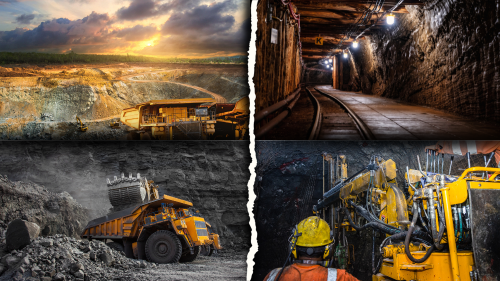
Underground mining is a complex logistical challenge where moving thousands of tons of rock efficiently dictates the profitability of an operation. When extracting minerals hundreds of meters below the surface, driving haul trucks up spiraling ramps is often too slow and expensive. To solve this, engineers rely on gravity. The heart of this gravity-driven logistics network is the ore pass in mining.
Welcome to Mining gyan. If you are learning about mining engineering, preparing for DGMS exams, or simply curious about how an underground mine haulage system operates, this guide is for you. We will break down exactly what an ore pass is, how it functions, the different types of ore transfer systems, and the design principles that keep these vertical highways flowing smoothly across Indian mines and globally.
What is an Ore Pass in Mining?
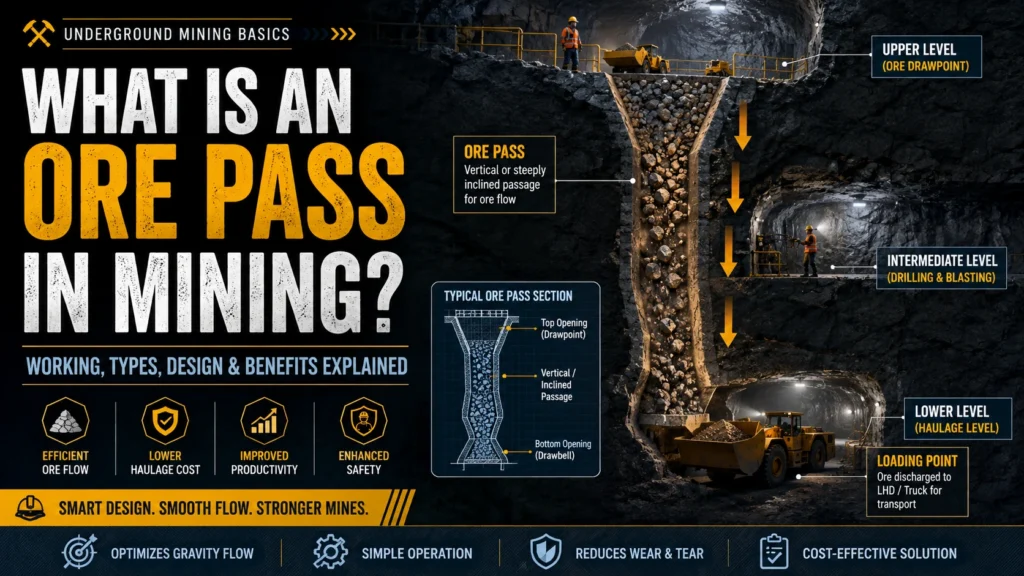
An ore pass in mining is a vertical or steeply inclined underground tunnel used to transfer broken ore or waste rock from a higher extraction level to a lower haulage level using the force of gravity. It functions as both a transportation conduit and a temporary storage bin.
At its core, an underground ore pass is a heavy-duty chute carved directly into the host rock. Instead of loading broken rock into trucks at every single sub-level, miners dump the blasted material down these dedicated passes. The rock falls or slides down to a central collection point—usually a loading pocket—where it is loaded onto larger underground trains, conveyor belts, or skips to be hoisted to the surface.
These structures are a critical part of the mine development infrastructure. The inclination of a gravity ore pass usually ranges between 55 degrees and 90 degrees (vertical). The shape can be circular if excavated mechanically using a raise borer, or square/rectangular if developed using traditional drill and blast methods like Alimak raising.
How an Ore Pass System Works in Underground Operations
An ore pass system works by utilizing gravity to move blasted rock. Dump trucks or load-haul-dump (LHD) loaders drop the material into the top of the pass through a protective grate called a grizzly. The rock falls to the bottom drawpoint, where specialized chutes control its release into a secondary transport vehicle.
The ore pass working principle is straightforward but requires precise engineering. Here is the step-by-step mineral extraction process flow:
-
Tipping and Sizing: Blasted ore is transported from the stope (the active mining area) to the top of the pass. Before entering, the rock usually passes through a grizzly—a heavy steel grate that prevents oversized boulders from entering and blocking the shaft. In some modern setups, a rock breaker is installed next to the grizzly to smash oversized chunks.
-
Vertical Transfer: The ore free-falls or slides down the rock pass in mining. The angle of the pass is designed to ensure the material flows steadily without excessive impact that could damage the rock walls.
-
Storage: The pass is rarely empty. It acts as an underground storage buffer. If the surface hoisting system stops, the miners can continue blasting and dumping ore into the pass until it is full.
-
Drawpoint Loading: At the bottom of the pass, the ore flow system in mining uses mechanical chutes, heavy chain feeders, or hydraulic crash gates. An operator opens the chute to let a controlled amount of ore flow into a waiting rail car, haul truck, or underground crusher.
There are two main operational philosophies for an ore pass:
-
Flow-Through System: The pass is kept mostly empty, and material flows directly to the bottom. This prevents fine, wet materials from compacting and causing blockages.
-
Full System: A certain level of ore is always kept in the pass. This cushions the impact of newly dumped rock, reducing wear and tear on the ore pass walls, though it increases the risk of the material getting stuck.
The Major Benefits of an Ore Pass in Mining
The main benefits of an ore pass in mining include massive reductions in vehicular haulage distances, significant energy and fuel savings, improved underground traffic safety, and the ability to buffer production rates between the mining face and the surface hoist.
Why is ore pass important in mining? The advantages of ore pass systems impact both safety and economics:
-
Reduced Haulage Costs: By using gravity, mines eliminate the need for trucks to drive down to the lowest levels just to pick up ore. This saves thousands of liters of diesel fuel and reduces vehicle maintenance costs.
-
Production Buffering: It acts as an underground silo. If the main crusher breaks down, the drilling and blasting teams do not have to stop working; they just fill the ore pass.
-
Improved Safety: Fewer trucks driving long distances on underground ramps means a lower risk of vehicular collisions and less diesel particulate matter polluting the mine air.
-
High Volume Transfer: An underground material handling system utilizing ore passes can move thousands of tons of rock per day much faster than a fleet of LHDs.
Key Features of a Well-Designed Ore Pass
A well-designed ore pass features a steep inclination of at least 55 degrees, a diameter large enough to prevent interlocking rock arches, reinforced dump points with grizzlies, and robust bottom-end flow control structures like hydraulic chutes.
To ensure the ore storage system operates without costly delays, mining engineers focus on several critical design features:
-
Optimal Inclination: Most ores will not flow reliably if the angle is less than 55 degrees. Ideally, an ore pass should be between 60 degrees and 80 degrees to balance flow rate and wall wear.
-
Correct Diameter: The diameter must be mathematically sized relative to the largest rock expected to pass through. A common rule of thumb is that the pass diameter should be at least three to five times the diameter of the largest rock fragment to prevent arching (blockages).
-
Knuckles (Dog-Legs): Instead of one massive vertical drop, engineers often design passes with a bend or knuckle. This breaks the free-fall velocity of the rock, preventing catastrophic impact damage at the bottom drawpoint.
-
Wear Liners: In areas of high impact, the walls of the pass or the bottom chutes are lined with heavy steel plates, rails, or high-strength concrete (shotcrete) to withstand abrasion.
Who Should Use an Ore Pass System?
An ore pass system should be used by any multilevel underground mine utilizing bulk mining methods, such as sublevel caving or sublevel stoping, where large tonnages of rock must be moved quickly from scattered upper levels to a centralized lower haulage level.
Not every mine needs one. If you are operating a shallow, single-level room-and-pillar coal mine, an ore pass is unnecessary. However, you need this infrastructure if your operation matches these profiles:
-
Steeply Dipping Orebodies: Mines extracting vertical or steeply angled mineral veins (like many gold and copper mines) rely heavily on gravity passes.
-
High-Tonnage Operations: Large-scale operations, such as those run by Vedanta (like Sindesar Khurd) or underground metal mines in Madhya Pradesh and Jharkhand, use these systems to maintain high daily production quotas.
-
Deep Shaft Mines: When the main hoisting shaft is the only way out, all ore from various sub-levels must be funneled down through passes to a central underground crushing station before being hoisted.
Common Mistakes to Avoid in Ore Pass Engineering
Common mistakes include designing the pass diameter too small for the fragmentation size, allowing water ingress which turns rock dust into concrete-like mud, and leaving the pass completely empty which leads to severe wall damage from falling rocks.
When ore pass construction is handled poorly, the mine suffers from hang-ups—situations where the rock wedges together and completely blocks the shaft. Clearing a hang-up is one of the most dangerous jobs in mining.
-
Poor Fragmentation Control: If the blasting team produces boulders that are too large, and there is no grizzly at the dump point, those boulders will inevitably wedge inside the pass.
-
Ignoring Water Management: If groundwater is allowed to seep into a pass filled with fine ore, it creates mud. When this mud dries, it cements the ore together, creating cohesive arches that completely stop the flow.
-
Incorrect Inclination: Designing an ore pass at a shallow angle like 45 degrees for sticky or clay-rich ore guarantees that the material will stall and build up on the footwall.
Expert Tips for Ore Pass Maintenance and Safety
Expert maintenance tips include conducting regular laser cavity monitoring surveys to check for wall degradation, managing water ingress diligently, maintaining strict rock sizing at the grizzly, and never sending personnel into a blocked ore pass.
At Mining gyan, we emphasize that ore pass safety measures in mining are non-negotiable. Here are best practices for maintaining these systems:
-
Use Cavity Monitoring Systems (CMS): Because you cannot safely send a person into a working ore pass, use lowered drone cameras or 3D laser scanners to map the wear and tear on the rock walls.
-
Controlled Blasting for Hang-ups: If a blockage occurs, never clear it from below. Use specialized explosive placement techniques (like bombing from the top or drilling small access holes from adjacent drifts) to dislodge the trapped rock safely.
-
Maintain the Buffer: If operating a full ore pass system, enforce strict rules about the minimum level of muck that must remain in the pass to protect the bottom chute from the impact of newly dumped rock.
Comparison Table: Ore Pass vs. Main Hoisting Shaft
Many beginners confuse these two vital pieces of underground mine infrastructure. Here is a clear breakdown of the mining shaft and ore pass differences.
Frequently Asked Questions
-
What is an ore pass in mining? An ore pass is a steep or vertical underground tunnel used to drop blasted ore or waste rock from a higher working level to a lower haulage level using gravity.
-
How does an ore pass work in underground mining? Dump trucks or loaders drop broken rock into the top of the pass. The rock falls to the bottom, where it is stored until a mechanical chute opens to load the material into a train or truck for final transport.
-
What causes an ore pass hang-up? Hang-ups are blockages caused either by large boulders interlocking with each other (interlocking arch) or by fine, wet material sticking together and cementing against the walls (cohesive arch).
-
How do miners clear a blocked ore pass? Clearing is done remotely for safety. Miners may drop explosives from the top level, use high-pressure water cannons, or drill small access holes from nearby tunnels to blast the blockage apart. Manual clearing from below is highly dangerous and illegal in most jurisdictions.
-
What is a grizzly in mining? A grizzly is a heavy steel grate placed over the dump point of an ore pass. It acts as a sieve to prevent oversized boulders from entering the pass and causing a blockage.
-
What is the difference between a rock pass and an ore pass? The design is identical, but the terminology depends on the material. An ore pass moves valuable mineralized rock, while a rock pass (or waste pass) moves barren waste rock that will be used for backfill or sent to a surface dump.
-
What is a drawpoint in mining? A drawpoint is the designated area at the bottom of an ore pass or stope where the broken rock accumulates and can be safely extracted by a loader or through a chute system.
-
Can an ore pass be circular? Yes. When excavated using a mechanized raise borer, the resulting ore pass is perfectly circular, which is actually structurally stronger and provides smoother material flow compared to rectangular passes.
-
Why are dog-legs or knuckles used in ore pass design? A straight vertical drop of 200 meters would cause falling rock to reach extreme velocities, destroying the steel chutes at the bottom. A dog-leg (a sharp bend in the shaft) breaks the fall and absorbs the kinetic energy of the rock.
-
Are ore passes used in open cast mining? Generally, no. Ore passes are specifically designed for underground mining operations. Open cast mines rely on heavy surface haul trucks and ramps to move material out of the pit.
Conclusion
The ore pass in mining is a brilliant application of basic physics to solve complex logistical problems. By letting gravity do the heavy lifting, mining companies can save enormous amounts of fuel, reduce underground traffic congestion, and maintain a steady flow of material to the processing plant.
Whether you are studying the mineral extraction process or analyzing underground mine infrastructure in regions like Madhya Pradesh, understanding the design, function, and safety protocols of ore pass systems is fundamental to modern mining engineering. A well-maintained ore pass system is the silent, highly efficient engine that keeps an underground mine profitable.
For more deep dives into mining machinery, DGMS compliance, and mineral extraction techniques, keep exploring Mining gyan. We are committed to bringing you the most accurate and practical mining knowledge available.