Timbering in Mining is one of the oldest and most fundamental ground support methods that every mining engineering student, ground control engineer, and underground mine professional must clearly understand, because wooden supports were the original means of holding up underground excavations long before rock bolts and steel arches existed.
From propping up the roofs and sides of roadways and stopes to giving an audible warning before the ground fails, Timbering in Mining has played a critical role in keeping underground workings safe for centuries and is still used today for temporary support and in specific mining conditions worldwide.
In this complete guide by MiningGyan, we cover everything about Timbering in Mining – from its precise definition and meaning to its components, types, the qualities of good mine timber, the difference between timber and steel supports, advantages, disadvantages, safety, and competitive exam MCQs – all in one structured and detailed article.
By the end of this guide, you will have a thorough, structured, and exam-ready understanding of Timbering in Mining and every related concept that accompanies it in ground control textbooks and competitive examinations across India.
What is Timbering in Mining?
Timbering in Mining is the use of wooden supports such as props, bars, and frames to support the roof, sides, and face of underground excavations, so that loose or weak rock is held in place and prevented from collapsing into the working area.
The defining feature of Timbering in Mining is that it uses timber – a cheap, light, and easily worked natural material – to provide ground support, and a key practical advantage is that timber gives an audible warning by creaking and cracking before it finally fails, giving miners time to escape from dangerous ground.
| Key Term | Meaning in Ground Support |
|---|---|
| Timbering | Supporting underground excavations using wooden members |
| Prop / Post / Leg | A vertical timber that carries the load down to the floor |
| Cap / Bar / Crossbar | A horizontal timber on top of the posts that supports the roof |
| Sill / Sole Plate | A timber under the posts that spreads load onto the floor |
| Lagging | Planks or poles placed behind the set to hold back loose rock |
| Wedges and Blocks | Used to tighten the set firmly against the roof and sides |
| Stull | A single timber prop wedged across a stope in metal mines |
| Timber Set | A complete frame of posts and cap (and sometimes sill) acting together |
Functions of Timbering in Mining
Timbering in Mining performs several important functions in keeping underground workings safe, and understanding these functions explains why timber support remained the standard method of ground control for so long and is still useful today.
| Function | Purpose in the Mine |
|---|---|
| Roof Support | Holds up the roof of roadways, drifts, and stopes |
| Side / Rib Support | Supports weak side walls that tend to crush inward |
| Face Support | Holds the freshly exposed working face in bad ground |
| Warning of Failure | Creaks and cracks audibly before collapsing, warning miners |
| Temporary Support | Provides quick support until permanent support is installed |
| Yielding Support | Can compress and absorb some ground movement before failing |
Components of a Timber Set in Mining
A complete timber set in Mining is made up of several wooden members that work together to transfer the load from the roof safely down to the floor, and understanding these components is essential for understanding how different types of timbering work.
| Component | Position | Function |
|---|---|---|
| Post / Prop / Leg | Vertical, at the sides | Carries the load from the cap down to the floor |
| Cap / Bar | Horizontal, on top of posts | Supports the roof and spreads its load to the posts |
| Sill / Sole Plate | Horizontal, under the posts | Spreads the load onto the floor and stops posts sinking |
| Lagging | Behind the set, in gaps | Holds back loose rock between and behind the main members |
| Wedges | Between timber and rock | Tighten the set firmly against the roof and sides |
| Blocks | At contact points | Fill gaps and protect the set against over-stressing |
Types of Timbering in Mining
Timbering in Mining can be carried out in several different forms depending on the size of the opening, the ground conditions, and whether the support is temporary or long-term, and the main types are the single prop, the prop and bar set, the square set, cribs, stulls, and forepoling.
Single Prop (Post)
A single prop is the simplest form of Timbering in Mining – a single vertical timber set between the floor and the roof to support the roof at a point, often with a small cap piece on top to spread the load and stop the prop cutting into the roof.
Prop and Bar (Timber Set)
A prop and bar set, also called a three-piece set, consists of two vertical posts with a horizontal cap or bar resting across their tops to form a frame, and it is the most common form of Timbering in Mining used to support roadways, drifts, and galleries where both the roof and the sides need support.
Square Set Timbering
Square set timbering uses complete cubical frames of interlocking posts, caps, and girts that are built one on top of another and side by side to fill and support large openings, and it was invented by the engineer Philipp Deidesheimer in 1860 for the Comstock Lode mines, becoming the international standard for supporting very large and weak ore bodies.
In square set timbering the interlocking timber cubes are tightly blocked and filled with waste rock or hydraulic fill, so that the whole stope is supported by a strong honeycomb-like framework of timber and fill working together.
Cribs and Chocks
A crib or chock is built by stacking short timbers log-cabin style in a square, layer upon layer, to form a strong pillar of timber that supports the roof over a wider area, and it is often packed with waste rock to increase its load-carrying capacity.
Stull Timbering
Stull timbering is used in narrow steeply dipping metal mine stopes, where single timbers called stulls are wedged across the opening between the footwall and the hanging wall to hold the walls apart and support the back of the stope.
Forepoling
Forepoling is a method of Timbering in Mining used in very bad, running ground, in which pointed timber spiles are driven forward ahead of the face over the top of the last set, so that the loose ground is held up while the next length of excavation is carried out safely beneath them.
| Type of Timbering | Description | Best Suited For |
|---|---|---|
| Single Prop | One vertical timber supporting the roof at a point | Light, local roof support |
| Prop and Bar Set | Two posts with a cap forming a frame | Roadways, drifts, and galleries |
| Square Set | Interlocking timber cubes filling an opening | Large, weak ore bodies and stopes |
| Crib / Chock | Timbers stacked log-cabin style as a pillar | Wider roof support and junctions |
| Stull | Single timber wedged across a narrow stope | Steep narrow metal mine stopes |
| Forepoling | Spiles driven ahead of the face | Very bad, running, loose ground |
Qualities of Good Mine Timber
Not every kind of wood is suitable for Timbering in Mining – good mine timber must have specific qualities so that it can carry heavy loads safely, last as long as possible underground, and warn of failure, and the timber is normally seasoned by drying before use.
| Quality | Why It Matters |
|---|---|
| Strength | Must carry heavy roof and side loads without sudden failure |
| Straight and Sound | Straight, knot-free timber carries load evenly along its axis |
| Well Seasoned | Dried timber resists rot; green timber is prone to dry and wet rot |
| Warning by Cracking | Good timber creaks and cracks before failing, warning miners |
| Light and Workable | Easy to carry, cut, and frame underground |
| Durability | Resists decay, fungus, and insect attack for a longer life |
Timber vs Steel Support in Mining – Key Difference
The difference between Timber and Steel support in Mining is one of the most frequently asked comparisons in ground control examinations, because both are used to support underground openings but they differ greatly in strength, cost, durability, and behaviour.
Timbering in Mining is cheap, light, and easy to handle and gives warning before it fails, while steel supports such as steel arches are far stronger, durable, and fire-resistant and can be reused, but they are more expensive, heavier, and fail suddenly without the audible warning that timber gives.
| Parameter | Timber Support | Steel Support |
|---|---|---|
| Strength | Lower strength | Much higher strength |
| Cost | Cheap and readily available | More expensive |
| Weight | Light and easy to handle | Heavier and harder to handle |
| Warning of Failure | Creaks and cracks before failing | Fails suddenly without warning |
| Fire Resistance | Combustible – a fire hazard | Fire-resistant |
| Durability | Decays and rots – limited life | Durable but can corrode |
| Reuse | Limited reuse | Can often be recovered and reused |
Advantages and Disadvantages of Timbering in Mining
Timbering in Mining offers important practical advantages that kept it as the main ground support method for centuries, but it also has serious limitations that have led to its gradual replacement by rock bolts, steel arches, and shotcrete in modern mines.
| Advantages of Timbering | Disadvantages of Timbering |
|---|---|
| Cheap and readily available | Combustible – a serious fire hazard underground |
| Light and easy to handle and cut | Decays and rots, needing frequent replacement |
| Easy to frame and install on site | Lower strength than steel supports |
| Gives audible warning before failure | Attacked by fungus and insects |
| Good for temporary and irregular support | Consumes large quantities of forest timber |
| Can yield and absorb some ground movement | High long-term maintenance and labour |
Timbering Safety in Mining
Timbering safety in Mining is important because timber support is a primary defence against falls of ground, and both the setting and the removal of timber involve hazards that must be carefully managed by the miners.
DGMS regulations in India and equivalent mine safety rules worldwide require that supports are set to an approved support plan, that loose rock is scaled before timbering, that decayed or damaged timber is replaced promptly, and that props are withdrawn safely using an approved device such as a Sylvester prop-withdrawer so that miners are never directly beneath unsupported ground.
| Safety Hazard | Description | Prevention Measure |
|---|---|---|
| Falls of Ground | Roof or sides falling where support is weak | Set supports promptly to an approved plan |
| Decayed Timber | Rotten timber failing under load | Inspect regularly and replace decayed timber |
| Loose Setting | Unblocked sets carrying little load | Tighten with wedges and blocks properly |
| Prop Withdrawal | Danger when removing props from goaf | Use a Sylvester prop-withdrawer from a safe place |
| Fire Hazard | Timber catching and spreading fire | Control ignition sources and fire precautions |
| Falling Timber | Heavy caps or props falling during erection | Use secure staging and safe handling methods |
Timbering in Mining – Diagram Explanation
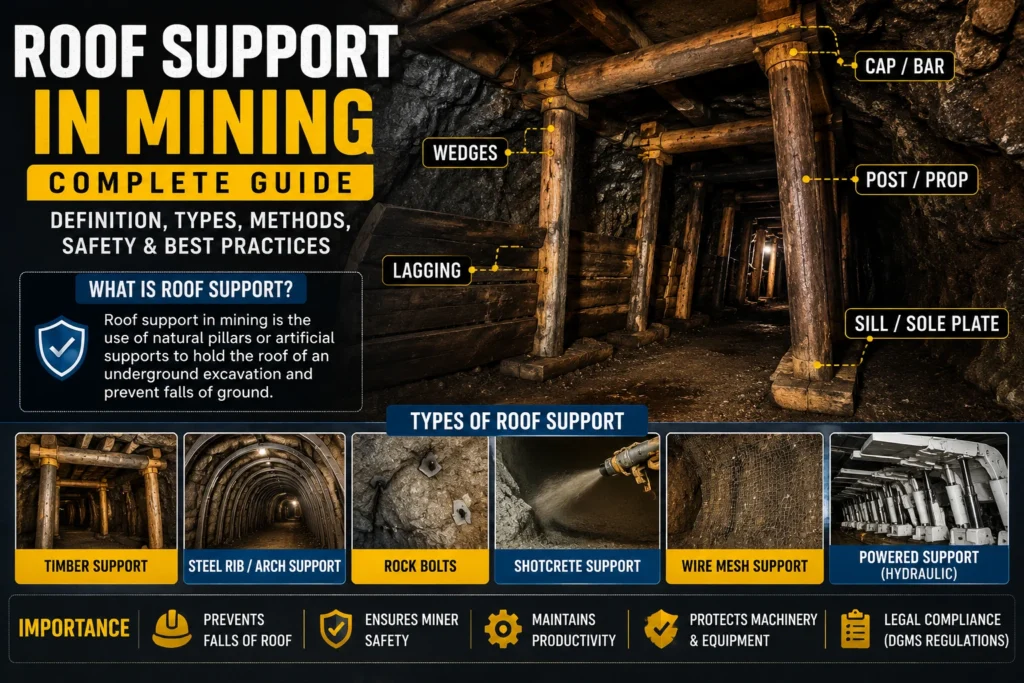
A standard Timbering in Mining diagram shows a section through an underground roadway supported by a prop and bar set, illustrating the two posts, the cap across their tops, the sill at the base, the lagging behind the set, and the wedges that tighten everything against the rock.
The table below explains each key label that appears in a typical Timbering in Mining diagram as used in ground control textbooks and DGMS examination study materials.
| Diagram Label | Position | Description |
|---|---|---|
| Cap / Bar | Across the top | Horizontal timber supporting the roof |
| Post / Prop | At the sides | Vertical timbers carrying the load to the floor |
| Sill / Sole Plate | At the base | Timber spreading the load onto the floor |
| Lagging | Behind the set | Planks holding back loose rock between members |
| Wedges | Between timber and rock | Tighten the set firmly against the ground |
| Roadway Opening | Inside the set | The supported underground roadway or gallery |
Timbering in Mining – Important for Competitive Exams
The topic of Timbering in Mining is regularly and frequently tested in GATE Mining, DGMS examinations, Mining Foreman, Overman, Mining Sirdar, and Junior Mining Engineer competitive examinations across India, as timbering and mine supports are core parts of the mine safety and ground control syllabus.
The MCQ table below contains the most important and most frequently asked exam-ready facts about Timbering in Mining that will directly help you score better in your next competitive mining examination.
| Exam Question Pattern | Correct Answer |
|---|---|
| What is Timbering in Mining? | Supporting underground roofs and sides using wooden props, bars, and frames |
| What is Timbering called in Hindi? | Lakdi ka Sahaara (Timber Support) |
| Which timber is widely used for support in Indian coalfields? | Sal, also called Sakhwa |
| What is a vertical timber support called? | A post, prop, or leg |
| What is the horizontal timber on top of posts called? | A cap or bar |
| What is a timber prop called in metal mines? | A stull |
| What is lagging used for? | To hold back loose rock between and behind the timber sets |
| Who invented square set timbering? | Philipp Deidesheimer, in 1860 for the Comstock Lode |
| What are the two main diseases of mine timber? | Dry rot and wet rot |
| What is the main advantage of timber over steel? | It is cheap, light, and gives audible warning before failing |
| What is the main disadvantage of timber support? | It is combustible and decays, needing frequent replacement |
| What device is used to withdraw props safely? | A Sylvester prop-withdrawer |
External References for Further Reading
To deepen your technical understanding of mine timbering and ground support, the following authoritative and academically reliable external resources are recommended for further study alongside this MiningGyan guide:
| Reference Source | What It Explains |
|---|---|
| Nevada Bureau of Mines and Geology – Square Set Timbering | University resource on the invention and working of square set timbering |
| University of Houston – The Timber Square Set | Academic history of timber supports and the square set method |
MiningGyan – Your Trusted Mining Education Platform
MiningGyan is a dedicated mining education platform built specifically for mining engineering students, diploma candidates, working mine professionals, and competitive exam aspirants across India who need accurate, complete, and well-structured technical knowledge delivered in clear and readable English.
At MiningGyan, important ground control concepts like Timbering in Mining are explained with simple clear definitions, component descriptions, complete type classifications, comparison tables with steel support, diagram label explanations, and comprehensive competitive exam MCQ notes – all in one freely accessible article.
MiningGyan covers the complete spectrum of mining engineering and geology – from ground control and rock mechanics to drilling and blasting, underground mining methods, mine safety regulations, ventilation engineering, mining equipment, and mineral exploration – making it a comprehensive and freely accessible mining education platform for Indian students and professionals today.
| What MiningGyan Covers | Who It Is Most Helpful For |
|---|---|
| Timbering, Rock Bolt, Shotcrete, and Ground Support Concepts | Mining Engineering and Diploma Students |
| Underground and Surface Mining Methods – Step-by-Step Guides | B.Tech and Diploma Mining Engineering Students |
| Mine Development, Design, and Planning | Junior Mining Engineers and Graduate Trainees |
| Mine Safety, Legislation, DGMS Regulations, and Ventilation | Supervisors, Overmen, Sirdars, and Managers |
| Competitive Exam Notes, MCQ Tables, and Revision Guides | GATE, DGMS, Foreman, Overman, and Surveyor Aspirants |
| Ore Body Geology, Country Rock, Vein, Lode, and Reef Concepts | Economic Geologists and Mine Planning Engineers |
MiningGyan’s mission is simple and unwavering – “To deliver accurate, complete, and accessible mining knowledge to every mining student and professional in India, completely free of charge.”
Frequently Asked Questions – Timbering in Mining
Timbering in Mining is the method of supporting the roof, sides, and face of underground excavations using wooden members such as props, bars, and frames. It is one of the oldest forms of ground support, valued because timber is cheap, light, easy to install, and gives an audible warning by cracking before it fails.
The main parts are the post or prop, a vertical timber that carries the load to the floor; the cap or bar, a horizontal timber on top of the posts that supports the roof; the sill or sole plate at the base that spreads the load onto the floor; the lagging behind the set that holds back loose rock; and wedges and blocks that tighten the set firmly against the ground.
The main types are the single prop, the prop and bar set used in roadways, the square set used to support large weak ore bodies, cribs or chocks stacked log-cabin style, stulls wedged across narrow stopes, and forepoling where spiles are driven ahead of the face in very bad ground.
Timber is cheap, light, easy to handle, and warns of failure by cracking, but it is combustible, decays, and is weaker. Steel supports are much stronger, durable, fire-resistant, and reusable, but they are more expensive, heavier, and fail suddenly without the audible warning that timber gives.
Timber is being replaced in modern mines because it is combustible, decays and rots, has lower strength than steel, and consumes large quantities of forest wood. Modern ground support methods such as rock bolts, steel arches, and shotcrete are stronger, longer-lasting, and safer, so timber is now mostly used for temporary support and in special situations.
Conclusion – Timbering in Mining
Timbering in Mining is a fundamental and historically important ground support method that supported underground workings for centuries and still has a place today, valued for being cheap, light, easy to install, and for giving miners an audible warning before the ground fails.
Whether you are a mining engineering student preparing for a competitive examination, a ground control engineer studying support methods, or an underground supervisor managing supports, a thorough understanding of what Timbering in Mining is, its components, its types, the qualities of good mine timber, and how it differs from steel support is absolutely essential knowledge.
This complete guide by MiningGyan has covered all major aspects of Timbering in Mining – from its precise definition and Hindi meaning to its functions, components, types, qualities of good mine timber, the Timber vs Steel comparison, advantages and disadvantages, safety requirements, diagram label explanations, and a comprehensive competitive exam MCQ table.
Explore more such free, detailed, and exam-ready mining guides on MiningGyan and continue building the strong technical foundation that every successful mining career truly requires.