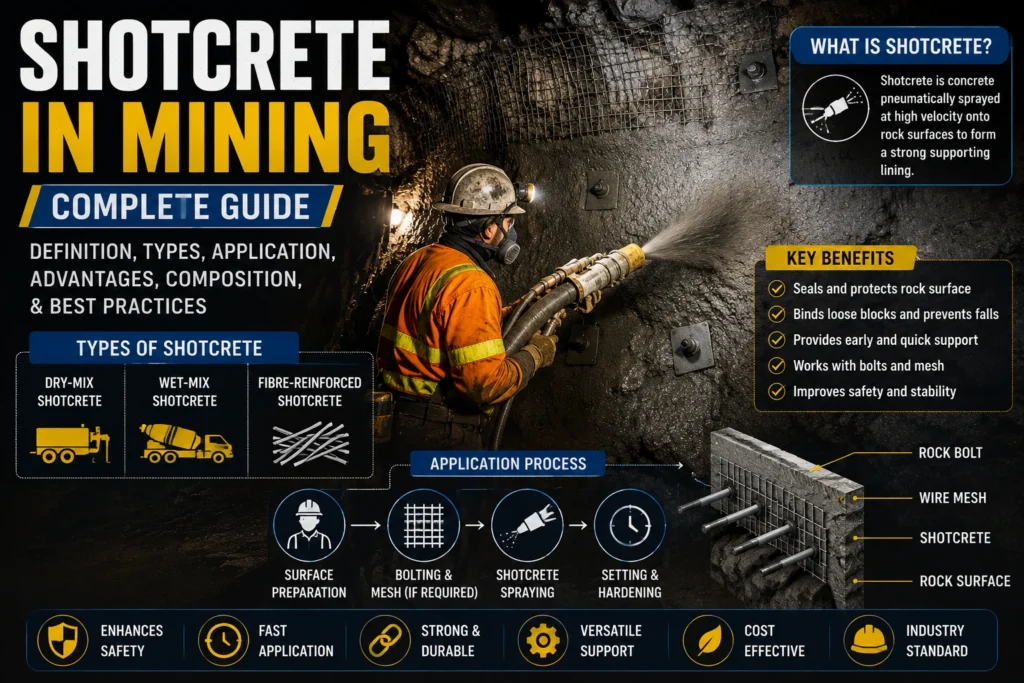
Shotcrete in Mining is one of the most important ground support and rock reinforcement methods that every mining engineering student, ground control engineer, and underground mine professional must clearly understand, because it is one of the fastest and most versatile ways to stabilise the roofs and walls of underground excavations.
From sealing exposed rock against weathering and binding loose blocks together to forming a strong structural lining that works alongside rock bolts, Shotcrete in Mining plays a critical role in keeping underground roadways, drifts, and stopes safe and stable worldwide.
In this complete guide by MiningGyan, we cover everything about Shotcrete in Mining – from its precise definition and meaning to its composition, types, the difference between wet-mix and dry-mix shotcrete, fibre-reinforced shotcrete, accelerators, rebound, application process, uses, safety, and competitive exam MCQs – all in one structured and detailed article.
By the end of this guide, you will have a thorough, structured, and exam-ready understanding of Shotcrete in Mining and every related concept that accompanies it in ground control textbooks and competitive examinations across India.
What is Shotcrete in Mining?
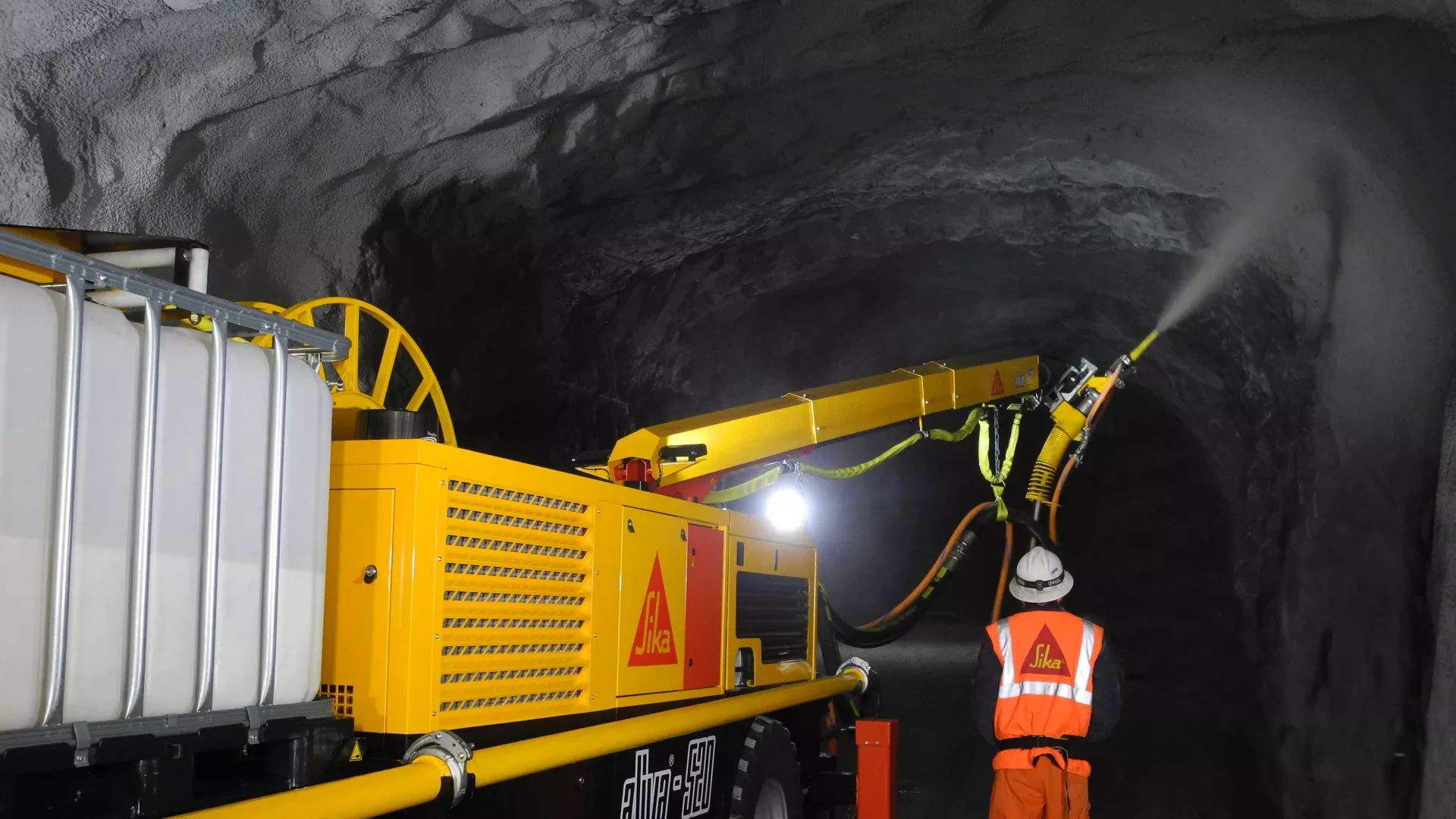
Shotcrete in Mining is concrete or mortar that is sprayed at high velocity through a hose and nozzle onto a rock surface using compressed air, so that it sticks to the roof and walls of an underground excavation and hardens into a strong, thin structural lining that supports and protects the rock.
The defining feature of Shotcrete in Mining is that it is pneumatically projected onto the rock rather than poured into formwork like ordinary concrete, which means it can be applied quickly to irregular surfaces overhead and on walls without any moulds, making it ideal for the rapid ground support that underground mining demands.
| Key Term | Meaning in Ground Support |
|---|---|
| Shotcrete | Concrete sprayed at high velocity onto a rock surface – sprayed concrete |
| Sprayed Concrete | The European name for shotcrete – the same material and method |
| Nozzleman | The skilled operator who controls the spray nozzle during application |
| Rebound | Material that bounces off the rock surface and is lost during spraying |
| Accelerator | An admixture that makes the shotcrete set and gain strength rapidly |
| Fibre-Reinforced Shotcrete (FRS) | Shotcrete mixed with steel or synthetic fibres for added toughness |
| Wet-Mix Shotcrete | Shotcrete pre-mixed with water and pumped to the nozzle |
| Dry-Mix Shotcrete | Dry mix conveyed by air with water added at the nozzle |
Why is Shotcrete Used in Mining?
Shotcrete in Mining is used because it provides fast, flexible, and effective ground support that helps the rock mass support itself, and it offers several advantages over both ordinary cast concrete and bolting alone in the demanding conditions of underground mines.
The key reasons Shotcrete in Mining is so widely used are that it gives early support soon after blasting, conforms to the natural irregular shape of the rock without any formwork, seals the rock against weathering, and combines with rock bolts and mesh to form a complete composite ground support system.
| Function of Shotcrete | Benefit in the Mine |
|---|---|
| Sealing the Rock Surface | Protects rock from weathering, slaking, and air exposure |
| Binding Loose Blocks | Holds small fractured blocks together and prevents falls |
| Surface Control | Stops small rock pieces falling between rock bolts |
| Structural Lining | Forms a thin arch that helps the rock support itself |
| Early Support | Provides ground support quickly after blasting for safe re-entry |
| Composite Support | Works with bolts and mesh for complete ground control |
Composition of Shotcrete in Mining
The composition of Shotcrete in Mining is similar to ordinary concrete but is carefully designed for spraying, with smaller aggregate sizes and special admixtures that allow it to be projected at high velocity, stick to overhead surfaces, and gain strength rapidly.
| Ingredient | Role in Shotcrete |
|---|---|
| Cement | The binder, usually Portland cement, that holds the mix together |
| Aggregate | Fine and small aggregate – smaller sizes reduce rebound |
| Water | Hydrates the cement; added at the nozzle in the dry process |
| Accelerator | Speeds up setting so shotcrete sticks overhead and gains early strength |
| Silica Fume | Improves cohesion, reduces rebound, allows thicker layers per pass |
| Fibres | Steel or synthetic fibres that add toughness and energy absorption |
| Admixtures | Plasticisers and stabilisers that adjust workability and set time |
Types of Shotcrete in Mining – Wet-Mix vs Dry-Mix
Shotcrete in Mining is classified mainly by the spraying process used into two main types – the wet-mix process and the dry-mix process – and the difference between them is one of the most frequently asked questions in ground control examinations.
The main difference is the stage at which water is added: in wet-mix shotcrete all the ingredients including water are mixed before being pumped to the nozzle, while in dry-mix shotcrete the dry materials are conveyed by compressed air and the water is added only at the nozzle as the material is sprayed.
Wet-Mix Shotcrete
In the wet-mix process, the cement, aggregate, water, and admixtures are fully mixed into a ready concrete that is pumped through the hose to the nozzle, where compressed air is added to throw it onto the rock – wet-mix shotcrete generally produces less rebound and dust, gives higher output, and offers more consistent quality.
Dry-Mix Shotcrete
In the dry-mix process, the cement and aggregate are mixed dry and carried by compressed air through the hose to the nozzle, where water and often a liquid accelerator are added just as the material is sprayed – dry-mix shotcrete allows easy starting and stopping and good control at the nozzle, but it usually produces higher rebound and more dust.
| Parameter | Wet-Mix Shotcrete | Dry-Mix Shotcrete |
|---|---|---|
| Water Added | Before pumping, in the mix | At the nozzle during spraying |
| Rebound | Lower rebound and material loss | Higher rebound and material loss |
| Dust | Less dust produced | More dust produced |
| Output Rate | Higher output, suited to large volumes | Lower output, suited to intermittent work |
| Quality Control | More consistent and uniform | Depends heavily on nozzleman skill |
| Starting / Stopping | Less convenient to stop and start | Easy to stop and restart |
| Best Suited For | High-volume production support | Small, remote, or intermittent work |
Fibre-Reinforced Shotcrete in Mining
Fibre-reinforced shotcrete (FRS) is a very important development in Shotcrete in Mining, in which steel or synthetic fibres are mixed into the shotcrete to give it much greater toughness and energy absorption, so that even after it cracks it can continue to hold the rock together as the ground moves.
Fibre-reinforced shotcrete in Mining is often used in place of welded wire mesh because the fibres are mixed throughout the material and reinforce it in all directions, and the mining industry has been an early adopter of synthetic fibres because they can absorb large amounts of energy over large displacements and resist the corrosive conditions often found underground.
| Fibre Type | Key Property | Typical Benefit in Mining |
|---|---|---|
| Steel Fibres | High strength and stiffness | Strong post-crack load capacity |
| Synthetic / Polymer Fibres | High energy absorption, corrosion-resistant | Good for deforming and corrosive ground |
| Fibre-Reinforced Shotcrete (FRS) | Toughness in all directions | Often replaces welded wire mesh |
Accelerators and Rebound in Shotcrete
Two of the most important practical concepts in Shotcrete in Mining are accelerators and rebound, because together they determine how well the shotcrete sticks to the rock, how quickly it gains strength, and how much material is wasted during spraying.
Accelerators in Shotcrete
Accelerators are chemical admixtures added to the shotcrete – at the nozzle in the dry process or just before spraying in the wet process – that make it set and harden very rapidly, which is essential so that the shotcrete sticks to overhead and vertical surfaces without sagging and develops the early strength needed for safe, fast re-entry after spraying.
Rebound in Shotcrete
Rebound is the shotcrete material that bounces off the rock surface during spraying and falls to the floor as waste, and controlling rebound is important because high rebound wastes expensive material and can reduce quality – ordinary mixes can lose a large fraction to rebound, but adding silica fume, using the correct spraying angle and distance, and using the wet process all help to reduce it.
| Factor | Effect on Rebound |
|---|---|
| Wet-mix process | Lower rebound than dry-mix |
| Silica fume in the mix | Greatly reduces rebound and allows thicker layers |
| Smaller aggregate | Reduces rebound compared with coarse aggregate |
| Correct nozzle angle (near 90°) | Minimises rebound from the surface |
| Correct shooting distance | About 1 to 1.5 m gives the least rebound |
Shotcrete Application Process in Mining
The application of Shotcrete in Mining follows a careful, systematic sequence because the quality and holding power of the shotcrete depend heavily on correct surface preparation, spraying technique, and curing.
| Step | Activity | Purpose |
|---|---|---|
| 1. Scaling | Bar down loose rock from the roof and walls | Makes the area safe before spraying |
| 2. Surface Cleaning | Wash the rock with an air-water jet | Removes dust so the first layer bonds well |
| 3. Mixing / Supply | Prepare the wet mix or dry mix and feed the machine | Provides a steady, consistent supply of material |
| 4. Spraying | Nozzleman sprays from low on the wall up to the back | Builds an even layer over the rock surface |
| 5. Layering | Apply in passes, avoiding spraying over rebound | Achieves the required thickness with good quality |
| 6. Curing | Allow the shotcrete to set and gain strength | Develops full strength and durability of the lining |
Shotcrete vs Concrete in Mining – Key Difference
The difference between Shotcrete and ordinary Concrete in Mining is an important distinction, because although both are made from cement, aggregate, and water, they are placed in completely different ways and used for different purposes underground.
Shotcrete in Mining is sprayed at high velocity onto a surface and sticks there without any formwork, giving fast support on irregular rock, while ordinary concrete is poured into moulds or formwork and is used where a cast structure can be built, which is much slower and not suited to immediate ground support.
| Parameter | Shotcrete | Ordinary Concrete |
|---|---|---|
| Placing Method | Sprayed at high velocity onto the surface | Poured into formwork or moulds |
| Formwork | No formwork needed | Requires formwork or moulds |
| Speed of Support | Provides early, fast ground support | Slower – needs forms and curing time |
| Surface | Conforms to irregular rock shapes | Takes the shape of the formwork |
| Typical Use | Roof and wall support in mines and tunnels | Cast linings, foundations, structures |
Uses of Shotcrete in Mining
Shotcrete in Mining is used across almost every type of underground excavation, and it is valued for the speed and flexibility with which it can be applied to support and protect newly exposed rock.
| Use of Shotcrete | Purpose |
|---|---|
| Roadway and Drift Support | Lines the roof and walls of underground roadways |
| Stope and Drive Support | Stabilises the backs and walls of working areas |
| Intersection Support | Reinforces wide, weaker spans where roadways cross |
| Surface Sealing | Seals weathering or air-slaking rock surfaces |
| Composite Lining | Combines with rock bolts and mesh for full support |
| Permanent Lining | Forms a final, durable lining for long-term openings |
Shotcrete Safety in Mining
Shotcrete safety in Mining is important both because shotcrete is a primary defence against falls of rock and because the spraying operation itself involves hazards such as dust, rebound, high-pressure equipment, and working under freshly exposed ground.
DGMS regulations in India and equivalent mine safety rules worldwide require that ground support including shotcrete is applied according to an approved support plan, that loose rock is scaled before spraying, that the nozzleman and crew use proper respiratory and eye protection against dust and rebound, and that re-entry under fresh shotcrete only takes place once it has gained sufficient early strength.
| Safety Hazard | Description | Prevention Measure |
|---|---|---|
| Falls of Ground | Loose rock falling before support is applied | Scale and support promptly to an approved plan |
| Dust Exposure | Cement and silica dust during spraying | Use the wet process where possible and wear respirators |
| Rebound Hazard | Material bouncing back at high speed | Maintain safe distance and wear eye protection |
| Early Re-Entry | Entering under shotcrete before it sets | Re-enter only after required early strength is reached |
| Equipment Hazards | High-pressure hoses and pumps | Maintain equipment and follow safe operating procedure |
| Poor Bonding | Shotcrete failing to stick to dirty rock | Clean the surface with an air-water jet first |
Shotcrete in Mining – Advantages and Disadvantages
Shotcrete in Mining offers major advantages as a fast and flexible ground support method, but like every support system it also has limitations that must be managed through good mix design, skilled application, and proper curing.
| Advantages of Shotcrete in Mining | Disadvantages / Limitations |
|---|---|
| Fast support applied soon after blasting | Quality depends heavily on nozzleman skill |
| No formwork needed – conforms to any shape | Rebound can waste material and add cost |
| Seals and protects the rock surface | Dust generation, especially in the dry process |
| Works with bolts and mesh for full support | Needs curing time to reach full strength |
| Fibre reinforcement adds toughness | Requires specialised equipment and supply |
| Can act as a permanent lining | Poor surface preparation causes bonding failure |
Shotcrete in Mining – Diagram Explanation
A standard Shotcrete in Mining diagram shows a section through an underground roadway, illustrating the shotcrete layer sprayed over the rock surface, the rock bolts anchored through it into the rock, and the mesh or fibres that reinforce the lining as part of a composite support system.
The table below explains each key label that appears in a typical Shotcrete in Mining diagram as used in ground control textbooks and DGMS examination study materials.
| Diagram Label | Position | Description |
|---|---|---|
| Rock Surface | Behind the lining | The exposed rock of the roof and walls |
| Shotcrete Layer | On the rock surface | The sprayed concrete lining supporting the rock |
| Reinforcement | Within the layer | Mesh or fibres that strengthen the shotcrete |
| Rock Bolt | Through the layer | Anchors the shotcrete and rock into deeper rock |
| Bearing Plate | On the shotcrete | Spreads the bolt load onto the lining and rock |
| Excavation Opening | Inside the lining | The supported underground roadway or stope |
Shotcrete in Mining – Important for Competitive Exams
The topic of Shotcrete in Mining is regularly and frequently tested in GATE Mining, DGMS examinations, Mining Foreman, Overman, and Junior Mining Engineer competitive examinations across India, as shotcrete and ground support are core parts of the mine safety and rock mechanics syllabus.
The MCQ table below contains the most important and most frequently asked exam-ready facts about Shotcrete in Mining that will directly help you score better in your next competitive mining examination.
| Exam Question Pattern | Correct Answer |
|---|---|
| What is Shotcrete in Mining? | Concrete sprayed at high velocity onto a rock surface to form a supporting lining |
| What is Shotcrete also called? | Sprayed concrete (the European name for shotcrete) |
| What are the two main shotcrete processes? | Wet-mix process and dry-mix process |
| What is the main difference between wet and dry mix? | In wet-mix water is added before pumping; in dry-mix water is added at the nozzle |
| Which process produces less rebound and dust? | The wet-mix process |
| What is rebound in shotcrete? | Material that bounces off the rock surface and is wasted |
| What does an accelerator do in shotcrete? | Makes the shotcrete set and gain strength rapidly |
| What is fibre-reinforced shotcrete? | Shotcrete mixed with steel or synthetic fibres for added toughness |
| What does silica fume do in shotcrete? | Improves cohesion, reduces rebound, and allows thicker layers |
| Who controls the shotcrete spray? | A skilled operator called the nozzleman |
| What is the ideal shooting distance for shotcrete? | About 1 to 1.5 metres from the rock surface |
| How does shotcrete support the ground? | It seals the rock, binds loose blocks, and forms a structural lining with bolts |
External References for Further Reading
To deepen your technical understanding of shotcrete and ground support, the following authoritative and academically reliable external resources are recommended for further study alongside this MiningGyan guide:
| Reference Source | What It Explains |
|---|---|
| American Shotcrete Association – Ground Support | Authoritative overview of shotcrete in ground support and underground use |
| Hoek – Practical Rock Engineering, Shotcrete Support | Classic academic chapter on shotcrete support, processes, and application |
MiningGyan – Your Trusted Mining Education Platform
MiningGyan is a dedicated mining education platform built specifically for mining engineering students, diploma candidates, working mine professionals, and competitive exam aspirants across India who need accurate, complete, and well-structured technical knowledge delivered in clear and readable English.
At MiningGyan, important ground control concepts like Shotcrete in Mining are explained with simple clear definitions, composition details, complete type classifications, wet vs dry comparison tables, application steps, diagram label explanations, and comprehensive competitive exam MCQ notes – all in one freely accessible article.
MiningGyan covers the complete spectrum of mining engineering and geology – from ground control and rock mechanics to drilling and blasting, underground mining methods, mine safety regulations, ventilation engineering, mining equipment, and mineral exploration – making it a comprehensive and freely accessible mining education platform for Indian students and professionals today.
| What MiningGyan Covers | Who It Is Most Helpful For |
|---|---|
| Shotcrete, Rock Bolt, Rock Mechanics, and Ground Support Concepts | Mining Engineering and Diploma Students |
| Underground and Surface Mining Methods – Step-by-Step Guides | B.Tech and Diploma Mining Engineering Students |
| Mine Development, Design, and Planning | Junior Mining Engineers and Graduate Trainees |
| Mine Safety, Legislation, DGMS Regulations, and Ventilation | Supervisors, Overmen, Safety Officers, and Managers |
| Competitive Exam Notes, MCQ Tables, and Revision Guides | GATE, DGMS, Foreman, Overman, and Surveyor Aspirants |
| Ore Body Geology, Country Rock, Vein, Lode, and Reef Concepts | Economic Geologists and Mine Planning Engineers |
MiningGyan’s mission is simple and unwavering – “To deliver accurate, complete, and accessible mining knowledge to every mining student and professional in India, completely free of charge.”
Frequently Asked Questions – Shotcrete in Mining
Shotcrete in Mining is sprayed concrete – concrete shot at high velocity through a nozzle onto the roof and walls of an underground excavation, where it sticks and hardens into a strong thin lining. It seals the rock, binds loose blocks, prevents small rock falls, and works with rock bolts and mesh for complete ground support.
The difference is when water is added. In wet-mix shotcrete all ingredients including water are mixed before being pumped to the nozzle, giving less rebound and dust and more consistent quality. In dry-mix shotcrete the dry materials are carried by compressed air and water is added at the nozzle, which allows easy stopping and starting but produces more rebound and dust.
Rebound is the shotcrete material that bounces off the rock surface during spraying and falls to the floor as waste. High rebound wastes material and money, so it is reduced by using the wet process, adding silica fume, using smaller aggregate, and spraying at the correct angle and distance of about 1 to 1.5 metres.
Fibre-reinforced shotcrete (FRS) is shotcrete that has steel or synthetic fibres mixed throughout it to give greater toughness and energy absorption, so it keeps holding the rock together even after it cracks. It is often used instead of welded wire mesh, and synthetic fibres are popular in mining because they absorb energy well and resist corrosion.
Shotcrete is preferred because it is sprayed at high velocity and sticks to the rock without any formwork, so it gives fast support on irregular surfaces soon after blasting. Ordinary concrete must be poured into formwork and cured, which is far too slow and impractical for the immediate ground support that underground mining requires.
Conclusion – Shotcrete in Mining
Shotcrete in Mining is a fundamental ground support method and a critically important rock reinforcement technique that seals exposed rock, prevents falls of ground, and forms a strong structural lining that keeps underground excavations safe and stable in mines and tunnels worldwide.
Whether you are a mining engineering student preparing for a competitive examination, a ground control engineer designing a support system, or an underground supervisor overseeing spraying, a thorough understanding of what Shotcrete in Mining is, how it is composed, the difference between the wet and dry processes, how it is applied, and how it works with rock bolts is absolutely essential knowledge.
This complete guide by MiningGyan has covered all major aspects of Shotcrete in Mining – from its precise definition and Hindi meaning to its functions, composition, wet-mix vs dry-mix comparison, fibre-reinforced shotcrete, accelerators and rebound, application process, Shotcrete vs Concrete comparison, uses, safety requirements, advantages and disadvantages, diagram label explanations, and a comprehensive competitive exam MCQ table.
Explore more such free, detailed, and exam-ready mining guides on MiningGyan and continue building the strong technical foundation that every successful mining career truly requires.