Primer in Blasting is one of the most important practical concepts in rock breakage that every mining engineering student, shotfirer, blasting foreman, and underground or opencast mine professional must clearly understand as part of their core drilling and blasting vocabulary.
From reliably initiating modern non-cap-sensitive blasting agents like ANFO to controlling fragmentation, toe breakage, and the avoidance of misfires, the Primer in Blasting plays a critical role in the safe, efficient, and economical breakage of rock in mines and quarries worldwide.
In this complete guide by MiningGyan, we cover everything about Primer in Blasting – from its precise definition and meaning to its types, priming methods, the key difference between Primer and Booster, Primer and Detonator, properties of an effective primer, bottom priming, safety requirements, and competitive exam MCQs – all in one structured and detailed article.
By the end of this guide, you will have a thorough, structured, and exam-ready understanding of Primer in Blasting and every related concept that accompanies it in drilling and blasting textbooks and competitive examinations across India.
What is Primer in Blasting?
A Primer in Blasting is a small unit of cap-sensitive high explosive – such as a cast booster or an explosive cartridge – into which a detonator or detonating cord is inserted, and which is placed inside the main charge of a blasthole so that when the detonator fires, the primer detonates and in turn reliably initiates the full main column of the less sensitive blasting agent.
The defining role of a Primer in Blasting is that it acts as the energetic bridge between the small initiating device and the bulk explosive – most modern bulk blasting agents like ANFO and emulsion are deliberately made insensitive to a detonator alone for safety, so they cannot be set off directly and require a primer to deliver the powerful shock needed to start a stable detonation.
| Key Term | Definition |
|---|---|
| Primer in Blasting | A sensitive high-explosive charge containing a detonator, used to initiate the main blasting agent |
| Priming | The act of positioning a suitable primer within the explosive column inside a blasthole |
| Detonator / Initiator | The device (electric, electronic, or non-electric) that starts the explosion of the primer |
| Booster | A high-energy explosive charge used to boost detonation; same as a primer when it carries a detonator |
| Blasting Agent | An insensitive bulk explosive such as ANFO that cannot be set off by a detonator alone |
| Cap-Sensitive Explosive | An explosive that can be reliably detonated by a standard blasting cap or detonator |
| Detonating Cord | A flexible cord with a PETN explosive core used to initiate or connect primers down the hole |
| VOD | Velocity of Detonation – the speed at which the detonation wave travels through the explosive |
Why is a Primer Needed in Blasting?
The fundamental reason a Primer in Blasting is required is that the bulk explosives used in modern mining – chiefly ANFO and emulsion-based blasting agents – are intentionally designed to be insensitive, meaning they will not detonate from the small energy output of a detonator alone, and this insensitivity is a deliberate and major safety feature of these explosives.
Because a detonator by itself cannot reliably start a stable detonation in these insensitive blasting agents, a Primer in Blasting is inserted to receive the detonator and amplify its small shock into a much larger and more powerful detonation pressure that is sufficient to initiate the surrounding main charge and drive it to its full, stable velocity of detonation.
| Without Proper Priming | Resulting Problem in Blasting |
|---|---|
| Primer too small or too weak | Main charge fails to reach full detonation velocity |
| Low detonation pressure primer | Incomplete detonation – wasted explosive energy |
| Wrong primer location in hole | Poor toe breakage and excessive borehole cut-offs |
| Inadequate priming overall | Misfires, oversize rock, and costly secondary blasting |
Primer in Blasting – Origin and Background of the Concept
The need for priming in blasting grew directly out of the shift in the explosives industry from sensitive nitroglycerine-based dynamites, which could be set off directly by a detonator, toward safer and cheaper bulk blasting agents such as ANFO, which became widely adopted in mining from the mid-twentieth century onward.
As these insensitive but economical blasting agents replaced traditional cap-sensitive explosives in mines and quarries across the world, the practice of using a separate, dedicated Primer in Blasting became standard, and cast boosters of pentolite and similar high-energy explosives were developed specifically to act as reliable, weatherproof primers for bulk charges.
| Era | Development Related to Priming in Blasting |
|---|---|
| Pre-1950s | Cap-sensitive dynamites set off directly by a detonator – little need for a separate primer |
| 1950s–1960s | ANFO becomes widely used – insensitive agent now requires a dedicated primer to initiate |
| 1970s–1980s | Cast pentolite boosters and primer cartridges become the standard for priming bulk charges |
| 1990s–2000s | Emulsion explosives and improved primers refine bottom-priming and deck-priming practice |
| 2000s–Present | Electronic detonators with primers give precise timing, better fragmentation, and safer blasts |
Types of Primer in Blasting
Primers in Blasting can be classified in several ways based on the explosive material from which the primer is made and on the position at which the primer is placed within the explosive column inside the blasthole, and understanding these types is important for selecting the right priming arrangement for any given blast design.
Cast Booster Primer
A cast booster primer is a moulded, solid charge of a high-energy explosive such as pentolite, manufactured with a pre-formed cap-well and a tunnel for detonating cord, and it is the most common dedicated primer used to initiate bulk blasting agents because it is robust, water-resistant, and delivers a very high detonation pressure.
Cartridge Primer
A cartridge primer uses a cap-sensitive packaged explosive cartridge – such as a nitroglycerine-based or emulsion cartridge – into which a detonator is inserted, and it is frequently used in underground blasting and in smaller-diameter blastholes where a full cast booster may not be necessary.
Bottom Primer
A bottom primer is positioned near the bottom or toe of the blasthole, and bottom priming is widely preferred in bench blasting because it allows the gas energy of the explosion to work for a longer time at the toe of the bench, improving toe breakage and significantly reducing the chance of borehole cut-offs and misfires.
Top Primer (Collar Priming)
A top primer is placed near the top of the explosive column close to the stemming, and although top priming was historically common, it is generally less favoured than bottom priming for bench work because it tends to release explosion gases through the collar earlier and gives poorer control over toe breakage.
Multiple / Deck Primer
In long or decked charges, more than one primer is used – this is called multiple priming or deck priming – where separate primers are placed in each deck of explosive separated by inert stemming, ensuring that every section of the charge is reliably initiated and that delays can be designed between the decks for better fragmentation and vibration control.
| Type of Primer | Basis | Where Used | Key Advantage |
|---|---|---|---|
| Cast Booster Primer | Material | Bulk ANFO and emulsion charges | High detonation pressure, water-resistant |
| Cartridge Primer | Material | Underground and small-diameter holes | Convenient, cap-sensitive, flexible |
| Bottom Primer | Position | Bench blasting (preferred practice) | Better toe breakage, fewer cut-offs |
| Top Primer | Position | Limited, specific blast designs | Simple loading near collar |
| Deck / Multiple Primer | Position | Long or decked charge columns | Reliable initiation of every deck |
Primer vs Booster in Blasting – Key Difference
The difference between Primer and Booster in Blasting is a frequently asked and slightly subtle distinction, because in everyday mine usage the two words are very often used interchangeably to describe the high-energy charge that initiates the main blasting agent – but there is a precise technical difference worth understanding clearly.
Strictly speaking, a Primer in Blasting is a high-explosive charge that contains or carries an initiating device such as a detonator or detonating cord, whereas a Booster strictly refers to a high-explosive charge that boosts or sustains the detonation but does not itself contain the initiating device – the same physical cast charge becomes a “primer” the moment a detonator is placed into it.
| Parameter | Primer in Blasting | Booster in Blasting |
|---|---|---|
| Initiating Device | Contains a detonator or detonating cord | Does not itself contain the initiating device |
| Primary Role | Starts the detonation of the main charge | Boosts and sustains detonation along the column |
| Position | Placed where the charge must be initiated | Placed where detonation must be reinforced |
| Common Usage | Often used interchangeably with booster | Often used interchangeably with primer |
| Example | Cast booster with a detonator inserted | Cast charge added mid-column without a cap |
Primer vs Detonator in Blasting – Key Difference
The difference between Primer and Detonator in Blasting is a fundamental distinction that every blasting student must understand, because the two work together in sequence but they are entirely different components with different functions, sizes, and energy outputs.
A Detonator is the small, sensitive initiating device that produces the first shock wave when triggered electrically, electronically, or by a shock tube, while a Primer in Blasting is the larger high-explosive charge that receives the detonator’s small shock and amplifies it into a powerful detonation capable of starting the bulk main charge.
| Parameter | Primer in Blasting | Detonator in Blasting |
|---|---|---|
| Function | Amplifies shock to initiate the main charge | Provides the initial triggering shock |
| Energy Output | High – enough to start the bulk charge | Low – not enough to start a blasting agent alone |
| Size | Larger charge (booster or cartridge) | Small device (cap-sized) |
| Sequence | Fired by the detonator, then fires main charge | Fired first by the firing system |
| Sensitivity | Cap-sensitive high explosive | Highly sensitive initiating composition |
| Relationship | Detonator is inserted into the primer | Detonator sits inside the primer |
Properties of an Effective Primer in Blasting
Not every explosive charge makes a good Primer in Blasting – an effective primer must possess specific physical and energetic properties so that it can reliably and fully initiate the surrounding main charge under the real, often wet and confined, conditions inside a blasthole.
The four most important properties that determine how well a Primer in Blasting performs are its detonation pressure, its diameter relative to the blasthole, its length, and its overall shape – and selecting a primer with the right combination of these properties is essential for achieving good fragmentation and avoiding misfires.
| Property | Why It Matters | General Guideline |
|---|---|---|
| Detonation Pressure | Drives the shock that starts the main charge | A high detonation pressure is required for reliable initiation |
| Diameter | Closer to hole diameter gives stronger initiation | Primer diameter should be a large fraction of the blasthole diameter |
| Length / Mass | Provides enough energy to sustain detonation buildup | Adequate length ensures the main charge reaches steady VOD |
| Shape | Affects how the detonation wave spreads into the charge | Designed shape directs energy efficiently into the column |
| Water Resistance | Wet holes can desensitise a poorly protected primer | Cast boosters are favoured in wet and deep holes |
Priming Methods in Blasting – Bottom, Top and Deck Priming
The way a Primer in Blasting is positioned inside the blasthole is just as important as the primer itself, and the choice of priming method has a direct effect on toe breakage, fragmentation, ground vibration, and the likelihood of misfires – so blast designers give careful thought to where the primer is placed in the column.
Bottom Priming
In bottom priming, the Primer in Blasting is placed near the bottom of the hole at the toe, and this is the most widely recommended method for bench blasting because it keeps the high-pressure gases working at the toe for longer, improving toe breakage and greatly reducing the chance of borehole cut-offs and resulting misfires.
Top Priming
In top priming, the primer is placed near the top of the explosive column close to the stemming – this method is simpler to load but generally gives poorer toe breakage and allows blast gases to vent through the collar earlier, which is why it is used less commonly than bottom priming in modern bench work.
Deck Priming
In deck priming, the explosive column is divided into separate decks by inert stemming and each deck is given its own primer, which allows individual delays between decks for better fragmentation control and reduced ground vibration, and ensures that every section of the charge is reliably and independently initiated.
| Priming Method | Primer Location | Main Benefit | Typical Use |
|---|---|---|---|
| Bottom Priming | Near the toe of the hole | Best toe breakage, fewest cut-offs | Standard bench blasting practice |
| Top Priming | Near the collar / stemming | Simple loading | Limited, specific situations |
| Deck Priming | One primer per explosive deck | Vibration control and fragmentation | Long holes, vibration-sensitive areas |
Primer in Blasting – Safety Considerations
Because a Primer in Blasting carries the detonator and represents the most sensitive and energetic point in the entire charge, handling and placing primers safely is one of the most critical responsibilities of the shotfirer, and strict procedures must be followed to prevent premature initiation and accidents during charging.
DGMS regulations in India and equivalent mine safety rules worldwide impose specific requirements on the assembly, transport, and placement of primers in blasting, including rules on when the detonator may be inserted into the primer, careful lowering of the primed charge into the hole, and protection of the primer and its leads from impact and friction during loading.
| Safety Hazard | Description | Prevention Measure |
|---|---|---|
| Premature Initiation | Primer firing accidentally during assembly or loading | Assemble primers only at the hole, follow approved procedure |
| Damaged Detonator Leads | Pulling or kinking leads while lowering the primer | Lower the primed charge gently, never drop it |
| Impact or Friction | Striking the primer during charging | Avoid tamping directly onto the primer |
| Wet Hole Desensitisation | Water weakening a poorly protected primer | Use water-resistant cast boosters in wet holes |
| Misfire from Under-priming | Inadequate primer leaving unexploded charge | Use correctly sized primers, follow misfire procedure |
| Static and Stray Current | Accidental firing of electric detonators | Follow electrical safety and stray-current precautions |
Primer in Blasting – Advantages and Disadvantages
Using a dedicated Primer in Blasting offers major safety and performance benefits in modern mining, but the practice also carries certain limitations and responsibilities that blast designers and shotfirers must manage carefully.
| Advantages of Using a Primer | Disadvantages / Limitations |
|---|---|
| Allows safe use of insensitive bulk blasting agents | Adds an extra component and cost to each blast |
| Ensures the main charge reaches full detonation velocity | Incorrect sizing can still cause poor results |
| Improves fragmentation and toe breakage | Requires skilled assembly and careful handling |
| Reduces misfires and borehole cut-offs | Most sensitive point of the charge – needs care |
| Enables precise timing with modern detonators | Wet or deep holes need higher-grade primers |
| Makes bulk explosives safer to transport and store | Adds steps to the charging cycle |
Primer in Blasting – Diagram Explanation
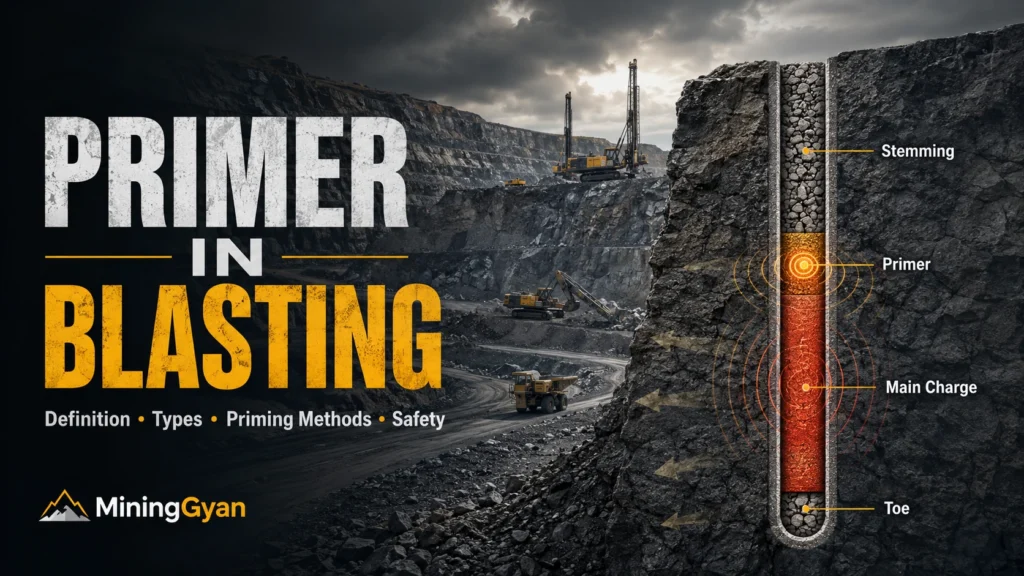
A standard Primer in Blasting diagram shows a vertical section through a charged blasthole, illustrating the position of the primer within the explosive column, the detonator inserted into the primer, the main charge of blasting agent surrounding it, the stemming above, and the surrounding rock burden that the blast is intended to break.
The table below explains each key label that appears in a typical Primer in Blasting diagram as used in drilling and blasting textbooks and DGMS examination study materials.
| Diagram Label | Position | Description |
|---|---|---|
| Stemming | Top of the hole | Inert material that confines the blast gases inside the hole |
| Detonator | Inserted into primer | The initiating device that fires the primer |
| Primer | Within the main charge | Sensitive booster charge that initiates the main column |
| Main Charge | Body of the hole | Bulk blasting agent such as ANFO or emulsion |
| Bottom Primer Position | Near the toe | Preferred location for best toe breakage and fewer cut-offs |
| Burden | Rock in front of hole | The rock mass that the blast is designed to break and move |
| Toe | Bottom of the bench | The base of the hole where breakage is hardest to achieve |
Primer in Blasting – Important for Competitive Exams
The topic of Primer in Blasting is regularly and frequently tested in GATE Mining, DGMS examinations, Mining Foreman, Overman, Shotfirer, Blaster, and Junior Mining Engineer competitive examinations across India, as priming is a core part of the drilling and blasting syllabus that every mining professional must know.
The MCQ table below contains the most important and most frequently asked exam-ready facts about Primer in Blasting that will directly help you score better in your next competitive mining examination.
| Exam Question Pattern | Correct Answer |
|---|---|
| What is a Primer in Blasting? | A sensitive high-explosive charge containing a detonator, used to initiate the main blasting agent |
| What is a Primer called in Hindi? | Praathmik Aavesh or Prerak Aavesh |
| Why is a primer needed for ANFO? | ANFO is insensitive and cannot be detonated by a detonator alone, so a primer is required |
| What is the difference between Primer and Detonator? | The detonator provides the initial shock; the primer amplifies it to initiate the main charge |
| What is the difference between Primer and Booster? | A primer carries the detonator; a booster boosts detonation without containing the initiator |
| What is priming in blasting? | Positioning a suitable primer within the explosive column inside the blasthole |
| Which priming method is preferred in bench blasting? | Bottom priming – it improves toe breakage and reduces cut-offs and misfires |
| What is deck priming? | Using a separate primer for each explosive deck separated by stemming |
| Name a common dedicated primer explosive. | Cast pentolite booster |
| What happens if priming is inadequate? | Poor fragmentation, bad toe breakage, oversize rock, and misfires |
| What is the field rule for primer size when in doubt? | Choose a bigger rather than a smaller primer |
| What property must an effective primer have? | High detonation pressure and a diameter close to the blasthole diameter |
External References for Further Reading
To deepen your technical understanding of priming and initiation in blasting, the following authoritative and academically reliable external resources are recommended for further study alongside this MiningGyan guide:
| Reference Source | What It Explains |
|---|---|
| Encyclopaedia Britannica – Blasting Cap | Authoritative explanation of detonators, blasting caps, and priming composition |
| Penn State – Introduction to Mining Engineering | Open courseware explaining initiators, primers, and boosters in the blasting sequence |
MiningGyan – Your Trusted Mining Education Platform
MiningGyan is a dedicated mining education platform built specifically for mining engineering students, diploma candidates, working mine professionals, and competitive exam aspirants across India who need accurate, complete, and well-structured technical knowledge delivered in clear and readable English.
At MiningGyan, important drilling and blasting concepts like Primer in Blasting are explained with simple clear definitions, background, complete type classifications, priming method descriptions, detailed comparison tables with Booster and Detonator, real-world guidance, diagram label explanations, and comprehensive competitive exam MCQ notes – all in one freely accessible article.
MiningGyan covers the complete spectrum of mining engineering and geology – from drilling and blasting and underground mining methods to ore body geology, mine safety regulations, ventilation engineering, mining equipment, and mineral exploration – making it a comprehensive and freely accessible mining education platform for Indian students and professionals today.
| What MiningGyan Covers | Who It Is Most Helpful For |
|---|---|
| Primer, Blasting, Spacing, Drilling, and Rock Breakage Concepts | Mining Engineering and Diploma Students |
| Underground and Surface Mining Methods – Step-by-Step Guides | B.Tech and Diploma Mining Engineering Students |
| Mine Development, Design, and Planning | Junior Mining Engineers and Graduate Trainees |
| Mine Safety, Legislation, DGMS Regulations, and Ventilation | Supervisors, Overmen, Shotfirers, and Managers |
| Competitive Exam Notes, MCQ Tables, and Revision Guides | GATE, DGMS, Foreman, Overman, and Surveyor Aspirants |
| Ore Body Geology, Country Rock, Vein, Lode, and Reef Concepts | Economic Geologists and Mine Planning Engineers |
MiningGyan’s mission is simple and unwavering – “To deliver accurate, complete, and accessible mining knowledge to every mining student and professional in India, completely free of charge.”
Frequently Asked Questions – Primer in Blasting
A Primer in Blasting is a small charge of sensitive high explosive that contains a detonator and is placed inside the main charge in a blasthole. When the detonator fires, the primer detonates and initiates the surrounding bulk blasting agent, which is otherwise too insensitive to be set off by a detonator alone.
A detonator is the small initiating device that provides the first shock when triggered, while a primer is the larger high-explosive charge that receives the detonator’s shock and amplifies it into a powerful detonation capable of starting the main charge. The detonator is inserted into the primer.
The terms are often used interchangeably. Strictly, a primer is a high-explosive charge that carries the detonator and starts the main charge, while a booster is a high-explosive charge that reinforces or sustains the detonation without itself containing the initiating device. The same cast charge becomes a primer once a detonator is inserted.
ANFO is a blasting agent that is deliberately made insensitive for safety, so it cannot be reliably detonated by a detonator alone. A primer with high detonation pressure is required to deliver the strong shock needed to initiate the ANFO column and drive it to its full velocity of detonation.
Bottom priming means placing the primer near the toe of the blasthole. It is preferred in bench blasting because it keeps the high-pressure gases working at the toe for longer, giving better toe breakage and a much lower chance of borehole cut-offs and misfires compared with top priming.
Conclusion – Primer in Blasting
Primer in Blasting is a fundamental drilling and blasting concept and a critically important practical component that makes the safe and efficient use of modern bulk explosives possible in mines and quarries worldwide.
Whether you are a mining engineering student preparing for a competitive examination, a blast designer planning a bench blast, or a shotfirer charging holes underground, a thorough understanding of what a Primer in Blasting is, how it differs from a booster and a detonator, what properties make it effective, and how priming methods affect fragmentation and safety is absolutely essential knowledge.
This complete guide by MiningGyan has covered all major aspects of Primer in Blasting – from its precise definition and Hindi meaning to why it is needed, its types, priming methods, Primer vs Booster comparison, Primer vs Detonator comparison, properties of an effective primer, safety requirements, advantages and disadvantages, diagram label explanations, and a comprehensive competitive exam MCQ table.
Explore more such free, detailed, and exam-ready mining guides on MiningGyan and continue building the strong technical foundation that every successful mining career truly requires.