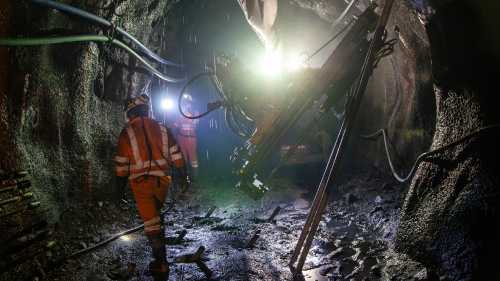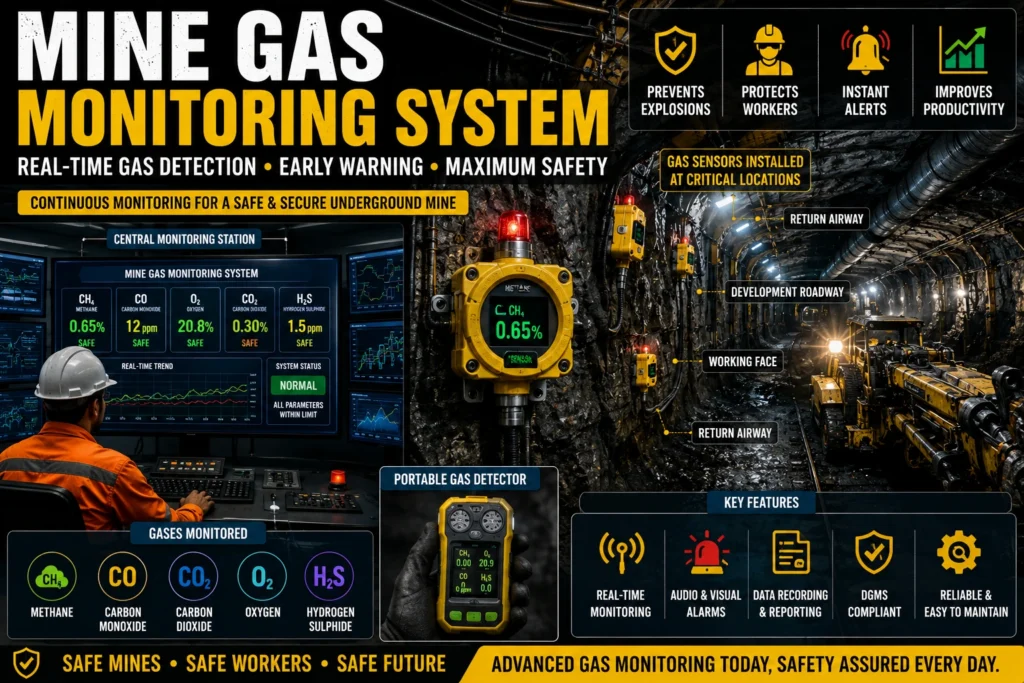
Accurate gas monitoring is one of the most critical safety requirements in underground mining. Harmful gases such as methane (CH₄), carbon monoxide (CO), carbon dioxide (CO₂), hydrogen sulphide (H₂S), and oxygen deficiency can create life-threatening situations if they are not detected in time. A Mine Gas Monitoring System continuously monitors the mine atmosphere and alerts workers before dangerous gas concentrations reach hazardous levels.
Modern Mine Gas Monitoring Systems use advanced gas sensors, PLC-based monitoring units, wireless communication, IoT technology, and centralized control rooms to provide real-time monitoring of underground mine conditions. These systems automatically generate alarms, activate safety measures, and help mine management take immediate corrective action.
For GATE Mining, Mining Sirdar, Overman, DGMS, PSU recruitment, and Mining Engineering examinations, the Mine Gas Monitoring System is one of the most important technical topics because it combines mine safety, gas detection, environmental monitoring, automation, and statutory compliance.
What Is a Mine Gas Monitoring System?
A Mine Gas Monitoring System is an integrated safety system designed to continuously detect, measure, record, and monitor the concentration of harmful gases present in underground mines.
The system consists of gas sensors, communication networks, control panels, alarm units, display systems, and data recording software. It continuously monitors mine air quality and immediately alerts mine officials whenever gas concentrations exceed permissible limits.
The primary objectives of a Mine Gas Monitoring System include:
- Detect methane accumulation
- Monitor oxygen concentration
- Detect toxic gases
- Prevent explosions
- Improve mine safety
- Support emergency response
Continuous gas monitoring is mandatory in many underground coal mines where methane emission is significant.
Why Is a Mine Gas Monitoring System Important?
Underground mining environments are constantly exposed to hazardous gases released from coal seams, blasting operations, diesel equipment, and spontaneous heating.
Methane accumulation above permissible limits may cause explosions, while carbon monoxide can lead to poisoning. Oxygen deficiency may result in suffocation, making continuous monitoring essential.
Major benefits include:
- Early gas detection
- Prevention of explosions
- Improved worker safety
- Real-time monitoring
- Faster emergency response
- Automatic warning system
- Better ventilation control
- Regulatory compliance
A reliable monitoring system greatly reduces accident risks and supports safe mining operations.
Gases Monitored in Underground Mines
A Mine Gas Monitoring System detects several important gases.
Major gases include:
- Methane (CH₄)
- Carbon Monoxide (CO)
- Carbon Dioxide (CO₂)
- Oxygen (O₂)
- Hydrogen Sulphide (H₂S)
- Nitrogen Oxides (NOx)
- Sulphur Dioxide (SO₂)
Each gas has different safety limits and requires continuous monitoring.
Working Principle of a Mine Gas Monitoring System
The Mine Gas Monitoring System operates using strategically installed gas sensors throughout underground workings.
These sensors continuously measure gas concentrations and transmit data through wired or wireless communication networks to the central monitoring station. If gas concentration exceeds the preset alarm level, the system immediately activates visual and audible alarms and informs the control room.
The basic working cycle includes:
- Gas detection
- Signal generation
- Data transmission
- Central monitoring
- Alarm activation
- Corrective action
Modern systems also store historical data for analysis and safety audits.
Components of a Mine Gas Monitoring System
A Mine Gas Monitoring System consists of several integrated components.
Major components include:
- Gas Sensors
- Methane Detector
- Carbon Monoxide Sensor
- Oxygen Sensor
- Control Panel
- PLC System
- Communication Network
- Display Unit
- Alarm System
- Data Logger
- UPS Backup
- Central Monitoring Software
These components work together to provide continuous gas surveillance.
Types of Gas Monitoring Systems
Different monitoring methods are used depending on mine conditions.
Fixed Gas Monitoring System
Permanent gas sensors are installed at strategic locations throughout the mine and continuously transmit gas concentration data to the control room.
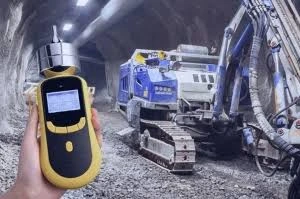
Portable Gas Detector
Portable gas detectors are carried by miners and supervisors to check gas concentration before entering working areas.
Personal Multi-Gas Detector
These compact instruments simultaneously monitor multiple gases such as CH₄, CO, O₂, and H₂S, providing individual protection to workers.
Wireless Gas Monitoring System
Wireless monitoring systems transmit real-time gas data without extensive cable networks, making installation easier in expanding mine workings.
Types of Gas Sensors
Different sensors are used to detect different gases.
Common gas sensors include:
- Catalytic Combustion Sensor
- Infrared Gas Sensor
- Electrochemical Sensor
- Semiconductor Sensor
- Thermal Conductivity Sensor
- Optical Gas Sensor
Each sensor is selected according to the gas being monitored and the required level of accuracy.
Applications of a Mine Gas Monitoring System
Mine Gas Monitoring Systems are used throughout underground mining operations.
Major applications include:
- Underground coal mines
- Development headings
- Longwall panels
- Belt conveyor roadways
- Mine return airways
- Pump houses
- Refuge chambers
- Mine rescue operations
Continuous gas monitoring is essential wherever explosive or toxic gases may accumulate.
Advantages of a Mine Gas Monitoring System
Modern monitoring systems offer several operational benefits.
Major advantages include:
- Continuous gas monitoring
- Early hazard detection
- Automatic alarm generation
- Better ventilation management
- Improved worker safety
- Data recording
- Reduced accident risk
- Compliance with safety regulations
These advantages make gas monitoring one of the most important mine safety systems.
Challenges in Mine Gas Monitoring
Despite advanced technology, several challenges remain.
Common issues include:
- Sensor calibration
- Dust accumulation
- High humidity
- Communication failure
- Power interruptions
- Sensor poisoning
- Battery maintenance
- Equipment damage
Regular calibration and preventive maintenance are essential for reliable monitoring.
Future of Mine Gas Monitoring Systems
Gas monitoring technology is rapidly becoming smarter and more connected.
Emerging developments include:
- AI-based gas prediction
- IoT-enabled gas sensors
- Wireless sensor networks
- Cloud monitoring
- Digital twin integration
- Remote control rooms
- Predictive safety analytics
- Autonomous gas monitoring robots
These technologies will further improve underground mine safety while reducing operational risks.
Conclusion
A Mine Gas Monitoring System is one of the most important safety systems in underground mining. It continuously monitors hazardous gases, prevents explosions, supports ventilation management, and protects workers from life-threatening situations.
From portable gas detectors to AI-enabled wireless monitoring systems, gas monitoring technology continues to evolve rapidly. Every Mining Engineer, Mining Sirdar, Overman, DGMS candidate, and GATE aspirant should understand the principles and applications of Mine Gas Monitoring Systems because they are fundamental to modern underground mine safety.
Frequently Asked Questions
What is a Mine Gas Monitoring System?
A Mine Gas Monitoring System is a safety system that continuously detects and monitors hazardous gases in underground mines.
Which gases are commonly monitored in underground coal mines?
Methane (CH₄), Carbon Monoxide (CO), Carbon Dioxide (CO₂), Oxygen (O₂), Hydrogen Sulphide (H₂S), Nitrogen Oxides (NOx), and Sulphur Dioxide (SO₂).
Why is methane monitoring important?
Methane is highly explosive when mixed with air in certain concentrations. Continuous monitoring helps prevent explosions.
What is the difference between a fixed and portable gas monitoring system?
Fixed systems continuously monitor selected locations, whereas portable detectors are carried by workers for personal safety.
What is the future of Mine Gas Monitoring Systems?
Future systems include AI-based prediction, IoT sensors, wireless monitoring, digital twins, cloud analytics, and autonomous inspection robots.