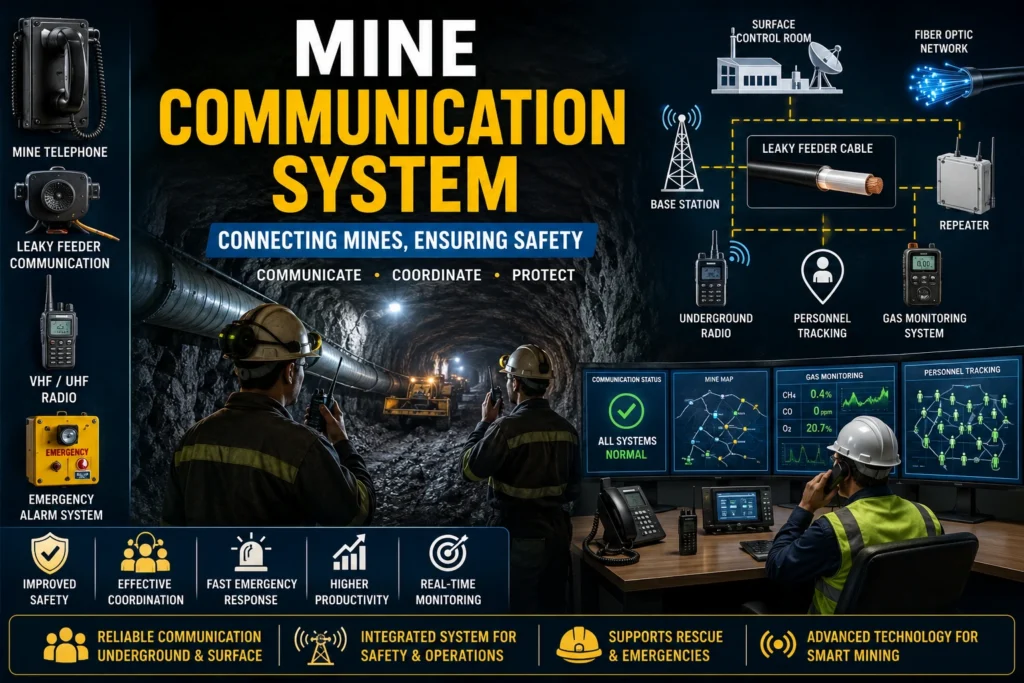
Accurate communication is the backbone of every successful mining operation. Whether it is an underground coal mine or a large opencast project, effective communication ensures smooth coordination between workers, supervisors, machine operators, and the control room. A reliable Mine Communication System helps improve productivity, enhances worker safety, and enables immediate response during emergencies.
Modern Mine Communication Systems have evolved from traditional wired telephones to advanced digital technologies such as leaky feeder communication, fiber optics, Wi-Fi networks, LTE/5G communication, and IoT-enabled monitoring systems. These technologies provide uninterrupted communication even in deep underground mines where normal mobile networks cannot function.
For GATE Mining, Mining Sirdar, Overman, DGMS, PSU recruitment, and Mining Engineering examinations, the Mine Communication System is one of the most important technical topics because it combines mine safety, communication technology, emergency preparedness, and modern mining automation.
What Is a Mine Communication System?
A Mine Communication System is an integrated communication network used to transmit voice, data, alarms, and operational information between underground workings and the surface.
It allows miners, supervisors, rescue teams, equipment operators, and mine management to stay connected throughout mining operations. The communication system is also integrated with gas monitoring systems, tracking devices, CCTV cameras, and emergency warning systems to improve overall mine safety.
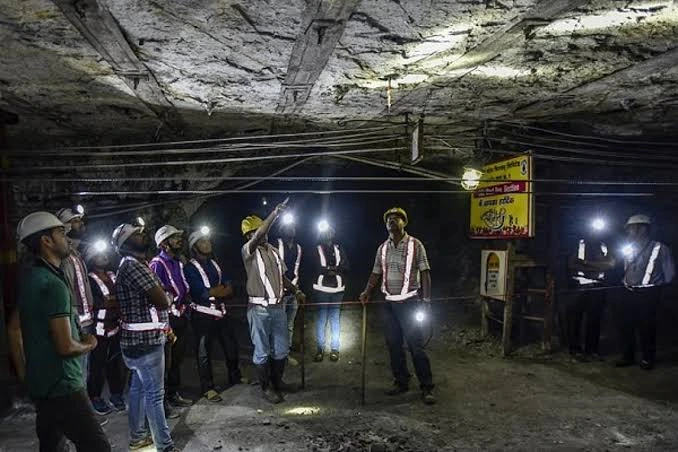
The primary objectives of a Mine Communication System are:
- Communication between underground and surface
- Production coordination
- Emergency warning and evacuation
- Equipment monitoring
- Worker safety
- Mine rescue support
Without an efficient communication network, mining operations become less productive and emergency response becomes significantly more difficult.
Why Is a Mine Communication System Important?
Mining environments are dynamic and hazardous. Underground mines often have poor visibility, confined spaces, explosive gases, and difficult working conditions. A delay of even a few minutes in transmitting information during an emergency can have serious consequences.
A well-designed Mine Communication System ensures that information flows quickly between workers and the control room. It enables supervisors to monitor mining activities, coordinate machinery, report hazards, and respond immediately to accidents.
Major benefits include:
- Faster emergency response
- Improved worker safety
- Better production coordination
- Reliable equipment monitoring
- Efficient rescue operations
- Reduced operational delays
- Real-time information sharing
- Improved mine management
Proper communication reduces accidents, improves productivity, and helps maintain smooth mining operations.
Working Principle of a Mine Communication System
A Mine Communication System works by transmitting voice or digital signals through wired or wireless communication networks installed throughout the mine.
When a miner uses a communication device, the signal is transmitted through communication cables, radio frequencies, or fiber optic networks to underground communication stations. These signals are then routed to the surface control room, where supervisors monitor operations and provide instructions.
Modern communication systems also receive information from gas sensors, equipment monitoring systems, CCTV cameras, and personnel tracking devices. This allows mine managers to monitor the mine in real time and quickly identify abnormal situations.
The basic communication cycle includes:
- Signal generation
- Signal transmission
- Signal routing
- Signal reception
- Data processing
- Response and acknowledgement
Advanced communication systems automatically trigger alarms when dangerous conditions such as gas leakage or equipment failure are detected.
Components of a Mine Communication System
A modern Mine Communication System consists of several interconnected devices working together to provide uninterrupted communication.
The major components include:
- Mine Telephone
- Leaky Feeder Cable
- Base Station
- Repeaters
- VHF/UHF Radios
- Fiber Optic Cable
- Wireless Access Points
- Communication Server
- Control Room Console
- Emergency Alarm System
- Battery Backup
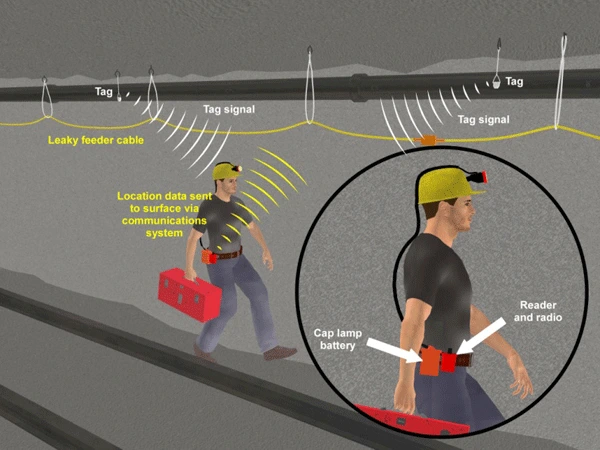
- Personnel Tracking Devices
Each component has a specific function and contributes to maintaining reliable communication throughout the mine.
Types of Mine Communication System
Different mining conditions require different communication technologies depending on mine depth, production capacity, and operational requirements.
Mine Telephone System
The mine telephone system is the oldest and most reliable communication method. It uses wired communication to connect underground workings with the surface control room. Even today, it serves as an important backup communication system in many mines.
Leaky Feeder Communication
Leaky Feeder Communication is the most commonly used underground wireless communication system. A specially designed coaxial cable acts like an antenna, allowing radio signals to travel throughout underground roadways. This enables continuous communication using portable radios even in deep underground mines.
VHF/UHF Radio Communication
Portable VHF and UHF radios provide quick communication between mine officials, supervisors, equipment operators, and rescue teams. They are widely used in both underground and opencast mines.
Fiber Optic Communication
Fiber optic communication provides extremely high-speed transmission of voice, video, and digital data with minimal signal loss. It is commonly used for CCTV monitoring, centralized control rooms, and automation systems.
Wi-Fi Communication
Modern underground mines increasingly use industrial Wi-Fi networks to support digital monitoring, autonomous equipment, and real-time data transmission.
LTE / 5G Communication
The latest generation of Mine Communication Systems uses LTE and 5G technology for high-speed communication, autonomous mining equipment, IoT sensors, and remote machine operation.
Applications of a Mine Communication System
Mine Communication Systems are used throughout mining operations to improve safety, coordination, and productivity.
Major applications include:
- Underground communication
- Surface communication
- Mine rescue operations
- Emergency evacuation
- Gas monitoring integration
- Production monitoring
- Equipment control
- Worker tracking
- Ventilation monitoring
- Remote supervision
With increasing automation, communication systems have become an essential part of intelligent mine management.
Advantages of a Mine Communication System
Modern communication systems provide several operational and safety benefits.
Major advantages include:
- Instant communication
- Improved emergency preparedness
- Better worker safety
- Higher production efficiency
- Reduced equipment downtime
- Reliable underground coverage
- Digital record keeping
- Easy integration with automation systems
These advantages help mining companies improve productivity while maintaining high safety standards.
Challenges in Mine Communication Systems
Despite significant technological advancements, communication systems still face several operational challenges in mining environments.
Common challenges include:
- Signal attenuation
- Underground obstructions
- Dust and humidity
- Power interruptions
- Electromagnetic interference
- Equipment maintenance
- Limited network coverage
- High installation cost
Regular maintenance, redundancy planning, and periodic upgrades are essential for maintaining reliable communication.
Future of Mine Communication Systems
The future of Mine Communication Systems is closely connected with Industry 4.0 and smart mining technologies.
Emerging technologies include:
- 5G Underground Networks
- AI-based Communication Management
- IoT-enabled Smart Mines
- Autonomous Equipment Communication
- Real-time Personnel Tracking
- Cloud-based Monitoring
- Digital Twin Technology
- Satellite-assisted Communication
These technologies will further improve safety, automation, operational efficiency, and predictive maintenance in modern mining operations.
Conclusion
A Mine Communication System is one of the most important infrastructures in modern mining. It enables reliable communication between underground workers, equipment operators, supervisors, rescue teams, and surface control rooms while supporting production, monitoring, and emergency response.
From traditional mine telephones to advanced fiber optics, LTE networks, Wi-Fi systems, and IoT-enabled communication platforms, mining communication technology continues to evolve rapidly. Every Mining Engineer, Surveyor, Mining Sirdar, Overman, DGMS candidate, and GATE aspirant should understand the principles and applications of Mine Communication Systems because they play a vital role in mine safety and operational efficiency.
Frequently Asked Questions
What is a Mine Communication System?
A Mine Communication System is a network used for voice, data, video, and emergency communication between underground and surface mining operations.
Which communication system is most commonly used in underground mines?
Leaky Feeder Communication is one of the most widely used underground wireless communication systems because it provides reliable radio communication throughout underground workings.
Why is a Mine Communication System important?
It improves worker safety, emergency response, production coordination, equipment monitoring, and overall mine management.
What is a Leaky Feeder System?
A Leaky Feeder System is a specialized coaxial cable communication network that acts like an antenna, allowing radio signals to travel throughout underground mines.
What is the future of Mine Communication Systems?
The future includes 5G communication, AI, IoT-enabled smart mines, autonomous equipment communication, digital twins, and real-time monitoring.