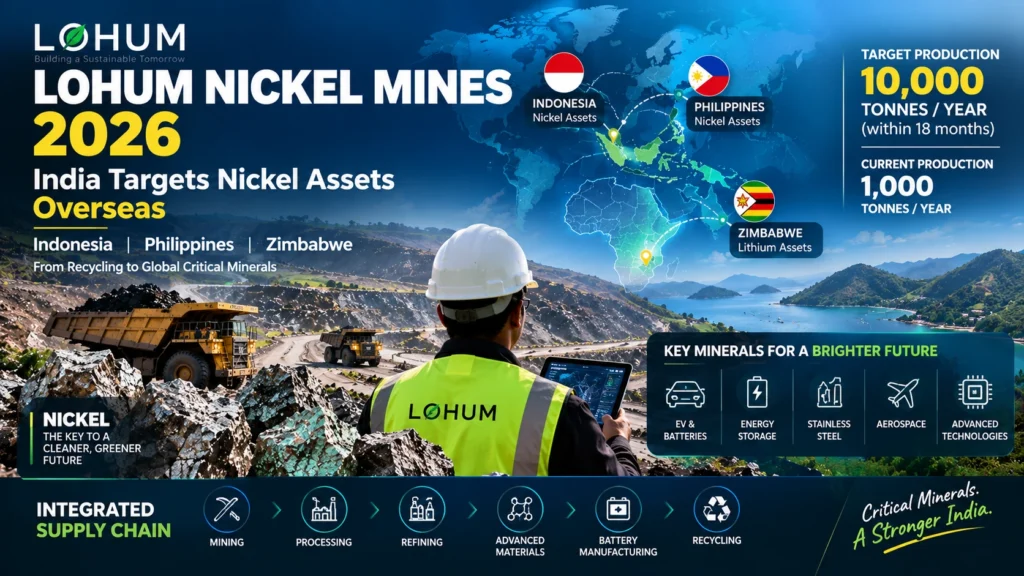
India’s critical minerals sector is entering a new phase as Indian battery-materials company Lohum looks to acquire nickel mining assets in Indonesia and the Philippines.
The company is seeking to significantly increase its nickel production as demand for battery materials grows. Lohum currently produces around 1,000 tonnes of nickel annually from recycled materials in Gujarat and is targeting production of approximately 10,000 tonnes per year within 18 months.
The proposed expansion would move the company further upstream, from recycling and processing into primary mining.
Lohum is also developing overseas lithium operations in Zimbabwe, making its latest nickel strategy part of a broader effort to build an international critical-minerals supply chain.
Lohum Nickel Mining Expansion 2026
Lohum is exploring opportunities to acquire nickel mines in Indonesia and the Philippines, two major countries in the global nickel supply chain.
The company plans to use acquired mining assets to increase the availability of nickel for its growing battery-materials business.
According to the company’s plans, Lohum is targeting a tenfold increase in annual nickel production:
Current production: Approximately 1,000 tonnes per year
Target production: Approximately 10,000 tonnes per year
Target timeline: Within 18 months
The actual production level will depend on the quality of assets acquired, development timelines, financing and operational performance.
Why Is Lohum Looking at Nickel Mines?
Nickel is an important industrial and battery mineral.
It is used in:
- Stainless steel
- Battery materials
- Electric vehicles
- Energy storage systems
- High-performance alloys
- Aerospace and industrial applications
Nickel demand has become increasingly connected with the growth of battery manufacturing.
For companies operating in the battery-materials sector, securing reliable access to nickel can therefore become an important part of long-term supply-chain planning.
Lohum’s planned move into mining would give the company greater exposure to the upstream part of the nickel supply chain.
Indonesia and Philippines Are Important Nickel Regions
Indonesia has become one of the world’s most important nickel-producing countries.
The country has extensive nickel resources and a rapidly expanding processing and refining industry.
The Philippines is also a major nickel producer and an important supplier of nickel ore to international markets.
For Lohum, these countries provide potential access to established nickel-producing regions.
However, acquiring a mine overseas is considerably more complex than simply purchasing mineral rights.
Companies must evaluate:
- Geological resources
- Ore grades
- Mining conditions
- Existing infrastructure
- Processing facilities
- Government regulations
- Environmental requirements
- Local partnerships
- Transportation networks
- Commodity prices
A suitable mining asset must therefore be commercially and technically evaluated before an acquisition can move forward.
Lohum’s Current Nickel Production
Lohum already produces approximately 1,000 tonnes of nickel annually through recycling operations in Gujarat.
This means the company’s business model has historically included recovery of nickel and other valuable materials from secondary sources.
The planned mining expansion would add primary mineral production to this existing recycling capability.
This creates the possibility of a broader supply chain:
Mining → Processing → Refining → Battery Materials → Recycling
Such integration can potentially give companies greater control over raw-material supply.
However, each stage requires different technical capabilities, infrastructure and investment.
Lohum Plans to Raise ₹30,000 Crore?
Lohum plans to raise approximately ₹3,000 crore, or about $315 million, through a combination of equity and debt to support its expansion plans.
The capital could support acquisitions, mining development and expansion across its critical-minerals business.
The company’s expansion strategy extends beyond nickel.
It is also developing lithium resources in Zimbabwe and expanding its downstream battery-material operations.
The financing requirement therefore reflects a broader critical-minerals growth strategy rather than only one mining project.
Lohum’s Zimbabwe Lithium Project
Nickel is only one part of Lohum’s overseas mining strategy.
The company has secured rights to 10 lithium mining blocks in Zimbabwe.
These blocks are located in Matabeleland South Province and cover approximately 1,100 hectares.
The company has reported estimated deposits of around 30 million to 40 million tonnes of ore.
Lohum has also stated that the assets could support approximately 300,000 tonnes of lithium carbonate equivalent over their operating life.
These figures are company estimates and should not be interpreted as independently verified reserves or guaranteed future production.
The company plans to develop processing capabilities in Zimbabwe before sending material to India for further refining.
First Overseas Lithium Production
Lohum has already dispatched its first lithium ore shipment from its Zimbabwe mining assets.
This marks an important step in the company’s move from recycling and refining toward primary mineral production.
The Zimbabwe operation could provide Lohum with direct access to lithium resources while its existing downstream operations provide experience in refining and battery-material production.
The company is also considering further expansion in Zimbabwe, including potential access to additional blocks.
From Recycling to Mining
Lohum’s strategy demonstrates how some Indian critical-minerals companies are attempting to integrate multiple stages of the mineral supply chain.
The traditional business model of recycling battery materials can recover valuable minerals from used products.
Mining provides access to primary resources.
Processing and refining then convert those resources into higher-value materials.
The combination can create a more integrated business structure.
A simplified model is:
Primary Mining → Beneficiation → Refining → Advanced Materials → Battery Manufacturing → Recycling
The ability to operate across multiple stages can potentially reduce dependence on external suppliers, although it also increases capital and operational requirements.
Rare Earths Are Also Part of the Strategy
Lohum is also exploring opportunities involving rare earth elements in Southeast Asia.
Rare earths are important for several advanced technologies, including permanent magnets used in electric motors and other industrial applications.
The company is developing a 1,200-tonne-per-year rare earth magnet plant in Uttar Pradesh.
This indicates that Lohum’s expansion is not limited to lithium and nickel.
The broader strategy involves building capabilities across several critical-mineral supply chains.
New Battery Material Manufacturing Capacity
Lohum is also developing a 5,000-tonne-per-year cathode active material plant in Uttar Pradesh.
Cathode materials are an important component of lithium-ion batteries.
The availability of nickel and lithium becomes particularly relevant for companies seeking to manufacture battery materials domestically.
This creates a connection between Lohum’s upstream mining strategy and its downstream manufacturing plans.
If the company successfully develops mining assets and processing facilities, it could potentially create a more integrated supply chain for battery materials.
Why Overseas Mining Matters for India
India is increasingly focused on securing reliable supplies of critical minerals.
Domestic resources alone may not provide sufficient quantities of every mineral required by the country’s growing manufacturing and energy sectors.
Critical minerals are important for:
- Electric vehicles
- Batteries
- Renewable energy
- Electronics
- Defence equipment
- Aerospace
- Advanced manufacturing
Overseas mining investments can provide Indian companies with access to mineral resources in countries where geological availability is higher.
However, international mining also introduces additional risks.
These can include regulatory changes, political developments, currency movements, environmental requirements and local community considerations.
Challenges for Lohum’s Nickel Expansion
Lohum’s planned acquisition of nickel mines could face several challenges.
Acquisition Cost
High-quality nickel assets can require substantial capital investment.
Geological Risk
The quality and quantity of a mineral deposit must be independently assessed before major investment decisions.
Regulatory Approvals
Mining projects in Indonesia and the Philippines operate under local mining and environmental regulations.
Processing Requirements
Mining nickel is only the first step. Ore must be processed into suitable products for downstream applications.
Commodity Price Volatility
Nickel prices can change significantly depending on global supply, demand and production levels.
Infrastructure
Some mineral deposits are located in areas where roads, ports, power and processing facilities require additional investment.
Opportunities for Mining Engineers
The growth of critical-mineral companies such as Lohum could also create new opportunities for mining professionals.
Mining engineers may increasingly work in:
- Nickel mine planning
- Lithium mining
- Mineral exploration
- Resource estimation
- Mine development
- Mineral processing
- Battery-material supply chains
- Overseas mining projects
- Environmental management
- Mine economics
The shift toward critical minerals means mining careers are becoming increasingly connected with industries such as batteries, electric mobility and advanced manufacturing.
India’s Critical Mineral Supply Chain Is Expanding
The Lohum development is part of a broader shift in India’s mining industry.
Indian companies are increasingly looking beyond traditional commodities such as coal and iron ore toward minerals required by emerging industries.
This includes:
Lithium
Nickel
Cobalt
Rare Earth Elements
Graphite
Copper
The future critical-mineral supply chain is likely to involve a combination of domestic exploration, overseas mining, processing, recycling and advanced manufacturing.
Future Outlook for Lohum
Lohum’s next major challenge will be converting its international expansion plans into stable commercial production.
The company’s nickel strategy depends on finding suitable mining assets in Indonesia and the Philippines.
At the same time, its Zimbabwe lithium operations need to develop further, while its processing and manufacturing projects in India and other countries move toward commercial operation.
If these projects progress successfully, Lohum could become more vertically integrated across the critical-minerals value chain.
However, acquisition announcements and production targets should not be treated as completed capacity. Actual results will depend on project execution, financing, approvals, mineral quality and market conditions.
Conclusion
The Lohum Nickel Mines 2026 expansion highlights the growing role of Indian private companies in the global critical-minerals industry.
Lohum currently produces approximately 1,000 tonnes of nickel annually through recycling and is targeting around 10,000 tonnes within 18 months by expanding into primary mining.
The company is exploring nickel mining opportunities in Indonesia and the Philippines while simultaneously developing lithium assets in Zimbabwe and downstream battery-material facilities.
For India’s mining industry, the development shows how the sector is moving beyond traditional mineral production toward an integrated model involving mining, processing, refining, advanced materials and recycling.
The success of this strategy will depend on the company’s ability to secure suitable assets, develop them efficiently and manage the technical, financial and regulatory challenges associated with international mining.