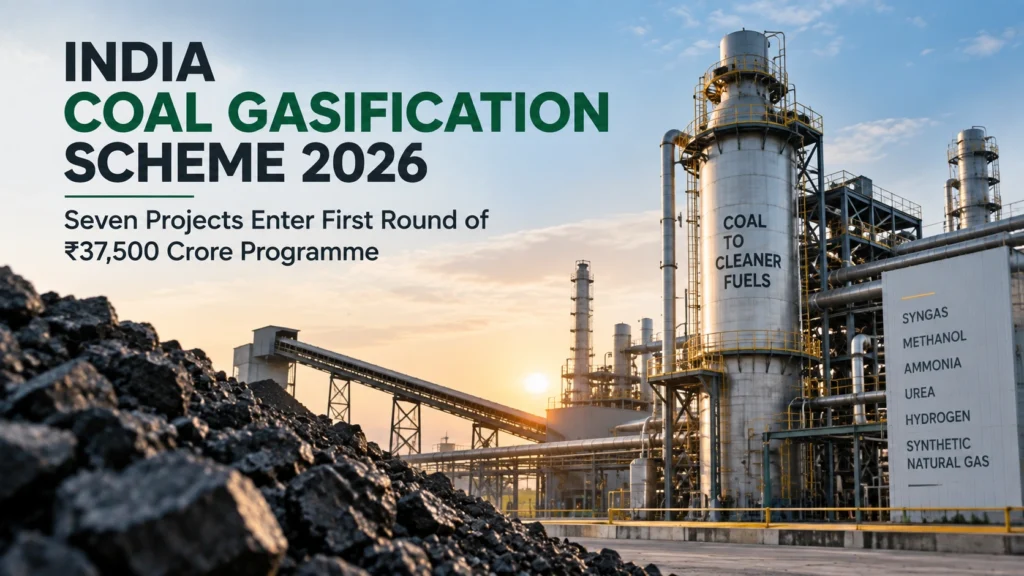
India’s coal gasification programme has received strong industry participation, with seven applications submitted during the first round of the government’s ₹37,500 crore scheme for promoting surface coal and lignite gasification projects.
The applications have come from major public and private-sector companies and cover products including synthetic natural gas, urea, direct reduced iron and syngas.
The development is important because India is attempting to use domestic coal and lignite not only as fuels for power generation but also as feedstock for higher-value industrial products.
What Is the India Coal Gasification Scheme 2026?
The Scheme for Promotion of Surface Coal/Lignite Gasification Projects has a total financial outlay of ₹37,500 crore.
The scheme was approved in May 2026.
Its objective is to encourage companies to convert coal and lignite into higher-value products.
These can include:
- Syngas
- Methanol
- Ammonia
- Urea
- Hydrogen
- Synthetic natural gas
The programme is part of India’s broader coal gasification strategy.
Seven Applications Were Received
The first round received seven applications.
The applicants include:
- NTPC Limited
- Adani Enterprises Limited
- Gallantt Ispat Limited
- Shyam Sel & Power Limited
- Talcher Fertilisers Limited
Adani Enterprises submitted three projects.
The proposed end products include synthetic natural gas, urea, direct reduced iron and syngas.
What Is Coal Gasification?
Coal gasification is a process that converts coal into a combustible gas known as synthesis gas or syngas.
Instead of simply burning coal, the process uses controlled amounts of oxygen and steam at high temperature.
The resulting syngas primarily contains:
- Carbon monoxide
- Hydrogen
Syngas can then be processed into different products.
How Does Coal Gasification Work?
A simplified process is:
Coal → Gasification → Syngas → Processing → Industrial Product
Depending on the technology and downstream plant, syngas can be converted into products such as:
- Methanol
- Ammonia
- Urea
- Synthetic natural gas
- Hydrogen
- Reducing gas for iron production
This gives coal a role beyond conventional combustion.
Why Is India Promoting Coal Gasification?
India has large domestic coal resources but imports several products that can potentially be produced using gasification.
The government has highlighted imports of LNG, urea, ammonia and methanol.
Together, these imports were worth approximately ₹2.77 lakh crore during FY 2024-25, according to the Ministry of Coal.
The gasification strategy aims to increase domestic production of selected products using domestic coal and lignite.
Coal Gasification and Import Substitution
One potential benefit is import substitution.
For example, coal gasification can produce syngas that can be processed into ammonia and then used to manufacture urea.
The basic chain can be represented as:
Coal → Syngas → Hydrogen/Ammonia → Urea
This creates a connection between India’s coal resources and its fertiliser industry.
NTPC’s Synthetic Natural Gas Project
NTPC is among the applicants in the first round.
Its proposed project focuses on synthetic natural gas.
Synthetic natural gas can be produced from syngas through additional chemical processing.
The objective is to create a gas product from solid domestic coal.
This demonstrates the flexibility of gasification technology.
Adani Enterprises and Urea Projects
Adani Enterprises submitted three applications under the first round.
All three projects are associated with urea production.
Urea is a major fertiliser used in agriculture.
India has historically relied heavily on imported fertiliser inputs.
Domestic production using coal-derived syngas could potentially reduce some import dependence if projects become commercially viable.
Gallantt Ispat and Direct Reduced Iron
Gallantt Ispat submitted an application targeting Direct Reduced Iron and syngas.
Direct Reduced Iron, or DRI, is produced by reducing iron ore using a reducing gas instead of relying entirely on a conventional blast furnace route.
Syngas can provide hydrogen and carbon monoxide for the reduction process.
This creates another potential industrial application for coal gasification.
Shyam Sel & Power and Syngas
Shyam Sel & Power submitted a project focused on syngas.
Syngas can be used as an intermediate feedstock for several downstream processes.
The project therefore demonstrates how gasification can become a platform for industrial chemicals and energy products.
Talcher Fertilisers and Urea
Talcher Fertilisers is another applicant in the first round.
The Talcher region in Odisha has a long association with coal and fertiliser development.
The company is developing coal-gasification-based fertiliser production using domestic coal as a feedstock.
The project reflects the connection between India’s coal sector and fertiliser security.
₹37,500 Crore Programme and Investment Potential
The government estimates that the scheme could catalyse approximately ₹2.5 lakh crore to ₹3 lakh crore of investment across the gasification value chain.
This includes spending on:
- Gasification plants
- Coal handling
- Gas-cleaning systems
- Chemical processing
- Storage
- Transport
- Supporting infrastructure
Large-scale gasification projects are capital intensive and require significant technical planning.
India’s 2030 Coal Gasification Target
India has established a target of reaching 100 million tonnes of coal gasification capacity by 2030.
The ₹37,500 crore scheme is intended to support approximately 75 million tonnes of that capacity.
Achieving such a target would require substantial investment and the successful completion of multiple large-scale projects.
Coal Gasification Is Different From Underground Coal Gasification
It is important to distinguish surface coal gasification from Underground Coal Gasification.
Surface Coal Gasification
Coal is mined first and then converted into syngas in a surface facility.
Underground Coal Gasification
Coal is converted into gas while it remains underground.
The two technologies have different engineering requirements.
The current ₹37,500 crore programme focuses on surface coal and lignite gasification.
Environmental Considerations
Coal gasification can produce higher-value products, but it also requires careful environmental management.
Important considerations include:
- Carbon emissions
- Water consumption
- Gas-cleaning systems
- Ash and waste management
- Process efficiency
- Carbon capture possibilities
Modern gasification plants therefore require sophisticated environmental and process-control systems.
Why Technology Selection Matters
There is no single gasification technology suitable for every coal type.
Coal characteristics can affect:
- Gasification efficiency
- Ash behaviour
- Syngas composition
- Oxygen consumption
- Process economics
Companies therefore need detailed technical studies before selecting the appropriate gasification process.
Coal Quality Is Important
Different coal types behave differently during gasification.
Important parameters can include:
- Ash content
- Moisture
- Volatile matter
- Fixed carbon
- Sulphur
- Mineral composition
Indian coal often has relatively high ash content.
This creates additional technical requirements for gasification projects.
Role of Mining Companies
Mining companies can become important participants in the gasification ecosystem.
A gasification plant needs a reliable coal supply.
This creates opportunities for integrated models where companies control:
Coal Mine → Coal Handling → Gasification Plant → Downstream Product
Such integration can provide greater control over feedstock supply.
Opportunities for Mining Engineers
Coal gasification creates career opportunities beyond traditional mine production.
Mining professionals may work in:
- Coal quality management
- Feedstock planning
- Mine-to-plant logistics
- Coal handling
- Resource planning
- Project development
- Industrial safety
- Environmental management
Chemical and process engineers will also play important roles in the gasification plant itself.
Round 2 of the Scheme
Following the first round, the Ministry of Coal opened the next application window.
The programme is designed to provide recurring application opportunities, with application windows expected to open at regular intervals.
This means additional companies could participate in future rounds.
As more applications are received, India’s coal gasification project pipeline could expand significantly.
What Could Coal Gasification Mean for India’s Mining Industry?
Gasification could create a new market for domestic coal.
Instead of coal being used primarily for power generation, a portion of production could become feedstock for industrial chemicals and materials.
This could diversify coal demand.
Potential downstream industries include:
- Fertilisers
- Chemicals
- Synthetic fuels
- Iron and steel
- Hydrogen
- Gas products
Future of Coal Gasification in India
The success of the programme will depend on whether proposed projects can achieve technical and commercial viability.
Large gasification projects require:
- Reliable coal supply
- Appropriate technology
- Large capital investment
- Infrastructure
- Environmental approvals
- Skilled manpower
- Stable downstream markets
The first round’s seven applications provide an initial project pipeline.
The next challenge is converting applications into financially viable projects and eventually operating plants.
Conclusion
The India Coal Gasification Scheme 2026 has received seven applications in its first round, marking an important development in India’s strategy to convert domestic coal and lignite into higher-value products.
The ₹37,500 crore programme supports projects involving synthetic natural gas, urea, syngas and direct reduced iron.
The government aims to develop 100 million tonnes of coal gasification capacity by 2030, including 75 million tonnes under the current scheme.
For India’s mining sector, gasification could create a new pathway for coal utilisation beyond conventional power generation.
However, the technology is capital intensive and technically complex. Coal quality, process efficiency, environmental performance and downstream economics will determine whether individual projects become commercially successful.
If the projects progress as planned, coal gasification could become an important new area connecting India’s mining, chemicals, fertiliser, steel and energy industries.
SEO Details
Focus Keyword: India Coal Gasification Scheme 2026
SEO Title: India Coal Gasification Scheme 2026: Seven Projects Enter ₹37,500 Crore Programme
Meta Description: India’s ₹37,500 crore coal gasification scheme received seven applications in Round 1. Learn about NTPC, Adani, urea, syngas, DRI and India’s 2030 gasification target.
Suggested URL Slug: india-coal-gasification-scheme-2026
Secondary Keywords: coal gasification India 2026, coal gasification scheme, ₹37,500 crore coal scheme, NTPC coal gasification, Adani coal gasification, syngas India, coal-to-chemicals
Source verification: Ministry of Coal/PIB announcement dated September 8, 2026.