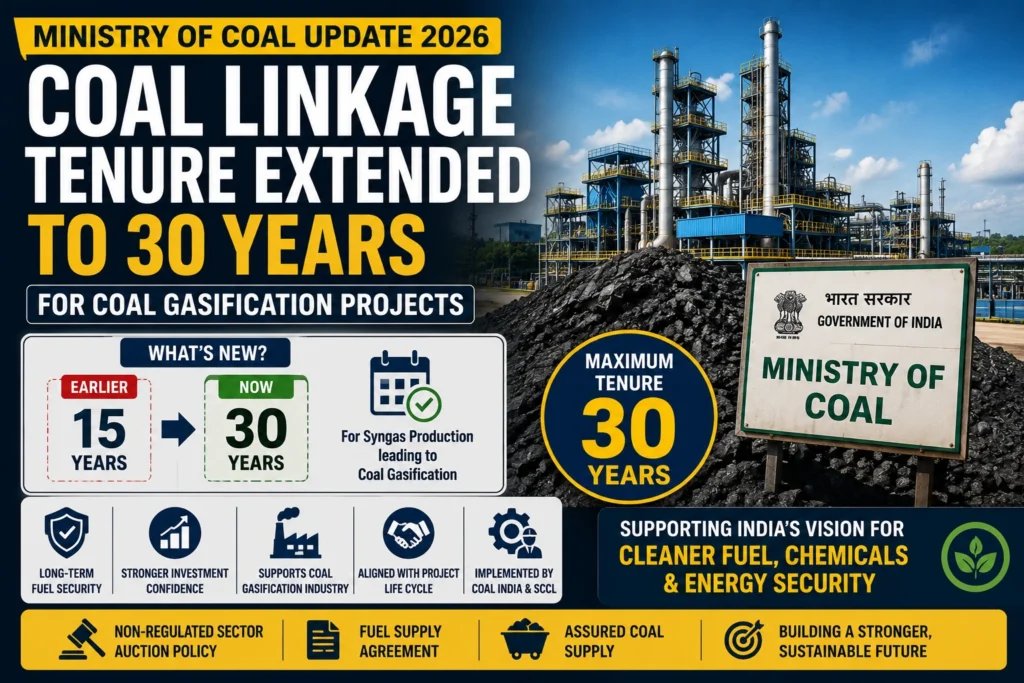
The Government of India has announced an important policy change for the coal-gasification sector. On 24 July 2026, the Ministry of Coal extended the maximum tenure of coal linkage from 15 years to 30 years for projects falling under the sub-sector “Production of Syngas leading to Coal Gasification.”
The change has been introduced under the Non-Regulated Sector Linkage Auction Policy. Coal India Limited and Singareni Collieries Company Limited have been asked to take further action according to the revised policy. The longer linkage period has been aligned with the extended project cycle and capital-intensive nature of coal-gasification plants.
This decision is important for mining professionals, industrial consumers, investors and Mining Engineering students because it connects coal supply policy with India’s broader coal-gasification strategy. It may provide greater fuel security to gasification projects and improve confidence in long-term investment.
What Is the Latest Coal-Linkage Policy Update?
Under the earlier policy, a new Fuel Supply Agreement under the relevant Non-Regulated Sector sub-sector could have a tenure determined by the Ministry of Coal, subject to a maximum of 15 years.
The Government has now approved a maximum tenure of 30 years specifically for coal linkages awarded under the sub-sector dealing with syngas production leading to coal gasification. The Ministry has stated that the revised tenure is similar to the provision already applicable to coking-coal linkage for the steel sector.
The policy change does not mean that every Non-Regulated Sector coal linkage has automatically been extended to 30 years. It applies specifically to eligible projects under the identified coal-gasification sub-sector.
Key points of the notification
- Previous maximum linkage tenure: 15 years
- Revised maximum linkage tenure: 30 years
- Applicable sub-sector: Production of Syngas leading to Coal Gasification
- Policy framework: Non-Regulated Sector Linkage Auction
- Implementing coal suppliers: Coal India Limited and SCCL
- Purpose: Align coal availability with the longer project cycle of gasification plants
What Is a Coal Linkage?
A coal linkage is a formal arrangement through which an eligible industrial consumer receives coal from a recognised coal-producing company for a defined quantity and period. The supply is normally governed through a Fuel Supply Agreement, commonly known as an FSA.
Coal linkage provides greater supply certainty than purchasing the entire requirement through short-term market-based auctions. This is particularly important for industries that require a continuous and predictable supply of coal to maintain production.
Under the linkage framework, the coal-consuming plant may receive an assured or contracted quantity subject to the terms of the auction, FSA, coal availability, grade, source and applicable policy conditions.
A coal linkage normally specifies:
- Annual Contracted Quantity
- Coal grade or quality parameters
- Supply source
- Agreement tenure
- Pricing conditions
- Lifting obligations
- Performance and security conditions
For a large coal-gasification plant, long-term coal availability is critical because the project may operate for several decades and requires a consistent feedstock supply.
What Is the Non-Regulated Sector?
The Non-Regulated Sector generally includes coal-consuming industries whose final product prices are not directly regulated like electricity tariffs in the conventional regulated power sector.
The Ministry of Coal introduced the auction-based policy for coal linkages to the Non-Regulated Sector in 2016. Under this system, coal linkages for most eligible NRS industries are allocated through competitive auction rather than administrative allocation. Fertilizer production involving urea has historically been treated separately under the policy framework.
Major NRS categories have included industries such as:
- Cement
- Sponge iron
- Captive power plants
- Steel using coking coal
- Other coking-coal consumers
- Other non-coking-coal consumers
- Syngas production leading to coal gasification
Separate quantities may be earmarked for different sub-sectors, and eligible consumers generally compete within the relevant category.
What Is Coal Gasification?
Coal gasification is a process in which coal is converted into a combustible gaseous mixture known as synthesis gas or syngas. Instead of burning coal directly, the coal reacts under controlled conditions with oxygen, air, steam or a combination of these agents.
The resulting syngas mainly contains gases such as carbon monoxide and hydrogen. After cleaning and processing, it can be used to manufacture several industrial products.
Coal gasification may support the production of:
- Methanol
- Synthetic natural gas
- Ammonia
- Hydrogen
- Fertilizer feedstock
- Industrial chemicals
- Liquid fuels
- Power and heat
In 2022, the Ministry of Coal created a separate sub-sector for the production of syngas leading to coal gasification under the NRS linkage-auction framework. The stated purpose was to encourage new coal-gasification consumers and support the adoption of gasification technology.
Why Has the Coal-Linkage Tenure Been Extended?
Coal-gasification projects require significant capital investment, complex engineering and long construction periods. Their project life is also generally much longer than that of many ordinary industrial facilities.
A 15-year fuel-supply horizon may not always provide adequate certainty for a plant expected to recover its investment over several decades. By extending the linkage tenure to 30 years, the policy brings coal supply closer to the economic life of such projects.
Longer linkage duration can help developers prepare more reliable financial and operational plans. Banks and financial institutions may also view a long-term fuel arrangement as an important factor while assessing project viability.
The notification explicitly states that the extension has been made to align the coal-linkage tenure with the project cycle.
How Can the 30-Year Linkage Benefit Gasification Projects?
The revised tenure can provide greater certainty to companies planning large gasification plants. Coal generally represents one of the most important raw materials for these projects, and uncertainty regarding future availability can create serious commercial risk.
With a longer linkage period, project developers may be able to estimate feedstock availability and operating costs over a longer horizon. This does not eliminate all risks, because actual supply will remain subject to the agreement and applicable conditions, but it can strengthen overall project planning.
Potential benefits include
- Improved long-term coal-supply security
- Better alignment between FSA tenure and plant life
- Greater confidence for investors and lenders
- More predictable feedstock planning
- Lower dependence on short-term coal procurement
- Support for large-scale gasification capacity
- Improved prospects for domestic chemical and fuel production
These benefits will depend on successful auctions, implementation by coal companies and compliance with individual Fuel Supply Agreements.
Role of Coal India Limited and SCCL
The Ministry’s notification has been addressed to the Chairman-cum-Managing Directors of Coal India Limited and Singareni Collieries Company Limited. Both organisations have been requested to take further action under the revised policy.
Coal India and its subsidiaries play a major role in supplying domestic coal to the power and non-power sectors. The company also conducts linkage auctions for Non-Regulated Sector consumers under the policy issued by the Ministry of Coal. The Ministry’s National Coal Index framework separately recognises NRS linkage auctions as an important channel of coal sale and price discovery.
Implementation may involve the preparation or modification of auction documents, eligibility conditions, model Fuel Supply Agreements and related operating procedures.
How Does an NRS Linkage Auction Generally Work?
The precise conditions can vary between auction tranches and sub-sectors. Therefore, bidders must rely on the latest official scheme document and notice inviting registration.
At a broad level, the process may involve registration of eligible consumers, submission of technical documents, declaration of coal requirement, participation in an electronic auction and execution of a Fuel Supply Agreement by successful bidders.
A simplified process is:
- The coal company identifies the quantity available for a particular sub-sector.
- Eligible consumers register for the linkage auction.
- Applicants submit plant, capacity and end-use documents.
- Qualified bidders participate in the electronic bidding process.
- Coal quantity is booked according to the auction methodology.
- The successful bidder completes security and documentation requirements.
- An FSA is signed for the approved quantity and tenure.
- Coal supply begins according to the agreed schedule and conditions.
The exact bid parameter, reserve premium, quantity allocation method and performance requirements should always be checked in the relevant auction document.
Difference Between Coal Linkage and Spot E-Auction
Coal linkage and spot e-auction are both methods of obtaining coal, but they serve different procurement requirements.
A coal linkage is intended to support relatively stable and longer-term supply through an FSA. Spot or other short-term e-auction channels are generally used for immediate, additional or market-based coal requirements.
| Basis | Coal Linkage | Spot or Short-Term E-Auction |
|---|---|---|
| Supply period | Long-term | Short-term |
| Agreement | Usually linked with an FSA | Auction-specific terms |
| Main purpose | Regular industrial requirement | Immediate or additional demand |
| Supply certainty | Comparatively higher | Depends on auction availability |
| Planning horizon | Long-term operational planning | Short-term procurement |
| Price discovery | Linkage-auction mechanism and policy terms | Competitive e-auction |
A gasification project may still use multiple procurement channels, but long-term linkage can form the foundation of its principal fuel-supply strategy.
Impact on India’s Coal-Gasification Mission
The policy amendment may strengthen India’s efforts to increase the use of coal for value-added products rather than depending only on direct combustion.
Coal gasification can support domestic production of chemicals, fuels and industrial feedstock. This may help utilise suitable domestic coal resources and reduce import dependence in selected product categories. However, technical viability depends on coal quality, gasifier technology, water availability, pollution-control systems, economics and carbon-management measures.
The 30-year linkage does not by itself guarantee project success. It addresses one major concern—long-term coal availability—but developers must still manage technology, finance, environmental compliance, product demand and infrastructure.
Environmental Considerations
Coal gasification is often described as a more controlled conversion route than conventional direct burning because pollutants can be removed from the syngas before final use. However, the complete environmental impact depends on the technology and the entire project design.
Gasification plants may require careful management of:
- Carbon dioxide emissions
- Water consumption
- Ash and slag
- Sulphur compounds
- Wastewater
- Particulate emissions
- Mine-to-plant transportation
Advanced gas cleaning, water recycling, energy efficiency and carbon-capture technologies can improve environmental performance. Therefore, coal linkage security should be accompanied by strict environmental safeguards and continuous monitoring.
Importance for Mining and Competitive Examinations
The latest policy is relevant for students preparing for Mining Engineering and coal-sector examinations because it connects coal distribution with gasification, industrial policy and Coal India’s marketing system.
Important exam points include:
- NRS coal-linkage auction policy was introduced in 2016
- A syngas-to-coal-gasification sub-sector was created in 2022
- Earlier maximum tenure for the relevant FSA was 15 years
- Revised maximum tenure is 30 years
- The change was notified on 24 July 2026
- Coal India Limited and SCCL have been directed to implement it
- The revised tenure is aligned with the project cycle
Questions may be asked in current affairs, coal economics, mine management, coal marketing or general mining-awareness sections.
Challenges in Implementing the Revised Policy
Although the policy provides a longer supply horizon, practical implementation will require coordination among coal producers, project developers, railways and regulatory agencies.
A coal-gasification plant needs regular coal of suitable quality. Variations in ash, moisture and calorific value can affect gasifier performance. Transport infrastructure must also support uninterrupted movement from the linked mine or coal company to the plant.
Other challenges may include:
- High initial project cost
- Availability of suitable coal
- Coal-quality consistency
- Long project-development timelines
- Water and land requirements
- Environmental clearances
- Product-market uncertainty
- Carbon-emission management
The effectiveness of the policy will ultimately depend on whether these projects achieve financial closure, complete construction and operate commercially.
Conclusion
The extension of coal-linkage tenure from 15 years to 30 years is an important policy development for India’s coal-gasification industry. It applies specifically to the Non-Regulated Sector sub-sector involving the production of syngas leading to coal gasification.
By aligning coal linkage with the longer project cycle, the Government aims to provide greater fuel-supply certainty and encourage investment in capital-intensive gasification plants. Coal India Limited and SCCL will play the central role in implementing the revised framework.
For Mining Engineering students and industry professionals, this update is important because it demonstrates how coal-supply policy can influence industrial investment, resource utilisation and the future development of value-added coal technologies.
Frequently Asked Questions
What is the latest coal-linkage update of July 2026?
The Ministry of Coal has extended the maximum coal-linkage tenure from 15 years to 30 years for the sub-sector involving syngas production leading to coal gasification.
Does the 30-year tenure apply to every NRS industry?
No. The July 2026 amendment specifically covers the identified coal-gasification sub-sector. Other linkages remain governed by their respective policy provisions and auction conditions.
What is a Fuel Supply Agreement?
A Fuel Supply Agreement is a contract between the coal supplier and consumer specifying coal quantity, quality, supply period, pricing and performance conditions.
Why is a longer coal linkage important?
A longer linkage provides greater raw-material certainty and better aligns coal supply with the operating life and investment-recovery period of a major industrial project.
Which companies will implement the revised policy?
Coal India Limited and Singareni Collieries Company Limited have been requested by the Ministry of Coal to take further action.
What is syngas?
Syngas is a gaseous mixture produced by gasifying coal or another carbon-containing feedstock. It mainly contains carbon monoxide and hydrogen and can be used to manufacture fuels and chemicals.