India’s mining and steel industries could face significant changes over the next two decades as the government plans a major expansion in domestic steelmaking capacity.
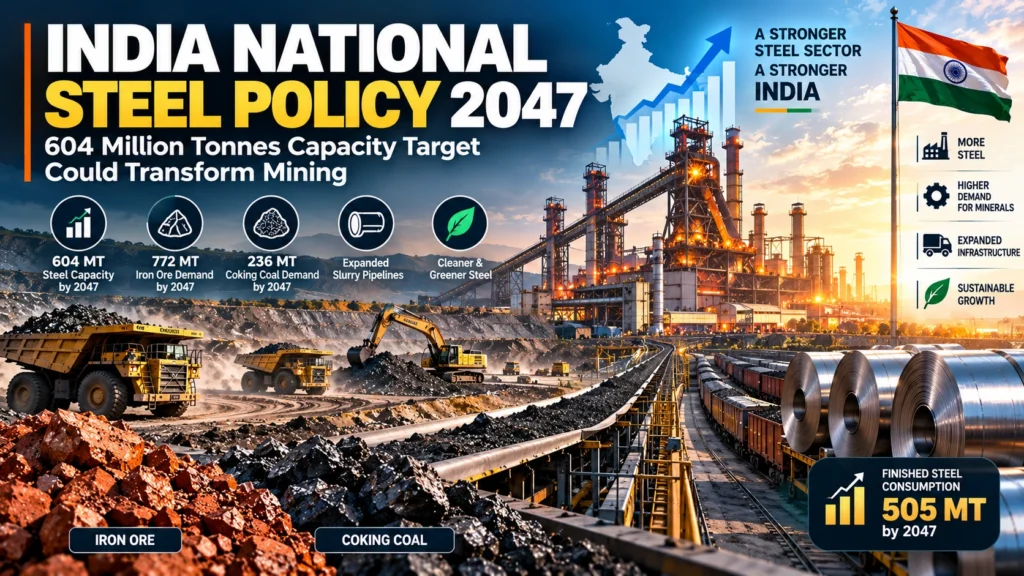
The Ministry of Steel has released the draft National Steel Policy–Vision 2047 for public consultation. The proposal aims to increase India’s crude steel capacity from approximately 220 million tonnes per annum to 604 million tonnes per annum by 2047.
The draft also projects finished steel consumption of 505 million tonnes by 2047. Achieving these targets would require substantial investment in steel plants, raw-material supply, mineral transportation, processing infrastructure and technologies that reduce emissions.
For the mining industry, one of the most important implications is the expected increase in demand for iron ore and coking coal. Both materials are essential to conventional steelmaking, and their availability will influence the sector’s ability to expand.
The policy remains a draft, so its targets and proposals should not be treated as final government commitments.
Key Targets of the Draft National Steel Policy 2047
The draft outlines a long-term vision for expanding steel production, improving resource security and reducing the industry’s environmental impact.
| Indicator | Current or baseline level | Draft target for 2047 |
|---|---|---|
| Crude steel capacity | About 220 million tonnes/year | 604 million tonnes/year |
| Crude steel production | About 170 million tonnes in 2025–26 | 531 million tonnes |
| Finished steel consumption | About 164 million tonnes in 2025–26 | 505 million tonnes |
| Per capita finished steel consumption | About 116 kg | 302 kg |
| Iron ore requirement | About 299 million tonnes in 2025 | 772 million tonnes |
| Coking coal requirement | About 72 million tonnes in 2025 | 236 million tonnes |
| Steel export target | — | 45 million tonnes |
These figures are projections in the draft policy, not guaranteed production or demand outcomes.
The scale of the proposed expansion makes raw-material security a central issue for mining companies, steel producers and infrastructure developers.
Why Steel Capacity Expansion Matters to Mining
Steel is a fundamental material for construction, transportation, manufacturing and infrastructure development.
Its demand is closely linked to housing, roads, railways, bridges, industrial facilities, renewable-energy infrastructure and urban development.
As India continues to invest in infrastructure, the steel industry will need dependable access to raw materials.
Iron Ore: The Foundation of Steel Production
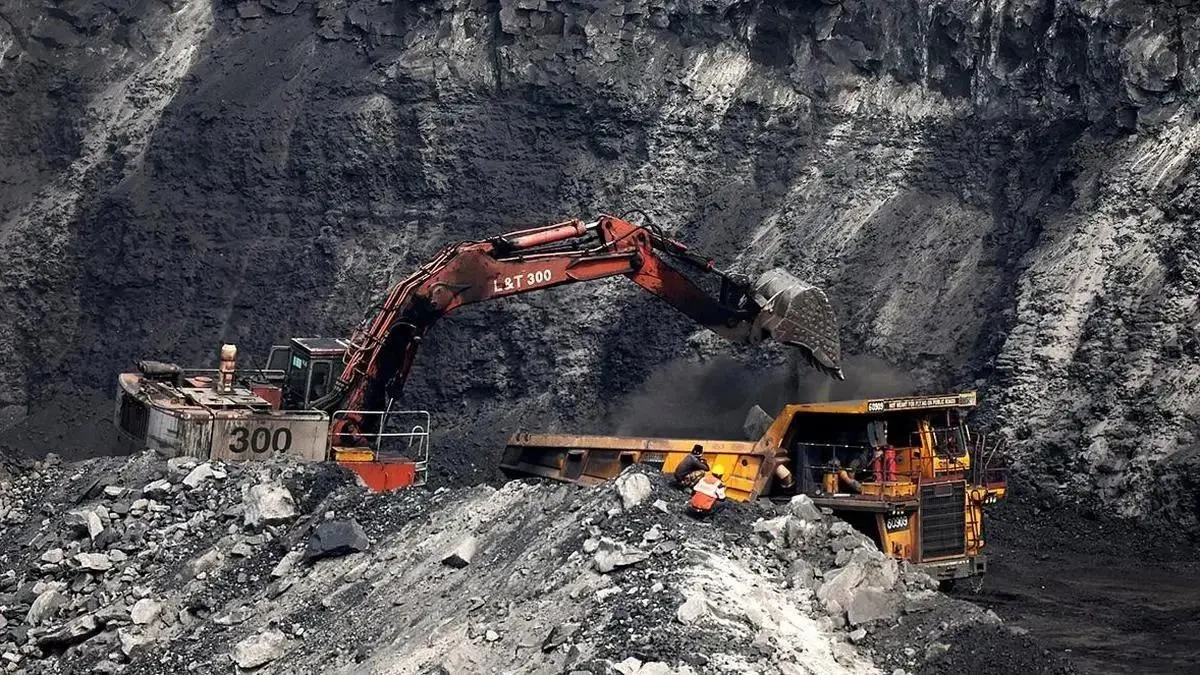
Iron ore is the primary raw material used to produce iron, which is subsequently converted into steel through different production routes.
The draft National Steel Policy projects India’s iron ore requirement to rise from approximately 299 million tonnes in 2025 to 772 million tonnes by 2047.
This would more than double the projected annual requirement.
India already has a substantial iron ore mining industry, but increasing demand could create pressure to improve production efficiency, develop suitable deposits and strengthen transportation systems.
The availability of high-grade iron ore is also important because ore quality affects processing requirements, energy consumption and overall production economics.
The draft proposes securing access to high-grade resources through domestic mining, overseas assets and joint ventures.
Coking Coal: A Major Supply Challenge
Coking coal is another important raw material, particularly for blast-furnace steelmaking.
It is processed into coke, which supports ironmaking by providing heat, helping remove oxygen from iron ore and maintaining the physical structure of the furnace burden.
The draft projects coking coal demand to increase from around 72 million tonnes in 2025 to 236 million tonnes by 2047.
India imports a large proportion of its coking coal requirements. The draft identifies import dependence as a raw-material security concern and proposes diversifying supplies while improving domestic coal preparation and utilisation.
For the mining sector, this could increase attention on coking coal exploration, coal washing, quality assessment, blending and overseas resource acquisition.
India May Need More Iron Ore Mining and Processing Capacity
Higher steelmaking capacity does not automatically translate into an equivalent increase in domestic iron ore production. Actual requirements will depend on steel output, ore grades, imports, recycling and the efficiency of individual production routes.
Nevertheless, the projected rise in iron ore demand indicates the need to assess whether existing mining and processing systems can support future consumption.
Several areas may become increasingly important.
1. Exploration and Resource Evaluation
Exploration can help identify additional economically recoverable resources and improve understanding of existing deposits.
Geologists and mining engineers may be required to evaluate ore quality, deposit size, mineability and long-term production potential.
2. Mine Productivity
Existing mines may need improvements in equipment utilisation, mine planning, material handling and production scheduling.
Technology adoption can help operators improve productivity while managing operating costs and environmental impacts.
3. Beneficiation and Ore Quality
Not all iron ore is suitable for direct use in steelmaking.
Beneficiation can improve ore quality by removing unwanted material and producing a more suitable feed for downstream processes.
Efficient processing can help utilise certain lower-grade resources, depending on their mineralogy and economics.
4. Transportation Infrastructure
Large mining operations require reliable systems to transport ore from mines to processing facilities, railheads and steel plants.
Railways, roads, conveyor systems and slurry pipelines may all play roles in the future supply chain.
Mineral Slurry Pipelines Could Become More Important
One notable proposal in the draft policy is to expand iron ore slurry pipeline capacity.
Slurry pipelines transport finely ground mineral material mixed with water through dedicated pipelines. At the receiving end, the material is processed further, and water management systems are required.
The draft proposes increasing iron ore slurry pipeline capacity from approximately 18 million tonnes per annum to more than 299 million tonnes per annum by 2047.
This would represent a major expansion of the proposed transportation network.
Potential Advantages of Slurry Pipelines
Depending on the route and project conditions, slurry pipelines can offer several benefits:
- Reduce dependence on road and rail transportation for suitable mineral flows.
- Support large-volume movement between mines and processing facilities.
- Improve the consistency of mineral transportation.
- Reduce certain logistics bottlenecks.
- Help connect remote mineral deposits with industrial consumers.
However, slurry pipelines are not suitable for every mining project. Their feasibility depends on terrain, distance, water availability, land access, permitting, capital costs and the location of processing facilities.
Water consumption and the management of pipeline residues also require careful planning.
The draft proposes streamlining approvals and providing viability gap funding for iron ore and coking coal slurry pipelines. These are proposals and would depend on the final policy and implementation framework.
Coking Coal Washing and Domestic Resource Utilisation
India’s coking coal supply presents a different challenge from iron ore.
Even where domestic coal resources exist, the quality of coal and the characteristics required by steel plants can limit its direct usability.
Coal washing separates impurities and can improve the quality of coal for specific applications.
The draft highlights underutilisation of domestic coking coal washing capacity. It cites operational washing capacity of approximately 39 million tonnes per annum, while actual output is estimated at around 6 million tonnes from roughly 17 million tonnes of feed.
The draft identifies washery expansion, better coal blending and improved grade mapping as areas requiring attention.
Why Coal Washing Matters
Coal washing can help improve the suitability of coal for steelmaking and support more efficient use of available resources.
Its benefits depend on coal quality, the washing process, yield, operating costs and the quality specifications of the final product.
Mining companies and steel producers may need closer coordination to match coal characteristics with plant requirements.
Increasing domestic utilisation would not necessarily eliminate imports, but it could contribute to a more diversified supply strategy.
Overseas Mineral Assets and Raw-Material Security
The draft policy also proposes securing raw materials through overseas assets and joint ventures.
International investments can provide access to deposits that complement India’s domestic mineral resources.
For iron ore, access to suitable high-grade deposits may help steel producers diversify procurement.
For coking coal, overseas assets and long-term supply arrangements could help reduce exposure to interruptions in international trade.
However, overseas mining investments involve geological, regulatory, political, financial and operational risks. Acquiring a mineral asset does not automatically guarantee economical production or reliable delivery to Indian steel plants.
Successful projects require detailed due diligence, infrastructure planning, reliable logistics and long-term commercial arrangements.
How the Policy Addresses Steel Industry Emissions
The proposed expansion must also account for the environmental impact of steel production.
The draft aims to reduce average carbon dioxide emission intensity from approximately 2.54 tonnes per tonne of crude steel to around 1.54 tonnes by 2047.
This represents a proposed reduction of roughly 39%.
The draft points towards a phased approach that includes:
- Improving energy and resource efficiency.
- Increasing the use of scrap steel.
- Expanding renewable-energy use where practical.
- Adopting advanced steelmaking technologies.
- Exploring green hydrogen-based direct reduced iron.
- Considering carbon capture, utilisation and storage for residual emissions.
These measures could influence future raw-material demand and the types of mining and processing facilities required.
For example, changes in steelmaking technology may affect the balance between iron ore, scrap, coking coal and other inputs. The eventual impact will depend on how quickly new technologies become commercially viable and how widely they are adopted.
Opportunities for Mining Companies and Engineers
The draft policy could create long-term opportunities across the mineral supply chain if its targets lead to new projects and investment.
Mining and Exploration
Iron ore and coal projects may require resource evaluation, mine planning, production optimisation and infrastructure development.
Mineral Processing
Beneficiation, coal washing, sampling, laboratory analysis and quality control could become increasingly important as producers focus on material efficiency.
Transportation and Logistics
Large-scale mineral movement may require investment in rail links, conveyors, slurry pipelines, loading facilities and integrated logistics systems.
Environmental Management
Mine operators will need to manage land disturbance, water use, waste, rehabilitation and regulatory compliance.
Digital Mining
Data analytics, equipment monitoring and automated mine-planning systems can help improve productivity and resource utilisation.
For mining students and professionals, the proposed policy highlights the value of understanding not only extraction but also mineral quality, processing, logistics and industrial demand.
Challenges to Achieving the 2047 Vision
The proposed targets are ambitious, and several factors could influence their feasibility.
Raw-material availability: Higher steel production requires dependable supplies of suitable iron ore and coking coal.
Capital investment: New mines, processing plants, steel facilities and transportation infrastructure require substantial funding.
Environmental clearances: Mining and infrastructure projects must address land, water, ecological and regulatory considerations.
Import dependence: Domestic production improvements may need to be combined with diversified international sourcing.
Technology transition: Lower-emission steelmaking requires technological development, investment and appropriate infrastructure.
Project execution: Delays in approvals, land acquisition, construction and logistics can affect the pace of capacity expansion.
The final policy will need to balance industrial growth with commercial feasibility, resource efficiency and environmental sustainability.
What Happens Next?
The draft National Steel Policy–Vision 2047 is available through the Ministry of Steel for public consultation.
Industry participants and other stakeholders can review the proposals and submit feedback through the ministry’s published process.
The next important steps are the completion of consultation, consideration of stakeholder feedback and the government’s decision on the final policy.
Mining companies should follow the final provisions concerning mineral exploration, raw-material security, coal washing, overseas asset acquisition and slurry pipeline development.
Until the policy is finalised, its targets should be treated as proposed long-term objectives rather than confirmed project commitments.
Conclusion
The draft India National Steel Policy 2047 sets out a vision for expanding crude steel capacity to 604 million tonnes per annum while improving raw-material security and reducing emissions.
For the mining industry, the most significant projections are the increase in iron ore requirements to 772 million tonnes and coking coal requirements to 236 million tonnes by 2047.
Meeting these needs could require improvements in exploration, mine productivity, beneficiation, coal washing and mineral transportation.
The proposed expansion of slurry pipelines and the focus on overseas mineral assets also highlight the importance of building a more integrated raw-material supply chain.
The draft is not yet a final policy, and the eventual outcomes will depend on implementation, investment, resource availability and technology.
Nevertheless, it provides an important indication of how India’s steel ambitions could influence the future direction of mining and mineral infrastructure.