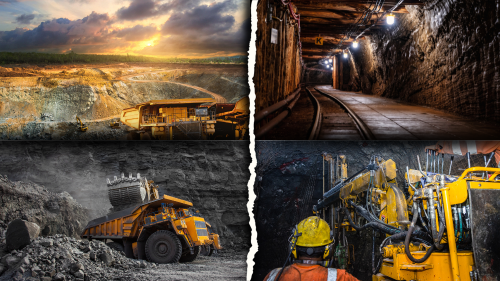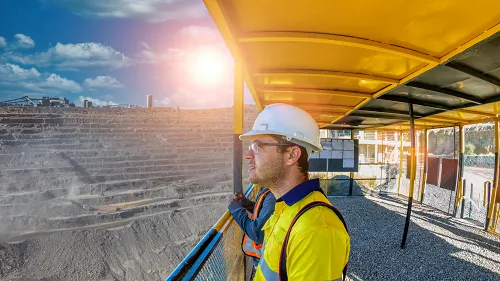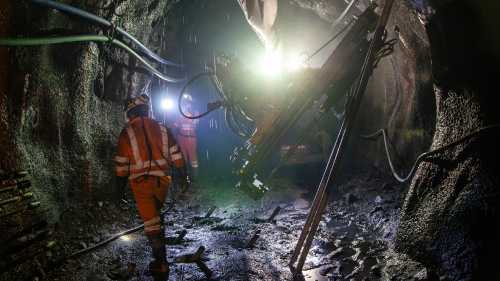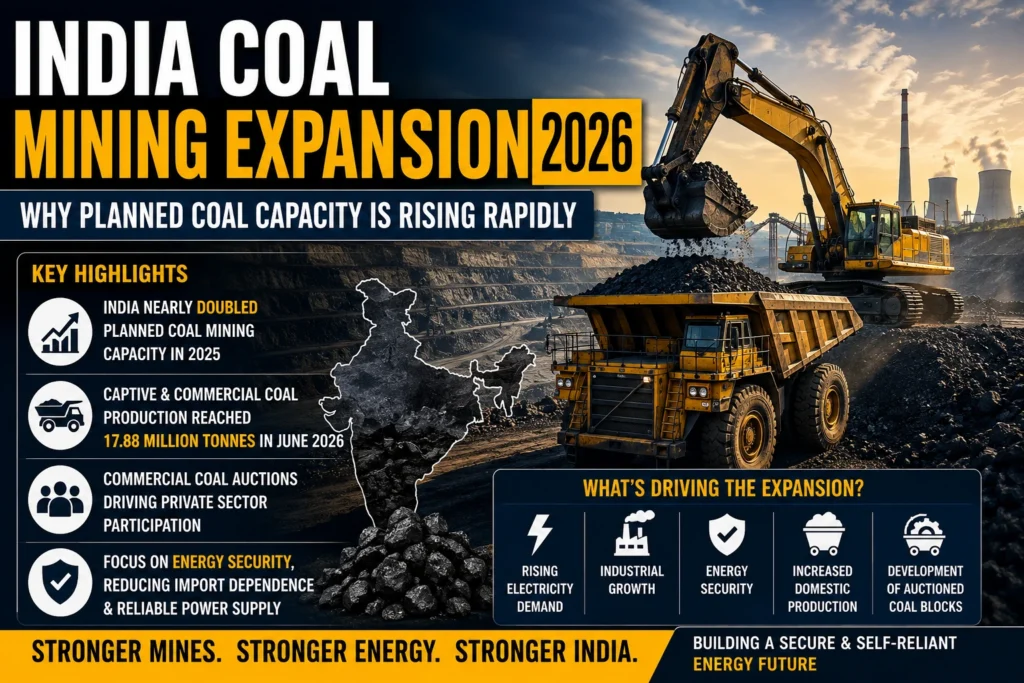
India has emerged as one of the biggest drivers of new coal mining capacity globally, highlighting the continuing importance of coal in the country’s energy and industrial strategy.
Recent industry analysis shows that India significantly increased its planned coal mining capacity during 2025. At the same time, domestic coal production from captive and commercial mines continues to grow.
The India Coal Mining Expansion 2026 is particularly important because it is happening while the country is also rapidly expanding renewable energy. Instead of relying on a single source of energy, India is increasing domestic coal availability while simultaneously developing solar, wind and other energy sources to meet rising electricity and industrial demand.
What Is Driving India Coal Mining Expansion in 2026?
India’s growing economy requires enormous quantities of electricity, fuel and raw materials.
Coal continues to play an important role in electricity generation and is also required by industries such as steel, cement and manufacturing.
As electricity consumption and industrial activity increase, maintaining reliable fuel availability becomes an important part of India’s energy strategy.
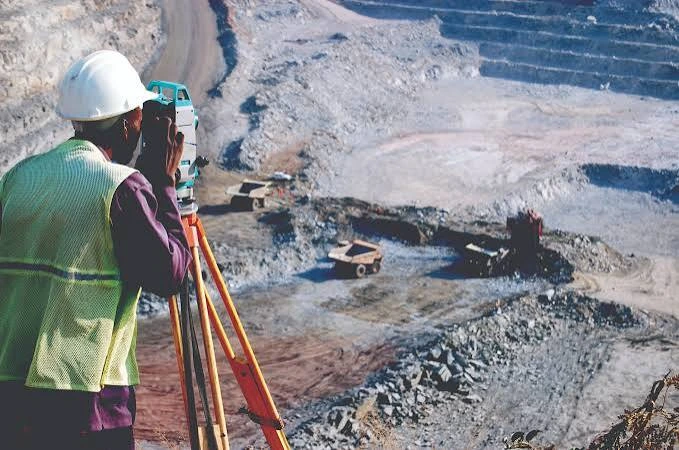
The major factors driving coal mining expansion include:
- Rising electricity demand
- Industrial growth
- Domestic energy security
- Reduction in coal import dependence
- Expansion of commercial coal mining
- Development of auctioned coal blocks
- Increasing production from captive mines
India’s strategy increasingly focuses on producing more of the coal it consumes domestically instead of depending heavily on international suppliers.
India Is Increasing Planned Coal Mining Capacity
One of the most important developments is the rapid increase in proposed coal mining capacity.
India nearly doubled its planned coal mining capacity during 2025 and became one of the largest contributors to the global increase in proposed coal mine development.
However, planned mining capacity should not be confused with actual coal production.
A proposed coal mine normally passes through several stages before becoming operational.
The typical development cycle includes:
Exploration → Resource Assessment → Auction or Allocation → Approvals → Mine Development → Production
Some proposed projects can take several years to reach commercial production.
Others may face delays because of environmental clearances, land acquisition, infrastructure development or economic conditions.
Therefore, planned capacity represents potential future production rather than guaranteed coal output.
Captive and Commercial Coal Production Is Growing
India’s coal expansion is not limited to future projects.
Actual production from captive and commercial coal mines is also increasing.
Coal production from captive and commercial mines reached approximately 17.88 million tonnes in June 2026, compared with around 15.56 million tonnes during June 2025.
This represents year-on-year growth of approximately 14.9%.
Coal dispatch during the same period reached approximately 18.55 million tonnes.
These numbers indicate that India’s efforts to increase participation beyond traditional public-sector coal production are beginning to contribute significantly to overall supply.
What Are Captive and Commercial Coal Mines?
Understanding India’s coal expansion requires knowing the difference between captive and commercial coal mining.
Captive Coal Mining
A captive coal mine primarily produces coal for the company’s own industrial requirements.
Coal produced from these mines can support industries such as:
- Power generation
- Steel production
- Cement manufacturing
- Other approved industrial activities
Captive mining helps large industrial consumers secure their own supply of coal.
Commercial Coal Mining
Commercial coal mining allows eligible companies to produce coal for sale in the market.
This means the mine operator is not necessarily required to consume all the coal within its own industrial operations.
The introduction of commercial coal mining increased private-sector participation and created opportunities for more companies to develop India’s coal resources.
Commercial Coal Auctions Are Expanding the Sector
Coal block auctions have become an important part of India’s mining strategy.
Through commercial coal mine auctions, private and public companies can compete for mining rights to identified coal blocks.
Successful auctions can increase competition and encourage investment in new mining projects.
However, winning a coal block does not mean production begins immediately.
The successful bidder generally needs to complete several stages, including:
- Geological assessment
- Mining plan preparation
- Environmental approvals
- Land acquisition
- Infrastructure development
- Equipment deployment
- Mine development
Only after these requirements are completed can large-scale commercial production begin.
Why Does India Want More Domestic Coal Production?
One of the biggest reasons is energy security.
Heavy dependence on imported fuel can expose a country to international risks.
These risks can include:
- Global commodity price fluctuations
- International supply disruptions
- Shipping costs
- Currency movements
- Geopolitical conflicts
Increasing domestic coal production can reduce some of these risks.
India has significant coal resources, making domestic mine development an important component of the country’s energy strategy.
Higher domestic production can also reduce the requirement for certain categories of imported coal.
Coal Mining and India’s Electricity Demand
India’s electricity consumption has increased substantially as the economy has expanded.
Power demand grows because of several factors, including:
- Industrialisation
- Urbanisation
- Infrastructure development
- Household electricity consumption
- Commercial development
- Increasing use of cooling systems
Reliable electricity supply requires sufficient generation capacity as well as dependable fuel availability.
Coal-fired power plants continue to supply a significant part of India’s electricity.
This is one reason coal production remains strategically important even while renewable energy capacity expands.
Coal Expansion and Renewable Energy
The India Coal Mining Expansion 2026 does not mean India has stopped investing in renewable energy.
India is simultaneously expanding solar, wind and other non-fossil electricity capacity.
The challenge is maintaining reliable electricity supply throughout the day.
Solar generation depends on sunlight, while wind generation depends on weather conditions.
Energy storage, transmission infrastructure and grid flexibility therefore become increasingly important as renewable energy penetration increases.
During this transition, coal-fired generation continues to provide dependable electricity.
India’s energy transition is therefore more complex than simply replacing coal with renewable energy immediately.
What Does Coal Expansion Mean for Mining Engineers?
Increasing coal production creates significant technical requirements.
Modern coal projects require professionals with expertise across different mining disciplines.
Important areas include:
- Mine planning
- Geological modelling
- Mine surveying
- Production management
- Mine ventilation
- Ground control
- Equipment management
- Environmental management
- Mine safety
- Digital mining technologies
For mining engineering students, the development of new mines could create opportunities across public-sector companies, private operators, mine developers and contractors.
Future mining engineers will also need knowledge beyond traditional extraction methods.
Digital technologies, automation and environmental management are becoming increasingly important in modern mining operations.
Technology Will Play a Bigger Role in Coal Mining
Increasing coal production does not simply mean adding more workers and machines.
Technology can help mining companies improve productivity, safety and operational efficiency.
Modern coal mines can use technologies such as:
- GPS-based equipment tracking
- Fleet management systems
- Drone surveying
- Digital mine planning
- Remote equipment monitoring
- Real-time production dashboards
- Automated environmental monitoring
- Predictive maintenance
Fleet management systems, for example, can help mine operators understand where trucks and excavators are operating and how efficiently equipment is being utilised.
Drone surveys can provide faster information about mine development, stockpiles and excavation areas.
These technologies could become increasingly important as India’s mining operations expand.
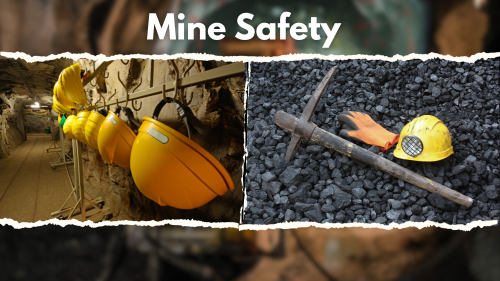
Mine Safety Must Remain a Priority
Higher production targets should never come at the cost of mine safety.
Coal mining involves several operational hazards that need continuous monitoring and management.
Important safety areas include:
- Risk assessment
- Mine ventilation
- Ground stability
- Equipment safety
- Worker training
- Emergency preparedness
- Continuous monitoring
Mining companies need strong safety management systems as new mines become operational.
Modern technology can also support safety through gas monitoring, equipment tracking and remote inspection systems.
Environmental Challenges of Coal Mining Expansion
Coal mining can create significant environmental challenges.
Mining activities can affect land, vegetation, water resources and surrounding communities.
Land Disturbance
Open-cast mining requires substantial land for mine pits, infrastructure, roads and waste dumps.
Water Management
Mining operations need effective systems for managing surface water, groundwater and mine discharge.
Dust Control
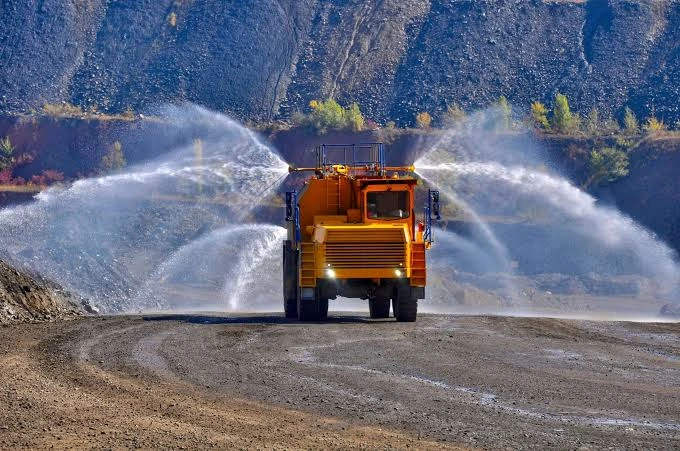
Excavation, blasting, transportation and mineral handling can generate significant quantities of dust.
Overburden Management
Large amounts of rock and soil may need to be removed before coal seams can be accessed.
This material needs proper dumping, stabilisation and reclamation.
Mine Closure
Every mine eventually reaches the end of its economic life.
Mining companies therefore need proper mine closure and land rehabilitation plans.
Why Mine Reclamation Matters
Mine reclamation is becoming increasingly important as India’s mining industry expands.
Mining changes the original landscape of an area.
Once mining operations are completed, disturbed land needs to be rehabilitated according to applicable regulations and site conditions.
Progressive reclamation allows rehabilitation to begin while mining continues in other parts of the project.
Reclamation activities may include:
- Reshaping mined land
- Stabilising waste dumps
- Replacing topsoil
- Planting vegetation
- Managing water
- Monitoring rehabilitated areas
Effective reclamation can reduce long-term environmental liabilities and improve the future use of mined land.
Economic Risks of Coal Mining Expansion
Coal projects require large amounts of capital.
The economics of a mine depend on several factors.
These include:
- Production costs
- Coal quality
- Transportation expenses
- Market demand
- Infrastructure
- Regulatory costs
- Competing energy sources
A coal mine developed today may operate for several decades.
Mining companies therefore need to consider how electricity markets and energy technologies could change during the life of the project.
This creates a long-term planning challenge for both mining companies and policymakers.
Infrastructure Will Be Critical
Producing coal is only one part of the mining supply chain.
Coal must also be transported efficiently from mines to consumers.
Large coal operations may require:
- Railway connectivity
- Coal handling plants
- Conveyor systems
- Roads
- Loading facilities
- Storage infrastructure
Poor transportation infrastructure can reduce the benefits of higher mine production.
India’s coal expansion therefore requires development of both mining capacity and coal evacuation infrastructure.
India’s Broader Mineral Production Strategy
Coal is not the only mineral sector India is expanding.
The country is simultaneously increasing exploration and development of several other minerals.
These include:
- Iron ore
- Limestone
- Bauxite
- Copper
- Lithium
- Graphite
- Rare earth elements
- Other critical minerals
India has also increased the auctioning of mineral blocks and is encouraging greater private-sector participation.
Critical minerals have become particularly important because they are required for electric vehicles, renewable energy, electronics and advanced manufacturing.
This means India’s future mining industry will be significantly more diversified than its traditional focus on coal and major bulk minerals.
The Future of India Coal Mining Expansion
The future of Indian coal mining will depend on how quickly proposed projects move into actual production.
Announcing or auctioning a coal block is only the beginning.
Projects need regulatory approvals, land, infrastructure, financing and technical development before commercial production can start.
Several indicators will therefore be important to monitor:
- Number of auctioned mines becoming operational
- Annual domestic coal production
- Captive and commercial mine output
- Coal imports
- Railway and evacuation capacity
- Power-sector coal demand
- Renewable energy growth
- Mine closure and reclamation performance
Together, these indicators will provide a clearer picture of how India’s coal industry is changing.
Conclusion
The India Coal Mining Expansion 2026 represents one of the most important developments currently taking place in the country’s mining industry.
India significantly increased its planned coal mining capacity during 2025 while actual production from captive and commercial mines has also continued to grow.
Coal production from captive and commercial mines reached approximately 17.88 million tonnes in June 2026, representing year-on-year growth of around 14.9%.
The expansion reflects India’s efforts to strengthen domestic energy security