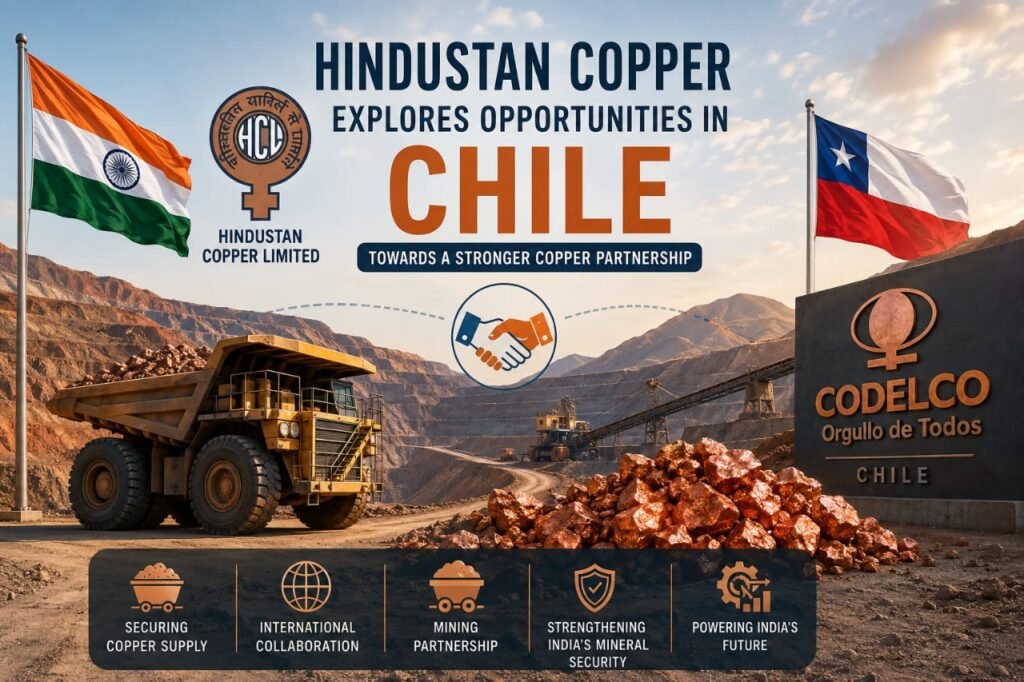
India’s copper sector is entering a new phase as Hindustan Copper Limited (HCL) explores opportunities to strengthen its access to international copper resources. According to a Reuters report published on August 10, 2026, Hindustan Copper is planning to source copper concentrate from Chile and is also discussing a potential joint venture with Chile’s state-owned copper giant Codelco.
The development is significant because India’s demand for copper is growing much faster than its domestic supply. Copper is increasingly important for power infrastructure, electric vehicles, renewable energy, electronics, data centres and other technologies.
For the Indian mining industry, the Hindustan Copper Chile copper development could therefore become an important step toward securing long-term access to copper resources and strengthening India’s critical mineral supply chain.
What Is the Hindustan Copper Chile Copper Development?
Hindustan Copper is reportedly working on an arrangement under which copper concentrate sourced from Chile could be supplied to Indian companies, including major copper and metal producers.
Reuters reported that Hindustan Copper is also in discussions with Codelco regarding a possible joint venture for copper mining and marketing. The discussions are still under consideration, and the companies involved have not publicly confirmed a final joint-venture agreement.
The development follows earlier cooperation between Hindustan Copper and Codelco. HCL had signed a preliminary agreement with Codelco to explore mutually beneficial opportunities in exploration and mining and later signed a non-disclosure agreement as discussions progressed.
Why Chile Is Important for India’s Copper Supply
Chile is one of the world’s most important copper-producing countries and has some of the largest copper resources and mining operations globally.
For India, developing relationships with major copper-producing countries can help diversify the supply chain.
India currently faces a major gap between copper demand and domestic availability. Reuters reported that India produces around 573,000 tonnes of refined copper annually, while domestic demand is around 1.8 million tonnes.
This gap makes imported raw materials and international mining partnerships increasingly important for the country’s long-term copper strategy.
Key reasons Chile matters to India include:
- Large-scale copper resources
- Established copper mining infrastructure
- Global experience in copper exploration and production
- Potential access to long-term concentrate supplies
- Opportunity for Indian companies to participate in overseas mining
- Diversification of India’s mineral supply chain
Hindustan Copper and Codelco: What Could the Partnership Mean?
A potential partnership between Hindustan Copper and Codelco could extend beyond simply purchasing copper concentrate.
The reported discussions include the possibility of cooperation in mining and marketing copper. If eventually finalized, such an arrangement could give Indian companies greater exposure to international copper mining operations.
However, it is important to distinguish between discussions and a completed project. As of August 10, 2026, the reported joint venture remains under discussion and due diligence is continuing.
A successful partnership could potentially involve:
- Exploration of copper assets
- Development of mining projects
- Production of copper concentrate
- International marketing
- Long-term supply arrangements
- Technical and operational cooperation
Why India Needs More Copper
Copper has moved beyond its traditional role in electrical wiring and industrial equipment.
Today, copper is an important material for several strategic sectors, including:
- Power transmission and distribution
- Electric vehicles
- Renewable energy systems
- Charging infrastructure
- Electronics
- Telecommunications
- Industrial machinery
- Data centres
As these industries expand, copper consumption is expected to remain strategically important.
This creates a challenge for India because domestic copper mining and production capacity is not sufficient to comfortably meet the country’s growing requirements.
Hindustan Copper itself describes exploration, mining and beneficiation of copper ore as central areas of its operations. The company currently operates copper mines at Malanjkhand in Madhya Pradesh, Khetri in Rajasthan and Ghatsila in Jharkhand.
India’s Growing Focus on Critical Minerals
The Hindustan Copper Chile copper development also fits into India’s broader strategy of strengthening critical mineral security.
Copper is essential to modern infrastructure, although its strategic importance is often discussed alongside other critical minerals required for batteries, renewable energy, electronics and advanced technologies.
Hindustan Copper has already indicated that it is looking beyond India’s borders for opportunities in critical and strategic minerals. In one of its company communications, HCL highlighted collaboration with Codelco and its efforts to explore mineral assets overseas.
This indicates that international mineral partnerships could become a larger part of India’s mining strategy in the coming years.
What Is Copper Concentrate?
Copper concentrate is an intermediate product obtained after processing copper-bearing ore.
The basic mining and processing chain can be understood as:
Copper ore → Crushing → Grinding → Concentration → Copper concentrate → Smelting → Refining → Copper metal
During mineral processing, valuable copper-bearing minerals are separated from waste material. The resulting concentrate contains a much higher concentration of copper than the original ore.
The concentrate is then generally sent for further processing through smelting and refining.

For India, securing reliable copper concentrate supplies is therefore important because it directly connects mining resources with downstream copper production.
How This Could Affect Indian Mining Companies
If overseas copper partnerships expand, Indian mining and metals companies could gain opportunities beyond domestic mineral extraction.
Potential benefits include:
Greater Resource Access
Indian companies could gain access to copper resources outside the country and reduce dependence on a limited number of suppliers.
International Mining Experience
Participation in overseas projects could help Indian companies build expertise in international exploration, mine development and resource management.
Supply Chain Security
Long-term relationships with copper-producing countries could improve the reliability of India’s copper raw-material supply.
Support for Downstream Industries
A more secure copper supply could benefit industries involved in electrical equipment, renewable energy, electric mobility and infrastructure.
What About Coal India and NTPC Mining?
The development also has a wider connection with India’s public-sector mining strategy.
Reuters reported that Hindustan Copper, Coal India and NTPC Mining have been involved in discussions concerning copper mining opportunities with Codelco.
A technical team involving Indian companies also visited Chile earlier this year, according to people familiar with the discussions.
This is notable because it shows how India’s large public-sector mining companies are increasingly looking beyond their traditional commodities.
Coal India, for example, is primarily associated with coal production, but the company has also been exploring opportunities connected with critical minerals and resource diversification.
India’s Copper Demand Could Become a Major Challenge
The biggest issue is the gap between India’s copper consumption and domestic production.
With demand estimated at around 1.8 million tonnes compared with refined copper production of roughly 573,000 tonnes, India already depends heavily on international supply.
Reuters reported that the Indian government expects the country could need to import 91% to 97% of its copper concentrates by 2047 if domestic production does not expand sufficiently.
This makes overseas mining partnerships strategically important.
However, international mining projects are not short-term solutions. Mining development requires exploration, feasibility studies, environmental approvals, infrastructure, financing and construction.
Reuters reported that it could still take around a decade before mining from the discussed Chilean opportunities begins and concentrate is produced.
What This Means for Mining Engineers
The shift toward international mining and critical minerals could also create new areas of expertise for mining professionals.
Mining engineers may increasingly need knowledge of:
- Mineral exploration
- Mine planning
- Mineral processing
- Resource estimation
- Critical minerals
- International mining regulations
- Mine economics
- Sustainability
- Digital mine technologies
- Supply-chain management
For students and professionals, the changing role of Indian mining companies shows that mining engineering is expanding beyond traditional coal operations.
The Bigger Picture for India’s Mining Sector
The Hindustan Copper Chile development is more than a single overseas mining discussion.
It reflects a broader shift in India’s mineral strategy—from focusing mainly on domestic production toward building a diversified international resource network.
India will need copper and other minerals to support infrastructure development, electrification and emerging technologies. At the same time, domestic exploration and mining capacity will remain essential.
International partnerships can complement domestic production, but they cannot completely replace the need to discover and develop India’s own mineral resources.
Conclusion
The Hindustan Copper Chile copper development is an important development for India’s mining and metals sector. Hindustan Copper is reportedly exploring copper concentrate supply from Chile while discussions are also underway regarding potential cooperation with Codelco in copper mining and marketing.
The move comes at a time when India’s copper demand is significantly higher than its domestic production, making reliable international supply increasingly important.
For India’s mining industry, the development highlights a growing trend: public-sector mining companies are looking beyond traditional domestic operations and exploring international resources, critical minerals and strategic partnerships.
However, the proposed cooperation is still at the discussion and due-diligence stage. The final impact will depend on whether commercial agreements and mining partnerships are ultimately completed.
For now, the development signals that copper security and international mineral partnerships are becoming increasingly important parts of India’s long-term mining strategy.