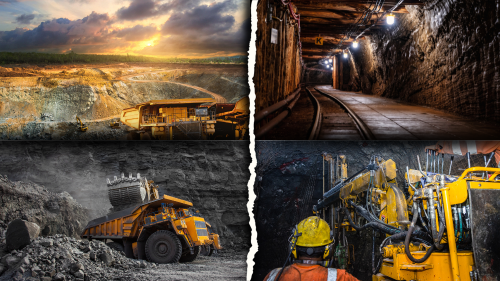
When delving into the fascinating world of underground mining, one quickly realizes that extracting minerals is only half the battle. The other, arguably more complex challenge, is moving thousands of tons of heavy, broken rock from deep within the earth to the surface efficiently and safely. For anyone learning about mining, mastering the concepts of underground mine development is absolutely crucial.
At Mining gyan, our goal is to simplify these complex mining tunnel engineering concepts for students, professionals, and enthusiasts across India. Whether you are studying coal seams in the Damodar Valley or metalliferous deposits in Rajasthan, the infrastructure that connects the ore body to the surface is the lifeline of the mine.
At the heart of this transportation network is the haulage drift. This primary artery ensures that the mining operations management can keep production flowing without bottlenecks. In this comprehensive guide, we will explore the haulage drift meaning in mining, its working principles, design elements, and how it compares to other underground excavations.
What is a Haulage Drift in Mining?
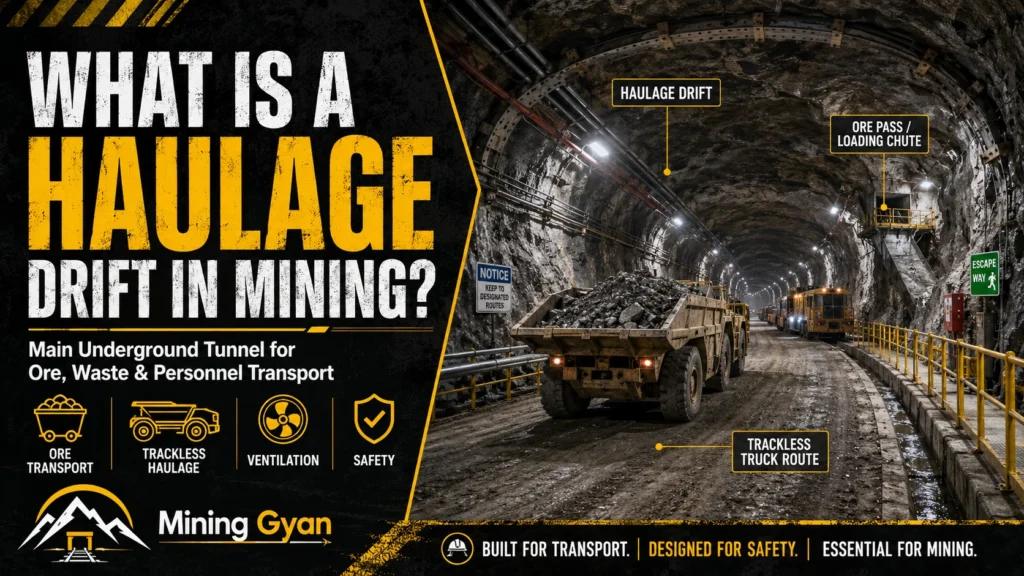
Direct Answer: A haulage drift in mining is a horizontal or near-horizontal underground tunnel driven specifically for the transportation of ore, waste rock, materials, and personnel. It is excavated alongside or within the ore body, serving as the main arterial route connecting working stopes to shafts, declines, or the surface.
To fully understand the underground haulage drift, we need to look at mine geometry. In underground mining, excavations have specific names based on their orientation and purpose. A shaft is vertical, a decline is a spiral ramp, and a drift is horizontal. What makes a haulage tunnel in mining distinct is its primary function: high-capacity movement.
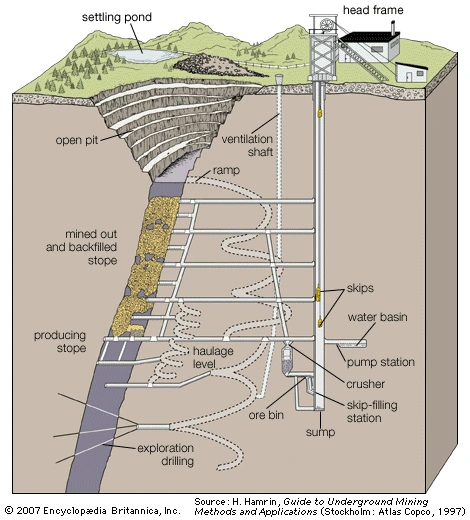
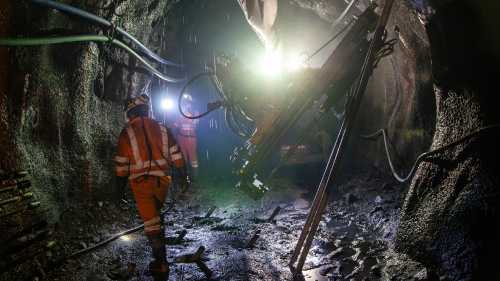
A mine haulage drift is typically larger and more robustly supported than a standard exploration tunnel. It must accommodate heavy underground haulage equipment, such as Low Profile Dump Trucks (LPDTs), Load-Haul-Dump (LHD) loaders, or underground rail locomotives hauling a train of mine cars. Because the drift mining operations occur continuously for years or decades, the haulage drift design incorporates permanent ground support, heavy-duty ventilation, and extensive drainage systems to manage underground water.
How Does a Haulage Drift Work? (Working Principle)
Direct Answer: A haulage drift works by providing a stable, low-gradient pathway for heavy transport vehicles or conveyor systems. Broken ore from production areas is transferred via ore passes or crosscuts into the haulage drift, where vehicles or trains load it and transport it to a hoisting shaft or directly to the surface.
The haulage drift working principle is centered around fluid logistics. It is the core of the mine transportation system. Here is a step-by-step look at how ore is transported through haulage drifts:
Step 1: Material Transfer to the Drift
Ore is blasted in a production area, known as a stope. This fragmented rock is collected by LHD machines. Instead of driving all the way to the surface, the LHD drops the rock down a vertical ore pass. The bottom of this ore pass is connected to the haulage drift via a loading chute.
Step 2: Loading in the Haulage Drift
Inside the ore haulage drift, the primary transport equipment waits below the chute. This could be an underground haul truck or a string of rail cars pulled by an electric locomotive. The chute is opened, and the transport vehicle is loaded with precision.
Step 3: Transit Along the Haulage Route in Mining
Once loaded, the vehicle travels along the haulage drift. The drift is engineered with a very slight gradient (usually around 1% to 2%). This slight slope allows water to drain naturally into sumps, keeping the roadway dry, while still being flat enough that heavily loaded trucks or trains do not struggle with steep inclines.
Step 4: Final Discharge
The transport vehicle follows the underground haulage drift to its destination. In deep mines, this is usually a central underground crushing station or a loading pocket at the main shaft. The ore is dumped, and the vehicle returns via the haulage drift for the next load, creating a continuous loop of mine material transport.
Benefits of Haulage Drift Systems
Direct Answer: The primary benefits of haulage drift systems include high-volume ore transportation, reduced vehicle wear due to low gradients, improved mine ventilation routing, enhanced safety for personnel transit, and the ability to establish centralized, efficient underground mine infrastructure.
Implementing a dedicated haulage drift system transforms a chaotic underground environment into an organized, industrial operation. The benefits of haulage drifts in mines include:
-
High Capacity Movement: Unlike steep ramps where trucks move slowly, a flat haulage drift allows rail systems or trucks to move massive tonnages at higher speeds.
-
Energy Efficiency: Moving heavy loads on a horizontal plane requires significantly less energy and diesel fuel compared to driving loaded trucks up steep spiral declines.
-
Extended Equipment Life: The flat, well-maintained roadways of a haulage level reduce the mechanical strain on axles, tires, and engines of underground haulage equipment.
-
Ventilation Airways: Haulage drifts are large excavations, making them excellent intake airways for fresh air to reach the deeper, hotter parts of the mine.
Key Features of a Mining Transportation Drift
Direct Answer: Key features of a haulage drift include a wide cross-sectional profile, a slight water-draining gradient, heavy-duty ground support like rock bolts and shotcrete, integrated utility lines for power and water, and often, a dedicated refuge chamber for emergency safety.
The haulage drift design requires meticulous planning by mining engineers. A successful mine transport tunnel features:
Profile and Dimensions: The drift must be wide and high enough to allow the largest piece of equipment to pass safely, with additional clearance for ventilation ducting and utility pipes hanging from the roof (back).
Roadbed Construction: For trackless mining (using rubber-tired vehicles), the floor of the haulage drift is graded and compacted with crushed aggregate to prevent rutting. For track mining, steel rails are laid on wooden or concrete sleepers with proper ballast.
Ground Support Systems: Because the drift is a permanent structure expected to last the life of the mine, it requires maximum rock stability. Engineers use a combination of resin-grouted rock bolts, steel wire mesh, and thick layers of sprayed concrete (shotcrete) to prevent rockfalls.
Who Should Use Haulage Drifts?
Direct Answer: Haulage drifts are essential for medium to large-scale underground mining operations dealing with tabular, vein, or massive ore bodies. They are utilized by mines operating at depths where direct surface-to-stope ramp access is inefficient or too expensive to maintain.
If you are a mining student looking up mining institutes near me or preparing for your DGMS manager’s certificate, understanding who uses these systems is critical.
Deep metalliferous mines (like those extracting gold, copper, lead, and zinc) rely heavily on haulage level mining. Once a main vertical shaft is sunk, horizontal haulage drifts are driven outwards at regular vertical intervals (e.g., every 50 or 100 meters of depth) to access the ore body. Coal mines also use a variation of these, often referred to as main haulage roads or gateways, to move coal from longwall panels or bord-and-pillar sections to the main incline or shaft.
Common Mistakes in Haulage Drift Construction
Direct Answer: Common mistakes in haulage drift construction include excavating with an incorrect gradient leading to severe waterlogging, undersizing the tunnel profile causing equipment bottlenecks, and inadequate initial ground support resulting in long-term instability and costly rehabilitation.
Even seasoned mining tunnel engineering professionals can fall into traps when rushing mine drift excavation.
Ignoring Water Management: Underground mines generate a lot of water. If a haulage drift is driven perfectly flat, or worse, with a dipping gradient, water will pool. This destroys the roadbed, ruins vehicle tires, and creates massive safety hazards. A strict 1% to 2% grade toward a pumping station is mandatory.
Poor Blasting Practices: Overbreaking (blasting more rock than intended) damages the surrounding rock mass, requiring more expensive ground support. Underbreaking creates a tight tunnel where large equipment gets stuck, causing severe production delays.
Inadequate Ventilation Planning: Failing to size the drift appropriately to accommodate massive ventilation ducting means the deepest parts of the drift will suffer from poor air quality, stalling the entire underground haulage system.
Expert Tips for Haulage Drift Maintenance
Direct Answer: Expert maintenance for haulage drifts requires daily roadbed grading, continuous monitoring of rock bolt integrity, routine scaling of loose rocks from the roof and walls, and keeping drainage ditches perfectly clear to prevent water accumulation and road deterioration.
To maintain topical authority in mine material transport, one must look beyond construction and focus on the lifespan of the drift. Here are expert recommendations from Mining gyan:
Maintain the Roadway Daily: For trackless haulage drifts, deploy an underground motor grader every single shift. A smooth road allows trucks to travel faster, reduces tire wear, and prevents operator fatigue.
Monitor Convergence: In deep mines, the massive pressure of the earth tries to crush the tunnels. Use extensometers and visual inspections to monitor if the roof or walls of the haulage drift are slowly closing in (convergence). Catching this early allows for rehabilitation before a catastrophic collapse.
Keep the Ditches Clean: Mud and sludge will eventually fill the drainage ditches running alongside the drift. If the ditches overflow, the roadbed is destroyed. Regular mechanical or manual cleaning of these drains is a non-negotiable best practice.
Haulage Drift vs Access Drift: A Comparison
Direct Answer: An access drift is a secondary, often smaller tunnel used primarily to move personnel and equipment into specific working areas. A haulage drift is a larger, primary arterial tunnel designed for the heavy, continuous, high-capacity transport of extracted ore to the main shaft.
To clear up any confusion regarding underground mining infrastructure, let us look at this detailed comparison table.
The Role of Haulage Drifts in Indian Mining Operations
Direct Answer: In India, haulage drifts form the backbone of major underground operations. From the mechanized underground coal mines of Singareni Collieries to the deep metalliferous zinc mines of Rajasthan, efficient haulage drifts are vital for meeting national production targets safely.
For our Mining gyan community based in India, applying local context is essential. The Directorate General of Mines Safety (DGMS) provides strict regulations on how an underground haulage drift must be constructed, supported, and ventilated in Indian mines.
In regions like Udaipur or the mineral-rich belts of Jharkhand, mines are going deeper than ever before. Surface mining (open-pit) is no longer viable for many mature deposits. Therefore, Indian mining engineers are adopting global best practices in drift mining operations, utilizing advanced electro-hydraulic jumbo drills for mine drift excavation, and transitioning from traditional rail haulage to highly flexible trackless LPDT systems to navigate the underground ore transportation network.
Is Investing in a Haulage Drift Worth It?
Direct Answer: Yes, investing in a properly designed haulage drift is absolutely worth it. While the initial capital expenditure for excavation and ground support is high, it is the only way to guarantee a reliable, high-volume ore transportation method that sustains long-term mine profitability.
If you ask any senior planner in underground mine development, they will tell you that the haulage drift is not a place to cut costs. A poorly designed drift acts as a permanent choke point. If you cannot move the broken ore out of the mine, the entire operation halts. The investment in robust mining tunnel engineering pays off daily through uninterrupted ore haulage networks and reduced vehicle maintenance costs.
What are the Alternatives to Haulage Drifts?
Direct Answer: Alternatives to traditional horizontal haulage drifts include steep spiral declines for direct-to-surface trucking, vertical hoisting shafts for immediate vertical transport, and continuous conveyor belt inclines. However, these are often used in conjunction with, rather than replacing, horizontal drifts.
While the haulage drift is a staple, mine planners look at the geometry of the ore body to determine the best material handling in mining.
Direct Declines: For shallower ore bodies, a spiral ramp (decline) is driven from the surface down to the ore. Trucks load at the face and drive directly up the ramp to the surface, bypassing the need for a long horizontal drift and vertical shaft combination.
Conveyor Systems: In some modern operations, especially in coal or potash, the haulage drift may not use vehicles at all. Instead, a continuous belt conveyor is installed along the drift, providing a steady, uninterrupted stream of material transport.
Frequently Asked Questions
What is a haulage drift in mining? A haulage drift is a main horizontal underground tunnel created primarily to transport mined ore and waste rock from the extraction areas to a vertical shaft or surface access point.
Why is a haulage drift important? It serves as the main highway of an underground mine. Without a well-designed haulage drift, moving thousands of tons of heavy rock efficiently and safely would be impossible, causing massive production bottlenecks.
How ore is transported through haulage drifts? Ore is usually dropped into the drift via ore passes from higher levels, loaded into underground dump trucks or rail cars, and driven along the flat drift to a crushing station or hoisting shaft.
What is the difference between a drift and a crosscut? A drift is a horizontal tunnel driven parallel to the strike (the long direction) of the ore body. A crosscut is a horizontal tunnel driven across the rock to intersect the ore body.
How is a haulage drift constructed? It is constructed through a cycle of drilling holes into the rock face, loading them with explosives, blasting, removing the broken rock (mucking), and installing steel bolts and concrete for roof support.
What equipment is used in a haulage drift? Equipment includes Load-Haul-Dump (LHD) loaders, Low Profile Dump Trucks (LPDTs), underground electric or diesel rail locomotives, and sometimes continuous conveyor belt systems.
How do mines prevent water flooding in haulage drifts? Haulage drifts are designed with a slight gradient (1-2%) so that groundwater naturally flows into drainage ditches on the sides of the tunnel, which lead to large underground pumping stations.
Why are haulage drifts supported with concrete? Because they are permanent structures that face continuous heavy traffic and massive geological pressure. Sprayed concrete (shotcrete) prevents the rock from shifting, crumbling, and collapsing over time.
Can personnel travel in a haulage drift? Yes, personnel travel in light utility vehicles along haulage drifts. However, strict traffic management rules, radio communications, and safety bays are utilized to prevent collisions with massive haul trucks.
What is trackless haulage? Trackless haulage refers to a drift mining system that uses rubber-tired vehicles (like trucks and loaders) rather than traditional steel rails and locomotives. It offers much more flexibility in route planning.
Conclusion
Understanding the haulage drift in mining is foundational for anyone looking to build a career or deepen their knowledge in the mining industry. As we have seen, the underground haulage drift is much more than just a hole in the ground. It is a carefully engineered piece of mining infrastructure development, requiring precise geological planning, robust ground support, and meticulous traffic management.
From the trackless LPDTs navigating the deep metalliferous mines of India to the long, straight rail haulage systems of legacy operations, the ore haulage network dictates the heartbeat of the mine. By recognizing the critical differences between an access drift and a haulage drift, and by understanding the immense benefits of proper road maintenance and drainage, mining operations can ensure a safe, highly productive environment.
As technology advances, we are seeing the rise of automated, driverless trucks navigating these drifts, further enhancing safety and efficiency. The evolution of the mine transport tunnel is continuous, but its core purpose remains unchanged: moving the earth’s hidden wealth to the surface.
Thank you for joining us on this deep dive into underground mine development. For more expert insights, beginner guides, and industry updates, keep exploring with Mining gyan. Equip yourself with knowledge, stay safe underground, and keep learning!