
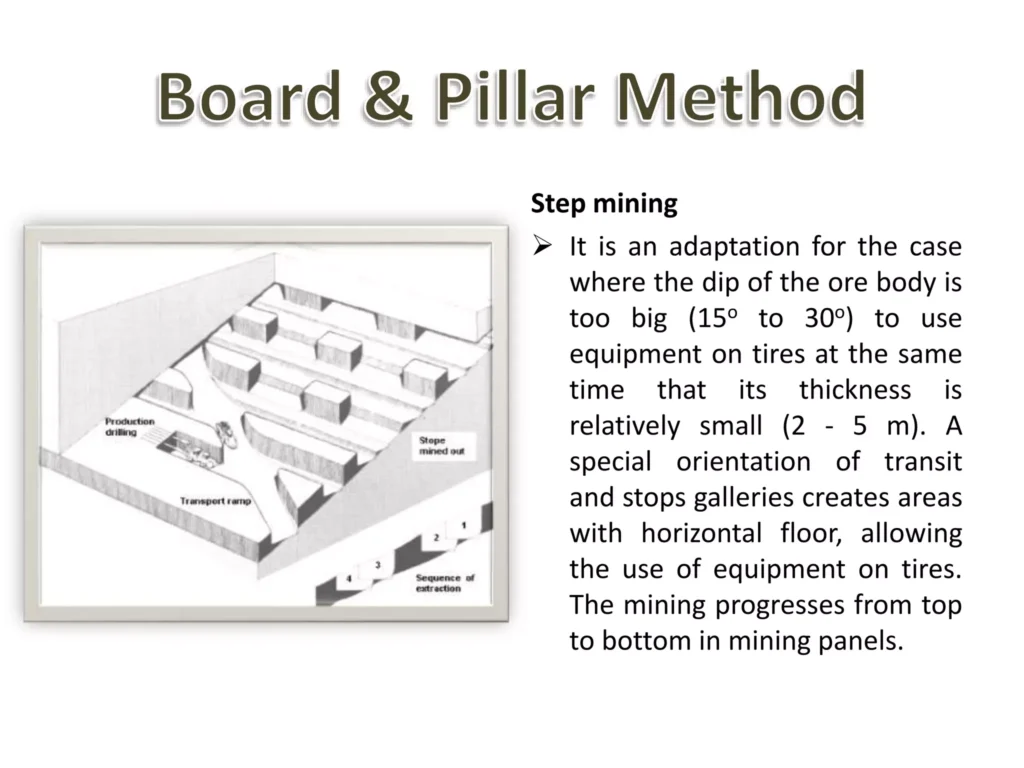
The Bord and Pillar method is one of the oldest and most widely used underground mining techniques in the world. It is commonly used for extracting flat-lying mineral deposits such as coal, potash, salt, and certain metal ores. In this method, miners excavate sections of the mineral deposit while leaving behind strong columns of material known as pillars to support the roof.
The word “bord” refers to the excavated passages or rooms from which the mineral is extracted. The word “pillar” refers to the blocks of unmined material that are intentionally left behind to support the overlying rock layers and prevent roof collapse.
This mining method has been used for centuries because of its simplicity, safety, and adaptability to various geological conditions. Although modern mechanized mining methods such as longwall mining are now widely used, the Bord and Pillar method still plays an important role in underground mining operations around the world.
Understanding this method is essential for mining engineers, geologists, and mining students because it forms the foundation of many underground mining practices.
What is Bord & Pillar Method in Mining?
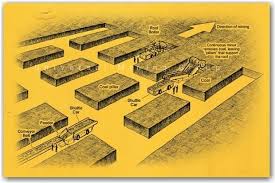
The Bord and Pillar method is an underground mining technique in which the mineral deposit is divided into a series of rectangular or square blocks. Miners extract the mineral in horizontal passages called bords while leaving pillars of the mineral intact to support the roof.
These pillars act as natural supports that prevent the collapse of the overlying rock strata. The arrangement of bords and pillars forms a grid-like pattern throughout the mine.
Once the development stage is completed, a second phase called pillar extraction or depillaring may take place. During this stage, some of the remaining pillars are partially or completely removed to recover additional mineral resources.
The Bord and Pillar method is particularly suitable for flat or gently dipping mineral deposits where the rock layers are stable enough to allow the formation of pillars.
History of Bord & Pillar Mining
The Bord and Pillar method has a long history that dates back to early underground mining operations. Before the development of advanced mining machinery, miners used simple tools to excavate mineral deposits while leaving support pillars.
During the Industrial Revolution, coal became the primary source of energy for industries and transportation. As a result, coal mining expanded rapidly, and the Bord and Pillar method became one of the most widely used techniques for underground coal extraction.
With the advancement of technology, mechanized equipment such as continuous miners, shuttle cars, and roof bolters were introduced to improve productivity and safety. Despite these technological advancements, the fundamental principles of the Bord and Pillar method remain largely unchanged.
Today, this method continues to be used in many countries due to its reliability and suitability for various geological conditions.
Main Components of Bord & Pillar Mining
The Bord and Pillar method consists of several important structural components that allow safe and efficient extraction of minerals.
Bords (Rooms)
Bords are the excavated passages from which the mineral is removed. These rooms are created by cutting through the mineral seam using mining machinery.
The width of the bords depends on factors such as seam thickness, roof strength, and mining equipment used.
Pillars
Pillars are blocks of unmined material that are intentionally left between the bords. These pillars support the roof and prevent the overlying rock layers from collapsing.
The size and spacing of pillars are carefully designed to ensure mine stability while maximizing mineral recovery.
Roadways
Roadways are main passages that allow transportation of workers, equipment, and extracted minerals. They also serve as ventilation routes within the mine.
Crosscuts
Crosscuts connect adjacent bords and roadways. They improve ventilation and provide additional access routes inside the mine.
Working Principle of Bord & Pillar Method
The working process of Bord and Pillar mining involves several stages that allow systematic extraction of mineral deposits.
Development Stage
During the development stage, the initial network of roadways and bords is created. This stage establishes the basic layout of the mine.
Extraction Stage
In the extraction stage, miners remove the mineral from the bords while leaving the pillars intact to support the roof.
Pillar Extraction Stage
After most of the mineral has been extracted from the bords, the remaining pillars may be partially removed to recover additional resources.
This stage requires careful planning and controlled operations to prevent roof collapse.
Layout of Bord & Pillar Mining
The layout of a Bord and Pillar mine usually follows a grid pattern consisting of parallel bords separated by pillars.
The dimensions of the bords and pillars depend on several factors including seam thickness, rock strength, depth of cover, and mining equipment.
| Parameter | Description |
|---|---|
| Bord Width | Width of excavated passage |
| Pillar Size | Size of support blocks left behind |
| Gallery Spacing | Distance between parallel passages |
| Depth of Cover | Thickness of rock above the mine |
Proper design of the layout is essential to ensure both safety and efficient resource recovery.
Pillar Extraction (Depillaring)
Depillaring is the process of removing the remaining pillars after the development stage is completed. This stage allows miners to recover additional mineral resources that were initially left behind.
However, pillar extraction is one of the most dangerous stages of mining because removing the support pillars may cause the roof to collapse.
To control this risk, engineers use systematic pillar extraction techniques and support systems.
Advantages of Bord & Pillar Method
The Bord and Pillar method offers several advantages that make it suitable for many underground mining operations.
| Advantage | Description |
|---|---|
| Simple Technique | Easy to understand and implement |
| Low Initial Investment | Requires less capital compared to highly mechanized methods |
| Flexible Layout | Mine design can be adjusted according to geological conditions |
| Good Ventilation | Multiple roadways allow efficient air circulation |
Disadvantages of Bord & Pillar Method
Despite its advantages, the Bord and Pillar method also has several limitations.
| Disadvantage | Description |
|---|---|
| Low Recovery Rate | Large amount of mineral remains in pillars |
| Risk During Depillaring | Pillar removal may cause roof collapse |
| Limited Depth Application | Not suitable for very deep mines |
| Higher Labor Requirement | May require more workforce than mechanized methods |
Equipment Used in Bord & Pillar Mining
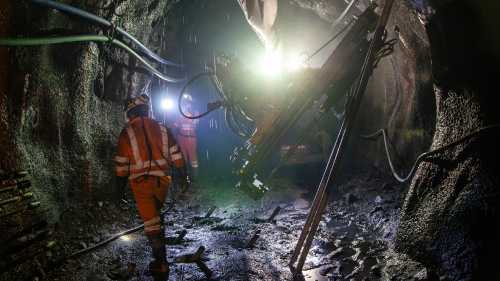
Modern Bord and Pillar mines use various types of machinery to improve efficiency and safety.
| Equipment | Function |
|---|---|
| Continuous Miner | Mechanically cuts and extracts coal or ore |
| Shuttle Car | Transports mined material |
| Roof Bolter | Installs roof support bolts |
| Conveyor System | Moves minerals to the surface |
Bord & Pillar vs Longwall Mining
| Feature | Bord & Pillar | Longwall |
|---|---|---|
| Recovery Rate | Moderate | High |
| Mechanization | Moderate | Highly mechanized |
| Cost | Lower | Higher |
| Safety | Depends on pillar stability | Controlled roof collapse |
Applications of Bord & Pillar Method
The Bord and Pillar method is widely used in various types of underground mining operations.
- Coal mining
- Potash mining
- Salt mining
- Limestone mining
- Gypsum mining
This method is particularly suitable for deposits that are flat or gently inclined.
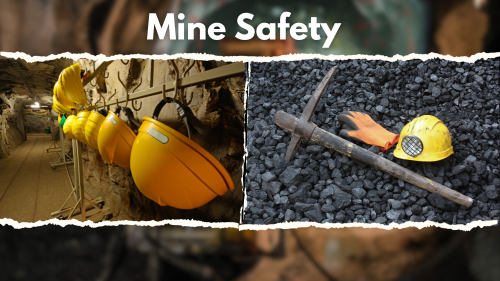
Safety Considerations in Bord & Pillar Mining
Safety is a critical aspect of underground mining operations. Proper planning and monitoring are required to prevent accidents.
Engineers must ensure that pillar sizes are adequate to support the roof and that ventilation systems provide sufficient airflow to remove harmful gases.
Roof support systems such as bolts and steel supports are commonly used to enhance stability.
Continuous monitoring of rock pressure and structural stability is also essential to maintain safe working conditions.
Frequently Asked Questions
What is Bord and Pillar method in mining?
What is a pillar in mining?
What is depillaring?
Where is Bord & Pillar mining used?
Conclusion
The Bord and Pillar method remains one of the most important underground mining techniques used across the world. Its simple design, adaptability, and reliability make it suitable for many mineral deposits.
Although modern mechanized methods have improved mining efficiency, the Bord and Pillar method continues to play a crucial role in underground mining operations, especially in coal mines.
By carefully designing pillars, maintaining proper ventilation, and using modern equipment, mining engineers can ensure safe and productive mining operations using this traditional yet effective mining method.



One Response