
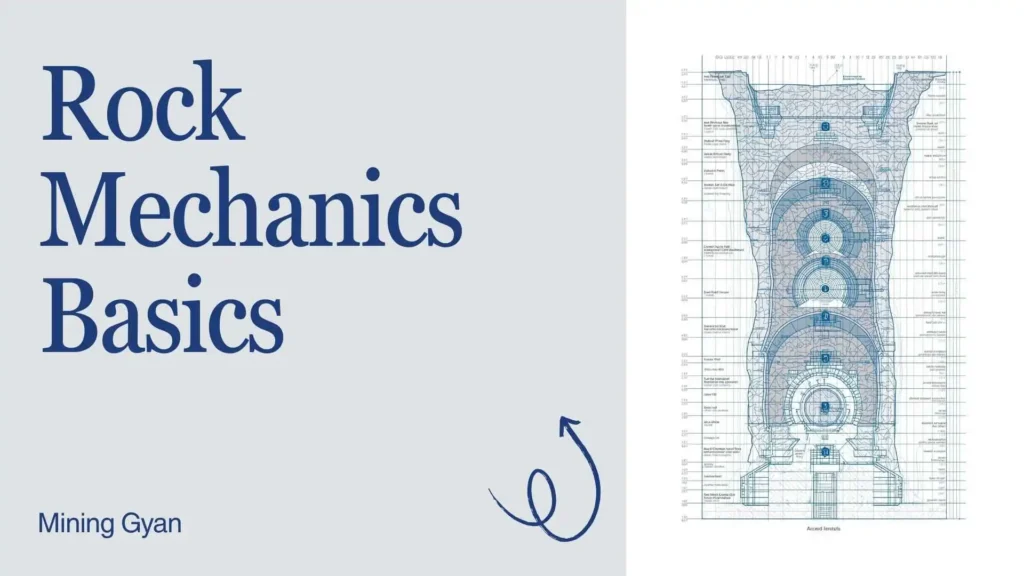
And today, Rock Mechanics combines geology, physics as well as mathematics and also engineering judgment to solve complex subsurface problems.

Classification of Rocks
Rocks are also classified based on their origin and also which directly affects their mechanical behavior as well.
Igneous Rocks and Their Engineering Behavior
Igneous rocks form from its cooling of magma or lava. Granite and also basalt are common examples as well. And these rocks are generally strong and dense and also durable as well making them suitable for the foundations and also for underground openings for sure. However, they can be brittle and fail suddenly under high stress.

Sedimentary Rocks in Engineering Applications
Sedimentary rocks such as sandstone and limestone and also shale form through deposition and also its compaction. Their layered nature often creates planes of weakness as well. And in Rock Mechanics the understanding of bedding orientation is essential as well and especially for slope stability and its tunneling projects for sure.
Metamorphic Rocks and Structural Characteristics
Metamorphic rocks like schist and gneiss form under heat and pressure. They often display foliation, which strongly influences their deformation and failure behavior. Engineers must carefully assess these directional properties during design.
Physical and also Mechanical Properties of Rocks
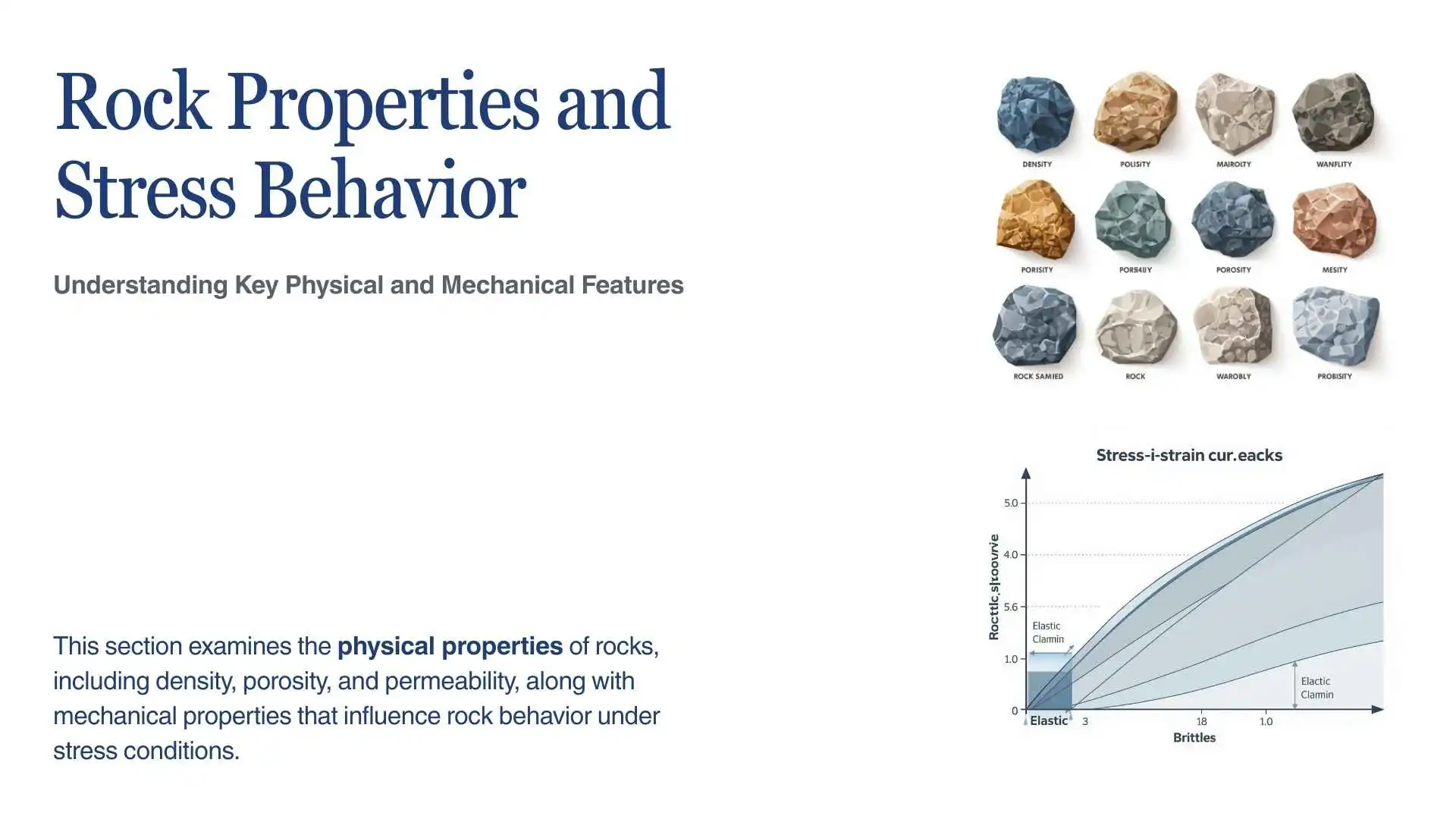
Density, porosity, and also Permeability
Physical properties can also determine how rocks interact with fluids and with its external loads as well. High porosity may reduce strength but can also increase permeability as well. And these properties are especially important in groundwater control and also in petroleum engineering.
Strength, Hardness, and Durability
Mechanical properties also describe how rocks resist forces. And compressive strength, tensile strength and also shear strength are fundamental parameters in Rock Mechanics for sure. And durability indicates resistance to weathering and also its long term degradation.
Stress and Strain in Rock Mechanics
Stress refers to its force per unit area and while strain describes deformation as well. In Rock Mechanics in situ stresses arise from the weight of overlying rock and also tectonic forces.
In Situ Stress Conditions
Understanding its natural stress fields is so crucial for excavation design for sure. Incorrect stress estimation can also lead to rock bursts and also excessive deformation or collapse as well.
Principal Stresses and Stress Distribution
Principal stresses act perpendicular to each other and also govern failure mechanisms as well. Their orientation and also its magnitude significantly affect excavation stability.
Rock Deformation Behavior
Elastic, Plastic and also Brittle Deformation
Rocks initially deform elastically as well and meaning they return to their original shape when unloaded. And beyond this range plastic deformation or its brittle failure occurs. Most hard rocks fail in a brittle manner that can produce fractures as well.
Time Dependent Behavior
Some rocks and particularly salt and also shale, exhibit creep slow deformation under constant stress as well. And this behavior is critical in long term underground storage and also tunneling.
Rock Strength and also its Failure Theories
Mohr Coulomb Failure Criterion
This is also widely used criterion relates shear strength to normal stress and cohesion and also internal friction angle as well. It is simple and also effective for many engineering applications as well.
Hoek Brown Failure Criterion
Developed specifically for rock masses and also this criterion accounts for intact rock strength and geological conditions as well. It is commonly used in modern Rock Mechanics design.
Laboratory Testing of Rocks
Uniaxial Compression Test
This test determines compressive strength and also elastic properties as well. It is one of the most common tests in Rock Mechanics laboratories for sure.
Triaxial Compression Test
By applying confining pressure and also this test simulates in situ stress conditions and also provides more realistic strength parameters as well.
Discontinuities and Rock Mass Behavior
Joints, Faults and Bedding Planes
Natural fractures often control its rock mass behavior more than intact rock strength for sure. Their orientation and spacing and also condition are critical factors as well.

Rock Mass Classification Systems
Systems such as RMR and also Q systems, which are foundational for students utilizing tools from Mining gyan, can help engineers assess rock mass quality and also select appropriate support measures as well.
Applications of Rock Mechanics
Mining Engineering Applications
Rock Mechanics is also essential for mine design and ground support selection and also hazard prevention. It helps ensure worker safety and also production efficiency.
Tunneling, Slopes and Foundations
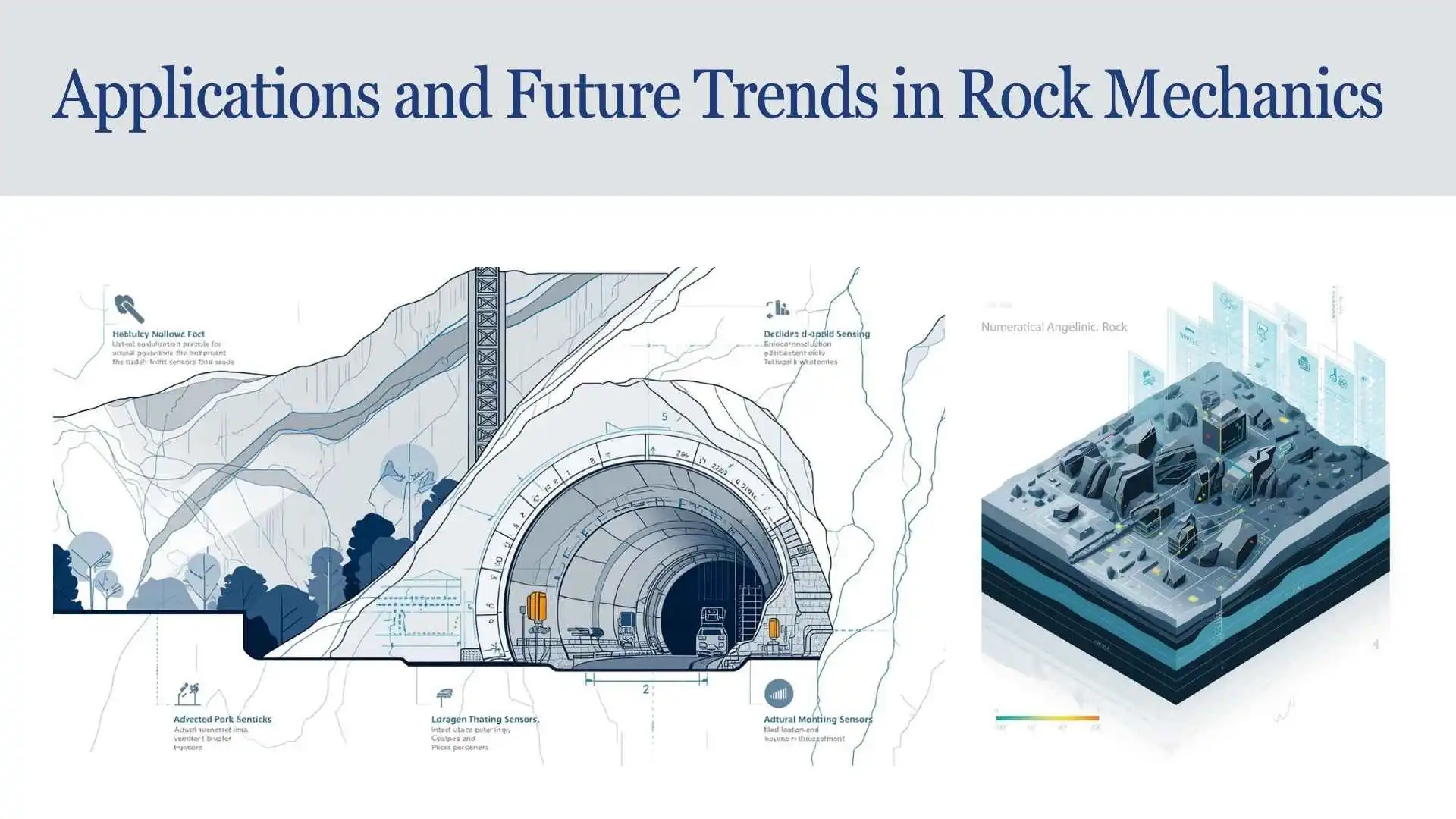
From subway tunnels to dam foundations and Rock Mechanics principles guide safe and also its economical designs.
Challenges and Limitations in Rock Mechanics
Scale Effects and Natural Variability
Laboratory samples may not represent field scale behavior for sure. Geological variability remains one of its biggest challenges in Rock Mechanics as well.
Future Trends in Rock Mechanics
Numerical Modeling and Digital Monitoring
Advanced software and real time monitoring and also AI based analysis are transforming Rock Mechanics and allowing better predictions and also safer designs.
FAQs
- What is Rock Mechanics used for? Rock Mechanics is used to analyze and design structures interacting with rock, such as mines, tunnels and slopes.
- Is Rock Mechanics different from soil mechanics? Yes, Rock Mechanics focuses on hard, jointed materials, while soil mechanics deals with loose or weak materials.
- Why are discontinuities important? Discontinuities often control failure patterns and stability more than intact rock strength.
- What tests are commonly used in Rock Mechanics? Uniaxial and triaxial compression tests are the most common.
- Can Rock Mechanics prevent mining accidents? Yes, proper application significantly reduces risks like collapses and also rock bursts.
- Is Rock Mechanics relevant outside mining? Absolutely. It is vital in civil engineering, petroleum engineering and also environmental projects.
Conclusion
Rock Mechanics is also a foundational discipline that bridges geology and also engineering for sure. And by understanding its rock properties, stresses and failure mechanisms and also real world behavior that the engineers can design safer and more efficient structures. As technology advances, Rock Mechanics continues to evolve, offering smarter tools and also deeper insights for future engineering challenges.



5 Responses