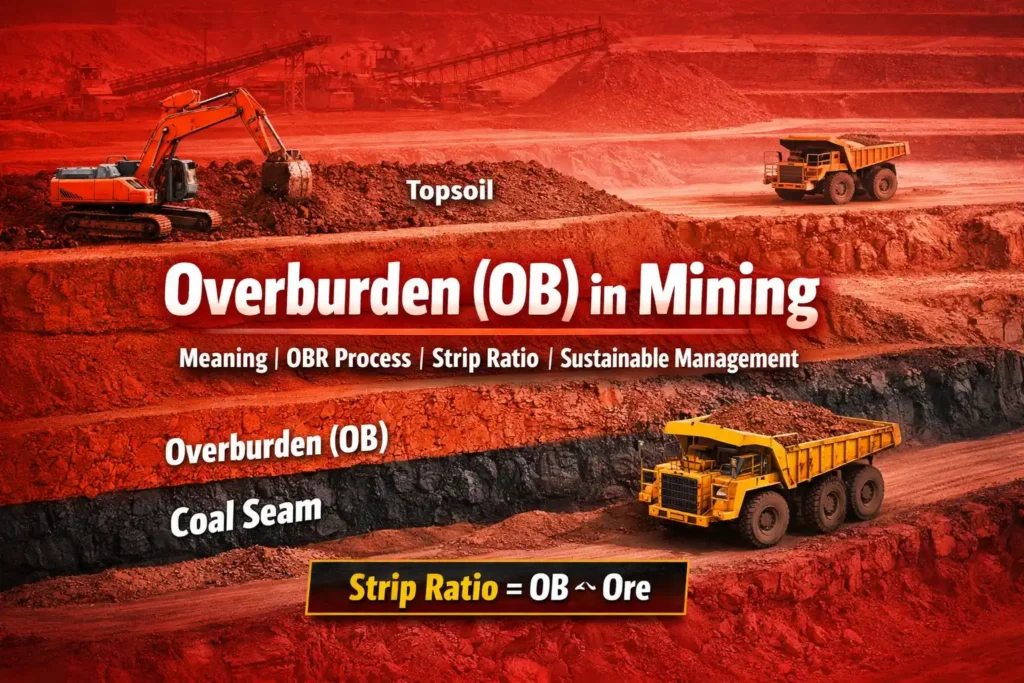
Overburden is the layer of soil, rock, and natural material that lies above a coal seam or ore body. It must be removed before extraction of minerals can begin. In surface mining operations, overburden handling forms the largest operational activity by volume. Efficient OB management directly influences mining cost, safety, and long-term sustainability.
What is Overburden in Mining?
Overburden includes topsoil, clay, sand, gravel, weathered rock, and hard rock that covers a mineral deposit. Although it has no direct economic value, it plays a critical role in mine planning. The thickness of overburden determines the scale of excavation required. In coal mining, OB removal is the first stage before coal extraction begins.
Legal and Technical Definition
Mining regulations define overburden as the waste material excavated to expose mineral deposits. It is reported separately in mining returns and production statistics. OB quantities are usually measured in cubic meters (m³) or bank cubic meters (BCM). Proper accounting of OB is necessary for compliance and cost control.
Etymology and Industry Usage
The term “overburden” originates from geological terminology where it represents the burden above a deposit. In mining practice, it refers specifically to removable covering strata. The term is widely used in coal, iron ore, bauxite, and limestone mining industries.
Types and Characteristics of Overburden
The nature of overburden depends on regional geology. Some mines encounter soft soil layers, while others deal with compact sandstone or shale. The physical properties of OB influence blasting requirements, equipment selection, and dump design.
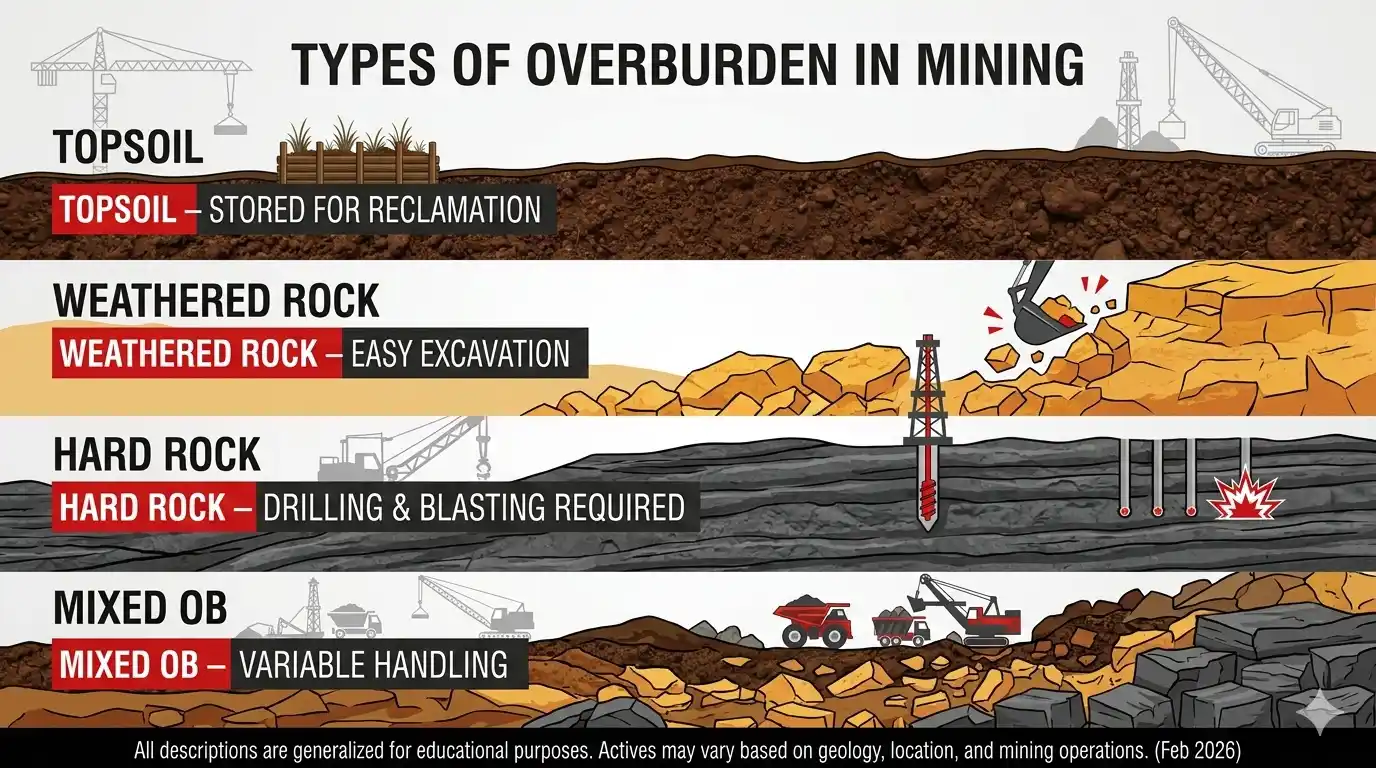
| Type of Overburden | Description | Mining Implication |
|---|---|---|
| Topsoil | Loose fertile upper layer | Stored separately for reclamation |
| Weathered Rock | Partially fragmented strata | Easy excavation |
| Hard Rock | Compact sandstone/shale | Requires drilling & blasting |
| Mixed OB | Combination of soil and rock | Variable handling methods |
Characteristics of Overburden Dumps
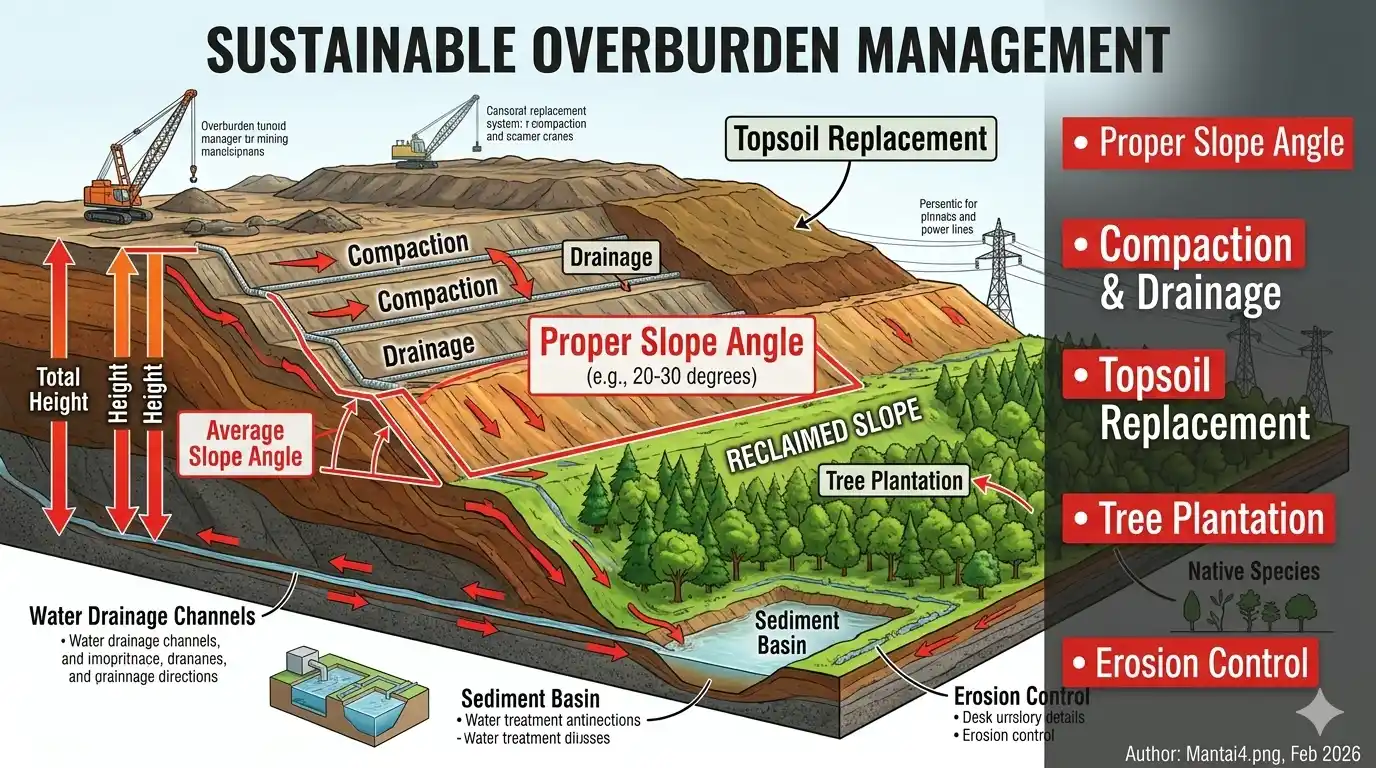
After excavation, OB is transported to designated dump sites. Dump design must ensure slope stability, drainage control, and environmental safety. Poorly managed dumps can cause landslides and erosion.
| Parameter | Importance |
|---|---|
| Slope Angle | Controls dump stability |
| Compaction | Reduces settlement |
| Drainage System | Prevents water accumulation |
| Vegetation Cover | Minimizes erosion and dust |
Overburden Removal (OBR) Process
Overburden Removal (OBR) is the systematic excavation and disposal of waste material to expose the coal or ore seam. OBR volume determines the mine’s readiness for future mineral extraction. Efficient OBR ensures continuity of production cycles.
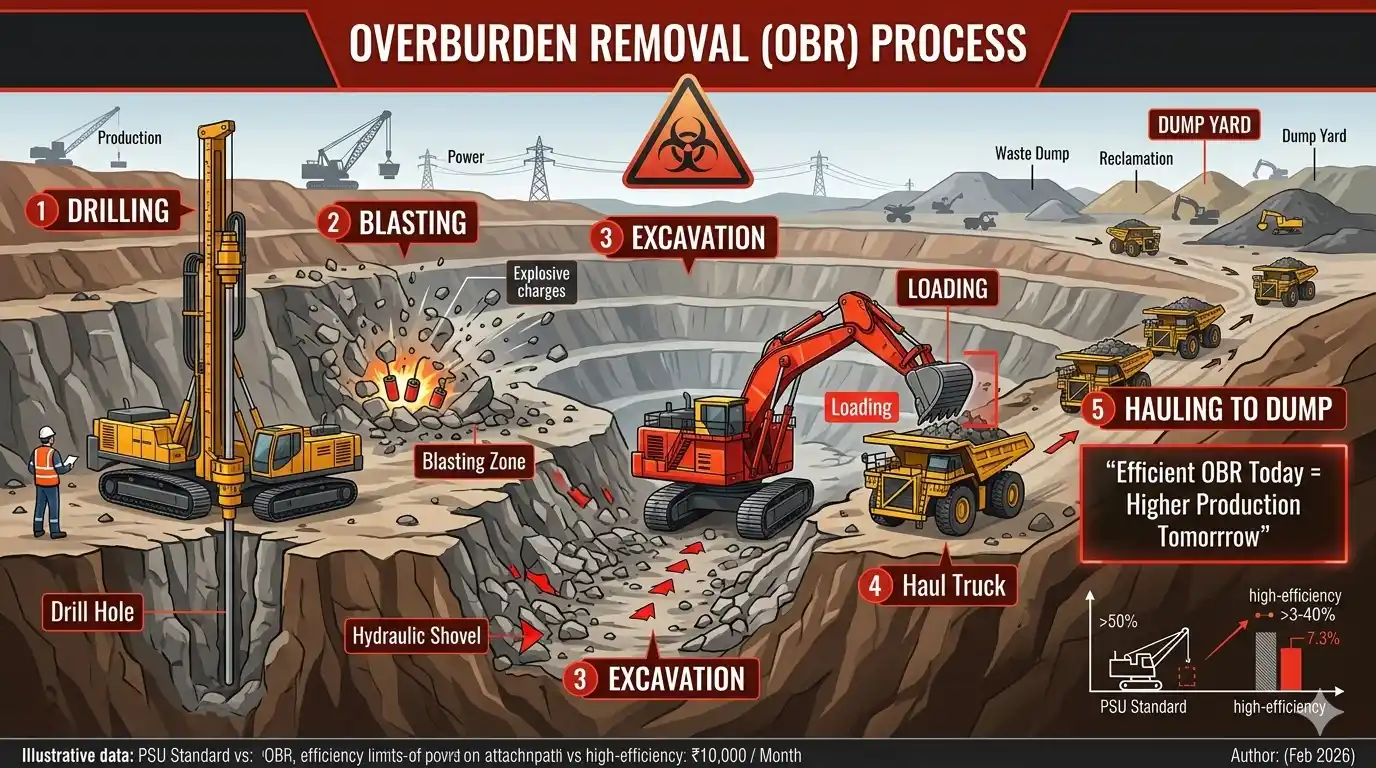
The Process of Removing Overburden
| Stage | Activity |
|---|---|
| 1 | Drilling blast holes |
| 2 | Blasting rock mass |
| 3 | Excavation using shovels |
| 4 | Loading into dumpers |
| 5 | Hauling to dump yard |
Overburden Removal and Benching
Benching involves creating stepped working levels in open-pit mines. Each bench has a defined height, width, and slope angle. Proper bench design ensures safe equipment movement and slope stability. Regulatory authorities prescribe maximum permissible bench heights.
Importance of Overburden Management
Overburden removal accounts for a major share of mining expenditure. Higher OB thickness increases excavation cost and fuel consumption. Effective planning improves economic viability and operational safety.
| Aspect | Impact on Mining |
|---|---|
| Cost Management | Controls operating expenses |
| Production Planning | Ensures steady mineral exposure |
| Environmental Compliance | Reduces pollution risk |
| Worker Safety | Prevents slope failures |
The Role of Technology and Drones
Modern mines use drones for topographic surveys and dump volume calculations. GPS-enabled fleet management systems monitor dumper cycles. Data analytics optimizes haul road alignment and reduces idle time. Technology integration increases transparency and efficiency.
Strip Ratio in Mining
What is Strip Ratio?
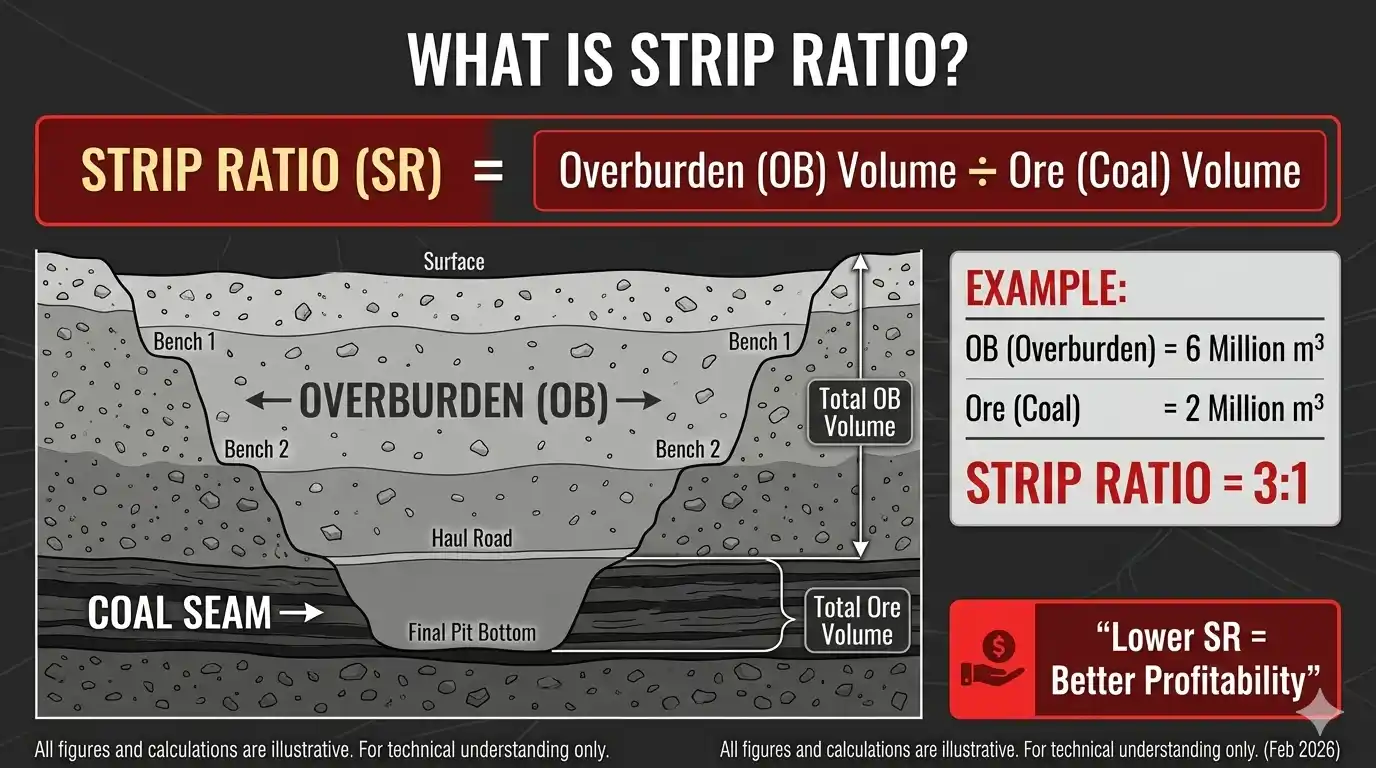
Strip Ratio (SR) represents the relationship between overburden volume and ore production. It indicates how much waste must be removed to recover a unit of mineral. Lower strip ratios generally indicate better profitability.
[su_alert style=”info” icon=”icon: calculator”] Strip Ratio (SR) = Overburden Volume ÷ Ore Volume[/su_alert]
How to Calculate Strip Ratio
If a mine removes 6 million m³ of OB and extracts 2 million m³ of coal, the strip ratio is 3:1. This means three units of waste are handled for every unit of coal. Strip ratio can also be expressed in tonne-to-tonne terms.
Economic Significance of Strip Ratio
Strip ratio directly affects mining cost per tonne. Higher SR increases fuel, manpower, and equipment usage. However, high-grade deposits may remain profitable even with moderate strip ratios. Market demand and coal price play decisive roles.
Company-wise OBR Performance Monitoring
Large mining companies track OBR performance monthly and annually. Production targets depend on timely OB clearance. Delays in OBR lead to future coal shortages. Therefore, OBR is considered a leading indicator of production performance.
Sustainable Use of Mining Waste Dumps
Reclamation of OB dumps is essential for environmental restoration. Backfilling exhausted pits reduces land disturbance. Plantation programs improve ecological balance. Sustainable OB handling ensures long-term land usability.
Ecorestoration Techniques
| Technique | Purpose |
|---|---|
| Topsoil Replacement | Restores soil fertility |
| Hydroseeding | Rapid vegetation growth |
| Tree Plantation | Long-term ecosystem recovery |
| Drainage Control | Prevents erosion |
Environmental Challenges in Overburden Handling
Improper OB disposal can cause dust pollution, water contamination, and slope instability. Rainwater runoff may carry silt into nearby water bodies. Strict environmental management plans are mandatory in modern mining.
[su_alert style=”warning” icon=”icon: warning”] Proper dump design, compaction, and monitoring significantly reduce environmental degradation.[/su_alert]
Our Approach to Efficient Earthmoving
Efficient earthmoving focuses on equipment matching and productivity optimization. Selecting the right shovel-dumper combination reduces idle time. Preventive maintenance lowers breakdown risk. Data monitoring enhances operational transparency.
| Optimization Area | Benefit |
|---|---|
| Fleet Matching | Improves cycle efficiency |
| Fuel Monitoring | Reduces operational cost |
| Haul Road Maintenance | Enhances dumper speed |
| Predictive Maintenance | Minimizes downtime |