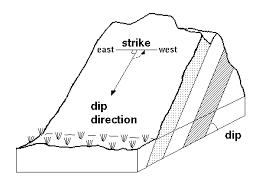
Dip is one of the most important concepts in mining geology and structural geology. It refers to the angle at which a rock layer, coal seam, or ore body is inclined from the horizontal plane. In mining operations, understanding dip helps engin
eers determine the orientation of mineral deposits and design efficient extraction methods.
Every rock layer in the earth’s crust is rarely perfectly horizontal. Geological forces such as tectonic movements, folding, and faulting often tilt rock layers at various angles. The direction and angle of this inclination are known as the dip of the strata. Knowledge of dip allows mining engineers to plan mine layouts, transportation systems, drainage systems, and support structures.
What is Dip in Mining?
In mining geology, dip is defined as the maximum angle of inclination of a rock bed or mineral seam measured downward from the horizontal plane. The dip direction is always perpendicular to the strike direction of the rock layer.
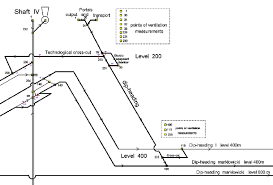
The dip indicates how steeply the rock layer is sloping underground. This information is essential for locating mineral deposits and determining how excavation should proceed. Without understanding the dip of the strata, mining operations may face problems such as misalignment of tunnels, inefficient ore extraction, or unstable roof conditions.
In practical mining conditions, dip is commonly measured in degrees using specialized geological instruments. The dip direction indicates the compass direction in which the rock layer slopes downward.
Dip and Strike Relationship
Dip and strike are two fundamental measurements used to describe the orientation of rock layers. These two parameters always exist together and help geologists define the three-dimensional position of geological strata.
The strike represents the horizontal direction of a rock layer, while the dip represents the direction and angle at which the layer slopes downward. The dip direction is always perpendicular to the strike direction.
| Parameter | Dip | Strike |
|---|---|---|
| Definition | Angle of inclination of rock layer | Horizontal direction of rock layer |
| Measurement | Measured in degrees from horizontal | Measured using compass direction |
| Importance | Determines slope of strata | Defines orientation of strata |
Understanding the relationship between strike and dip helps geologists create accurate geological maps and interpret underground structures.
Components of Dip
The concept of dip can be further divided into different components that help geologists analyze rock orientations more accurately.
True Dip
True dip is the maximum angle of inclination of a rock layer measured perpendicular to the strike direction. It represents the steepest slope of the rock bed.
This value is important because it provides the most accurate representation of how the rock layer is inclined underground.
Apparent Dip
Apparent dip is the angle of inclination measured in any direction other than the true dip direction. Since it is not measured perpendicular to strike, the apparent dip is always smaller than the true dip.
Apparent dip is useful when geological measurements are taken in directions that do not align with the true dip direction.
Measurement of Dip in Mining
Accurate measurement of dip is essential in geological surveys and mining exploration. Various instruments are used to measure dip in the field.
Instruments Used for Measuring Dip
| Instrument | Purpose |
|---|---|
| Brunton Compass | Measures strike and dip of rock layers |
| Clinometer | Measures angle of slope |
| Geological Compass | Used in structural geology mapping |
| Digital Dip Meter | Provides precise electronic measurements |
Steps to Measure Dip
The procedure for measuring dip in the field involves several steps.
First, the geologist identifies the rock surface or bedding plane. Next, the strike direction is determined using a compass. After identifying the strike, the clinometer is used to measure the angle of inclination perpendicular to the strike.
The direction in which the rock layer slopes downward is recorded as the dip direction.
Types of Dip in Mining
Rock layers may dip at different angles depending on geological conditions. Based on the angle of inclination, dip can be classified into different categories.
Gentle Dip
A gentle dip occurs when the rock layer slopes at a small angle, usually less than 30 degrees. Mining operations in gently dipping seams are generally easier to manage because transportation systems and excavation methods can be designed more efficiently.
Moderate Dip
Moderate dip occurs when the inclination angle ranges between 30 and 60 degrees. Mining in moderately dipping seams requires careful planning to ensure safe equipment movement and proper support systems.
Steep Dip
Steep dip refers to rock layers inclined at angles greater than 60 degrees. These conditions create significant challenges for mining operations because gravity affects material movement and roof stability.
| Dip Type | Angle Range | Mining Difficulty |
|---|---|---|
| Gentle Dip | 0° – 30° | Easy mining conditions |
| Moderate Dip | 30° – 60° | Moderate difficulty |
| Steep Dip | Above 60° | Difficult mining conditions |
Importance of Dip in Mining Engineering
The dip of rock layers has a direct influence on several aspects of mining operations. Proper knowledge of dip helps engineers design safer and more efficient mines.
Mine Planning
Dip determines the direction in which tunnels, shafts, and roadways should be developed. Aligning mine workings with the dip of the strata helps reduce excavation difficulties and improve stability.
Selection of Mining Method
The choice of mining method often depends on the dip of the mineral deposit. For example, room and pillar mining may be suitable for gently dipping seams, while steep seams may require specialized extraction techniques.
Drainage and Water Control
Dip influences the natural flow of water within the mine. Engineers must design drainage systems based on dip direction to prevent water accumulation in underground workings.
Ventilation Planning
Air circulation in underground mines can also be affected by the orientation of rock layers. Understanding dip helps engineers design efficient ventilation systems.
Dip in Underground Coal Mining
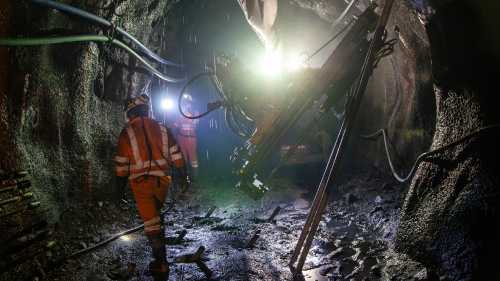
In underground coal mines, the dip of the coal seam plays a major role in determining the layout of roadways and transportation systems.
When a coal seam dips downward, mine galleries are often developed along the strike direction while cross-cuts follow the dip direction.
Effect on Transportation Systems
Coal transportation systems such as belt conveyors and haulage tracks must be designed according to the dip angle. Steep dips may require specialized equipment to prevent materials from sliding backward.
Effect on Roof Stability
Rock pressure distribution is influenced by the dip of the strata. Certain dip angles may create unstable roof conditions, requiring additional support systems.
Dip in Surface Mining
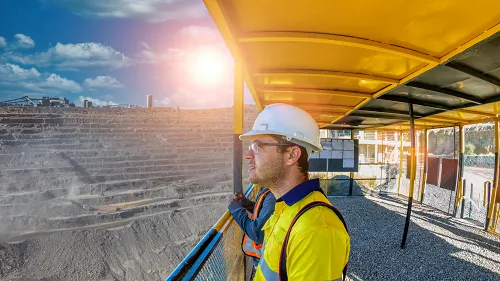
In open pit mining operations, dip also affects slope stability and pit design. The orientation of rock layers relative to the pit slope determines the likelihood of rock slides.
If the dip direction is parallel to the pit wall, the risk of slope failure may increase significantly.
Engineers analyze dip data carefully to design safe bench angles and prevent slope instability.
Calculation of Apparent Dip
In many geological situations, it is not possible to measure the true dip directly. Instead, apparent dip values are obtained and converted to true dip using mathematical relationships.
The formula used to calculate apparent dip is:
Apparent Dip = tan⁻¹ (tan True Dip × sin Angle between directions)
This calculation allows geologists to estimate the true orientation of rock layers based on measurements taken in different directions.
Challenges Caused by High Dip in Mining
Mining operations in steeply dipping deposits often face several technical challenges.
| Problem | Description |
|---|---|
| Material Transportation | Difficult movement of ore and equipment |
| Roof Control | Increased risk of rock falls |
| Water Flow | Drainage complications |
| Equipment Stability | Machines may lose stability on steep slopes |
To overcome these problems, mining engineers implement specialized support systems and transportation methods.
Modern Technology for Dip Measurement
Modern mining operations use advanced technologies to measure and analyze dip more accurately.
Digital geological mapping systems allow geologists to record dip measurements directly in computerized databases. These data are later used to create detailed geological models.
Drone-based mapping and LiDAR surveys are increasingly used to identify geological structures on the surface. These technologies provide high-resolution topographic data that improves geological interpretation.
Three-dimensional geological modeling software allows engineers to visualize the dip and orientation of rock layers in a digital environment.
Frequently Asked Questions
What is dip in mining?
What is the difference between dip and strike?
Which instrument is used to measure dip?
Why is dip important in coal mining?
What is true dip?
Conclusion
Dip is a fundamental concept in mining geology that describes the inclination of rock layers or mineral seams. Accurate knowledge of dip is essential for designing safe and efficient mining operations.
From mine planning and ventilation design to slope stability and resource exploration, dip influences many aspects of mining engineering. Modern technologies such as digital mapping and 3D geological modeling have further improved the accuracy of dip measurements.
Understanding dip allows mining professionals to make informed decisions, reduce operational risks, and improve overall productivity in both underground and surface mining environments.