India is accelerating its search for critical and strategic minerals as the country works to strengthen domestic mineral security and reduce dependence on overseas supply chains.
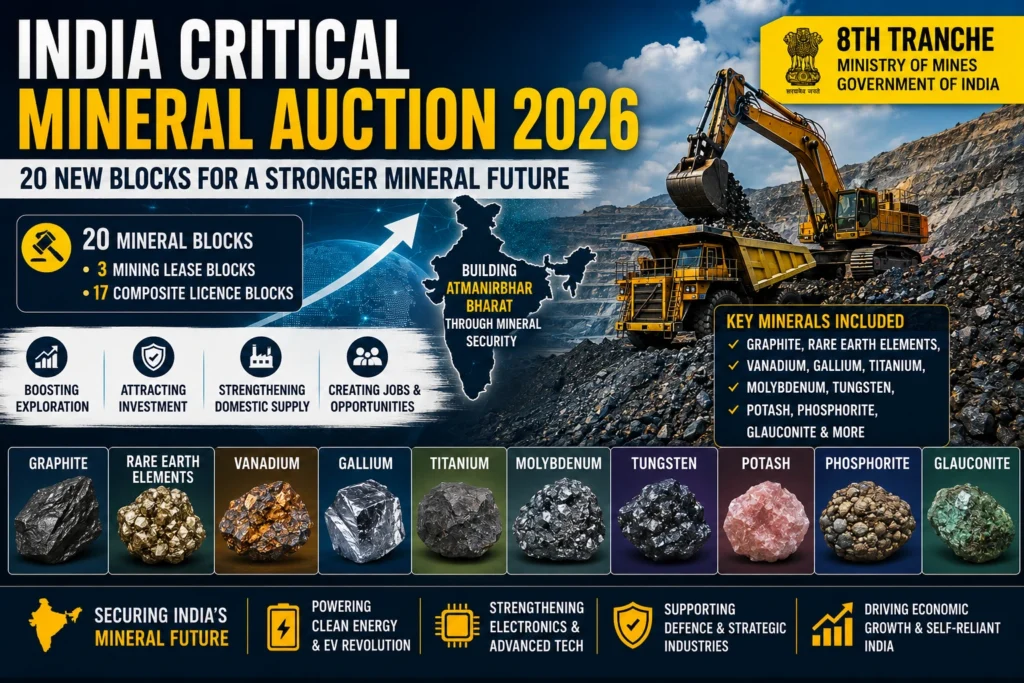
The Ministry of Mines has launched the eighth tranche of auctions for critical and strategic mineral blocks. The latest round includes 20 mineral blocks covering a diverse group of commodities such as graphite, rare earth elements, vanadium, gallium, titanium, molybdenum, tungsten, potash, phosphorite and glauconite.
The India Critical Mineral Auction 2026 is significant because these minerals are increasingly important for electric vehicles, renewable energy, electronics, advanced manufacturing, defence and other high-technology industries.
Of the 20 blocks offered in the eighth tranche, three are Mining Lease blocks and 17 are Composite Licence blocks.
The development demonstrates how India’s mining strategy is gradually expanding beyond traditional bulk minerals such as coal, iron ore and limestone toward minerals that could become strategically important for the country’s future economy.
What Is the India Critical Mineral Auction 2026?
The eighth tranche is part of India’s continuing programme to auction critical and strategic mineral resources.
The latest round covers 20 mineral blocks containing different critical and strategic commodities.
The minerals represented include:
- Graphite
- Rare Earth Elements
- Rare Metals
- Vanadium
- Gallium
- Titanium
- Molybdenum
- Tungsten
- Potash
- Phosphorite
- Glauconite
These commodities have different industrial applications, but they share one important characteristic: many are increasingly important to modern technology and industrial supply chains.
The auction programme is intended to encourage exploration, investment and eventual development of India’s domestic mineral resources.
Why Are Critical Minerals Important for India?
Modern economies depend on a much wider range of minerals than they did several decades ago.
Traditional industrial development depended heavily on coal, iron ore, limestone, copper and bauxite.
These minerals remain extremely important.
However, newer industries require additional specialised materials.
Electric vehicles need battery materials. Renewable energy systems require specialised metals and minerals. Electronics and advanced manufacturing require materials with specific physical and chemical properties.
Critical minerals can therefore influence industries such as:
- Electric vehicles
- Battery manufacturing
- Renewable energy
- Electronics
- Defence manufacturing
- Aerospace
- Telecommunications
- Advanced engineering
A disruption in the supply of these minerals can affect entire manufacturing chains.
This is why mineral security is increasingly treated as an important economic and strategic issue.
What Is a Critical Mineral?
A critical mineral is generally a mineral that has significant economic or strategic importance while also facing potential supply risks.
The exact definition can vary between countries because each economy has different industrial requirements.
A mineral may be considered critical because:
- Domestic production is limited
- Imports are concentrated in a small number of countries
- The mineral is difficult to substitute
- Demand is expected to grow rapidly
- It is required by strategic industries
Criticality can also change over time.
A mineral that was relatively unimportant several decades ago may become strategically important when new technologies create substantial demand for it.
Why Graphite Is Important
Graphite is one of the important minerals included in India’s critical mineral strategy.
It has applications across several industries and is particularly important in battery technology.
Graphite is widely used as an anode material in lithium-ion batteries.
This means demand for graphite can be influenced by the growth of:
- Electric vehicles
- Battery manufacturing
- Energy storage
- Electronics
Graphite also has traditional industrial applications in refractories, lubricants and other products.
Developing domestic graphite resources could therefore support both conventional industries and emerging battery supply chains.
Rare Earth Elements and India’s Technology Sector
Rare Earth Elements, commonly known as REEs, are another important group included in the latest mineral auction programme.
Despite their name, rare earth elements are not necessarily extremely rare in the Earth’s crust.
The challenge often lies in finding economically viable deposits and developing efficient processing and separation technologies.
Rare earth elements have applications in:
- Permanent magnets
- Electric motors
- Electronics
- Wind turbines
- Defence systems
- Communication equipment
- Advanced manufacturing
Permanent magnets are particularly important because they are used in several high-performance motors and generators.
Developing REE resources is therefore not only a mining challenge but also a mineral-processing challenge.
Why Vanadium Matters
Vanadium is another strategic mineral included in India’s critical mineral exploration and auction efforts.
Vanadium is widely associated with speciality steels.
Small quantities of vanadium can improve certain properties of steel, making it useful for specialised industrial applications.
Vanadium also has potential applications in energy-storage technologies.
Vanadium redox flow batteries are one example of an energy-storage technology that uses the mineral.
As renewable energy deployment increases, long-duration energy storage could become increasingly important.
This gives vanadium strategic significance beyond conventional metallurgy.
Gallium and Advanced Technology
Gallium is used in specialised semiconductor materials and advanced electronics.
Unlike bulk minerals such as coal or iron ore, gallium is required in relatively small quantities.
However, the value of a critical mineral is not determined only by the amount consumed.
A small quantity of a specialised mineral can be essential to manufacturing a high-value technological product.
Gallium-containing materials can be used in applications involving:
- Semiconductors
- Communication technology
- LEDs
- High-frequency electronics
- Advanced power electronics
This makes secure access to gallium important for technology-oriented industries.
Tungsten and Strategic Manufacturing
Tungsten has several properties that make it valuable for industrial applications.
It is known for its hardness and extremely high melting point.
Tungsten is commonly used in:
- Cutting tools
- Wear-resistant components
- Industrial machinery
- Special alloys
- High-temperature applications
Mining and processing tungsten can be technically demanding because economic deposits need careful geological evaluation and beneficiation.
Developing domestic tungsten resources could support specialised manufacturing industries.
Titanium in the Critical Mineral Strategy
Titanium is another important mineral associated with the eighth tranche.
Titanium has a high strength-to-weight ratio and strong corrosion resistance.
These properties make titanium valuable for applications where strength and low weight are important.
Applications can include:
- Aerospace
- Chemical processing
- Defence
- Medical equipment
- Advanced engineering
Titanium-bearing minerals therefore have both industrial and strategic significance.
What Are Mining Lease and Composite Licence Blocks?
The 20 blocks in the eighth tranche are divided between Mining Lease and Composite Licence blocks.
Understanding the difference is important.
Mining Lease
A Mining Lease generally applies where the mineral resource has reached a more advanced stage of exploration and the project can move toward mine development after the necessary procedures and approvals.
Composite Licence
A Composite Licence combines exploration rights with the possibility of subsequently obtaining mining rights after the required exploration milestones and conditions are completed.
In simple terms:
Composite Licence → Further Exploration → Resource Establishment → Mining Lease
Composite licences are particularly useful for mineral deposits that still require additional exploration before commercial mining can be planned.
The fact that 17 of the 20 blocks are Composite Licence blocks highlights how important exploration remains to India’s critical mineral strategy.
Exploration Is the Foundation of Mineral Development
A country cannot develop mineral resources without first understanding what exists underground.
Exploration is therefore the first major technical stage of mining.
Mineral exploration can involve:
- Geological mapping
- Geophysical surveys
- Geochemical surveys
- Remote sensing
- Trenching
- Drilling
- Core logging
- Laboratory analysis
- Resource estimation
As exploration progresses, geologists develop a better understanding of the geometry, grade and continuity of the mineral deposit.
This information is essential before a mining company can determine whether developing a mine is technically and economically viable.
Role of NMEDT in Mineral Exploration
India is also strengthening the institutional framework supporting mineral exploration.
The National Mineral Exploration and Development Trust, or NMEDT, supports activities aimed at improving mineral exploration and development.
The broader objective is to reduce exploration gaps and create a stronger pipeline of mineral projects.
For critical minerals, exploration can be particularly challenging because deposits may require specialised geological knowledge and advanced survey techniques.
A stronger exploration ecosystem can involve cooperation among:
- Government agencies
- Geological Survey of India
- Exploration companies
- Mining companies
- Research organisations
- Private investors
Developing this ecosystem will be important if India wants to convert geological potential into operating mines.
Why Auctions Alone Are Not Enough
Auctioning a mineral block is an important milestone, but it does not automatically create a producing mine.
A successful mineral project may still need to complete multiple stages.
These can include:
Auction → Exploration → Resource Estimation → Feasibility Study → Approvals → Mine Development → Processing Infrastructure → Commercial Production
For early-stage blocks, this process can take several years.
Some exploration projects may also discover that the mineral resource is not commercially viable.
Therefore, the success of the India Critical Mineral Auction 2026 should eventually be measured not only by the number of blocks auctioned but also by how many resources progress toward sustainable commercial production.
Mineral Processing Is a Major Challenge
Critical mineral mining is only one part of the supply chain.
The mined ore often requires sophisticated beneficiation, separation and refining.
The complete value chain can look like:
Exploration → Mining → Crushing → Beneficiation → Concentration → Refining → Manufacturing
For some critical minerals, processing technology can be more challenging than extraction itself.
Rare earth elements are a good example.
The minerals may occur together and require complex separation processes before individual elements can be used by manufacturers.
India therefore needs to develop both mining capacity and downstream processing capabilities.
Opportunities for Indian Mining Companies
The critical mineral push could create new opportunities for Indian mining and exploration companies.
Potential areas include:
- Geological exploration
- Drilling services
- Mine planning
- Mineral processing
- Laboratory testing
- Resource modelling
- Mining equipment
- Environmental consulting
- Project development
Companies traditionally focused on coal, iron ore or limestone may also begin exploring opportunities in new mineral categories.
This could gradually make India’s mining industry more diversified.
Opportunities for Mining Engineers and Geologists
Critical mineral development could also create new career opportunities.
Mining engineers may increasingly work with commodities that require different mining and processing approaches compared with traditional bulk minerals.
Geologists will play an especially important role because many blocks require substantial exploration.
Important skills could include:
- Economic geology
- Exploration geology
- Resource estimation
- Mine planning
- Mineral processing
- Geostatistics
- GIS
- Remote sensing
- Environmental management
- Mining economics
Knowledge of critical mineral deposits could therefore become increasingly valuable for future mining professionals.
Environmental Responsibility Will Remain Important
Critical minerals may support cleaner technologies, but mining them still creates environmental impacts.
Projects can affect:
- Land
- Water
- Vegetation
- Local ecosystems
- Communities
Critical mineral development therefore needs proper environmental planning.
Mining companies need to consider environmental management throughout the complete mine lifecycle.
This includes exploration, development, production, waste management and eventual mine closure.
Producing minerals for renewable energy does not automatically make a mining project sustainable.
Responsible mining practices remain essential.
India Needs Both Domestic and Overseas Mineral Strategies
India is simultaneously pursuing two broad approaches to mineral security.
The first is developing domestic resources through exploration and auctions.
The second involves securing access to overseas mineral resources.
Indian companies have been exploring opportunities in mineral-rich countries for commodities such as lithium, copper and other critical minerals.
These strategies can complement each other.
Domestic mining can reduce import dependence, while overseas investments can diversify supply sources for minerals that are limited within India.
What Happens After the Eighth Tranche?
The next stage will depend on investor participation and the results of the auction process.
Successful bidders will need to progress through the applicable exploration or mine-development requirements.
For Composite Licence blocks, exploration will be particularly important.
Over time, the industry will need to monitor:
- Number of successfully auctioned blocks
- Exploration progress
- New mineral discoveries
- Resource estimates
- Environmental approvals
- Mine-development decisions
- Processing capacity
- Commercial production
These indicators will show whether India’s critical mineral strategy is successfully moving from policy and auctions toward actual mineral production.
Future of Critical Mineral Mining in India
India’s critical mineral sector is still developing.
However, the direction is becoming increasingly clear.
The country’s future mining industry is likely to extend well beyond traditional coal and iron ore operations.
Minerals such as graphite, rare earth elements, vanadium, gallium, tungsten and titanium could become increasingly important.
At the same time, mining companies will need new technical capabilities.
Exploration, mineral processing, environmental management and advanced geological modelling will become increasingly important skills.
The industry could therefore become both more diversified and more technologically advanced.
Conclusion
The India Critical Mineral Auction 2026 represents another important step in India’s effort to strengthen mineral security and develop domestic resources required by emerging industries.
The eighth tranche includes 20 critical and strategic mineral blocks, consisting of three Mining Lease blocks and 17 Composite Licence blocks.
The blocks cover minerals including graphite, rare earth elements, rare metals, vanadium, gallium, titanium, molybdenum, tungsten, potash, phosphorite and glauconite.
These resources could become increasingly important for batteries, renewable energy, electronics, advanced manufacturing and other strategic industries.
However, auctions are only the beginning.
India will need extensive exploration, investment, mineral processing technology, environmental management and project development to convert these geological resources into commercially producing mines.
The large number of Composite Licence blocks also demonstrates that exploration remains one of the most important priorities.
If India can successfully move from exploration to processing and commercial production, the country’s critical mineral programme could reduce supply risks while creating new opportunities for mining companies, engineers, geologists and the wider mineral industry.