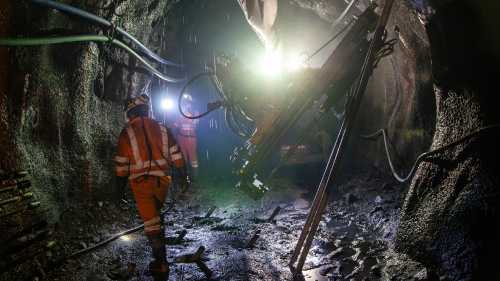
Mining plays an important role in supplying coal, metals and minerals required for power generation, infrastructure, manufacturing and economic development. However, every mine has a limited operating life. Once economically recoverable mineral reserves are exhausted, mining operations eventually have to stop.
Stopping production, however, is not the end of a mining project.
A mine leaves behind excavated land, overburden dumps, mine infrastructure, water bodies, roads and other disturbed areas. If these areas are simply abandoned, they can create environmental and safety problems for decades.
This is where Scientific Mine Closure in India becomes important.
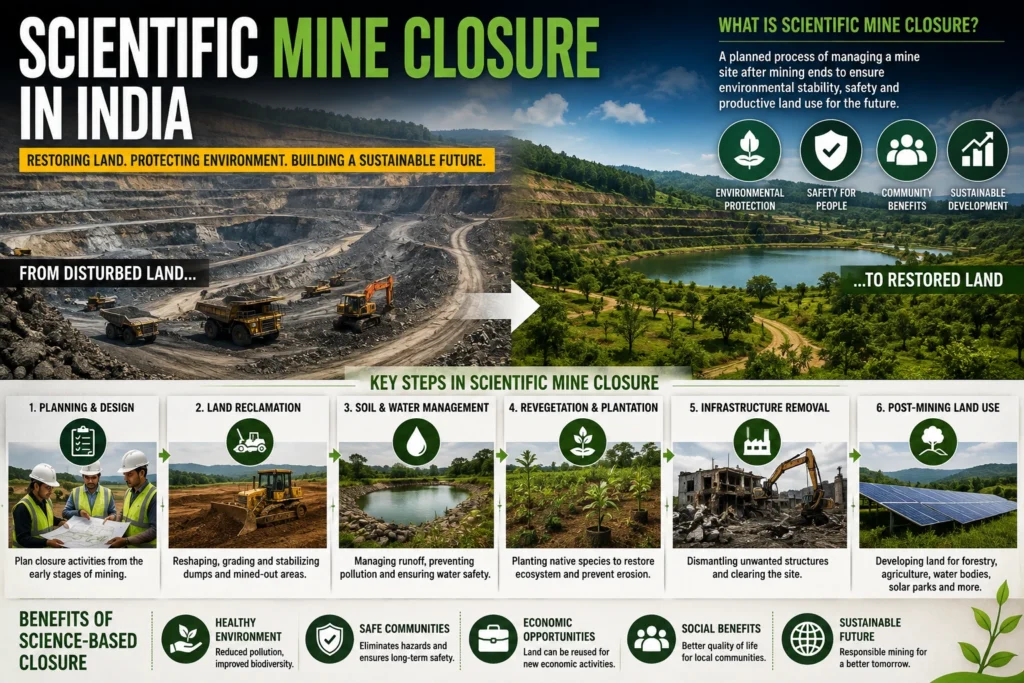
Scientific mine closure is a planned process through which a mined area is made physically stable, environmentally safe and suitable for an appropriate post-mining use. Modern mine closure can include land reclamation, water management, plantation, infrastructure removal, environmental monitoring and development of alternative uses for former mining land.
As India expands coal and mineral production, scientific mine closure is becoming an increasingly important part of sustainable mining.
What Is Scientific Mine Closure?
Scientific mine closure is the systematic process of closing a mine after production ends while reducing its long-term environmental, physical and social impacts.
Mine closure should ideally be considered from the planning stage of a mining project rather than only when mineral reserves are exhausted.
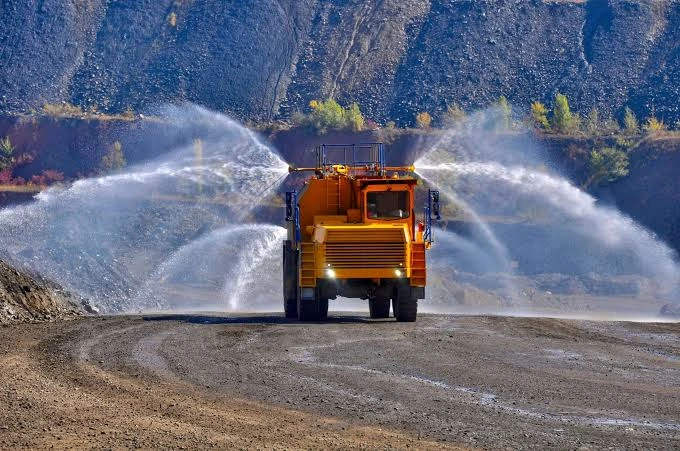
A typical mining lifecycle can be represented as:
Exploration → Mine Planning → Development → Production → Progressive Reclamation → Final Mine Closure → Post-Closure Monitoring
This approach ensures that rehabilitation takes place gradually throughout the life of the mine.
The main objective is not simply to stop mining. It is to leave the mining area in a stable and manageable condition.
Why Is Scientific Mine Closure Important in India?
India has a large mining industry covering coal, iron ore, limestone, bauxite and many other minerals.
Large-scale mining can significantly modify the natural landscape.
Open-cast mining may create large pits and overburden dumps, while underground mines can leave shafts, inclines and other infrastructure after production ends.
Without proper closure, abandoned mining areas can face problems such as:
- Unstable mine slopes and waste dumps
- Contaminated or unmanaged mine water
- Soil erosion
- Abandoned mining infrastructure
- Loss of vegetation
- Public safety risks
- Long-term environmental liabilities
Scientific mine closure attempts to manage these issues systematically.
Progressive Mine Closure vs Final Mine Closure
Two important concepts in mine closure are progressive closure and final closure.
Progressive Mine Closure
Progressive closure happens while the mine is still operating.
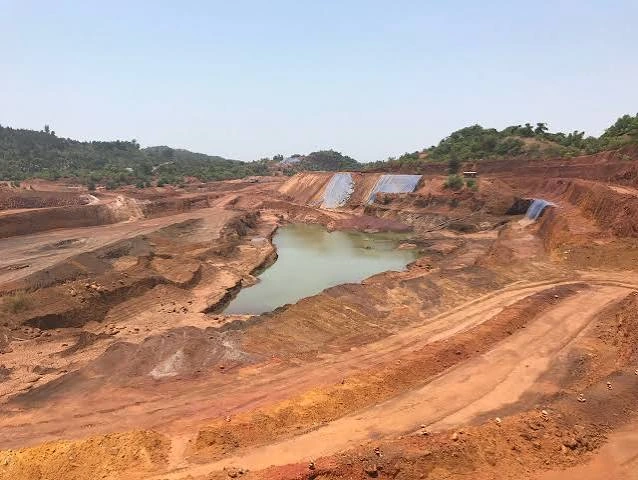
Areas that are no longer required for mining can be reclaimed before the entire mine reaches the end of its life.
For example, completed overburden dumps may be stabilised and planted with vegetation even while coal production continues elsewhere.
This approach reduces the amount of rehabilitation work required at the end of mining.
Final Mine Closure
Final mine closure begins when mining operations permanently stop.
It deals with remaining infrastructure, excavations, water management systems and other areas that could not be reclaimed during production.
Both processes are important for responsible mine management.
Major Steps in Scientific Mine Closure
A scientific mine closure programme involves several technical and environmental activities.
The exact requirements depend on the mining method, mineral, geology, environmental conditions and future land use.
However, some common activities are found across many mine closure projects.
Land Reclamation After Mining
Land reclamation is one of the most visible parts of mine closure.
Mining can significantly alter the original shape and condition of land.
During reclamation, disturbed areas may be reshaped to create more stable landforms.
Activities can include:
- Backfilling excavated areas where technically feasible
- Reshaping waste dumps
- Stabilising slopes
- Spreading topsoil
- Controlling erosion
- Developing drainage systems
The objective is to create land that remains physically stable after active mining ends.
Overburden Dump Management
Open-cast mines often generate la
Overburden Dump Management
rge quantities of overburden.
Overburden refers to soil, rock and other material that must be removed to access the mineral deposit.
This material is commonly stored in external or internal dumps.
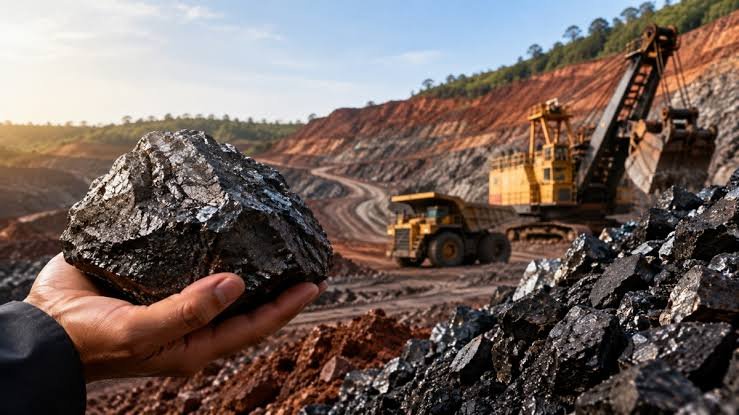
Poorly managed dumps can face erosion and slope stability problems.
During scientific mine closure, dump management can include reshaping slopes, creating drainage channels, applying topsoil and developing vegetation.
Vegetation helps reduce erosion and gradually improves the ecological condition of reclaimed areas.
Plantation and Ecological Restoration
Plantation is an important part of mine reclamation, but successful ecological restoration involves more than simply planting trees.
Species need to be selected according to local environmental conditions.
Revegetation can help:
- Reduce soil erosion
- Stabilise reclaimed surfaces
- Improve soil quality over time
- Restore vegetation cover
- Improve the appearance of mined land
Long-term monitoring is important because not every plantation survives successfully.
The objective should be the development of a stable ecosystem rather than only achieving a high number of planted trees.
Mine Water Management After Closure
Water management can continue long after mining stops.
Open pits may accumulate rainwater and groundwater, while underground mines may gradually fill with water.
Mine closure planning therefore needs to evaluate:
- Surface drainage
- Groundwater conditions
- Mine-water quality
- Pit-water accumulation
- Discharge requirements
- Long-term monitoring
In suitable conditions, mine water may potentially be treated and used for beneficial purposes.
However, any reuse depends on water quality, treatment requirements and applicable environmental standards.
What Happens to Open-Cast Mine Pits?
A common question is what happens to the large pits created by open-cast mining.
There is no single solution suitable for every mine.
Depending on geological, environmental and technical conditions, a final mine void may be:
- Partially or completely backfilled
- Converted into a water reservoir
- Stabilised and secured
- Integrated into another approved post-mining land use
The selected option requires proper technical assessment.
Simply allowing an abandoned pit to remain without safety and environmental planning is not scientific mine closure.
Closing Underground Mines
Underground mine closure involves different challenges.
Mine entries such as shafts, inclines and adits may need to be permanently secured.
The closure programme may also need to consider:
- Mine flooding
- Surface subsidence
- Gas accumulation
- Abandoned underground workings
- Groundwater interaction
- Public access
Proper records of underground workings remain important even after the mine has closed.
Future construction or development near old underground mines may depend on accurate information about the location of previous workings.
Mine Infrastructure After Closure
Mining projects develop substantial infrastructure during their operating life.
This can include:
- Workshops
- Offices
- Coal or mineral handling plants
- Conveyor systems
- Electrical installations
- Storage facilities
- Roads
- Buildings
At closure, authorities and mine operators need to determine which facilities should be removed and which may have a useful post-mining purpose.
Infrastructure that has no future use may need dismantling and the site may require rehabilitation.
Useful buildings or roads may sometimes be transferred for another approved purpose.
Post-Mining Land Use
One of the most interesting areas of modern mine closure is the development of productive post-mining land uses.
A closed mine does not necessarily have to become unused land.
Depending on local conditions, reclaimed mining land can potentially support:
- Forestry
- Agriculture
- Water reservoirs
- Renewable energy projects
- Public recreation
- Tourism
- Industrial development
- Community infrastructure
The appropriate use depends on land capability, environmental conditions, safety and local requirements.
Planning future land use before mine closure can improve the value of reclamation work.
Closed Mines and Renewable Energy
Former mining land can potentially provide opportunities for renewable energy development.
Large reclaimed areas may be suitable for solar installations where technical and environmental conditions allow.
Mine areas often already have access to roads and power infrastructure, which can sometimes make redevelopment easier.
However, suitability must be evaluated carefully.
Land stability, drainage, environmental restrictions and future maintenance requirements need to be considered before developing any project on reclaimed mining land.
Mine Closure and Local Communities
Mining projects can support local employment and businesses for many years.
When a large mine closes, the economic impact can therefore extend beyond the mining company.
Workers, contractors, transportation businesses and local suppliers may all be affected.
Modern mine closure planning increasingly considers the social transition associated with closure.
This may involve:
- Skill development
- Alternative employment opportunities
- Community infrastructure
- Consultation with local stakeholders
- Development of alternative economic activities
A successful mine closure should therefore consider both environmental rehabilitation and the long-term interests of communities around the mine.
Mine Closure Planning Should Begin Early
One of the biggest misconceptions about mine closure is that planning should begin only when a mine is almost exhausted.
Modern mining practice takes the opposite approach.
Closure considerations should begin during mine planning.
For example, the location and design of overburden dumps can influence how easily they can later be reclaimed.
Similarly, topsoil removed during mine development can be preserved for future rehabilitation.
Early planning can reduce future closure costs and environmental problems.
Role of Technology in Scientific Mine Closure
Technology is making mine closure monitoring more effective.
Mining companies can use digital tools to track reclaimed land and environmental conditions.
Useful technologies include:
- Drone surveys
- Satellite imagery
- GIS mapping
- Digital elevation models
- Water-quality sensors
- Environmental monitoring systems
Drone surveys can rapidly capture high-resolution information about dump slopes, plantation areas and reclaimed surfaces.
Satellite imagery can help track land-use changes over longer periods.
Digital monitoring can therefore provide measurable evidence of reclamation progress.
Challenges in Scientific Mine Closure
Scientific mine closure is technically complex.
Some of the major challenges include:
Long-Term Environmental Monitoring
Environmental impacts may continue after production stops, requiring monitoring for years.
Financial Requirements
Mine reclamation and closure require significant expenditure.
Uncertain Future Conditions
A mine may operate for decades, making it difficult to predict exactly what conditions will exist when closure begins.
Large Disturbed Areas
Major open-cast mines can disturb extensive areas that require progressive rehabilitation.
Community Transition
Areas economically dependent on mining may require alternative employment and development opportunities.
These challenges make early closure planning particularly important.
Scientific Mine Closure and Sustainable Mining
Sustainable mining does not mean mining without environmental impact.
Mineral extraction inevitably changes the physical environment.
The objective of sustainable mining is to manage these impacts responsibly throughout the complete life of the mine.
Scientific mine closure is therefore an essential part of sustainable mining.
A responsible mining lifecycle should include:
Responsible Extraction + Environmental Management + Progressive Reclamation + Scientific Closure
Without the final two stages, the mining lifecycle remains incomplete.
Why Mining Engineers Need to Understand Mine Closure
Mine closure is becoming an important professional area for mining engineers.
Engineers involved in mine planning need to understand how decisions made during production can affect eventual reclamation.
Important skills include:
- Mine planning
- Geotechnical engineering
- Waste dump design
- Water management
- Environmental management
- Land reclamation
- GIS and surveying
- Mine closure planning
Mining engineers increasingly work with environmental scientists, geologists, hydrologists and community specialists when developing closure plans.
This multidisciplinary approach is likely to become even more important in the future.
Future of Scientific Mine Closure in India
As India’s mining sector expands, the number of mines eventually reaching closure will also increase.
At the same time, environmental expectations surrounding mining are becoming stronger.
The future of mine closure in India is therefore likely to involve greater use of progressive reclamation, digital monitoring and productive reuse of mining land.
Closed mines may increasingly be viewed not simply as abandoned industrial areas but as land assets that can be restored and reused.
Successful projects can demonstrate that the end of mineral extraction does not have to mean the end of economic or environmental value from the land.
Conclusion
Scientific Mine Closure in India is becoming an essential part of responsible and sustainable mineral development.
A mine’s responsibility does not end when the final tonne of coal, iron ore or another mineral is extracted.
Disturbed land needs to be stabilised, waste dumps need to be managed, water systems require attention, infrastructure must be secured and reclaimed areas need long-term monitoring.
Progressive reclamation can reduce the amount of rehabilitation required at the end of a mine’s life, while final closure addresses the remaining environmental and safety issues after production stops.
Modern mine closure also creates opportunities for productive reuse of mining land through forestry, water resources, renewable energy, recreation and other suitable activities.
For mining companies, engineers and students, mine closure should therefore be understood as an integral stage of mining rather than an activity that begins only after production ends.
As India’s mining industry continues to develop, effective Scientific Mine Closure will be critical to ensuring that mineral production contributes to economic development while reducing long-term environmental liabilities.