
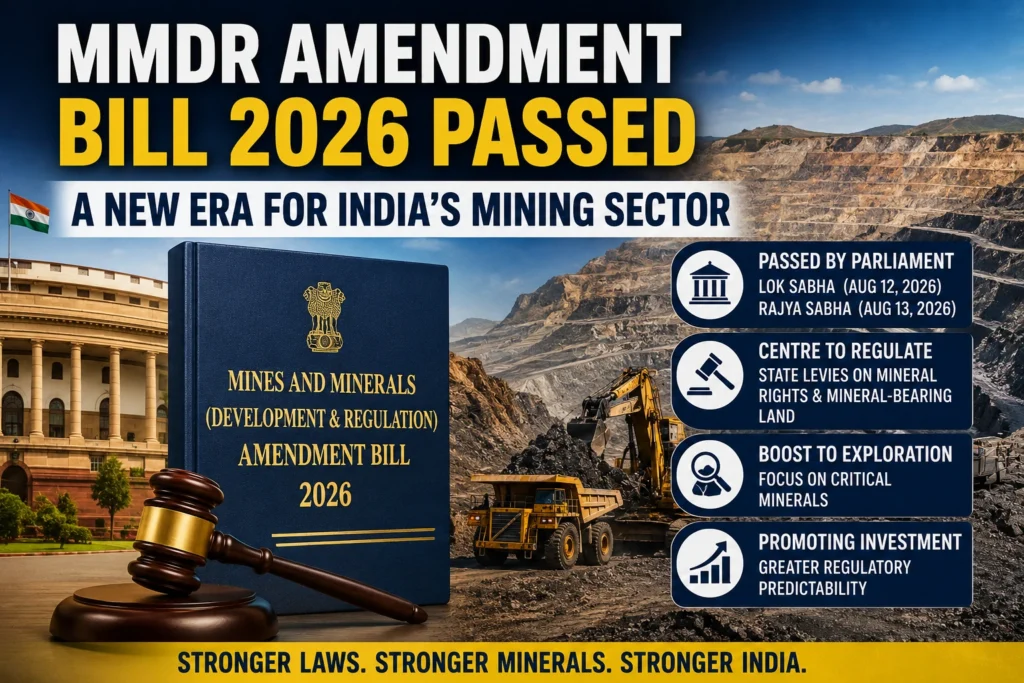
India’s mining sector has witnessed a major regulatory development with Parliament passing the MMDR Amendment Bill 2026 on August 13, 2026. The Rajya Sabha cleared the Bill on Thursday, a day after it was passed by the Lok Sabha.
The legislation proposes important changes to the regulatory framework governing mines and minerals in India, including changes related to mineral exploration and the powers of state governments to impose taxes, cesses and other levies connected with mineral rights or mineral-bearing land.
The MMDR Amendment Bill 2026 is particularly important at a time when India is trying to increase domestic mineral exploration, secure critical minerals and attract investment into the mining sector.
However, the Bill is not yet an Act. It will become law after receiving the President’s assent.
What Is the MMDR Amendment Bill 2026?
The Mines and Minerals (Development and Regulation) Amendment Bill 2026 seeks to modify India’s existing Mines and Minerals (Development and Regulation) Act, 1957.
The MMDR Act is one of the country’s primary legal frameworks for the development and regulation of mineral resources. It governs important aspects of mineral concessions, exploration, mining and the relationship between different levels of government in mineral administration.
The 2026 amendment comes after the Ministry of Mines had released proposals for changes to the MMDR framework earlier this year and invited comments from stakeholders.
The Bill’s passage marks the latest step in the government’s broader effort to modernise India’s mining regulations and increase exploration of minerals that are strategically important for the country’s economy.
Parliament Passes MMDR Amendment Bill 2026
The legislative process moved quickly this week.
The Lok Sabha passed the MMDR Amendment Bill 2026 on August 12, 2026. The Rajya Sabha subsequently approved it on August 13, completing Parliament’s approval process. Reports said both Houses passed the legislation by voice vote.
The next major step is the President’s assent.
Until that happens, the Bill should technically be referred to as the MMDR Amendment Bill 2026, rather than the MMDR Amendment Act 2026.
Key developments at a glance
- Lok Sabha passed the Bill on August 12, 2026.
- Rajya Sabha passed it on August 13, 2026.
- The Bill has now cleared both Houses of Parliament.
- Presidential assent is still required before it becomes law.
- The legislation includes provisions affecting state levies related to mineral rights.
- The reforms are also aimed at strengthening mineral exploration, including critical minerals.
What Changes Does the MMDR Amendment Bill 2026 Propose?
One of the most significant aspects of the MMDR Amendment Bill 2026 concerns the taxation and levies associated with mineral rights and mineral-bearing land.
According to reports on the legislation passed by Parliament, the amendment gives the Central Government greater authority to regulate the ability of state governments to impose taxes, cesses or other levies connected with mineral rights or mineral-bearing land.
This represents an important change in India’s mining regulatory landscape because mineral-rich states have traditionally played a major role in administering mining activities and receiving revenue from mineral development.
The proposed framework is intended to create greater consistency in the way such levies are regulated across different states.
Why Is Regulation of Mining Levies Important?
Mining companies operate in an environment where the cost of extracting a mineral depends on several factors.
These can include:
- Royalty payments
- Auction premiums
- Taxes and statutory charges
- Land-related costs
- Environmental compliance
- Exploration expenses
- Infrastructure costs
- Processing and transportation expenses
If additional state-level levies vary significantly between jurisdictions, companies may face greater uncertainty when evaluating mining projects.
The government’s argument behind greater central regulation is therefore linked to creating a more predictable investment environment.
For mining companies, greater predictability can make it easier to estimate the long-term economics of a mining project.
Impact on Mineral-Rich States
The proposed changes could have significant implications for states where mining contributes substantially to government revenue.
States such as Odisha, Jharkhand, Chhattisgarh, Rajasthan and other mineral-rich regions have large mining sectors and receive substantial economic benefits from mineral development.
The debate around the amendment is therefore not only about mining companies.
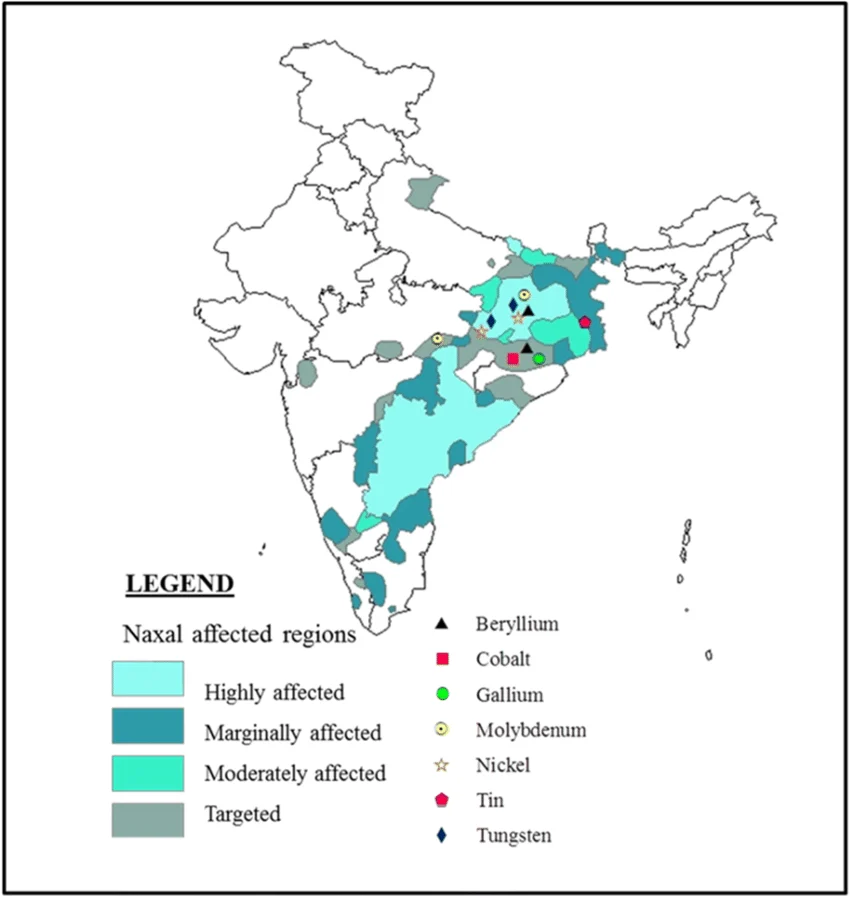
It also involves the distribution of regulatory and fiscal powers between the Centre and the states.
Reports have highlighted concerns from some state-level political groups that the amendment could affect state revenue and autonomy. For example, Jharkhand opposition to the changes has focused on the potential revenue implications for the state.
At the same time, supporters argue that a more uniform regulatory framework could encourage investment and reduce uncertainty for the mining industry.
MMDR Amendment Bill 2026 and Critical Mineral Exploration
Another important objective associated with the 2026 mining reforms is accelerating exploration of critical minerals.
Critical minerals have become increasingly important because they are required for modern technologies and strategic industries.
These include minerals used in:
- Electric vehicle batteries
- Renewable energy equipment
- Electronics
- Energy storage
- Defence applications
- Advanced manufacturing
India has already been increasing its focus on critical mineral exploration through the National Critical Mineral Mission and recent changes to the mining framework.
The Ministry of Mines has also been working to reduce exploration risks and encourage greater participation in mineral exploration. Earlier government measures included financial support through the National Mineral Exploration and Development Trust for eligible exploration activities.
The passage of the MMDR Amendment Bill 2026 therefore comes as part of a broader policy push to strengthen India’s domestic mineral resource base.
Why Critical Minerals Matter for India
India’s industrial development increasingly depends on minerals that were previously considered less strategically important.
Lithium, graphite, rare earth elements, nickel and other critical minerals are now closely linked to emerging industries.
For example, lithium and graphite are important for battery technologies, while rare earth elements are essential for several advanced manufacturing applications.
A stronger domestic exploration framework could help India identify and develop more of these resources.
However, exploration is only the first stage.
The complete mineral development cycle includes:
Exploration → Resource estimation → Feasibility studies → Auction/allocation → Mine development → Production → Mineral processing
Therefore, faster exploration must eventually be followed by efficient project development and responsible mining.
What Could the Amendment Mean for Mining Companies?
The MMDR Amendment Bill 2026 could influence mining companies in several ways.
Greater Regulatory Predictability
A more standardised approach to state-level mining levies could make it easier for companies to estimate project costs.
Potentially Better Investment Conditions
Mining projects often require significant capital and long development timelines. Regulatory certainty can be an important factor when companies evaluate investment decisions.
Increased Focus on Exploration
The government’s continued emphasis on critical minerals could create more opportunities for exploration companies, mining firms and technology providers.
Stronger Central Coordination
The amendment represents a greater role for the Central Government in certain aspects of mineral-related taxation and regulation.
What Does It Mean for Mining Engineers?
The MMDR Amendment Bill 2026 is not only relevant to mining companies and policymakers. It is also important for mining engineering students and professionals.
Mining engineers increasingly need to understand both technical and regulatory aspects of mining.
A modern mining professional may need knowledge of:
- Mine planning
- Mineral exploration
- Mining legislation
- Mineral economics
- Environmental regulations
- Critical minerals
- Mine safety
- Sustainable mining
- Digital mining technologies
- Project management
For students preparing for mining examinations, current developments in the MMDR Act can also be important for general awareness and mining-law questions.
Understanding why a regulation has been introduced is often more useful than simply memorising its name.
How Is This Different From the MMDR Changes of 2025?
The 2026 Bill should also be viewed in the context of the reforms already introduced through the MMDR Amendment Act 2025.
The 2025 reforms included several changes intended to improve mineral exploration and development. For example, government information on the earlier amendment highlighted measures relating to deep-seated minerals, exploration support and mineral auctions.
The 2026 Bill builds on this continuing reform process.
This shows that India’s mining legislation is undergoing a series of changes rather than being modified through a single reform.
For mining companies and professionals, keeping track of each amendment is therefore becoming increasingly important.
Challenges and Questions Ahead
Although the passage of the MMDR Amendment Bill 2026 is a major development, its final impact will depend on how the provisions are implemented.
Some important questions will become clearer after the legislation receives Presidential assent and the government issues the necessary rules or notifications.
Key areas to watch include:
- How the new framework for state levies will operate in practice
- How states respond to the changes
- Whether mining investment increases
- Whether exploration of critical minerals accelerates
- How quickly new mineral resources move from exploration to production
- How the Centre and states coordinate implementation
The practical impact of any mining reform ultimately depends on implementation at the ground level.
What Happens Next?
The immediate next step is Presidential assent.
Once the President gives assent and the legislation comes into force through the applicable legal process, the government can move ahead with implementation of the amended provisions.
Mining companies, state mining departments, investors and other stakeholders will then need to understand the detailed rules and notifications associated with the new framework.
For the mining industry, the implementation phase will be just as important as Parliament’s approval.
Conclusion
The MMDR Amendment Bill 2026 marks another significant step in the ongoing reform of India’s mining regulatory framework.
Parliament has now passed the Bill, with the Lok Sabha approving it on August 12 and the Rajya Sabha giving its approval on August 13, 2026. The Bill still requires the President’s assent before it becomes law.
One of the most important changes concerns the Central Government’s role in regulating state-level taxes, cesses and other levies associated with mineral rights and mineral-bearing land. At the same time, the legislation is linked to India’s wider objective of increasing exploration and development of critical minerals.
For India’s mining sector, the reform could have implications for investment, mineral exploration, project economics and Centre-State relations.
The real test, however, will come during implementation.
As India seeks to secure critical minerals and increase domestic mineral production, a predictable and effective regulatory framework will be essential. The MMDR Amendment Bill 2026 could become an important part of that transition once it receives Presidential assent and its provisions begin to take effect.



2 Responses
[618539]supplies professional anti-violence equipments and solutions for the whole world with strong and perfect production capacity. anti-violence.org
Đọc xong thấy rất bổ ích. Letco chuyên du học Hàn Quốc, tư vấn 1-1 theo năng lực và ngân sách từng bạn. Ghé thăm letco.vn để được hỗ trợ.