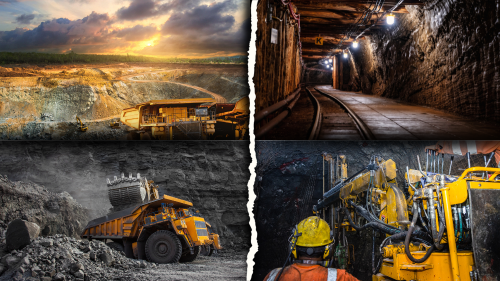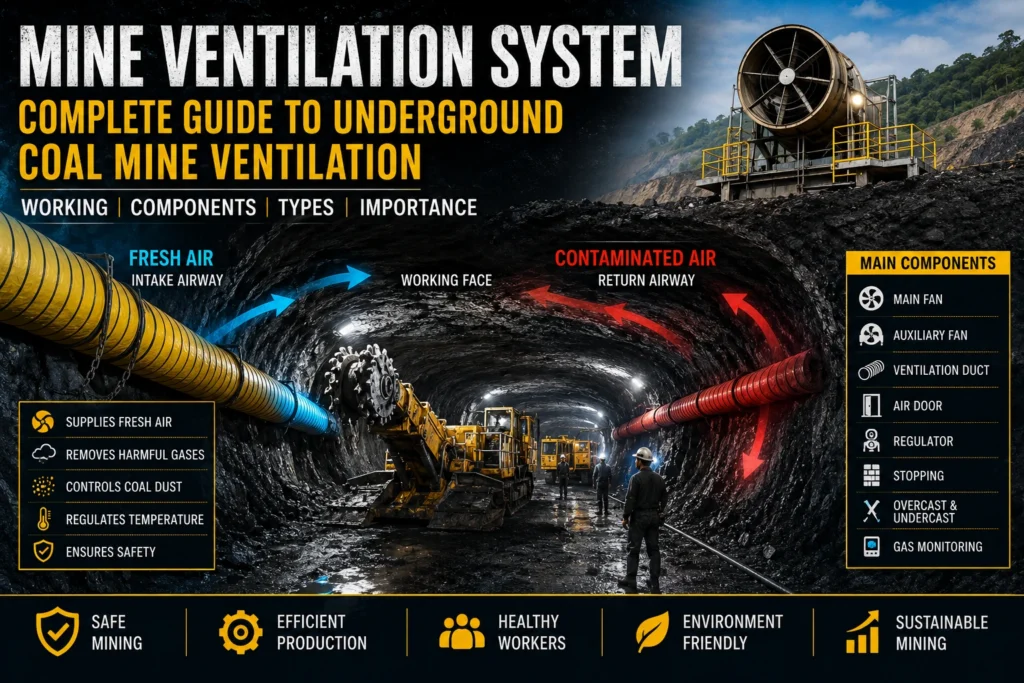
A mine ventilation system is one of the most important safety and operational systems used in underground mining. It supplies fresh air to working areas and removes methane, coal dust, heat, smoke, moisture and harmful gases from the mine atmosphere.
Underground mining activities continuously affect air quality. Workers consume oxygen, machinery produces heat and fumes, blasting generates toxic gases, and coal seams may release methane. Therefore, a reliable Mine Ventilation System is essential for maintaining safe and comfortable working conditions.
The system is not limited to installing a large fan at the surface. It includes a complete network of intake airways, return airways, fans, stoppings, regulators, doors, air crossings and monitoring instruments. All these elements must work together to distribute air in the required quantity.
For Mining Engineering students, Mining Sirdar, Overman and GATE Mining aspirants, this topic is especially important because questions related to ventilation circuits, fans, air quantity, mine gases and ventilation devices are frequently asked in examinations.
What Is a Mine Ventilation System?
A Mine Ventilation System is a planned arrangement used to circulate fresh atmospheric air through underground mine workings. Fresh air enters through an intake shaft, incline or roadway and travels towards working districts. After collecting gases, dust and heat, the contaminated air returns to the surface through return airways.
The main purpose of this circulation is to maintain sufficient oxygen and keep harmful substances below their permissible limits. Air must reach every active working face, travelling roadway, development heading and machinery location where workers may be present.
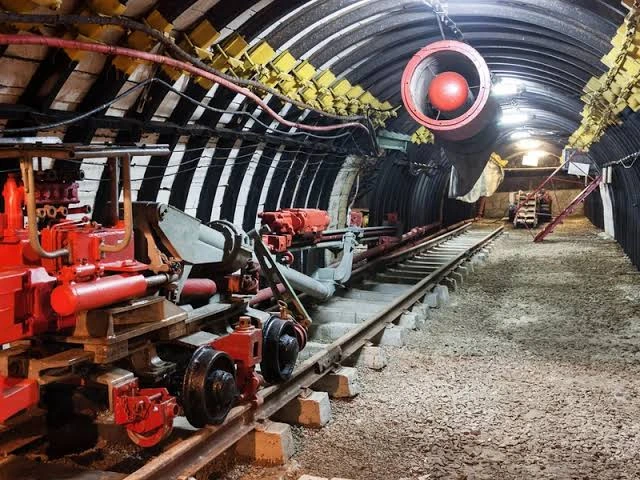
The basic flow of air can be understood in three stages:
- Fresh air enters through the intake airway.
- Air passes through working districts and active faces.
- Contaminated air leaves through the return airway.
A properly designed Mine Ventilation System prevents fresh intake air from mixing unnecessarily with return air. This separation improves ventilation efficiency and reduces the possibility of contaminated air reaching workers.
Why Is a Mine Ventilation System Important?
The importance of a Mine Ventilation System extends beyond providing breathable air. Underground mines contain several atmospheric hazards that can become dangerous when ventilation is inadequate.
Methane released from coal seams may accumulate in poorly ventilated areas. When its concentration enters the explosive range and an ignition source is present, a serious explosion can occur. Ventilation continuously dilutes methane and carries it towards the return airway.
A good ventilation arrangement also helps to:
- Supply oxygen to underground workers.
- Remove methane and toxic mine gases.
- Control airborne coal and stone dust.
- Reduce heat and excessive humidity.
- Remove blasting fumes and diesel emissions.
- Improve visibility and working efficiency.
An effective Mine Ventilation System also supports emergency response. During a mine fire or gas incident, knowledge of ventilation routes helps mine officials predict the movement of smoke and contaminated air.
How Does a Mine Ventilation System Work?
A Mine Ventilation System works by creating a pressure difference between the intake and return sides of the mine. This pressure difference is generally produced by a mechanically operated main fan installed at the surface.
When the fan operates, air moves through the mine along the path created by the ventilation network. The amount of air reaching a district depends on the resistance of the airways, fan pressure, roadway dimensions and ventilation controls.
Fresh air is directed towards working faces through intake roadways. At the face, it mixes with gases, dust and heat generated during cutting, drilling, blasting and transportation. The used air then enters the return airway and is exhausted to the atmosphere.
Ventilation devices are used to guide the airflow correctly:
- Stoppings separate intake and return airways.
- Regulators control air quantity in different districts.
- Air doors allow the passage of workers and vehicles.
- Overcasts and undercasts help air currents cross without mixing.
- Brattices and ducts direct air towards blind headings.
The efficiency of the Mine Ventilation System depends on preventing leakage and short-circuiting. If air takes an easier route instead of reaching the working face, the required area may receive insufficient ventilation.
Main Components of a Mine Ventilation System
A complete Mine Ventilation System consists of several components, each having a specific function. The main fan is the central component because it produces the pressure required to move air throughout the mine.
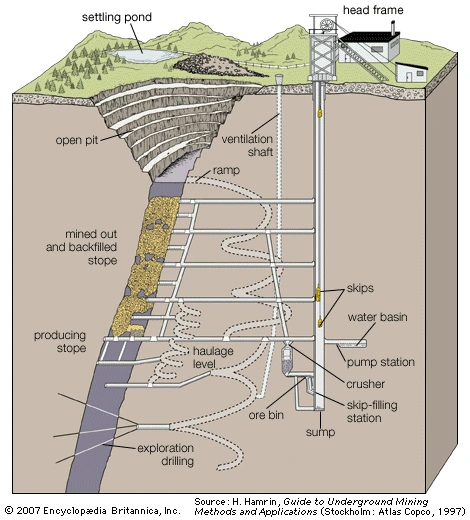
Main ventilation fan
The main fan is generally installed at the surface near the upcast or return opening. It handles the total quantity of air circulating through the mine. Axial-flow and centrifugal fans are commonly used depending on mine requirements.
Auxiliary fan and ventilation duct
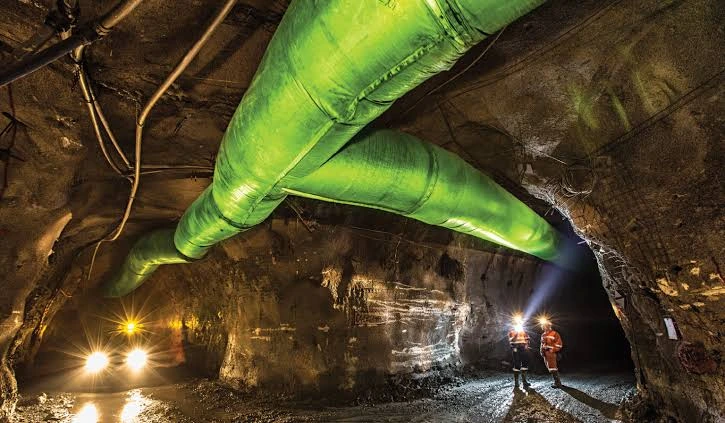
An auxiliary fan provides air to development headings, drivages and blind ends that are not ventilated directly by the main air current. Flexible or rigid ducts carry air near the working face.
Ventilation control devices
Ventilation control devices distribute air according to the mine plan. Important devices include:
- Stoppings
- Air doors
- Regulators
- Brattices
- Air crossings
- Ventilation ducts
These components must be inspected regularly. Damage to a stopping, door or duct can disturb the entire Mine Ventilation System and reduce airflow at critical locations.
Types of Mine Ventilation System
The Mine Ventilation System may be classified according to the source of airflow and the arrangement of the main fan.
Natural ventilation
Natural ventilation occurs because of differences in air temperature, density and atmospheric pressure between mine openings. Although it may produce some airflow, it is not reliable enough for modern mining operations.
Mechanical ventilation
Mechanical ventilation uses fans to create controlled airflow. It is the standard method used in underground coal and metal mines because air quantity can be adjusted according to changing production and gas conditions.
Mechanical systems are commonly arranged as:
- Exhaust system: The main fan draws contaminated air out of the mine.
- Forcing system: The main fan forces fresh air into the mine.
- Combined system: Forcing and exhaust arrangements are used together.
Auxiliary ventilation
Auxiliary ventilation is used in headings where there is only one mine opening and natural through-flow cannot occur. A fan and duct arrangement supplies fresh air or removes contaminated air from the face.
The selection of a suitable Mine Ventilation System depends on mine depth, layout, methane emission, mining method, production level and statutory requirements.
Air Quantity in a Mine Ventilation System
Air quantity is a basic parameter used to evaluate a Mine Ventilation System. It represents the volume of air passing through an airway per unit time and is commonly expressed in cubic metres per second.
Air quantity is calculated using the relationship:
Air quantity = Cross-sectional area × Air velocity
The required air quantity depends on several factors:
- Number of workers underground
- Methane and gas emission rate
- Quantity of explosives used
- Diesel-powered equipment
- Mine temperature and humidity
- Dust generation
- Production and development activities
Supplying excessive air unnecessarily increases fan power consumption, while insufficient air creates unsafe conditions. Therefore, ventilation engineers must balance safety requirements with energy efficiency.
Regular ventilation surveys are conducted to measure air velocity, pressure, temperature, humidity and gas concentration. These observations help determine whether the Mine Ventilation System is performing according to the approved ventilation plan.
Hazards Caused by Poor Mine Ventilation System
An inadequate Mine Ventilation System can create several serious hazards. The most dangerous is the accumulation of methane in underground coal mines. Methane is colourless, odourless and combustible, making continuous monitoring essential.
Carbon monoxide may be produced by mine fires, explosions, blasting and incomplete combustion. Even at low concentrations, prolonged exposure can be harmful. Carbon dioxide and other asphyxiating gases may also reduce the oxygen content of mine air.
Poor ventilation can result in:
- Methane accumulation and explosion risk
- Carbon monoxide poisoning
- Oxygen deficiency
- High dust concentration
- Heat stress and dehydration
- Poor visibility
- Reduced worker productivity
Coal dust is another major concern. Fine airborne dust can affect respiratory health, while deposited combustible dust can contribute to the spread of an explosion. An efficient Mine Ventilation System helps dilute airborne dust, although water spraying and dust suppression are also required.
Maintenance of a Mine Ventilation System
The performance of a Mine Ventilation System depends on regular inspection and maintenance. Even a well-designed network can become ineffective if air doors are left open, stoppings are damaged or ventilation ducts develop leakage.
Mine officials should conduct periodic ventilation surveys and compare actual air quantities with planned values. Any significant reduction in airflow must be investigated immediately.
Important maintenance practices include:
- Inspecting main and auxiliary fans
- Repairing damaged stoppings and doors
- Checking ventilation ducts for leakage
- Calibrating gas and airflow instruments
- Updating ventilation plans
- Monitoring methane continuously
- Training workers in ventilation discipline
Workers also play an important role. Unauthorized changes to regulators, doors, ducts or brattices can disturb the Mine Ventilation System and expose an entire district to danger.
Modern Technology in a Mine Ventilation System
Technology is making the Mine Ventilation System more intelligent and energy-efficient. Traditional ventilation systems often operate fans continuously at fixed speed, even when activity in some districts is low.
Modern mines use sensors to monitor methane, carbon monoxide, airflow, temperature and worker location. This information can be transmitted to a surface control room for real-time monitoring.
Ventilation-on-demand systems adjust airflow according to actual underground requirements. For example, fan speed may increase when workers or diesel machinery enter a district and reduce when the area is inactive.
Other modern developments include:
- IoT-based gas sensors
- Variable-frequency fan drives
- Remote ventilation monitoring
- Computerized network simulation
- Automated alarms
- Artificial intelligence-based airflow control
These technologies improve the reliability of the Mine Ventilation System while reducing electricity consumption and operating costs.
Mine Ventilation System for Students and Mining Professionals
Understanding the Mine Ventilation System is essential for both students and working professionals. Examination questions may involve ventilation devices, fan arrangements, mine gases, air measurement and ventilation calculations.
Students should study the topic conceptually instead of memorizing isolated definitions. They should understand how intake and return airways are arranged, why pressure difference is required and how ventilation controls direct airflow.
Important areas for examination preparation include:
- Natural and mechanical ventilation
- Forcing and exhaust systems
- Auxiliary ventilation
- Mine fans and fan laws
- Air quantity and velocity
- Mine resistance
- Ventilation devices
- Methane and other mine gases
For professionals, ventilation knowledge is directly connected with workplace safety. Mining Sirdars, Overmen and managers must recognize signs of poor ventilation and take immediate corrective action.
Conclusion: Importance of a Mine Ventilation System
A reliable Mine Ventilation System is the foundation of safe underground mining. It supplies oxygen, removes hazardous gases, controls dust, reduces heat and creates suitable working conditions.
The system includes fans, airways, ducts, stoppings, regulators, doors and monitoring instruments. Each component must function correctly to ensure that sufficient air reaches every active working area.
As mines become deeper and more mechanized, ventilation challenges will continue to increase. Digital sensors, automated fan control and ventilation-on-demand systems will play a major role in improving future mine safety.
For students and mining professionals, understanding the Mine Ventilation System is essential for examinations, statutory responsibilities and safe mine operation.
FAQs About Mine Ventilation System
What is the main purpose of a Mine Ventilation System?
Its main purpose is to supply fresh air to underground workings and remove methane, toxic gases, dust, heat and moisture.
Which fan is used in a Mine Ventilation System?
Axial-flow and centrifugal fans are commonly used as main ventilation fans. Auxiliary fans are used in development headings and blind ends.
What is an intake airway?
An intake airway carries fresh air from the surface towards underground working areas.
What is a return airway?
A return airway carries contaminated air from working districts towards the surface exhaust opening.
Why is auxiliary ventilation required?
Auxiliary ventilation is required in blind headings where a natural through-flow of air is not possible.
What happens when a Mine Ventilation System fails?
Ventilation failure may cause methane accumulation, oxygen deficiency, toxic gas exposure, heat stress and explosion risk.
How is airflow measured in underground mines?
Air velocity is measured using instruments such as an anemometer, and air quantity is calculated by multiplying velocity by airway area.
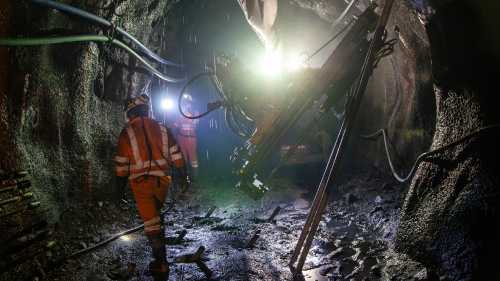
Image ALT Text: Mine Ventilation System showing fresh intake air, underground workings, ventilation fans and return airways.