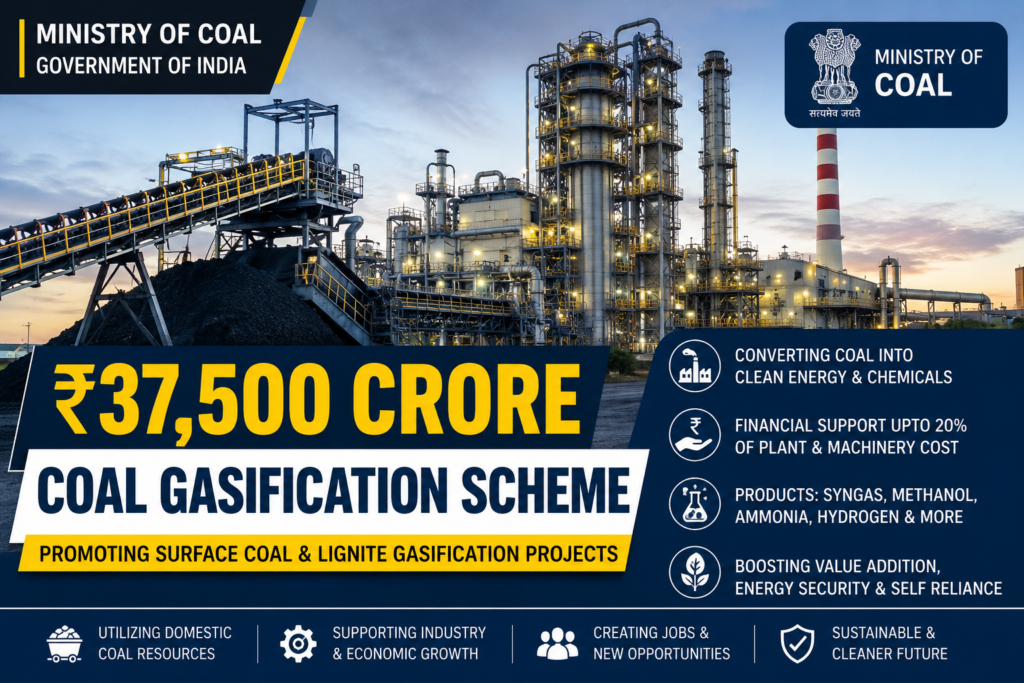
The Ministry of Coal has invited applications under the Government of India’s ₹37,500 crore scheme for promoting surface coal and lignite gasification projects.
The latest development is important for mining, energy, chemical and industrial companies because it aims to encourage the conversion of coal and lignite into valuable products instead of using them only through conventional combustion.
The scheme was approved by the government on 13 May 2026. Scheme guidelines were issued on 25 June 2026, followed by the Request for Proposal on 7 July 2026. Eligible companies and project developers can now submit proposals under the scheme.
Coal Gasification Scheme in India: Key Highlights
The Coal Gasification Scheme in India has a total financial outlay of ₹37,500 crore.
Under the scheme, eligible surface coal or lignite gasification projects may receive financial assistance of up to 20% of the cost of plant and machinery.
However, the financial incentive for a single project is capped at ₹5,000 crore.
The scheme is designed to support new projects that convert coal or lignite into useful products such as:
- Syngas
- Methanol
- Ammonia
- Ammonium nitrate
- Synthetic natural gas
- Hydrogen
- Other chemical feedstocks
What Is Surface Coal Gasification?
Surface coal gasification is a process in which coal is converted into a combustible gas mixture under controlled temperature and pressure conditions.
The gas produced during the process is generally known as synthesis gas or syngas. It mainly contains carbon monoxide and hydrogen.
Syngas can be further processed to manufacture fuels, fertilizers and industrial chemicals.
Unlike underground coal gasification, surface gasification is carried out in a dedicated industrial plant after coal is extracted from the mine.
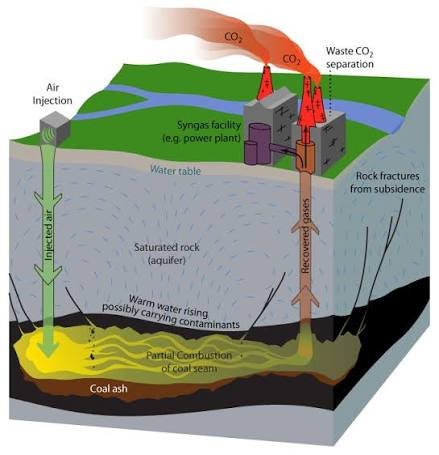
Why Is the Coal Gasification Scheme Important?
India has large coal reserves but depends heavily on imports for several energy products, chemicals and industrial raw materials.
Coal gasification can help India use its domestic coal resources for higher-value applications.
The scheme may provide the following benefits:
Reduced Import Dependence
Coal gasification can support domestic production of methanol, ammonia, hydrogen and other chemicals that are currently imported in significant quantities.
Better Value Addition
Instead of using coal only for power generation, gasification allows it to be converted into multiple industrial products.
Growth of New Mining-Linked Industries
Large gasification plants can create demand for coal production, coal handling, transportation, equipment manufacturing and skilled technical workers.
Support for Energy Security
Domestic production of fuels and chemicals can reduce exposure to fluctuations in international energy prices and supply chains.
Opportunities for Mining and Engineering Professionals
The expansion of coal gasification projects can create opportunities for professionals from mining, chemical, mechanical, electrical and environmental engineering backgrounds.
Mining engineers may contribute in areas such as:
- Coal quality management
- Mine planning and production
- Coal blending
- Material handling
- Safety management
- Environmental compliance
- Project coordination
- Coal supply planning
The projects may also generate demand for trained operators, safety officers, technicians and maintenance personnel.
Challenges in Coal Gasification Projects
Although coal gasification offers major industrial opportunities, projects require high investment and advanced technology.
Some important challenges include:
- High capital cost
- Water requirement
- Carbon dioxide emissions
- Complex plant operation
- Coal quality variation
- Waste and ash management
- Need for carbon capture technologies
The long-term success of such projects will depend on efficient technology, proper environmental safeguards and reliable coal supply.
Conclusion
The ₹37,500 crore Coal Gasification Scheme in India is a major step towards increasing the industrial use of domestic coal and lignite.
By providing financial support for new projects, the government aims to reduce import dependence, promote value addition and strengthen India’s energy and chemical sectors.
The scheme could also create new opportunities for mining companies, project developers, equipment manufacturers and engineering professionals.
Frequently Asked Questions
What is the total outlay of the Coal Gasification Scheme?
The total financial outlay of the scheme is ₹37,500 crore.
How much financial support can a project receive?
Eligible projects may receive an incentive of up to 20% of the cost of plant and machinery, subject to the scheme conditions.
What is the maximum incentive for one project?
The maximum financial incentive for a single project is capped at ₹5,000 crore.
What products can be manufactured through coal gasification?
Coal gasification can produce syngas, methanol, ammonia, hydrogen, synthetic natural gas and other industrial chemicals.
Which ministry is implementing the scheme?
The scheme is being implemented by the Ministry of Coal, Government of India.