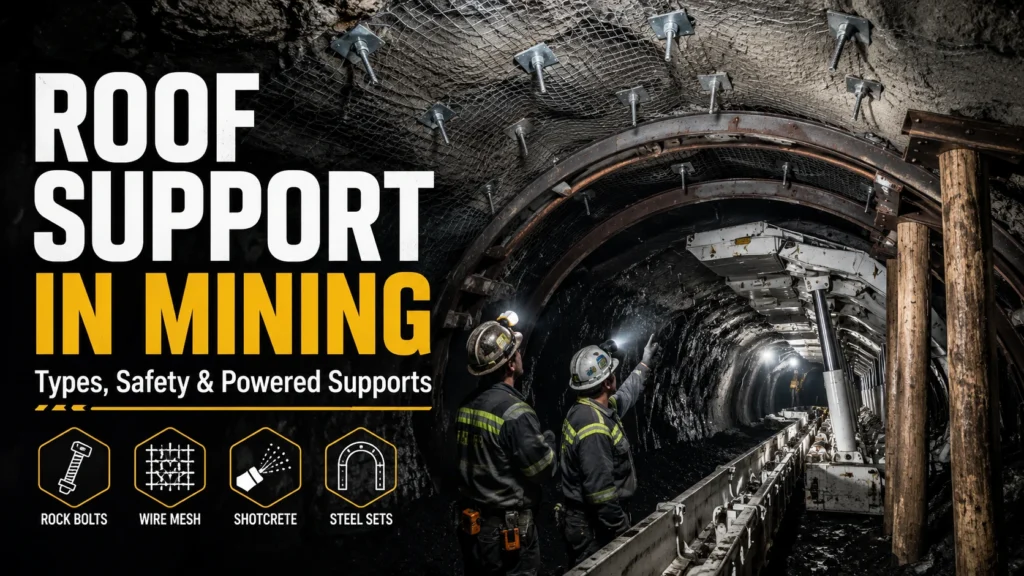
Roof Support in Mining is one of the most important and most fundamental topics in mine safety and ground control that every mining engineering student, ground control engineer, and underground mine professional must clearly understand, because falls of roof are the single largest cause of accidents and fatalities in underground mines.
From simple timber props and steel arches to rock bolts, shotcrete, and modern hydraulic powered supports on longwall faces, Roof Support in Mining covers the entire range of methods used to keep the roof of an underground excavation safely in place and protect the people and equipment working beneath it.
In this complete guide by MiningGyan, we cover everything about Roof Support in Mining – from its precise definition and meaning to its full classification, all the main types of support, powered roof supports, the factors that decide support choice, safety and the support plan, and competitive exam MCQs – all in one structured and detailed article.
By the end of this guide, you will have a thorough, structured, and exam-ready understanding of Roof Support in Mining and every related concept that accompanies it in ground control textbooks and competitive examinations across India.
What is Roof Support in Mining?
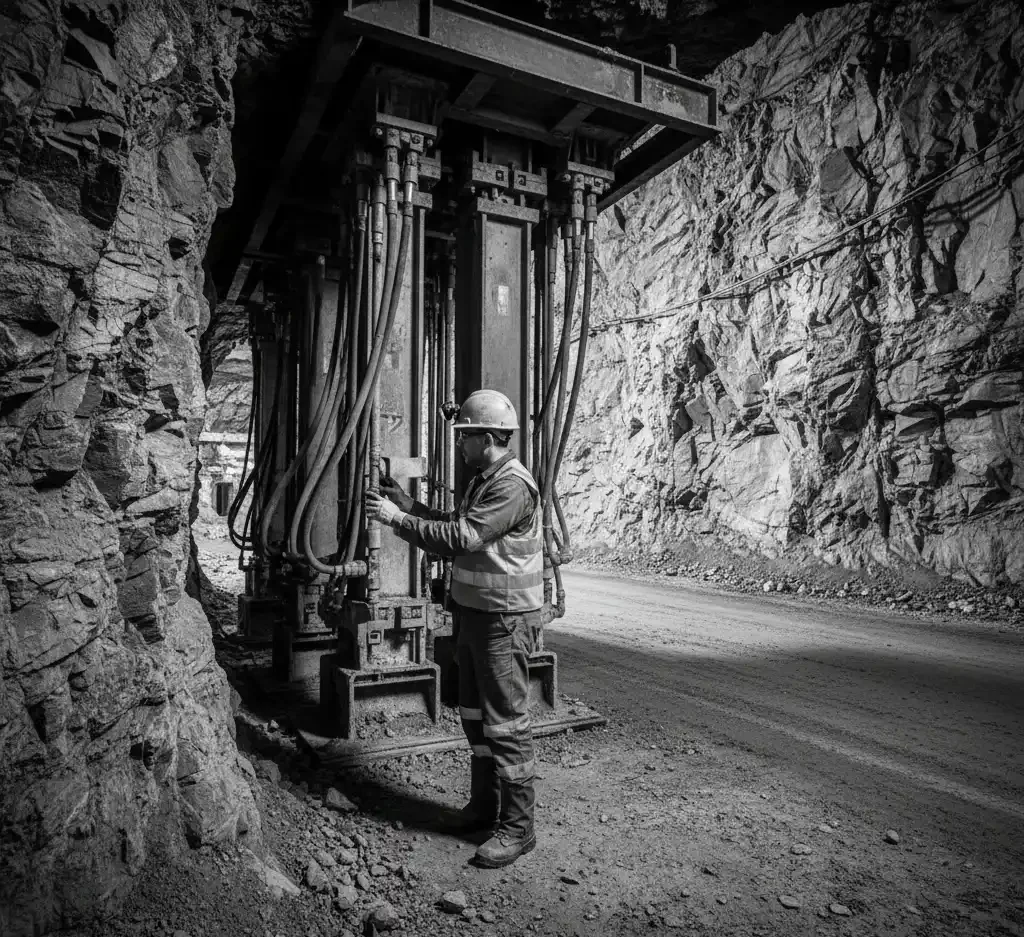
Roof Support in Mining is the use of natural pillars or artificial support elements such as timber, steel, rock bolts, shotcrete, and powered supports to hold up the roof of an underground excavation and prevent the overlying rock from falling into the working area.
The defining purpose of Roof Support in Mining is safety and stability – whenever rock is removed underground, the roof above the new opening loses its support and tends to sag and fall, so a support system must be installed to carry the load of the roof rock and keep the excavation open and safe throughout its working life.
| Key Term | Meaning in Ground Control |
|---|---|
| Roof Support | System of supports keeping the roof of an excavation stable |
| Fall of Ground | Collapse of roof or side rock into the working area |
| Natural Support | Pillars of in-situ rock or ore left to support the roof |
| Artificial Support | Man-made supports such as bolts, timber, steel, or shotcrete |
| Active Support | Support that applies load to the roof on installation |
| Passive Support | Support that loads up only as the roof moves |
| Powered Support | Self-advancing hydraulic supports used on longwall faces |
| Support Plan | An approved plan fixing the type and spacing of supports |
Why is Roof Support Important in Mining?
Roof Support in Mining is critically important because falls of roof and sides are the leading cause of death and serious injury in underground mines, and a properly designed and installed support system is the primary defence that protects miners from this hazard.
Beyond safety, Roof Support in Mining is also essential for keeping roadways and working places open and usable throughout the life of the mine, for protecting equipment and ventilation, and for allowing safe and continuous production without interruption from ground falls.
| Reason | Why Roof Support Matters |
|---|---|
| Safety of Miners | Roof falls are the largest single cause of underground fatalities |
| Keeping Openings Usable | Maintains roadways and working places throughout mine life |
| Protecting Equipment | Prevents damage to machinery and services from falls |
| Continuous Production | Avoids stoppages caused by ground control problems |
| Legal Compliance | Required under DGMS regulations and an approved support plan |
Classification of Roof Support in Mining
Roof Support in Mining is classified in several ways, and understanding these classifications is one of the most important and most frequently tested parts of the ground control syllabus, because the same support can be described in different ways depending on the basis of classification.
Natural Support vs Artificial Support
Natural support uses pillars of the in-situ rock or ore left unmined to hold up the roof, as in bord and pillar mining, while artificial support uses man-made elements such as timber, steel, rock bolts, and shotcrete that are installed into or against the rock to support the roof.
Active Support vs Passive Support
An active support applies a load to the roof at the time it is installed – such as a tensioned rock bolt or a pre-loaded hydraulic prop – while a passive support does not load the roof on installation and only develops its supporting force as the roof begins to sag and move against it.
Temporary Support vs Permanent Support
Temporary support is installed to keep a place safe for a short time, such as while a heading is being advanced or before permanent support is set, while permanent support is designed to hold the roof for the full working life of the roadway or excavation.
| Basis of Classification | Type 1 | Type 2 |
|---|---|---|
| Source of Support | Natural support (pillars) | Artificial support (bolts, timber, steel) |
| Loading Action | Active support (loads roof on install) | Passive support (loads up as roof moves) |
| Duration | Temporary support (short term) | Permanent support (full life) |
| Material | Timber and steel supports | Rock bolts, shotcrete, and powered supports |
Types of Roof Support in Mining
Roof Support in Mining includes a wide range of methods, from the oldest timber props to the most modern hydraulic powered supports, and the choice depends on the rock conditions, the size and life of the opening, and the mining method being used.
Timber Support
Timber support uses wooden props, bars, and frames to support the roof and sides, and it is the oldest method of roof support – cheap, light, and giving an audible warning by cracking before it fails, though it is combustible and decays over time. MiningGyan covers this in detail in its dedicated guide on Timbering in Mining.
Steel Support
Steel support uses steel props and steel arches – often yielding arches that can compress slightly under load – to support roadways, and steel is much stronger, more durable, and fire-resistant than timber, though it is heavier and more expensive and fails more suddenly without warning.
Rock Bolts
Rock bolts are steel rods or tubes anchored into drilled holes that reinforce the rock mass and tie weak roof layers to stronger rock above, and they are the most widely used modern roof support in roadways and development headings. MiningGyan covers this fully in its dedicated guide on Rock Bolt in Mining.
Shotcrete
Shotcrete is concrete sprayed at high velocity onto the roof and walls to seal the rock, bind loose blocks, and form a structural lining, and it is often used together with rock bolts and mesh for complete ground support. MiningGyan covers this in its dedicated guide on Shotcrete in Mining.
Wire Mesh and Straps
Wire mesh and steel straps are used together with rock bolts to hold back the small pieces of loose rock that can fall between the bolts, giving effective surface control over the roof and walls of an excavation.
Cribs, Chocks, and Packs
Cribs and chocks are built by stacking timber or other materials to form strong pillars of support, and packs of waste rock or other fill are built along roadways and goaf edges to give standing support where extra roof control is needed.
Powered Hydraulic Supports
Powered hydraulic supports are large self-advancing steel supports with hydraulic legs that are used along longwall faces to support the roof over the working area and advance themselves forward as the face progresses, providing a strong, mobile, and continuous roof support.
| Type of Roof Support | Description | Typical Use |
|---|---|---|
| Timber Support | Wooden props, bars, and frames | Temporary support, small mines |
| Steel Support | Steel props and yielding arches | Permanent roadways |
| Rock Bolts | Steel bolts anchored in the rock | Development headings and roadways |
| Shotcrete | Sprayed concrete lining | Sealing and lining with bolts |
| Wire Mesh / Straps | Surface control between bolts | Roof and wall surface control |
| Cribs / Chocks / Packs | Stacked standing support | Junctions and goaf edges |
| Powered Hydraulic Supports | Self-advancing hydraulic units | Longwall faces |
Powered Roof Supports in Mining
Powered roof supports are the most advanced form of Roof Support in Mining and are used on mechanised longwall faces, where a line of large hydraulic supports holds up the roof over the working area, shields the workers and conveyor from the caving goaf behind, and advances itself forward as the coal face is cut away.
Each powered roof support consists of a roof canopy, a base, hydraulic legs that provide the supporting force, and a rear shield, and the supports are connected to the armoured face conveyor so that they can push the conveyor forward and then pull themselves forward in sequence as mining advances.
Chock Support
A chock support is a multi-leg hydraulic support best suited to a strong, competent roof that caves periodically, where its high yielding load and good stability help control the roof and induce caving behind the face.
Shield Support
A shield support provides a continuous protective cover along the face with canopies placed side by side and a strong rear shield, and it works better than a chock under broken or weak roof conditions that need a continuous cover against falling debris.
Chock Shield Support
A chock shield support combines the advantages of both the chock and the shield, and the four-leg chock shield has been the most widely used type of powered roof support on longwall faces in India.
| Powered Support Type | Best Suited For | Key Feature |
|---|---|---|
| Chock Support | Strong, competent roof with periodic weighting | High yielding load, induces caving |
| Shield Support | Broken or weak roof | Continuous protective canopy cover |
| Chock Shield Support | A wide range of roof conditions | Combines chock and shield advantages |
Factors Affecting the Choice of Roof Support
The choice of Roof Support in Mining is not made at random – the mine planner must consider a number of factors together to select the support type, capacity, and spacing that will keep the roof safe and stable under the specific conditions of the mine.
| Factor | Influence on Support Choice |
|---|---|
| Rock / Roof Quality | Weaker, more broken roof needs heavier, closer support |
| Depth and Stress | Greater depth and stress require stronger support |
| Span / Width of Opening | Wider openings need higher-capacity support |
| Life of the Opening | Long-life roadways need durable permanent support |
| Mining Method | Longwall needs powered supports; development needs bolts |
| Cost and Availability | Support must be economical and readily available |
Roof Support Safety and the Support Plan
Roof Support safety in Mining is governed by strict regulations because falls of ground are so dangerous, and a key requirement is that every underground working is supported according to an approved systematic support plan that fixes the type, capacity, and spacing of the supports to be used.
DGMS regulations in India require a systematic support plan for underground workings, the scaling of loose rock before support is set, the setting of temporary support before anyone works under an unsupported roof, regular inspection and testing of installed support, and prompt replacement of any support that is damaged or has failed.
| Safety Requirement | Purpose |
|---|---|
| Approved Support Plan | Fixes the support type, capacity, and spacing |
| Scaling Loose Rock | Removes loose rock before support is set |
| Temporary Support First | Protects miners before permanent support is installed |
| Regular Inspection | Detects damaged or failing support in time |
| Testing of Support | Confirms bolts and supports hold their design load |
| Prompt Replacement | Replaces decayed or damaged support quickly |
Roof Support in Mining – Diagram Explanation
A standard Roof Support in Mining diagram shows a section through an underground roadway, illustrating the different support elements working together – the rock bolts anchored into the roof, the wire mesh and shotcrete on the surface, and the steel or timber set giving additional standing support.
The table below explains each key label that appears in a typical Roof Support in Mining diagram as used in ground control textbooks and DGMS examination study materials.
| Diagram Label | Position | Description |
|---|---|---|
| Strong Roof Strata | Above the opening | Competent rock into which bolts are anchored |
| Rock Bolts | Into the roof | Reinforce and tie the roof rock together |
| Wire Mesh | On the roof surface | Holds back small loose rock between bolts |
| Shotcrete Layer | On the surface | Seals the rock and forms a structural lining |
| Steel / Timber Set | Around the opening | Provides additional standing support |
| Roadway Opening | Inside the support | The supported underground working space |
Roof Support in Mining – Important for Competitive Exams
The topic of Roof Support in Mining is regularly and frequently tested in GATE Mining, DGMS examinations, Mining Foreman, Overman, Mining Sirdar, and Junior Mining Engineer competitive examinations across India, as roof support and ground control are core parts of the mine safety syllabus.
The MCQ table below contains the most important and most frequently asked exam-ready facts about Roof Support in Mining that will directly help you score better in your next competitive mining examination.
| Exam Question Pattern | Correct Answer |
|---|---|
| What is Roof Support in Mining? | The system of pillars and supports used to keep the roof of an excavation stable |
| What is Roof Support called in Hindi? | Chhat ka Sahaara |
| What is the largest single cause of underground fatalities? | Falls of roof and sides |
| What is natural support? | Pillars of in-situ rock or ore left to support the roof |
| What is the difference between active and passive support? | Active support loads the roof on installation; passive support loads up as the roof moves |
| Which is the oldest roof support method? | Timber support |
| Which is the most widely used modern support in roadways? | Rock bolts |
| What are the three types of powered roof support? | Chock support, shield support, and chock shield support |
| Which powered support suits a broken roof? | The shield support |
| Where were self-advancing supports first used in India? | Moonidih colliery, BCCL |
| What fixes the type and spacing of supports? | An approved systematic support plan under DGMS regulations |
| What is used with bolts to control surface rock? | Wire mesh and shotcrete |
External References for Further Reading
To deepen your technical understanding of roof support and ground control, the following authoritative and academically reliable external resources are recommended for further study alongside this MiningGyan guide:
| Reference Source | What It Explains |
|---|---|
| NIOSH / CDC – Roof Support Research | Authoritative government research on roof support and ground control |
| ScienceDirect – Rockbolts (Engineering Topics) | Academic overview of rock bolts as a roof support element |
MiningGyan – Your Trusted Mining Education Platform
MiningGyan is a dedicated mining education platform built specifically for mining engineering students, diploma candidates, working mine professionals, and competitive exam aspirants across India who need accurate, complete, and well-structured technical knowledge delivered in clear and readable English.
At MiningGyan, important ground control concepts like Roof Support in Mining are explained with simple clear definitions, complete classifications, all the main support types, powered support comparisons, diagram label explanations, and comprehensive competitive exam MCQ notes – all in one freely accessible article, with linked guides on individual methods such as rock bolts, shotcrete, and timbering.
MiningGyan covers the complete spectrum of mining engineering and geology – from ground control and rock mechanics to drilling and blasting, underground mining methods, mine safety regulations, ventilation engineering, mining equipment, and mineral exploration – making it a comprehensive and freely accessible mining education platform for Indian students and professionals today.
| What MiningGyan Covers | Who It Is Most Helpful For |
|---|---|
| Roof Support, Rock Bolt, Shotcrete, Timbering, and Rock Mechanics | Mining Engineering and Diploma Students |
| Underground and Surface Mining Methods – Step-by-Step Guides | B.Tech and Diploma Mining Engineering Students |
| Mine Development, Design, and Planning | Junior Mining Engineers and Graduate Trainees |
| Mine Safety, Legislation, DGMS Regulations, and Ventilation | Supervisors, Overmen, Sirdars, and Managers |
| Competitive Exam Notes, MCQ Tables, and Revision Guides | GATE, DGMS, Foreman, Overman, and Surveyor Aspirants |
| Ore Body Geology, Country Rock, Vein, Lode, and Reef Concepts | Economic Geologists and Mine Planning Engineers |
MiningGyan’s mission is simple and unwavering – “To deliver accurate, complete, and accessible mining knowledge to every mining student and professional in India, completely free of charge.”
Frequently Asked Questions – Roof Support in Mining
Roof Support in Mining is the system of natural pillars and artificial supports used to keep the roof of an underground excavation stable and prevent it from collapsing. It includes timber, steel, rock bolts, shotcrete, wire mesh, cribs, and powered hydraulic supports, and its main purpose is to protect the miners and equipment working underneath.
The main types are natural support using pillars, and artificial supports including timber props and frames, steel props and arches, rock bolts, shotcrete, wire mesh, cribs and chocks, and powered hydraulic supports used on longwall faces. Modern mines usually combine several of these, such as rock bolts with mesh and shotcrete.
An active support applies a load to the roof at the time of installation, such as a tensioned rock bolt or a pre-loaded hydraulic prop, while a passive support does not load the roof on installation and only develops its supporting force as the roof begins to sag and move against it.
Powered roof supports are large self-advancing hydraulic supports used along longwall faces. Each unit has a roof canopy, a base, hydraulic legs, and a rear shield, and it holds up the roof over the working area while advancing itself forward as the face is cut. The three main types are chock, shield, and chock shield supports.
Roof support is so important because falls of roof and sides are the single largest cause of death and serious injury in underground mines. A properly designed and installed support system, set to an approved support plan, is the primary defence that keeps the roof stable and protects miners from falls of ground.
Conclusion – Roof Support in Mining
Roof Support in Mining is a fundamental and critically important ground control topic that brings together every method used to keep the roof of an underground excavation stable – from natural pillars and timber props to rock bolts, shotcrete, and modern hydraulic powered supports – all working to protect the lives of miners.
Whether you are a mining engineering student preparing for a competitive examination, a ground control engineer designing a support system, or an underground supervisor managing supports, a thorough understanding of what Roof Support in Mining is, how it is classified, the different support types, powered supports, and the safety requirements is absolutely essential knowledge.
This complete guide by MiningGyan has covered all major aspects of Roof Support in Mining – from its precise definition and Hindi meaning to its importance, full classification, all the main support types, powered roof supports, factors affecting support choice, safety and the support plan, diagram label explanations, and a comprehensive competitive exam MCQ table.
Explore more such free, detailed, and exam-ready mining guides on MiningGyan and continue building the strong technical foundation that every successful mining career truly requires.