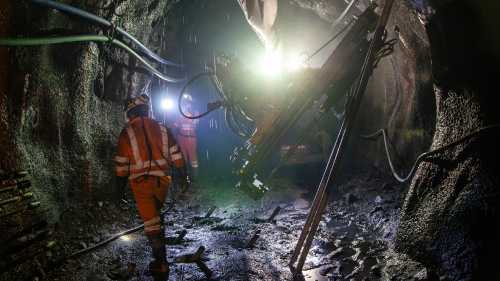
Rock Bolt in Mining is one of the most important ground support and rock reinforcement concepts that every mining engineering student, ground control engineer, and underground mine professional must clearly understand, because it is the single most widely used method of supporting roofs and walls in underground mines and tunnels.
From holding up weak roof layers and tying fractured rock blocks together to preventing dangerous rock falls that are the leading cause of underground mining fatalities, the Rock Bolt in Mining plays a critical role in keeping underground excavations safe and stable worldwide.
In this complete guide by MiningGyan, we cover everything about Rock Bolt in Mining – from its precise definition and meaning to its working mechanism, types, construction, installation process, the difference between a Rock Bolt and a Cable Bolt, safety, advantages, and competitive exam MCQs – all in one structured and detailed article.
By the end of this guide, you will have a thorough, structured, and exam-ready understanding of Rock Bolt in Mining and every related concept that accompanies it in ground control textbooks and competitive examinations across India.
What is a Rock Bolt in Mining?
A Rock Bolt in Mining is a steel reinforcement element installed into a drilled hole in the rock to support and strengthen the rock mass around an underground excavation, by anchoring weak or loose rock to stronger rock deeper inside and by tying separate rock layers and blocks together into a single, stable, self-supporting unit.
The defining idea of a Rock Bolt in Mining is that rock is strong in compression but weak in tension – just like concrete – so a rock bolt adds tensile strength to the rock mass in much the same way that steel rebar reinforces concrete, allowing the rock around a roadway or stope to support itself.
| Key Term | Meaning in Ground Support |
|---|---|
| Rock Bolt | Steel rod or tube anchored in a drilled hole to reinforce the rock mass |
| Shank / Tendon | The main body of the bolt that carries the tensile load |
| Anchor | The part that grips the rock – an expansion shell, grout, or friction |
| Face Plate / Bearing Plate | The steel plate at the bolt head that spreads the load onto the rock face |
| Nut | Tightened on the bolt head to apply tension and hold the plate |
| Grout | Cement or resin that bonds the bolt to the rock along its length |
| Active Bolt | A bolt tensioned during installation so it actively clamps the rock |
| Passive Bolt | A bolt not tensioned on installation that loads up only as the rock moves |
How Does a Rock Bolt Work in Mining?
To understand the Rock Bolt in Mining properly, it is essential to understand the ground support mechanisms by which it reinforces the rock – a single rock bolt can stabilise the ground in more than one way at the same time, depending on the rock conditions around the excavation.
Suspension Mechanism
In the suspension mechanism, the Rock Bolt in Mining hangs a weak or loose lower layer of roof rock from a stronger, more competent layer higher up, so that the weak rock is effectively suspended from the strong rock and is prevented from falling into the excavation.
Beam Building Mechanism
In the beam building mechanism, several thin rock layers are clamped tightly together by the rock bolt into a single thick composite beam that is far stronger and stiffer than the individual layers acting alone, much like gluing thin planks together to form one strong beam.
Keying and Friction Mechanism
In the keying mechanism, the Rock Bolt in Mining holds fractured and jointed rock blocks tightly together so that friction across the joints is increased and the blocks interlock and support each other, preventing individual loose blocks from sliding or falling out of the roof or walls.
| Support Mechanism | How the Rock Bolt Works | Best Suited For |
|---|---|---|
| Suspension | Hangs weak rock from a strong layer above | Thin weak roof under strong strata |
| Beam Building | Clamps thin layers into one thick beam | Layered or bedded roof rock |
| Keying / Friction | Holds fractured blocks together by friction | Jointed and blocky rock masses |
Parts of a Rock Bolt in Mining
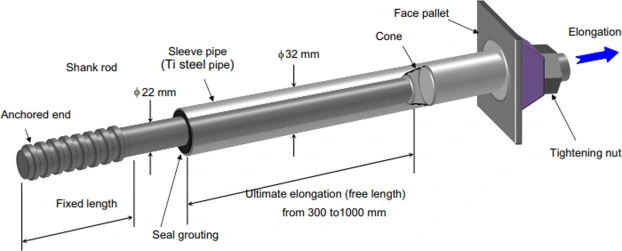
A typical Rock Bolt in Mining is made up of several components that work together to grip the rock, carry the load, and transfer it safely to the rock face, and understanding these parts is important for understanding how different types of bolts function.
| Component | Position | Function |
|---|---|---|
| Anchor | Inner end of the bolt | Grips the rock by expansion shell, grout, or friction |
| Shank / Tendon | Body of the bolt | Transfers tensile load from the anchor to the bolt head |
| Bearing / Face Plate | At the rock surface | Spreads the load from the bolt onto the rock face |
| Nut and Washer | At the bolt head | Tightened to tension the bolt and hold the plate firmly |
| Grout (if used) | Around the shank | Bonds the bolt to the rock along part or all of its length |
Types of Rock Bolt in Mining
Rock Bolts in Mining are classified mainly according to the way they are anchored inside the borehole – that is, how they grip the rock – and the main types are mechanical (expansion shell) bolts, grouted bolts, resin bolts, friction bolts such as Split Set and Swellex, and cable bolts for longer reinforcement.
Each type of Rock Bolt in Mining has its own anchoring method, installation speed, cost, and suitable rock conditions, and selecting the right type for the ground conditions is one of the most important decisions in underground ground control.
Mechanical (Expansion Shell) Rock Bolt
A mechanical or expansion shell Rock Bolt in Mining is anchored by an expansion shell or wedge at its inner end that is forced outward against the borehole walls when the bolt is turned or tightened, gripping the rock at that point and allowing the bolt to be tensioned immediately.
Mechanical rock bolts provide instant anchorage and active support, which makes them very useful where immediate support is needed, but they grip the rock only at a single point and work best in hard, competent rock that can hold the expansion shell securely.
Grouted (Cement) Rock Bolt
A grouted Rock Bolt in Mining is a ribbed steel bar inserted into a drilled hole that is then filled with cement grout, so the bolt is bonded to the rock along its full length through the bond between steel, grout, and rock, giving excellent long-term load distribution.
Fully grouted cement rock bolts are the most common choice for permanent ground support because they are durable, corrosion-resistant, and continuously coupled to the rock, though the cement needs curing time before the bolt reaches full strength.
Resin Rock Bolt
A resin Rock Bolt in Mining is bonded into the hole using fast-setting chemical resin cartridges instead of cement, which are pushed to the back of the hole and mixed by spinning the bolt, giving very rapid setting and an immediate load-carrying capacity within minutes.
Resin rock bolts are widely used where fast excavation cycles are needed, and they can be installed as point-anchored or fully encapsulated bolts depending on how much resin is used along the hole.
Friction Rock Bolt – Split Set and Swellex
A friction Rock Bolt in Mining grips the rock by direct friction along its entire length against the borehole wall rather than by a separate anchor or grout, and the two main types are the Split Set and the Swellex bolt.
A Split Set is a slotted steel tube that is driven into a slightly smaller diameter hole, so the tube is compressed and presses outward against the rock by spring action, while a Swellex bolt is a folded tube that is inflated with high-pressure water so that it expands to grip the full length of the hole – both give very fast installation and immediate support.
Cable Bolt
A cable bolt is a long, flexible steel cable that is grouted into a deep drilled hole and is used where much longer reinforcement is needed than a rigid rock bolt can provide, such as in large open stopes, intersections, and high-stress ground in deep mines.
| Type of Rock Bolt | How It Anchors | Key Advantage | Best For |
|---|---|---|---|
| Mechanical (Expansion Shell) | Wedge expands against borehole wall | Instant anchorage and tensioning | Hard, competent rock |
| Grouted (Cement) | Cement bond along full length | Durable, long-term support | Permanent installations |
| Resin | Fast-setting resin cartridges | Very fast setting, quick support | Rapid excavation cycles |
| Friction – Split Set | Driven tube presses on hole wall | Quick install, immediate support | Fractured and weak rock |
| Friction – Swellex | Tube inflated by water pressure | Full-length friction grip | Variable and broken ground |
| Cable Bolt | Long cable grouted in deep hole | Long reach, high capacity | Large stopes, high stress |
Active vs Passive Rock Bolt in Mining
Rock Bolts in Mining are also classified by whether or not they are tensioned at the time of installation, into active bolts and passive bolts, and this distinction is important because it changes how and when the bolt actually supports the rock.
An active Rock Bolt in Mining is tensioned during installation so that it immediately clamps the rock layers together with a designed working load, while a passive Rock Bolt is not tensioned on installation and only develops its supporting load gradually as the surrounding rock begins to move and load the bolt.
| Parameter | Active Rock Bolt | Passive Rock Bolt |
|---|---|---|
| Tensioning | Tensioned during installation | Not tensioned on installation |
| When It Supports | Immediately clamps the rock | Loads up only as the rock moves |
| Typical Examples | Mechanical and tensioned resin bolts | Fully grouted untensioned bolts, Split Set |
| Effect | Actively reinforces from the start | Acts more like a reinforcing dowel |
Rock Bolt Installation Process in Mining
The installation of a Rock Bolt in Mining follows a careful, systematic sequence, because the holding power of any rock bolt depends heavily on correct installation – the right hole size, proper anchoring, and adequate tensioning all determine whether a bolt performs as designed or simply occupies a hole.
| Step | Activity | Purpose |
|---|---|---|
| 1. Scaling | Bar down loose rock from the roof and walls | Makes the area safe before bolting begins |
| 2. Marking | Mark out the bolt pattern positions | Ensures correct spacing and coverage |
| 3. Drilling | Drill holes of the correct diameter and depth | Creates the holes to receive the bolts |
| 4. Inserting Anchor/Grout | Place resin cartridges, grout, or expansion shell | Provides the anchoring medium |
| 5. Inserting Bolt | Push and spin the bolt into the hole | Mixes resin or sets the anchor in place |
| 6. Tensioning | Tighten the nut and bearing plate | Applies tension and clamps the rock |
| 7. Testing | Pull-test selected bolts | Confirms the bolts hold their design load |
Rock Bolt vs Cable Bolt in Mining – Key Difference
The difference between a Rock Bolt and a Cable Bolt in Mining is a frequently asked distinction in ground control examinations, as both reinforce the rock mass but they differ in length, flexibility, capacity, and where they are used.
A Rock Bolt in Mining is a relatively short, rigid steel rod or tube used for the immediate reinforcement zone around an excavation, while a cable bolt is a long, flexible steel cable grouted much deeper into the rock to reinforce larger spans and higher-stress ground that a rigid rock bolt cannot reach.
| Parameter | Rock Bolt | Cable Bolt |
|---|---|---|
| Form | Short, rigid steel rod or tube | Long, flexible steel cable |
| Length | Typically 1.5 m to 3 m | Can be many metres long |
| Flexibility | Rigid – cannot bend | Flexible – fits long holes |
| Capacity / Reach | Supports the immediate rock zone | Reinforces large spans and deep zones |
| Typical Use | Roadways, drifts, and general roof support | Large stopes, intersections, high stress |
Uses of Rock Bolt in Mining
The Rock Bolt in Mining is the workhorse of underground ground support, and its uses extend across almost every type of underground excavation where rock must be kept stable and safe for people and equipment.
| Use of Rock Bolt | Purpose |
|---|---|
| Roof Support | Holds up the roof of roadways, drifts, and drives |
| Wall / Rib Support | Stabilises the side walls of underground openings |
| Stope Support | Reinforces the backs and walls of stopes during mining |
| Intersection Support | Supports wide, weaker spans where roadways cross |
| Surface Slope Support | Reinforces benches and slopes in opencast mines |
| Combined Support | Used with mesh and shotcrete for complete ground control |
Rock Bolt Safety in Mining
Rock Bolt safety in Mining is of paramount importance because roof, rib, and face falls are the single largest cause of underground mining fatalities, and a correctly designed and installed rock bolt pattern is the primary defence against these falls.
DGMS regulations in India and equivalent mine safety rules worldwide impose specific requirements for rock bolting, including approved support plans that fix the bolt pattern and spacing, scaling of loose rock before bolting, regular pull-testing of bolts to confirm their holding load, and routine inspection of installed support throughout the life of the excavation.
| Safety Hazard | Description | Prevention Measure |
|---|---|---|
| Roof / Rib Falls | Loose rock falling between or beyond bolts | Correct bolt pattern with mesh or shotcrete |
| Poor Installation | Wrong hole size or inadequate anchoring | Follow approved procedure, correct hole and resin |
| Insufficient Tension | Bolt acting as a passive dowel only | Tension bolts to the designed working load |
| Corrosion | Long-term weakening of the steel bolt | Use grouted or corrosion-resistant bolts |
| Overstressed Ground | High stress exceeding bolt capacity | Use cable bolts or energy-absorbing bolts |
| Unverified Support | Bolts not confirmed to hold load | Regular pull-testing and inspection of bolts |
Rock Bolt in Mining – Advantages and Disadvantages
The Rock Bolt in Mining offers major safety and economic advantages as a ground support method, but like every support system it also has limitations that must be managed by careful design and installation.
| Advantages of Rock Bolts in Mining | Disadvantages / Limitations |
|---|---|
| Strong, reliable, and widely proven roof support | Effectiveness depends heavily on correct installation |
| Fast to install with mechanised bolters | Loose rock can still fall between bolts |
| Makes the rock mass support itself | Limited capacity in very high-stress ground |
| Low cost compared with standing support | Some types need curing or setting time |
| Many types available for different conditions | Steel bolts can corrode over a long life |
| Can be combined with mesh and shotcrete | Requires regular testing and inspection |
Rock Bolt in Mining – Diagram Explanation
A standard Rock Bolt in Mining diagram shows a vertical section through the roof of an underground excavation, illustrating the bolt anchored deep in the strong rock, the shank running through the weaker rock layers, and the bearing plate and nut holding everything against the rock face.
The table below explains each key label that appears in a typical Rock Bolt in Mining diagram as used in ground control textbooks and DGMS examination study materials.
| Diagram Label | Position | Description |
|---|---|---|
| Strong Rock / Anchor Zone | Deep in the roof | Competent rock where the bolt is anchored |
| Anchor | Inner end of the bolt | Expansion shell, grout, or friction grip |
| Weak Rock Layers | Below the strong rock | Loose or bedded rock that the bolt reinforces |
| Bolt Shank | Through the rock | Steel body that carries the load to the head |
| Bearing Plate | At the rock surface | Spreads the load onto the rock face |
| Nut | At the bolt head | Tensions the bolt and holds the plate |
Rock Bolt in Mining – Important for Competitive Exams
The topic of Rock Bolt in Mining is regularly and frequently tested in GATE Mining, DGMS examinations, Mining Foreman, Overman, and Junior Mining Engineer competitive examinations across India, as ground support and rock bolting are core parts of the mine safety and rock mechanics syllabus.
The MCQ table below contains the most important and most frequently asked exam-ready facts about Rock Bolt in Mining that will directly help you score better in your next competitive mining examination.
| Exam Question Pattern | Correct Answer |
|---|---|
| What is a Rock Bolt in Mining? | A steel rod or tube anchored in a drilled hole to reinforce the rock mass and prevent falls |
| What is a Rock Bolt called in Hindi? | Chattan Bolt or Rock Anchor |
| What are the main ways a rock bolt supports rock? | Suspension, beam building, and keying / friction |
| How is a mechanical rock bolt anchored? | By an expansion shell or wedge forced against the borehole wall |
| What is a fully grouted rock bolt? | A ribbed bar bonded to the rock along its full length by cement or resin grout |
| What is a Split Set bolt? | A slotted steel tube driven into a smaller hole that grips by friction |
| How does a Swellex bolt work? | A folded tube inflated by high-pressure water to grip the full hole |
| What is the difference between active and passive bolts? | Active bolts are tensioned on installation; passive bolts load up as the rock moves |
| What is the difference between a rock bolt and a cable bolt? | A rock bolt is short and rigid; a cable bolt is long and flexible for deeper reach |
| What is the bearing plate for? | To spread the bolt load onto the rock face |
| How is a rock bolt’s holding load checked? | By pull-testing selected bolts after installation |
| Why are rock bolts so important for safety? | Roof and rib falls are the largest single cause of underground mining fatalities |
External References for Further Reading
To deepen your technical understanding of rock bolts and ground support, the following authoritative and academically reliable external resources are recommended for further study alongside this MiningGyan guide:
| Reference Source | What It Explains |
|---|---|
| ScienceDirect – Rockbolts (Engineering Topics) | Academic overview of rock bolt types, anchoring, and coupling mechanisms |
| NIOSH / CDC – Roof Bolting in Underground Coal Mines | Authoritative government research on roof bolting history and ground control |
MiningGyan – Your Trusted Mining Education Platform
MiningGyan is a dedicated mining education platform built specifically for mining engineering students, diploma candidates, working mine professionals, and competitive exam aspirants across India who need accurate, complete, and well-structured technical knowledge delivered in clear and readable English.
At MiningGyan, important ground control concepts like Rock Bolt in Mining are explained with simple clear definitions, working mechanisms, complete type classifications, installation steps, comparison tables with Cable Bolt, diagram label explanations, and comprehensive competitive exam MCQ notes – all in one freely accessible article.
MiningGyan covers the complete spectrum of mining engineering and geology – from ground control and rock mechanics to drilling and blasting, underground mining methods, mine safety regulations, ventilation engineering, mining equipment, and mineral exploration – making it a comprehensive and freely accessible mining education platform for Indian students and professionals today.
| What MiningGyan Covers | Who It Is Most Helpful For |
|---|---|
| Rock Bolt, Rock Mechanics, Ground Support, and Mine Safety Concepts | Mining Engineering and Diploma Students |
| Underground and Surface Mining Methods – Step-by-Step Guides | B.Tech and Diploma Mining Engineering Students |
| Mine Development, Design, and Planning | Junior Mining Engineers and Graduate Trainees |
| Mine Safety, Legislation, DGMS Regulations, and Ventilation | Supervisors, Overmen, Safety Officers, and Managers |
| Competitive Exam Notes, MCQ Tables, and Revision Guides | GATE, DGMS, Foreman, Overman, and Surveyor Aspirants |
| Ore Body Geology, Country Rock, Vein, Lode, and Reef Concepts | Economic Geologists and Mine Planning Engineers |
MiningGyan’s mission is simple and unwavering – “To deliver accurate, complete, and accessible mining knowledge to every mining student and professional in India, completely free of charge.”
Frequently Asked Questions – Rock Bolt in Mining
A Rock Bolt in Mining is a steel rod or tube anchored inside a drilled hole in the rock that reinforces the rock mass and prevents rock falls. It works like rebar in concrete, adding tensile strength to rock and tying weak surface rock to stronger rock deeper inside so the ground supports itself.
A rock bolt supports the roof in three main ways: by suspension, hanging weak rock from a strong layer above; by beam building, clamping thin layers into one thick beam; and by keying, holding fractured blocks together with friction so they interlock and support each other.
The main types are mechanical or expansion shell bolts anchored by a wedge, grouted bolts bonded with cement, resin bolts bonded with fast-setting resin, friction bolts such as Split Set and Swellex that grip by friction, and cable bolts that are long flexible cables for deeper, higher-capacity reinforcement.
Both are friction bolts. A Split Set is a slotted steel tube driven into a slightly smaller hole so it springs outward against the rock, while a Swellex bolt is a folded tube inflated with high-pressure water so it expands to grip the full length of the hole. Both give fast installation and immediate support.
Rock bolts are important because roof, rib, and face falls are the single largest cause of underground mining fatalities. A correctly designed and installed rock bolt pattern reinforces the rock mass, keeps roofs and walls stable, and is the primary means of protecting miners from falls of ground.
Conclusion – Rock Bolt in Mining
Rock Bolt in Mining is a fundamental ground support concept and a critically important physical reinforcement element that keeps underground roofs and walls stable, prevents rock falls, and protects the lives of miners in underground mines and tunnels worldwide.
Whether you are a mining engineering student preparing for a competitive examination, a ground control engineer designing a support plan, or an underground supervisor checking installed support, a thorough understanding of what a Rock Bolt in Mining is, how it works, its different types, how it is installed, and how it differs from a cable bolt is absolutely essential knowledge.
This complete guide by MiningGyan has covered all major aspects of Rock Bolt in Mining – from its precise definition and Hindi meaning to its support mechanisms, parts, types, active vs passive classification, installation process, Rock Bolt vs Cable Bolt comparison, uses, safety requirements, advantages and disadvantages, diagram label explanations, and a comprehensive competitive exam MCQ table.
Explore more such free, detailed, and exam-ready mining guides on MiningGyan and continue building the strong technical foundation that every successful mining career truly requires.