Charge Density in Blasting is one of the most important quantitative concepts in drilling and blasting that every mining engineering student, blast designer, and competitive exam aspirant must clearly understand, because it directly controls how much explosive energy is delivered into each metre of a blasthole.
From deciding the total charge required in a hole to controlling fragmentation, toe breakage, and the all-important powder factor, the Charge Density in Blasting is a fundamental design parameter that links the blasthole diameter and the explosive type to the actual breaking power of the blast.
In this complete guide by MiningGyan, we cover everything about Charge Density in Blasting – from its precise definition and meaning to its formula, units, step-by-step calculation with a solved example, the difference between Charge Density and Powder Factor, coupling and decoupling, factors affecting it, and competitive exam MCQs – all in one structured and detailed article.
By the end of this guide, you will have a thorough, structured, and exam-ready understanding of Charge Density in Blasting and every related concept that accompanies it in drilling and blasting textbooks and competitive examinations across India.
What is Charge Density in Blasting?
Charge Density in Blasting – also called loading density or charge concentration – is the mass of explosive contained in each unit length of the blasthole, and it is most commonly expressed in kilograms of explosive per metre of hole (kg/m).
The defining idea of Charge Density in Blasting is that it tells the blast designer exactly how much explosive is packed into every metre of the charged column, which in turn determines how much energy is available along the hole to break the surrounding rock.
| Key Term | Meaning in Blasting |
|---|---|
| Charge Density (Loading Density) | Mass of explosive per metre of blasthole – expressed in kg/m |
| Charge Concentration | Another common name for charge density (kg/m) |
| Explosive Density | The intrinsic density of the explosive material itself, in g/cc |
| Charge Diameter | The diameter of the explosive column – equal to the hole diameter when coupled |
| Charge Length / Column Length | The length of the hole actually filled with explosive |
| Total Charge per Hole | Charge density multiplied by the charged column length, in kg |
| Powder Factor | Explosive mass per unit volume or mass of rock broken (kg/m³) |
| Coupling | How fully the explosive fills the blasthole cross-section |
Charge Density in Blasting – Formula
The charge density in blasting is calculated directly from the diameter of the blasthole and the density of the explosive, because the explosive simply fills the circular cross-section of the hole along its length, so the mass per metre is the cross-sectional area multiplied by the explosive density.
Charge Density Formula:
Charge density (kg/m) = ( π × D² / 4 ) × ρ ÷ 1000
where:
D = diameter of the blasthole in millimetres (mm)
ρ = density of the explosive in grams per cubic centimetre (g/cc)
Simplified form: Charge density (kg/m) ≈ 0.000785 × D² × ρ
This formula works because the cross-sectional area of a circular blasthole is π D² / 4, and multiplying that area by the explosive density and adjusting the units converts it into kilograms of explosive per metre of hole length.
Charge Density in Blasting – Units
Understanding the correct units of Charge Density in Blasting is essential for solving numerical problems correctly in competitive examinations, as a small unit mistake can give a completely wrong answer.
| Quantity | Symbol | Common Unit |
|---|---|---|
| Charge Density (Loading Density) | — | kilograms per metre (kg/m) |
| Blasthole Diameter | D | millimetres (mm) |
| Explosive Density | ρ | grams per cubic centimetre (g/cc) |
| Charged Column Length | L | metres (m) |
| Total Charge per Hole | — | kilograms (kg) |
| Powder Factor | — | kilograms per cubic metre (kg/m³) |
Charge Density Calculation – Solved Example
Working through a solved example is the best way to understand how the Charge Density in Blasting formula is applied in practice, so let us calculate the charge density and the total charge for a typical production blasthole.
Problem: A blasthole of diameter 100 mm is charged with ANFO of density 0.85 g/cc over a column length of 8 m. Find the charge density and the total charge in the hole.
Step 1 – Charge density:
Charge density = ( π × D² / 4 ) × ρ ÷ 1000
= ( 3.1416 × 100² / 4 ) × 0.85 ÷ 1000
= ( 3.1416 × 2500 ) × 0.85 ÷ 1000
= 7854 × 0.85 ÷ 1000
≈ 6.68 kg/m
Step 2 – Total charge in the hole:
Total charge = charge density × column length
= 6.68 × 8
≈ 53.4 kg
So a 100 mm blasthole loaded with ANFO at 0.85 g/cc carries about 6.68 kg of explosive per metre, and an 8 m explosive column holds roughly 53.4 kg of ANFO – a value that the blast designer can then use to work out the powder factor for the volume of rock that hole is meant to break.
| Hole Diameter (mm) | Explosive (g/cc) | Charge Density (kg/m) |
|---|---|---|
| 50 | 0.85 (ANFO) | ≈ 1.67 |
| 75 | 0.85 (ANFO) | ≈ 3.76 |
| 100 | 0.85 (ANFO) | ≈ 6.68 |
| 100 | 1.20 (Emulsion) | ≈ 9.42 |
| 150 | 1.20 (Emulsion) | ≈ 21.2 |
Why is Charge Density Important in Blasting?
The Charge Density in Blasting is one of the most influential design parameters because it directly governs how much explosive energy is concentrated along the blasthole, and getting it right is essential for achieving good fragmentation without wasting explosive or creating safety problems.
| Effect of Charge Density | Result in the Blast |
|---|---|
| Higher charge density | More explosive energy per metre – finer fragmentation and stronger toe breakage |
| Lower charge density | Less energy per metre – coarser fragmentation and possible toe problems |
| Correct charge density | Balanced fragmentation, good muckpile, controlled vibration and flyrock |
| Basis of total charge | Used to calculate total kg per hole and the powder factor |
| Energy distribution | Controls how energy is spread along the column from toe to collar |
Factors Affecting Charge Density in Blasting
Several factors affect the Charge Density in Blasting, and the blast designer must consider all of them together when deciding how much explosive will be loaded into each metre of the hole.
Blasthole Diameter
The blasthole diameter has the strongest effect on charge density, because charge density increases with the square of the diameter – a larger diameter hole holds far more explosive per metre, which is why large opencast benches use large-diameter holes to load high charge densities.
Explosive Density
The density of the explosive used directly affects charge density, because a denser explosive such as an emulsion packs more mass into the same hole volume than a lighter explosive such as ANFO, giving a higher charge density and more energy per metre.
Degree of Coupling
The degree of coupling – how fully the explosive fills the hole cross-section – affects the effective charge density, because a fully coupled charge that fills the whole hole gives the maximum charge density, while a decoupled charge with an air gap around it gives a lower effective charge density along the hole.
Type of Charging
The charging method also matters, since bulk explosives pumped or augered into the hole generally couple fully and give a higher and more consistent charge density than packaged cartridges, which may leave gaps and give a slightly lower effective loading.
| Factor | Effect on Charge Density |
|---|---|
| Larger hole diameter | Strongly increases charge density (square relationship) |
| Higher explosive density | Increases charge density per metre |
| Full coupling (no air gap) | Gives maximum effective charge density |
| Decoupling (air gap) | Lowers the effective charge density along the hole |
| Bulk vs packaged charging | Bulk charging usually gives higher, more consistent density |
Coupling and Decoupling in Charge Density
The concepts of coupling and decoupling are closely linked to Charge Density in Blasting, because they describe how completely the explosive fills the blasthole and therefore how much of the hole’s potential charge density is actually used.
A coupled charge fills the full cross-section of the blasthole so the charge diameter equals the hole diameter, giving maximum charge density and maximum energy transfer to the rock, whereas a decoupled charge is deliberately made smaller than the hole, leaving an air or water gap that reduces the charge density and softens the shock on the borehole walls.
| Parameter | Coupled Charge | Decoupled Charge |
|---|---|---|
| Charge vs Hole Diameter | Charge fills the full hole | Charge smaller than the hole, with an air gap |
| Charge Density | Maximum for that hole | Reduced effective charge density |
| Energy on Walls | High shock on borehole walls | Softened shock – less wall damage |
| Typical Use | Production blasting for fragmentation | Presplitting and smooth blasting of final walls |
Charge Density vs Powder Factor in Blasting – Key Difference
The difference between Charge Density and Powder Factor in Blasting is one of the most frequently confused distinctions in competitive examinations, and it is important to understand clearly because the two describe completely different things even though both involve explosive quantity.
Charge Density in Blasting is the mass of explosive per metre of blasthole (kg/m), which is a property of how the hole is loaded, while Powder Factor is the mass of explosive used per unit volume or mass of rock broken (kg/m³), which is a measure of how efficiently the whole blast uses explosive to fragment rock.
| Parameter | Charge Density | Powder Factor |
|---|---|---|
| Definition | Explosive mass per metre of hole | Explosive mass per volume of rock broken |
| Unit | kg/m | kg/m³ (or kg/tonne) |
| Depends On | Hole diameter and explosive density | Total explosive and total rock volume |
| Describes | How the hole is loaded | How efficient the overall blast is |
| Relationship | Used to find total charge per hole | Total charge ÷ rock volume gives powder factor |
Charge Density in Blasting – Diagram Explanation
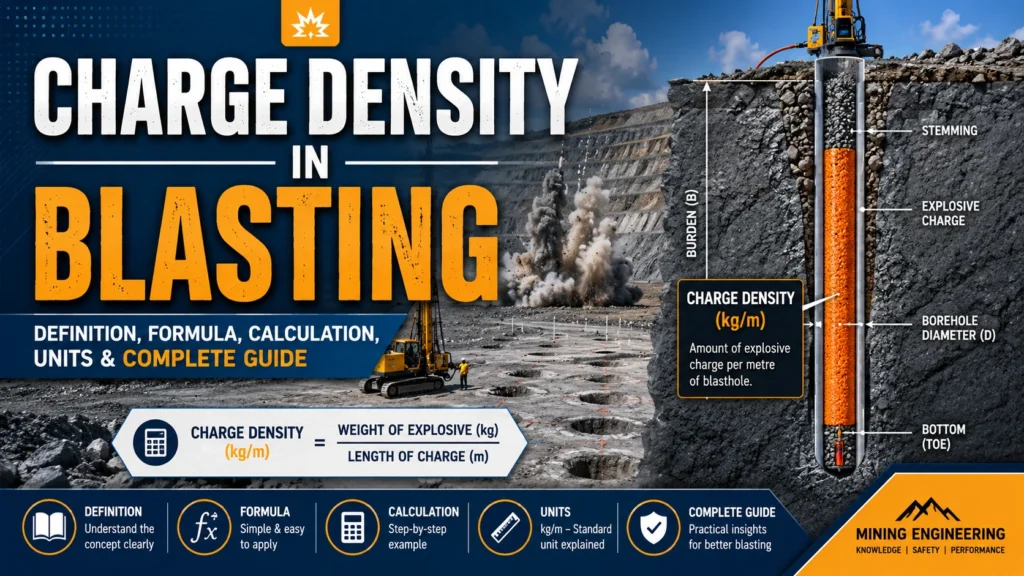
A standard Charge Density in Blasting diagram shows a vertical section through a charged blasthole, illustrating the hole diameter, the explosive column with its charge density in kg/m, the stemming above the charge, and the toe at the bottom of the hole.
The table below explains each key label that appears in a typical Charge Density in Blasting diagram as used in drilling and blasting textbooks and DGMS examination study materials.
| Diagram Label | Position | Description |
|---|---|---|
| Hole Diameter (D) | Across the hole | The diameter that, with explosive density, sets the charge density |
| Stemming | Top of the hole | Inert material above the charge that confines the blast gases |
| Explosive Column | Body of the hole | The charged length carrying the explosive at a given charge density |
| Charge Density (kg/m) | Along the column | Mass of explosive loaded per metre of the column |
| Column Length (L) | Length of charge | The charged length used to find the total charge in the hole |
| Toe | Bottom of the hole | The base where high charge density helps break the bench toe |
Charge Density in Blasting – Important for Competitive Exams
The topic of Charge Density in Blasting is regularly and frequently tested in GATE Mining, DGMS examinations, Mining Foreman, Overman, and Junior Mining Engineer competitive examinations across India, and it appears very often as a direct numerical problem, so mastering the formula and units is essential.
The MCQ table below contains the most important and most frequently asked exam-ready facts about Charge Density in Blasting that will directly help you score better in your next competitive mining examination.
| Exam Question Pattern | Correct Answer |
|---|---|
| What is Charge Density in Blasting? | The mass of explosive loaded per metre of blasthole, expressed in kg/m |
| What is Charge Density called in Hindi? | Aavesh Ghanatv or Loading Ghanatv |
| What is another name for charge density? | Loading density or charge concentration |
| What is the charge density formula? | ( π × D² / 4 ) × ρ ÷ 1000, with D in mm and ρ in g/cc |
| What is the unit of charge density? | Kilograms per metre (kg/m) |
| Which two factors mainly decide charge density? | Blasthole diameter and explosive density |
| How does charge density change with hole diameter? | It increases with the square of the diameter |
| What is the difference between charge density and powder factor? | Charge density is kg per metre of hole; powder factor is kg per m³ of rock |
| What is a coupled charge? | A charge that fills the full hole cross-section, giving maximum charge density |
| What is a decoupled charge used for? | Presplitting and smooth blasting, with reduced charge density and wall shock |
| How is total charge per hole found? | Charge density multiplied by the charged column length |
External References for Further Reading
To deepen your technical understanding of charge density, loading density, and blast design calculations, the following authoritative and academically reliable external resources are recommended for further study alongside this MiningGyan guide:
| Reference Source | What It Explains |
|---|---|
| Penn State – Bench Blasting (Intro to Mining Engineering) | Explains charge per unit length, charged column length, and powder factor calculation |
| OSMRE – Surface Blast Design Module | Official guidance on loading density, charge load, and blast design parameters |
MiningGyan – Your Trusted Mining Education Platform
MiningGyan is a dedicated mining education platform built specifically for mining engineering students, diploma candidates, working mine professionals, and competitive exam aspirants across India who need accurate, complete, and well-structured technical knowledge delivered in clear and readable English.
At MiningGyan, important drilling and blasting concepts like Charge Density in Blasting are explained with simple clear definitions, formulas, units, step-by-step solved examples, comparison tables with Powder Factor, factor analysis, diagram label explanations, and comprehensive competitive exam MCQ notes – all in one freely accessible article.
MiningGyan covers the complete spectrum of mining engineering and geology – from drilling and blasting and underground mining methods to ore body geology, mine safety regulations, ventilation engineering, mining equipment, and mineral exploration – making it a comprehensive and freely accessible mining education platform for Indian students and professionals today.
| What MiningGyan Covers | Who It Is Most Helpful For |
|---|---|
| Charge Density, Powder Factor, Blasting, Spacing, and Drilling Concepts | Mining Engineering and Diploma Students |
| Underground and Surface Mining Methods – Step-by-Step Guides | B.Tech and Diploma Mining Engineering Students |
| Mine Development, Design, and Planning | Junior Mining Engineers and Graduate Trainees |
| Mine Safety, Legislation, DGMS Regulations, and Ventilation | Supervisors, Overmen, Shotfirers, and Managers |
| Competitive Exam Notes, Numerical Problems, and Revision Guides | GATE, DGMS, Foreman, Overman, and Surveyor Aspirants |
| Ore Body Geology, Country Rock, Vein, Lode, and Reef Concepts | Economic Geologists and Mine Planning Engineers |
MiningGyan’s mission is simple and unwavering – “To deliver accurate, complete, and accessible mining knowledge to every mining student and professional in India, completely free of charge.”
Frequently Asked Questions – Charge Density in Blasting
Charge Density in Blasting, also called loading density or charge concentration, is the weight of explosive loaded into each metre of a blasthole, expressed in kg/m. It tells the blast designer how much explosive energy is packed into every metre of the charged column and depends mainly on the hole diameter and explosive density.
Charge density (kg/m) = ( π × D² / 4 ) × ρ ÷ 1000, where D is the blasthole diameter in millimetres and ρ is the explosive density in g/cc. A simplified version is charge density ≈ 0.000785 × D² × ρ. The total charge in a hole is the charge density multiplied by the charged column length.
The unit of charge density in blasting is kilograms per metre (kg/m), because it expresses the mass of explosive loaded per metre of blasthole length.
Charge density is the mass of explosive per metre of hole (kg/m) and describes how the hole is loaded, while powder factor is the mass of explosive per unit volume of rock broken (kg/m³) and describes how efficient the overall blast is. They are related because charge density is used to find the total charge per hole, which is then divided by the rock volume to get the powder factor.
Charge density increases with the square of the blasthole diameter. This means that if the hole diameter is doubled, the charge density – and the amount of explosive loaded per metre – increases by about four times, which is why large opencast benches use large-diameter holes to load high charge densities.
Conclusion – Charge Density in Blasting
Charge Density in Blasting is a fundamental and frequently examined drilling and blasting concept that directly controls how much explosive energy is delivered into every metre of a blasthole, making it a critical design parameter for achieving good fragmentation, safe blasting, and economical explosive use.
Whether you are a mining engineering student preparing for a competitive examination, a blast designer working out the charge for a production bench, or a supervisor checking the loading of holes, a thorough understanding of what Charge Density in Blasting is, how it is calculated, what units it uses, and how it differs from powder factor is absolutely essential knowledge.
This complete guide by MiningGyan has covered all major aspects of Charge Density in Blasting – from its precise definition and Hindi meaning to its formula, units, a step-by-step solved example, its importance, the factors affecting it, coupling and decoupling, the Charge Density vs Powder Factor comparison, diagram label explanations, and a comprehensive competitive exam MCQ table.
Explore more such free, detailed, and exam-ready mining guides on MiningGyan and continue building the strong technical foundation that every successful mining career truly requires.