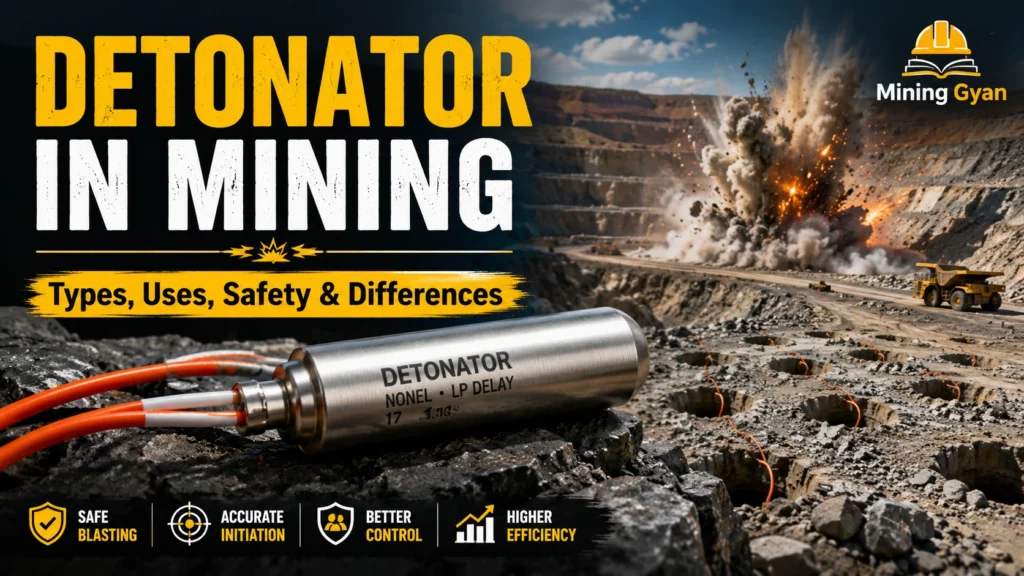
Detonator in Mining is one of the most important and most frequently tested topics in drilling and blasting that every mining engineering student, shotfirer, blasting foreman, and underground or opencast mine professional must clearly understand as part of their core explosives vocabulary.
From providing the very first triggering shock that starts a blast to enabling precisely timed delay sequences that control fragmentation, ground vibration, and safety, the Detonator in Mining plays a critical role in the safe, controlled, and efficient breakage of rock in mines and quarries worldwide.
In this complete guide by MiningGyan, we cover everything about Detonator in Mining – from its precise definition and meaning to its types, construction, delay detonators, the key difference between Detonator and Primer, Detonator and Detonating Cord, its uses, safety requirements, and competitive exam MCQs – all in one structured and detailed article.
By the end of this guide, you will have a thorough, structured, and exam-ready understanding of Detonator in Mining and every related concept that accompanies it in drilling and blasting textbooks and competitive examinations across India.
What is a Detonator in Mining?
A Detonator in Mining is a small but highly sensitive device containing a precise charge of initiating explosive that is used to start an explosion reliably, at a specified time, and in a prescribed sequence, by producing the initial shock wave that sets off the primer and, through it, the main charge in a blasthole.
The defining role of a Detonator in Mining is that it is the trigger of the entire blasting chain – it is the first component to fire, and although it is small and produces relatively little energy of its own, it produces enough shock to start the more powerful primer that in turn initiates the bulk main charge.
| Key Term | Definition |
|---|---|
| Detonator in Mining | A sensitive initiating device that produces the first shock to start a blast |
| Base Charge | The high-explosive charge (e.g. PETN) at the closed end of the detonator that produces the shock |
| Priming Charge | A primary explosive (e.g. lead azide) that fires the base charge |
| Delay Element | A pyrotechnic or electronic component that introduces a precise time lag before firing |
| Leg Wires / Lead Wires | The wires of an electric detonator connected to the blasting machine |
| Shock Tube | A thin plastic tube with a reactive inner coating that carries a low-energy shock signal |
| Primer | The booster charge that the detonator fires, which then initiates the main charge |
| Blasting Machine / Exploder | The device that sends the firing current or signal to the detonators |
Function of a Detonator in the Blasting Chain
To understand a Detonator in Mining properly, it is essential to understand its position in the blasting chain – the sequence of components that work together in order to break rock, where each component initiates the next more powerful one in a controlled, deliberate cascade.
The Detonator in Mining sits at the very start of this chain: the blasting machine sends a signal to the detonator, the detonator fires and produces a strong shock, that shock sets off the primer, and the primer in turn initiates the bulk main charge such as ANFO or emulsion to break the surrounding rock.
| Stage | Component | Role in the Chain |
|---|---|---|
| 1 | Blasting Machine | Sends the electric current or initiation signal |
| 2 | Detonator | Produces the first shock wave at the set time |
| 3 | Primer / Booster | Amplifies the shock to initiate the main charge |
| 4 | Main Charge | The bulk explosive that breaks the rock |
Construction of a Detonator in Mining
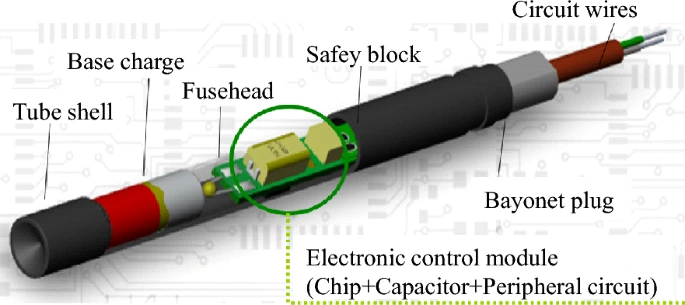
A typical Detonator in Mining is built inside a small metal or plastic shell that is closed at one end, and within this shell the explosive components are arranged in a precise order so that ignition at the open end travels down through the detonator and produces a powerful shock at the closed base end.
Understanding the internal construction of a Detonator in Mining is important because the arrangement of its charges and delay element directly determines how the detonator fires, how much delay it introduces, and how reliably it initiates the primer.
| Detonator Component | Position | Function |
|---|---|---|
| Outer Shell | Body of the detonator | Metal or plastic tube that holds all internal components |
| Ignition Charge / Fuse Head | Near the open end | Receives the initiation (electric, fuse, or shock-tube signal) |
| Delay Element | Above the priming charge | Introduces a precise time lag before the detonator fires |
| Priming Charge | Above the base charge | Primary explosive that sets off the base charge |
| Base Charge | At the closed end | Secondary high explosive that produces the output shock |
Types of Detonator in Mining
Detonators in Mining are classified mainly according to the way they are initiated – that is, how the firing signal reaches them – and the four main types used in modern mining are plain (ordinary) detonators, electric detonators, non-electric (shock tube) detonators, and electronic detonators.
Each type of Detonator in Mining has its own advantages, limitations, and suitable applications, and understanding the differences between them is essential for selecting the safest and most effective initiation system for any given blast design.
Plain or Ordinary Detonator in Mining
A plain detonator, also called an ordinary detonator, is the simplest type – it has no leg wires and no built-in delay, and it is fired by inserting and crimping a length of safety fuse into its open end, so that when the fuse burns down it ignites the detonator at the base.
Plain detonators in Mining are the oldest type and are used with safety fuse for single shots or simple work, but they offer no remote firing and no precise timing control, which is why they have largely been replaced by safer and more controllable systems in modern mechanised mining.
Electric Detonator in Mining
An electric detonator in Mining is fired by an electric current sent from a blasting machine through a pair of leg wires – the current heats an electric fuse head or match, which ignites the delay element and then the priming and base charges, allowing a number of detonators to be fired together or in timed sequence from a safe distance.
Electric detonators in Mining provide remote and timed firing, but they carry the risk of accidental initiation from stray currents, static electricity, and lightning, so strict electrical safety precautions and circuit testing with approved low-current instruments are mandatory when they are used.
Non-Electric (Shock Tube) Detonator in Mining
A non-electric detonator in Mining – widely known by the Nonel shock-tube system originally developed by Nobel of Sweden – is initiated not by electricity but by a low-energy shock wave that travels along the inside of a thin plastic tube whose inner wall is coated with a reactive substance.
In a non-electric detonator in Mining the shock signal travels through the plastic tube at roughly two thousand metres per second and carries just enough energy to fire the delay element of the detonator, while the tube itself has no blasting effect and simply acts as a safe signal conductor, eliminating the hazards associated with stray electric currents.
Electronic Detonator in Mining
An electronic detonator in Mining contains a microchip and an electronic delay circuit instead of a burning pyrotechnic delay element, which allows the delay time of each individual detonator to be programmed with very high precision, often to the nearest millisecond or better.
Electronic detonators in Mining give the most accurate and flexible timing available, which improves fragmentation, reduces ground vibration and air blast, and allows complex blast designs to be fired with great control – though they are the most expensive type and require specialised programming and testing equipment.
| Type of Detonator | How It Is Fired | Key Advantage | Main Limitation |
|---|---|---|---|
| Plain / Ordinary | Safety fuse crimped into it | Simple and low cost | No remote firing, no precise timing |
| Electric | Electric current via leg wires | Remote and timed firing | Risk from stray current, static, lightning |
| Non-Electric (Shock Tube) | Low-energy shock wave in a plastic tube | Immune to stray electric currents | Harder to test the circuit electrically |
| Electronic | Programmed electronic signal | Extremely precise, flexible timing | High cost, needs special equipment |
Instantaneous vs Delay Detonator in Mining
Detonators in Mining are also classified by their timing into instantaneous detonators and delay detonators, and this distinction is one of the most important practical concepts in blast design because the timing between holes has a direct effect on fragmentation, throw, and ground vibration.
An instantaneous detonator fires almost immediately when initiated, whereas a delay detonator in Mining contains a delay element that introduces a precise, predetermined time lag between initiation and firing, allowing holes in a blast pattern to be fired one after another in a designed sequence rather than all at once.
| Parameter | Instantaneous Detonator | Delay Detonator |
|---|---|---|
| Timing | Fires almost immediately on initiation | Fires after a set delay time |
| Delay Element | Absent or negligible | Present – pyrotechnic or electronic |
| Main Use | Single shots or simultaneous firing | Sequenced firing of a multi-hole pattern |
| Effect on Blast | All charges act together | Better fragmentation and vibration control |
| Common Series | Instantaneous (zero delay) | Millisecond (MS) and half-second delay series |
Detonator vs Primer in Mining – Key Difference
The difference between Detonator and Primer in Mining is one of the most frequently asked distinctions in blasting examinations, and it is important to understand clearly because the two components work together in sequence but are entirely different in size, energy, and function.
A Detonator in Mining is the small, sensitive device that provides the first triggering shock, while a Primer is the larger high-explosive charge that receives the detonator’s shock and amplifies it to initiate the bulk main charge – the detonator is inserted into the primer.
| Parameter | Detonator in Mining | Primer in Mining |
|---|---|---|
| Function | Provides the first triggering shock | Amplifies the shock to start the main charge |
| Size | Small, cap-sized device | Larger charge (booster or cartridge) |
| Energy Output | Low – not enough to start a blasting agent alone | High – enough to initiate the bulk charge |
| Sequence | Fires first in the chain | Fires after the detonator |
| Relationship | Inserted into the primer | Carries the detonator inside it |
Detonator vs Detonating Cord in Mining – Key Difference
The difference between Detonator and Detonating Cord in Mining is another important distinction, as both are part of the initiation system but they perform very different jobs in connecting and starting a blast.
A Detonator in Mining is a single-point initiating device that produces a shock at one location, whereas a detonating cord is a flexible cord with a high-explosive core, usually PETN, that runs down the hole or across the surface to carry and distribute detonation along its length and to connect multiple charges or primers together.
| Parameter | Detonator in Mining | Detonating Cord in Mining |
|---|---|---|
| Form | Small sealed capsule / device | Long flexible cord with explosive core |
| Function | Initiates a blast at a single point | Carries and distributes detonation along its length |
| Explosive Core | Base charge such as PETN | Continuous PETN core along the cord |
| Timing | Can include a precise delay | Detonates almost instantly along the cord |
| Typical Use | Triggering the primer in a hole | Connecting charges and down-hole priming |
Uses of Detonator in Mining
A Detonator in Mining is an indispensable part of every controlled blast, and its various uses go far beyond simply starting an explosion – the modern detonator is the key tool that gives the blasting engineer precise control over the timing, sequencing, and safety of the entire blast.
| Use of Detonator | Purpose | Benefit to Blasting Operation |
|---|---|---|
| Initiation | Starts the primer and main charge | Makes controlled rock breakage possible |
| Timing and Sequencing | Delay detonators fire holes in order | Improves fragmentation and creates free faces |
| Vibration Control | Spreads firing over time | Reduces ground vibration near structures |
| Remote Firing | Fired from a safe distance | Protects the blasting crew |
| Pattern Blasting | Many detonators in one designed pattern | Efficient breakage of large rock volumes |
Detonator Safety in Mining
Detonator safety in Mining is of paramount importance because the detonator is the most sensitive component in the entire blasting system, and any accidental initiation can cause serious injury or death – so the handling, storage, transport, and firing of detonators are tightly controlled by mining regulations.
DGMS regulations in India and equivalent mine safety rules worldwide impose strict requirements on detonator safety in Mining, including separate storage of detonators away from other explosives, careful handling to avoid impact and friction, strict electrical precautions for electric detonators, circuit testing only with approved low-current instruments, and firing only from a safe place at a safe distance.
| Safety Hazard | Description | Prevention Measure |
|---|---|---|
| Accidental Initiation | Detonator firing from impact, friction, or heat | Careful handling, no rough treatment, approved storage |
| Stray / Static Current | Electric detonators set off by stray electricity | Electrical precautions, avoid use near power lines and storms |
| Premature Firing | Detonator firing before the crew is clear | Connect and fire only when all persons are at a safe place |
| Mixed Storage | Detonators stored with other explosives | Store detonators separately as per regulations |
| Misfire | Detonator or charge fails to fire | Follow approved misfire procedure, do not approach too soon |
| Faulty Circuit | Open or short circuit in electric firing line | Test continuity with an approved low-current tester from a safe distance |
Detonator in Mining – Advantages and Disadvantages
The use of detonators makes modern controlled blasting possible, but each type of Detonator in Mining brings its own balance of benefits and limitations that the blasting engineer must weigh when designing a blast and choosing an initiation system.
| Advantages of Detonators in Mining | Disadvantages / Limitations |
|---|---|
| Enable safe, remote, and timed firing of blasts | Most sensitive component – require very careful handling |
| Delay detonators allow precise sequencing | Electric types are vulnerable to stray and static current |
| Improve fragmentation and reduce vibration | Electronic types are expensive and need special gear |
| Non-electric types avoid electrical hazards | Non-electric circuits are harder to test electrically |
| Allow large, complex blast patterns | Strict storage and transport regulations apply |
| Reduce misfires when used correctly | Misuse or damage can cause serious accidents |
Detonator in Mining – Important for Competitive Exams
The topic of Detonator in Mining is regularly and frequently tested in GATE Mining, DGMS examinations, Mining Foreman, Overman, Shotfirer, Blaster, and Junior Mining Engineer competitive examinations across India, as detonators are a core part of the drilling and blasting syllabus that every mining professional must know.
The MCQ table below contains the most important and most frequently asked exam-ready facts about Detonator in Mining that will directly help you score better in your next competitive mining examination.
| Exam Question Pattern | Correct Answer |
|---|---|
| What is a Detonator in Mining? | A sensitive initiating device that produces the first shock to start a blast |
| What is a Detonator called in Hindi? | Visphotak Prerak or Detonator |
| What are the four main types of detonator? | Plain (ordinary), electric, non-electric (shock tube), and electronic |
| How is a plain detonator fired? | By a safety fuse crimped into its open end |
| What initiates a non-electric detonator? | A low-energy shock wave travelling along a plastic shock tube |
| What is the Nonel system? | A non-electric shock-tube initiation system developed by Nobel of Sweden |
| What is the base charge of a detonator? | The output high-explosive charge, commonly PETN, at the closed end |
| What is a delay detonator used for? | To fire holes in a timed sequence for better fragmentation and vibration control |
| What is the difference between Detonator and Primer? | The detonator gives the first shock; the primer amplifies it to start the main charge |
| Which detonator gives the most precise timing? | The electronic detonator with a programmable delay circuit |
| What is a major hazard of electric detonators? | Accidental firing from stray current, static electricity, and lightning |
| How should detonators be stored? | Separately from other explosives, as required by DGMS regulations |
External References for Further Reading
To deepen your technical understanding of detonators and blast initiation, the following authoritative and academically reliable external resources are recommended for further study alongside this MiningGyan guide:
| Reference Source | What It Explains |
|---|---|
| Encyclopaedia Britannica – Blasting Cap | Authoritative explanation of detonators, blasting caps, and priming composition |
| US MSHA – Electronic Detonators (Federal Register) | Official definition and classification of non-electric, electric, and electronic detonators |
MiningGyan – Your Trusted Mining Education Platform
MiningGyan is a dedicated mining education platform built specifically for mining engineering students, diploma candidates, working mine professionals, and competitive exam aspirants across India who need accurate, complete, and well-structured technical knowledge delivered in clear and readable English.
At MiningGyan, important drilling and blasting concepts like Detonator in Mining are explained with simple clear definitions, construction details, complete type classifications, comparison tables with Primer and Detonating Cord, real-world guidance, diagram label explanations, and comprehensive competitive exam MCQ notes – all in one freely accessible article.
MiningGyan covers the complete spectrum of mining engineering and geology – from drilling and blasting and underground mining methods to ore body geology, mine safety regulations, ventilation engineering, mining equipment, and mineral exploration – making it a comprehensive and freely accessible mining education platform for Indian students and professionals today.
| What MiningGyan Covers | Who It Is Most Helpful For |
|---|---|
| Detonator, Primer, Blasting, Spacing, and Rock Breakage Concepts | Mining Engineering and Diploma Students |
| Underground and Surface Mining Methods – Step-by-Step Guides | B.Tech and Diploma Mining Engineering Students |
| Mine Development, Design, and Planning | Junior Mining Engineers and Graduate Trainees |
| Mine Safety, Legislation, DGMS Regulations, and Ventilation | Supervisors, Overmen, Shotfirers, and Managers |
| Competitive Exam Notes, MCQ Tables, and Revision Guides | GATE, DGMS, Foreman, Overman, and Surveyor Aspirants |
| Ore Body Geology, Country Rock, Vein, Lode, and Reef Concepts | Economic Geologists and Mine Planning Engineers |
MiningGyan’s mission is simple and unwavering – “To deliver accurate, complete, and accessible mining knowledge to every mining student and professional in India, completely free of charge.”
Frequently Asked Questions – Detonator in Mining
A Detonator in Mining is a small, sensitive device that produces the first shock wave to start a blast. It fires first, sets off the primer, and the primer then initiates the bulk main charge. Detonators can be plain, electric, non-electric, or electronic, and many include a built-in time delay.
The four main types are plain (ordinary) detonators fired by safety fuse, electric detonators fired by electric current, non-electric or shock-tube detonators fired by a low-energy shock wave in a plastic tube, and electronic detonators with a programmable electronic delay circuit for very precise timing.
A detonator is the small device that provides the first triggering shock, while a primer is the larger high-explosive charge that receives that shock and amplifies it to initiate the bulk main charge. The detonator is inserted into the primer, so the detonator fires first and the primer fires next.
A delay detonator contains a delay element that introduces a precise time lag between initiation and firing. It is used to fire the holes in a blast pattern one after another in a designed sequence, which creates free faces, improves fragmentation, and reduces ground vibration compared with firing every hole at once.
Key precautions include storing detonators separately from other explosives, handling them carefully to avoid impact and friction, following strict electrical precautions for electric detonators, testing circuits only with approved low-current instruments from a safe distance, and firing only when all persons are at a safe place, all as required by DGMS regulations.
Conclusion – Detonator in Mining
Detonator in Mining is a fundamental drilling and blasting concept and a critically important physical component that triggers and controls every modern blast, making the safe, timed, and efficient breakage of rock possible in mines and quarries worldwide.
Whether you are a mining engineering student preparing for a competitive examination, a blast designer planning a sequenced pattern, or a shotfirer charging and firing holes, a thorough understanding of what a Detonator in Mining is, how it is constructed, its different types, how it differs from a primer and a detonating cord, and what safety requirements govern its use is absolutely essential knowledge.
This complete guide by MiningGyan has covered all major aspects of Detonator in Mining – from its precise definition and Hindi meaning to its function in the blasting chain, construction, types, instantaneous vs delay detonators, Detonator vs Primer comparison, Detonator vs Detonating Cord comparison, uses, safety requirements, advantages and disadvantages, and a comprehensive competitive exam MCQ table.
Explore more such free, detailed, and exam-ready mining guides on MiningGyan and continue building the strong technical foundation that every successful mining career truly requires.