

Introduction
Blasting is the backbone of modern mining operations. Whether it is a limestone quarry, iron ore mine, coal mine, or granite quarry, the efficiency of rock breakage depends heavily on blast design. One of the most important blasting design parameters is Spacing in Blasting.
Spacing determines how blast holes interact with each other and how explosive energy is distributed throughout the rock mass. A well-designed spacing pattern improves fragmentation, reduces drilling costs, minimizes flyrock, and increases overall productivity.
For mining students, engineers, and quarry professionals in India, understanding blast hole spacing is essential for designing safe and efficient blasts.
Detailed Outline
H2 Sections Covered
- What is Spacing in Blasting?
- Why is Spacing Important?
- How Spacing Works
- Burden and Spacing Relationship
- Spacing Calculation in Blasting
- Factors Affecting Blast Hole Spacing
- Surface Mining Blast Spacing
- Underground Mining Blast Spacing
- Benefits of Proper Spacing
- Common Mistakes
- Expert Recommendations
- Comparison Table
- Myths vs Facts
- Indian Mining Perspective
- FAQs
- Conclusion
What is Spacing in Blasting?
Quick Answer
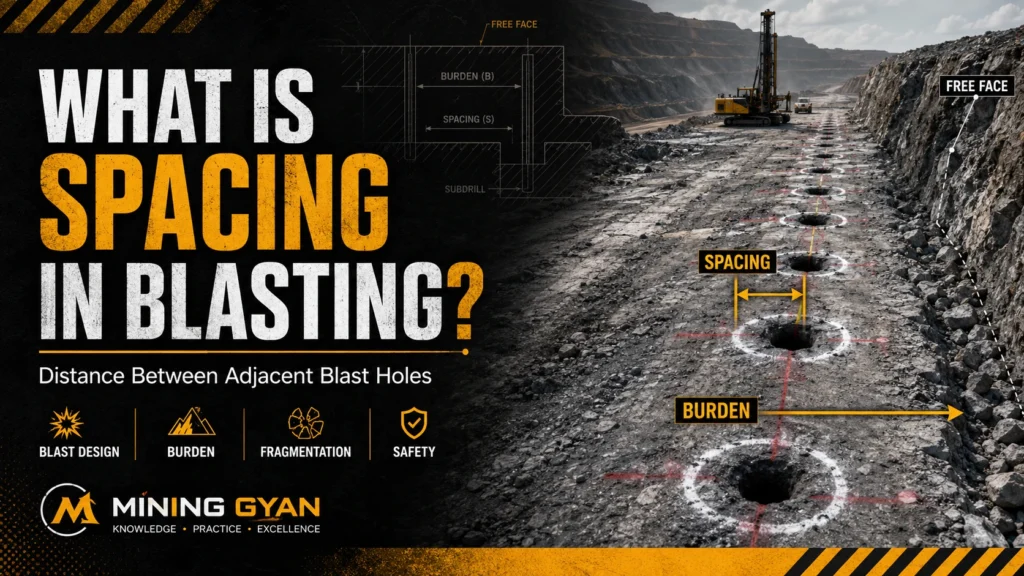
Spacing in blasting is the distance between two adjacent blast holes in the same row. It controls how explosive energy overlaps between neighboring holes and directly affects rock fragmentation, blast efficiency, and mining productivity.


In simple terms, spacing tells us how far apart holes should be drilled. When explosives detonate, cracks develop around each hole. Proper spacing ensures these cracks connect efficiently, breaking the rock into manageable fragments.
Definition
Spacing in Blasting = Distance between adjacent blast holes in the same row.
This parameter is a key part of blast pattern design, rock blasting spacing, and mining blast optimization.
Why is Spacing Important in Blasting?
Direct Answer
Spacing is important because it controls explosive energy distribution, fragmentation quality, vibration levels, and overall blast performance.
If spacing is incorrect:
- Rock may remain unbroken.
- Oversized boulders can form.
- Flyrock risks increase.
- Crushing costs rise.
- Blast efficiency decreases.
Benefits of Correct Spacing
- Better rock fragmentation
- Lower drilling costs
- Reduced secondary blasting
- Improved loader productivity
- Higher crusher efficiency
- Better safety performance
How Spacing Works in Blast Design
Direct Answer
Spacing works by controlling the interaction of shock waves and explosive gases between neighboring blast holes. Proper spacing allows cracks to meet and fragment the rock effectively.
When a blast occurs:
- Explosive detonates.
- Shock waves move through the rock.
- Cracks form around the hole.
- Cracks from adjacent holes intersect.
- Rock breaks efficiently.
- Muck pile is formed.
If spacing is too large, cracks fail to connect. If spacing is too small, energy overlaps excessively and creates excessive fines.
Burden and Spacing Relationship in Blasting
Direct Answer
Burden and spacing are the two most important blast geometry parameters. Burden controls movement toward the free face, while spacing controls interaction between blast holes.


| Parameter | Meaning | Function |
|---|---|---|
| Burden | Distance to free face | Controls rock movement |
| Spacing | Distance between holes | Controls energy overlap |
Common Industry Guideline
For many bench blasting operations:
Spacing = 1.2 × Burden to 1.5 × Burden
Example:
- Burden = 3 m
- Spacing Ratio = 1.3
Spacing:
3 × 1.3 = 3.9 m
Actual values vary according to geology and explosives used.
How to Calculate Spacing in Blasting
Direct Answer
Spacing is usually calculated from burden, rock properties, explosive energy, and desired fragmentation. Most mines use empirical relationships and then optimize through field testing.
Basic Formula
Spacing (S) = Burden (B) × Spacing Ratio
Example:
- Burden = 4 m
- Ratio = 1.25
Spacing:
4 × 1.25 = 5 m
Important Note
There is no universal spacing formula.
Professional blasting engineers consider:
- Rock strength
- Hole diameter
- Bench height
- Explosive type
- Desired fragmentation
- Geological structures
Factors Affecting Blast Hole Spacing
Direct Answer
Blast hole spacing depends on geology, explosive characteristics, drilling parameters, and production goals.
1. Rock Strength
Hard rocks require different spacing than soft rocks.
Examples:
- Granite
- Quartzite
- Basalt
Need more careful spacing optimization.
2. Hole Diameter
Larger blast holes generally support larger spacing.
3. Explosive Energy
High-energy explosives can break larger volumes of rock.
4. Bench Height
Bench geometry directly affects blast design.
5. Geological Structures
Natural joints and fractures influence fragmentation.
6. Water Conditions
Water-filled holes may require spacing adjustments.
7. Desired Rock Fragmentation
Crusher requirements often dictate final spacing selection.
Surface Mining Blast Hole Spacing
Direct Answer
Surface mining blasting uses spacing patterns designed to maximize production while maintaining acceptable fragmentation and safety levels.


Common applications:
- Limestone Mines
- Iron Ore Mines
- Granite Quarries
- Coal Mines
Key design considerations:
- Bench height
- Hole diameter
- Burden
- Stemming
- Powder factor
- Fragmentation target
Underground Mining Blast Spacing
Direct Answer
Underground blast spacing is typically tighter and more precise because excavation dimensions are limited and free faces are restricted.


Underground spacing design considers:
- Heading size
- Cut design
- Advance per round
- Ground support requirements
- Rock competency
Applications:
- Metal Mines
- Coal Mines
- Tunnel Development
- Shaft Sinking
Benefits of Proper Blast Hole Spacing
Direct Answer
Correct spacing improves both technical and economic blast performance.
Major benefits include:
Better Fragmentation
Produces manageable rock sizes.
Reduced Secondary Breaking
Less need for additional blasting.
Improved Explosive Efficiency
Better energy utilization.
Lower Operational Costs
Reduced drilling and crushing expenses.
Improved Muck Pile Shape
Faster loading operations.
Reduced Environmental Impact
Lower vibration and flyrock risk.
Common Mistakes in Blast Hole Spacing
Direct Answer
Most blast performance problems originate from incorrect spacing design rather than explosive selection.
Common mistakes:
Excessive Spacing
Results in:
- Oversized rocks
- Poor fragmentation
- Unbroken zones
Very Tight Spacing
Results in:
- Excessive fines
- Overbreak
- Increased explosive cost
Ignoring Geology
Geological conditions significantly affect spacing requirements.
Poor Drilling Accuracy
Hole deviation changes actual spacing.
Copy-Paste Blast Designs
Every mine requires site-specific optimization.
Expert Tips for Mining Blast Optimization
Direct Answer
Spacing optimization should be based on real blast performance data rather than fixed formulas.
Best practices:
- Monitor fragmentation.
- Track vibration levels.
- Maintain drilling accuracy.
- Use drone surveys when available.
- Review crusher performance.
- Keep blast records.
- Adjust spacing gradually.
Spacing vs Burden Comparison Table
| Feature | Spacing | Burden |
|---|---|---|
| Definition | Hole-to-hole distance | Hole-to-face distance |
| Controls | Hole interaction | Rock movement |
| Main Impact | Fragmentation uniformity | Initial breakage |
| Too Small | Excess fines | Flyrock risk |
| Too Large | Oversized rock | Toe problems |
Myths vs Facts
| Myth | Fact |
|---|---|
| Wider spacing always saves money | Poor fragmentation increases costs |
| One spacing formula works everywhere | Every mine requires customization |
| Explosives are more important than spacing | Both are equally important |
| Blast design never changes | Continuous optimization is necessary |
| Spacing affects only fragmentation | It affects safety and productivity too |
Indian Mining Industry Perspective
Direct Answer
Indian mines face unique blasting challenges due to varied geology, monsoon conditions, and environmental regulations.
Examples include:
- Rajasthan limestone mines
- Odisha iron ore mines
- Jharkhand coal mines
- Karnataka granite quarries
For users searching “spacing in blasting near me”, local geological conditions matter far more than geographic location alone.
Frequently Asked Questions (FAQ)
1. What is spacing in blasting?
Spacing is the distance between adjacent blast holes in the same row.
2. Why is spacing important?
It controls fragmentation, vibration, and explosive efficiency.
3. How is spacing calculated?
Usually using burden and spacing ratios along with field optimization.
4. What happens if spacing is too large?
Poor fragmentation and oversized rocks occur.
5. What happens if spacing is too small?
Overbreak, excessive fines, and higher costs result.
6. What is the relationship between burden and spacing?
Spacing is commonly 1.2–1.5 times the burden.
7. Does rock type affect spacing?
Yes. Hardness and geological structures strongly influence spacing.
8. Is spacing different in underground blasting?
Yes. Underground blasting uses different design principles.
9. Can proper spacing reduce costs?
Yes. It lowers drilling, crushing, and secondary blasting costs.
10. What is the ideal spacing?
There is no universal value. It depends on site conditions and blast objectives.
Key Takeaways
- Spacing is the distance between adjacent blast holes.
- It directly affects fragmentation quality.
- Proper spacing improves safety and productivity.
- Burden and spacing must be designed together.
- Geological conditions strongly influence spacing.
- Surface and underground mines require different spacing strategies.
- Blast optimization is an ongoing process.
Conclusion
Spacing in Blasting is one of the most important parameters in mining explosives engineering. It determines how efficiently explosive energy is distributed, how well the rock fragments, and how productive a mining operation becomes.
Whether you are a mining student, blasting engineer, quarry manager, or mining enthusiast, mastering blast hole spacing, burden and spacing relationships, and blast pattern design will help you understand the science behind successful drilling and blasting operations.
At Mining gyan, we recommend evaluating spacing as part of a complete blast design system that includes burden, stemming, timing, powder factor, geology, and production objectives. Proper spacing optimization leads to safer, more efficient, and more economical mining operations