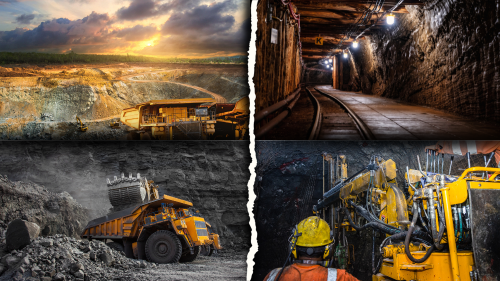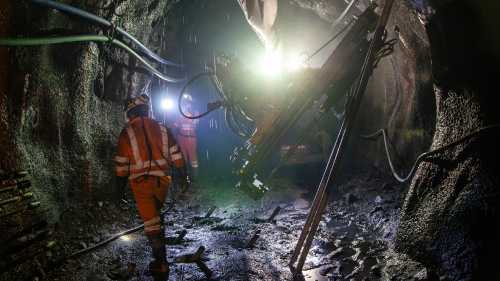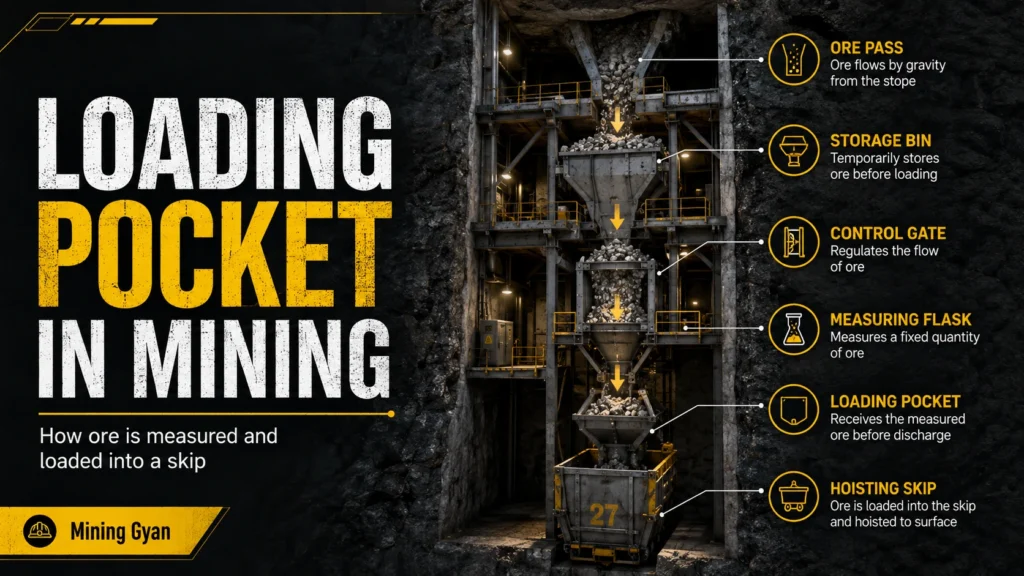
The journey of valuable minerals from deep within the earth to the surface is a marvel of engineering. When people learn about mining, they often focus on the extraction process—drilling, blasting, and mucking. However, the efficiency of a mining operation is heavily dependent on its material handling system. The loading pocket in mining stands as a monumental piece of underground infrastructure, acting as the bridge between horizontal underground transport and vertical shaft hoisting.
At Mining gyan, we understand that mastering mine material transfer systems is essential for anyone aspiring to build a successful career in the Indian mining sector or beyond. Whether you are studying the deep metalliferous mines of Rajasthan or the underground coal networks spanning central India, understanding how an ore storage pocket functions is a core competency.
This comprehensive guide will walk you through beginner concepts, intermediate mechanical functions, and advanced operational strategies related to mining loading pockets.
What is a Loading Pocket in Mining?
Direct Answer: A loading pocket in mining is a specialized underground excavation and mechanical installation located adjacent to a vertical or inclined mine shaft. It serves as a collection, measuring, and transfer station where fragmented ore or waste rock is temporarily stored before being precisely loaded into a skip for transportation to the surface.
To understand the loading pocket meaning in mining, imagine a highly controlled funnel system. After ore is blasted and gathered by load-haul-dump (LHD) vehicles, it is transported through underground tunnels and dumped into an ore pass. The ore pass feeds gravity-driven material down to the loading pocket.
The loading pocket infrastructure is essentially the gatekeeper. It does not just dump dirt into a bucket. Instead, it utilizes complex mechanical chutes, pneumatic cylinders, and measuring flasks to ensure that the exact maximum payload is delivered to the hoisting skip without overflowing. This precision protects the shaft winding system from catastrophic overloads and ensures maximum production capacity.
Why is a Loading Pocket Important in Mining Operations?
Direct Answer: A loading pocket is vital because it acts as a surge buffer between continuous underground mining activities and the cyclical batch process of shaft hoisting. It prevents production bottlenecks, ensures hoisting equipment operates at peak efficiency, and maintains strict safety protocols by preventing shaft spillages.
The importance of loading pockets in underground mines cannot be overstated. Consider the following functional roles:
-
Buffering Capacity: Underground mining operations produce ore at varying rates depending on the blasting schedule. Hoisting skips, however, operate on a fixed, continuous cycle. The loading station in mining acts as a surge bin, absorbing the irregular influx of ore and providing a steady supply to the skips.
-
Shaft Protection: Shaft sinking and maintenance are the most expensive aspects of underground mining. Spilling heavy rocks down a deep shaft can damage the shaft furniture (guides, buntons) and the hoisting ropes. The mine ore loading system prevents this by using interlocking mechanisms.
- Weighing and Volumetric Control: To maximize the life of the winding engine and hoisting ropes, the skip must be loaded with its exact design capacity. Underloading wastes energy and time, while overloading poses a severe safety hazard. The loading pocket precisely measures the payload before transfer.
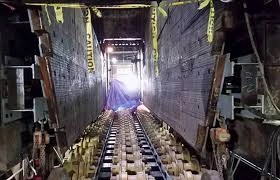
Why is a Loading Pocket Important in Mining Operations?
How Does a Loading Pocket Work? (Working Principle)
Direct Answer: A loading pocket works by receiving ore from an overhead bin, holding it behind a control gate, and releasing it into a measuring flask. Once the hoist skip arrives and locks into position, the flask’s bottom gate opens pneumatically or hydraulically, allowing the measured ore to flow instantly into the skip.
The loading pocket working principle involves a seamless orchestration of gravity, mechanics, and fluid power. Here is the step-by-step mining material handling process within the pocket:
Step 1: Material Reception
Ore travels down the ore pass system and accumulates in a storage bin situated directly above the loading pocket. This bin is equipped with heavy-duty chains or grizzlies to control the flow of massive boulders that could damage the delicate measuring equipment below.
Step 2: The Control Gate
At the base of the storage bin is the main control chute or gate. This is typically a radial door or an under-cut gate powered by massive hydraulic or pneumatic cylinders. When the operator (or automated system) initiates the cycle, this gate opens.
Step 3: The Measuring Flask
The ore drops from the main bin into the measuring flask (or measuring bin). The flask is a steel container engineered to hold the exact volume or weight capacity of the hoisting skip. Advanced mine material transfer systems use load cells attached to the flask to measure the exact tonnage. Once the flask hits its target weight, the upper control gate slams shut.
Step 4: Skip Arrival and Interlocking
The hoisting skip arrives at the loading station level. Modern loading pocket operations are equipped with magnetic proximity sensors and safety interlocks. The bottom gate of the measuring flask cannot physically open unless the skip is perfectly aligned and locked in place.
Step 5: Transfer
Once the skip is verified to be in position, the bottom gate of the measuring flask opens. Because the ore is already pre-measured and waiting, the transfer takes only a few seconds. The bottom gate closes, the skip receives the signal to ascend, and the upper gate simultaneously opens to refill the flask for the next cycle.
Key Features of a Loading Pocket System
Direct Answer: Key features of a modern loading pocket include robust steel structural supports, wear-resistant chute liners, pneumatic or hydraulic control gates, precise volumetric measuring flasks, load cell weighing systems, and automated safety interlock mechanisms.
To achieve continuous mining production, the ore handling equipment within the pocket must be incredibly durable.
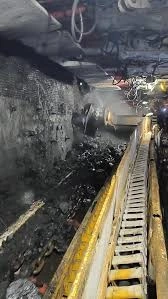
Wear Liners: The abrasive nature of hard rock ore can destroy standard steel in weeks. Loading pockets are lined with easily replaceable wear plates made of manganese steel or high-density chromium carbide. Dust Suppression: Falling ore creates massive amounts of silica dust. High-quality underground loading pockets feature mist sprays and active ventilation extraction hoods to protect the health of the operators. Automation Control Room: While older systems required manual lever operation, modern mine loading facility designs utilize Programmable Logic Controllers (PLCs). The operator sits in an air-conditioned cabin, monitoring the loading pocket operations via CCTV and computer screens.
Benefits of Using Loading Pocket Systems in Underground Mines
Direct Answer: The primary benefits of loading pocket systems include increased hoisting capacity, reduced shaft maintenance costs, enhanced operator safety, improved energy efficiency in winding engines, and the elimination of production bottlenecks in underground haulage.
When evaluating loading pocket benefits in underground mines, we see a massive return on investment across several domains:
-
Throughput Maximization: By reducing the time a skip sits idle at the shaft bottom waiting to be filled, the mine can achieve more hoisting cycles per hour.
-
Energy Conservation: Winding engines consume vast amounts of electricity. Lifting partially empty skips wastes power. Loading pockets ensure every hoist is optimized for maximum payload.
-
Longevity of Equipment: Controlled loading prevents the sudden shock-loading of the hoist rope, thereby extending the life of the wire rope and the winding drum.
-
Housekeeping: Controlled ore transfer pocket mechanisms drastically reduce spillage. Spillage requires manual cleanup at the shaft bottom, which is dangerous, time-consuming, and expensive.
Who Needs a Loading Pocket in Mining?
Direct Answer: Loading pockets are required by any deep underground mining operation that utilizes shaft hoisting to bring bulk materials (ore or waste rock) to the surface. They are essential for high-capacity metal mines, deep coal mines, and large-scale industrial mineral operations.
If you are a student learning via Mining gyan, it is important to know that not every mine uses a loading pocket. Shallow mines might use decline ramps where haul trucks drive directly to the surface. However, as mines go deeper, trucking becomes economically unviable due to fuel costs, ventilation requirements for diesel exhaust, and travel time.
Operations that transition to vertical shaft hoisting absolutely must implement an ore storage and loading system. This includes deep gold mines, copper operations, and underground zinc mines commonly found across India and globally.
Loading Pocket vs Ore Pass: A Comparison
Direct Answer: An ore pass is a vertical or inclined excavated tunnel used to drop ore via gravity from a higher level to a lower level. A loading pocket is the mechanical structure at the bottom of the system that measures and controls the transfer of that ore into a hoisting skip.
Many beginners confuse these two components of the underground mine infrastructure. The table below breaks down the differences clearly.
What Are the Alternatives to Loading Pockets?
Direct Answer: Alternatives to traditional loading pockets include direct truck haulage to the surface via a decline ramp, continuous conveyor belt systems for inclined shafts, and skip-loading via front-end loaders (which is highly inefficient and only used in temporary or artisanal setups).
While the loading pocket in underground mining is the gold standard for vertical shafts, mine planners sometimes opt for alternatives based on the ore body geometry. Conveyor Systems: If the shaft is inclined rather than perfectly vertical, a high-capacity conveyor belt might be used. This eliminates the batch-loading process of a skip and the need for a measuring flask. Direct Trucking: For depths less than 500 meters, mines may utilize articulated dump trucks driving up a spiral decline.
Is Investing in Advanced Loading Pockets Worth It?
Direct Answer: Yes, investing in advanced, automated loading pockets is highly worth it for deep mines. The high initial capital expenditure is rapidly offset by the drastic increase in daily hoisting tonnage, fewer maintenance shutdowns, and significantly lower safety incident rates.
For mining engineering students analyzing the economics of mining production systems, the loading pocket is a classic example of capital expenditure (CAPEX) vs. operational expenditure (OPEX). An automated volumetric measuring flask system might cost millions of rupees to design, fabricate, and install. However, if it prevents just one shaft accident or increases daily production by 5%, the system pays for itself within the first year of operation.
The Role of Loading Pockets in Indian Mining Operations
Direct Answer: In India, deep metalliferous mines in states like Rajasthan and Jharkhand rely heavily on automated loading pockets to meet high production targets while adhering to the strict safety regulations enforced by the Directorate General of Mines Safety (DGMS).
The target audience of Mining gyan knows that the Indian mining landscape is rapidly modernizing. Historically, manual loading stations in older coal mines led to inefficiencies and safety hazards. Today, as Indian mining companies push deeper to access resources like zinc, lead, and uranium, the installation of state-of-the-art loading pocket infrastructure has become standard practice.
For local SEO and context, consider a mine in the Zawar region. The integration of fully automated loading pockets allows these mines to hoist thousands of tons of ore daily, ensuring India remains globally competitive in metal production. Furthermore, these systems are designed with localization in mind, ensuring they can withstand the specific humidity and ambient temperatures of deep Indian mines.
Common Mistakes in Loading Pocket Design and Operation
Direct Answer: Common mistakes include undersizing the buffer storage bin, using inadequate wear liners for abrasive ores, failing to install sufficient dust suppression, and neglecting the calibration of load cells, which leads to skip overloading and shaft damage.
Even experienced mining operations management teams can make errors when designing or operating an ore collection point.
-
Ignoring Material Flow Properties: Wet, sticky ore behaves differently than dry, fragmented rock. If the chute angles in the loading pocket are too shallow, sticky ore will build up and block the system.
-
Inadequate Ventilation: Loading pockets generate heat (from hydraulic power packs) and dust. Failing to integrate the pocket into the primary mine ventilation circuit creates a hostile working environment.
-
Bypassing Safety Interlocks: Sometimes, operators bypass the proximity sensors to speed up loading. This is a fatal mistake that can result in releasing tons of rock down an empty shaft if the skip is not present.
Expert Tips for Loading Pocket Maintenance and Safety
Direct Answer: Expert maintenance requires a strict daily inspection of hydraulic hoses, regular calibration of weighing mechanisms, immediate replacement of worn chute liners, and routine testing of the skip-in-place safety interlocks to prevent catastrophic shaft spillages.
Building authority and trust in underground operations requires strict adherence to maintenance schedules. Here are expert tips for loading pocket maintenance:
-
Preventative Maintenance Over Reactive: Never wait for a chute to wear through before replacing the liner. Establish a condition-monitoring program using ultrasonic thickness gauges on the steel plates.
-
Hydraulic Fluid Cleanliness: The underground environment is incredibly dusty. The primary cause of gate failure is dust contaminating the hydraulic fluid, which ruins the cylinder seals. Use high-grade filtration systems.
-
Spillage Monitoring: Track the amount of spillage at the shaft bottom daily. A sudden increase in spillage is the first indicator that the loading pocket gates are not sealing properly.
Myths vs Facts About Mine Ore Loading Systems
Direct Answer: A common myth is that loading pockets simply pour rock into a skip until it looks full. The fact is that modern loading pockets are highly precise measuring instruments that use volumetric flasks and load cells to calculate the exact payload down to the kilogram.
Myth: Loading pockets can handle any size of rock. Fact: Loading pockets have a strict maximum lump size. Oversized boulders will jam the control gates. A grizzly or rock breaker must be installed upstream to manage fragmentation.
Myth: Loading pockets require a dozen manual laborers to operate. Fact: Modern mine loading facility designs are almost entirely automated, requiring only one control room operator, with maintenance personnel stepping in only during scheduled downtime.
Frequently Asked Questions
What is a Loading Pocket in Mining?
A loading pocket is an underground mechanical installation located near a shaft. It receives ore from upper levels, temporarily stores it, and precisely measures and loads it into a hoisting skip for transport to the surface.
Why is a loading pocket used in mining?
It is used to ensure that hoisting skips are loaded with their exact design capacity quickly and safely. It acts as a buffer between continuous underground mining and batch shaft hoisting, preventing production bottlenecks.
How ore is loaded from a loading pocket?
Ore drops from a storage bin into a measuring flask. Once the hoist skip arrives and locks into position, the measuring flask’s bottom gate opens, instantly dumping the pre-measured ore into the skip.
What is the difference between an ore pass and a loading pocket?
An ore pass is the vertical tunnel through which rock falls via gravity. The loading pocket is the mechanical machinery at the bottom of the ore pass that controls, measures, and stops the rock before loading it into the skip.
How do you maintain a loading pocket?
Maintenance involves routinely replacing the steel wear liners inside the chutes, checking hydraulic and pneumatic cylinders for leaks, calibrating the load cells, and ensuring all safety proximity sensors are functioning perfectly.
Can a loading pocket cause a mine accident?
If poorly maintained or if safety interlocks are bypassed, a loading pocket can release tons of rock into an empty shaft, severely damaging the shaft infrastructure, cables, and potentially endangering lives at the shaft bottom.
What materials are loading pockets made of?
The main structure is made of heavy-duty structural steel. However, the internal surfaces that contact the moving rock are lined with replaceable wear-resistant materials like manganese steel, white iron, or hardened rubber.
How deep underground are loading pockets located?
Loading pockets are located at various depths depending on the mine’s design. They are typically found at the lowest active production levels, which can range from 200 meters to over 3,000 meters deep in some of the world’s deepest mines.
Do loading pockets need electricity?
Yes. While gravity moves the rock, electricity is required to run the hydraulic power packs, pneumatic compressors, control room computers, PLCs, lighting, and ventilation systems within the loading station.
Is a loading pocket fully automated?
Modern loading pockets are highly automated. Sensors detect when the measuring flask is full and when the skip is in position, allowing the computer to manage the gate opening and closing sequences with minimal human intervention.
Conclusion
Understanding the loading pocket in mining is fundamental to grasping how large-scale underground operations achieve profitability and safety. As we have explored in this comprehensive guide, the mining material handling system is much more than just digging and dumping. It involves precise engineering, robust machinery, and strict adherence to safety protocols.
From the measuring flasks to the pneumatic control gates, every component of the underground loading pocket plays a crucial role in protecting the shaft infrastructure and optimizing the winding engine’s power. Whether you are comparing an ore pass to a loading pocket, or analyzing the capital costs of a new mine loading facility, the principles remain focused on volume control and continuous throughput.
As the mining industry continues to modernize, especially within India’s growing deep-mining sector, the automation and efficiency of these ore transfer pockets will only increase. By implementing expert maintenance tips and avoiding common design mistakes, mining engineers can ensure these vital arteries of the mine keep flowing smoothly.
Thank you for reading this guide. If you are passionate about learning more about underground mine infrastructure, stay connected with Mining gyan. We are committed to bringing you the most detailed, accurate, and practical mining education available. Keep digging deeper, and always prioritize safety in your operations!