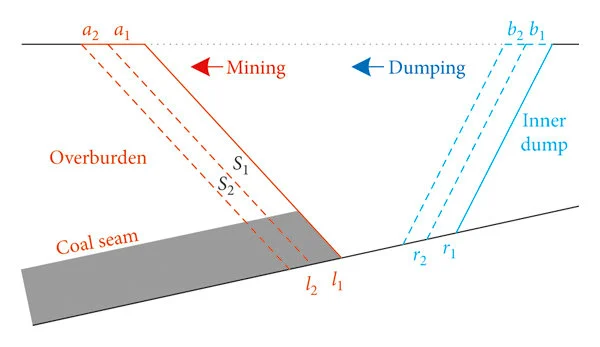
In underground mining, an incline refers to a sloping passage that connects the surface of the earth with underground mining levels. Unlike a vertical shaft, an incline is developed at an angle, allowing easier transportation of miners, equipment, and extracted minerals.
Inclines are widely used in underground mining operations, especially in coal mines where mineral seams occur at shallow or moderate depths. These sloping passages provide a practical and economical method of accessing underground deposits.
Mining operations require efficient access routes to move workers and machinery between the surface and underground working areas. Inclines provide this access while also serving as transportation and ventilation pathways.
Because of their flexibility and relatively lower construction cost compared to vertical shafts, inclines are commonly used in many modern underground mines around the world.
What is Incline in Mining?
In mining terminology, an incline is a sloping underground passage developed to provide access between the surface and underground mining levels.
These passages are usually constructed at an angle ranging between 1 in 3 and 1 in 6 depending on the geological conditions and transportation requirements.
Inclines may be large enough to allow vehicles, conveyor systems, or rail haulage systems to operate inside them.
In modern mining operations, inclines often become the main access route for the entire mine.
Purpose of Inclines in Mining
Inclines serve several important functions in underground mining operations. They play a crucial role in maintaining efficient and safe mining activities.
Mining Gyan Sponsors KHANAN’25 at IIT (ISM) Dhanbad: Empowering the Future of Mining Engineers
Access to Underground Workings
Inclines provide a direct pathway for miners to reach underground working areas safely and efficiently.
Transportation of Minerals
One of the primary purposes of an incline is to transport mined minerals from underground workings to the surface using conveyors, rail cars, or haulage vehicles.
Movement of Equipment
Heavy mining machinery such as loaders, drilling machines, and haulage trucks can be transported through inclines.
Ventilation Pathway
Inclines help circulate fresh air into underground workings and remove harmful gases.
Emergency Escape Route
In many mines, inclines also function as emergency escape routes for workers during accidents or hazardous situations.
Types of Inclines in Mining
Inclines in mining can be classified based on their design and operational purpose.
Conveyor Incline
A conveyor incline is designed to transport mined material using conveyor belts. These are commonly used in coal mining operations.
Track Incline
Track inclines are equipped with rail tracks used for mine carts or locomotives that transport ore and materials.
Belt Incline
Belt inclines are specifically developed for continuous belt conveyor systems used for material transport.
Manway Incline
A manway incline is designed for the movement of workers between different mining levels.
Vehicle Incline
Vehicle inclines are large enough to allow trucks and heavy mining vehicles to travel between the surface and underground workings.
| Type of Incline | Description |
|---|---|
| Conveyor Incline | Used for transporting minerals using conveyor belts |
| Track Incline | Equipped with rail tracks for mine carts |
| Belt Incline | Designed for belt conveyor transportation |
| Manway Incline | Used for movement of miners |
| Vehicle Incline | Allows vehicles and trucks to operate underground |
Development of Inclines in Underground Mining
The construction of mining inclines involves several engineering stages to ensure stability and safety.
Surveying and Planning
Mining engineers first conduct geological surveys to study rock formations and determine the best direction and gradient for the incline.
Drilling and Blasting
In hard rock mines, drilling and blasting techniques are used to excavate the rock and create the sloping passage.
Rock Removal
Broken rock fragments are removed using loaders, haulage vehicles, or conveyor systems.
Installation of Support Systems
Roof supports such as rock bolts, steel arches, and shotcrete are installed to stabilize the incline.
Transportation System Installation
After excavation and stabilization, transportation systems such as conveyors, rail tracks, or haulage roads are installed.
Support Systems Used in Mining Inclines
Inclines require strong support systems to prevent roof collapse and ensure worker safety.
Timber Supports
Traditional mining operations often used timber supports to hold the roof and walls of inclines.
Steel Supports
Steel arches and frames provide stronger and longer-lasting support for underground passages.
Rock Bolting
Rock bolts reinforce the surrounding rock mass and prevent falling rocks.
Shotcrete
Shotcrete is sprayed concrete used to stabilize rock surfaces and strengthen the incline walls.
Equipment Used in Incline Development
Various machines and tools are used during incline construction.
| Equipment | Function |
|---|---|
| Drilling Machines | Create holes for blasting |
| Explosives | Break rock during blasting |
| Continuous Miner | Mechanically cuts coal or rock |
| Load-Haul-Dump Machines | Remove broken rock |
| Conveyor Belts | Transport extracted minerals |
Advantages of Inclines in Mining
Inclines provide several operational advantages in underground mining.
- Lower construction cost compared to shafts
- Easier transportation of machinery
- Suitable for mechanized mining
- Allows vehicles to operate underground
- Provides flexible mine access
Safety Challenges in Mining Inclines
Although inclines are beneficial, they also present several safety challenges.
| Challenge | Description |
|---|---|
| Roof Collapse | Weak rock formations may cause structural failure |
| Gas Accumulation | Dangerous gases may accumulate without proper ventilation |
| Water Inflow | Underground water may flood incline passages |
| Transportation Accidents | Vehicle movement may cause accidents |
Modern Technology in Incline Mining
Technological advancements have improved incline mining efficiency and safety.
Automated Conveyor Systems
Modern conveyor systems allow continuous transportation of minerals.
Digital Mine Mapping
Computerized mapping helps engineers design optimal incline layouts.
Real-Time Monitoring Sensors
Sensors monitor gas levels, rock pressure, and structural stability.
Electric Mining Vehicles
Electric vehicles reduce emissions and improve underground air quality.
Frequently Asked Questions
What is incline in mining?
What is the difference between a shaft and an incline?
Where are inclines commonly used?
Why are inclines important?
Conclusion
Inclines are an essential part of underground mining infrastructure. These sloping passages provide safe access to underground deposits and allow efficient transportation of workers, machinery, and minerals.
Proper planning, construction, and support of inclines are crucial to ensure safety and productivity in mining operations.
With the help of modern technologies such as digital mapping, automated conveyors, and advanced monitoring systems, incline mining has become safer and more efficient than ever before.