
For candidates preparing for MOIL, CIL, SCCL, and other PSU mining examinations, DGMS rules are among the most frequently tested topics. For working professionals, they define responsibility, authority, and liability. Understanding DGMS rules is therefore essential not only to clear exams but also to build a long-term career in mining.
DGMS Rules and Regulations – Legal Framework Explained
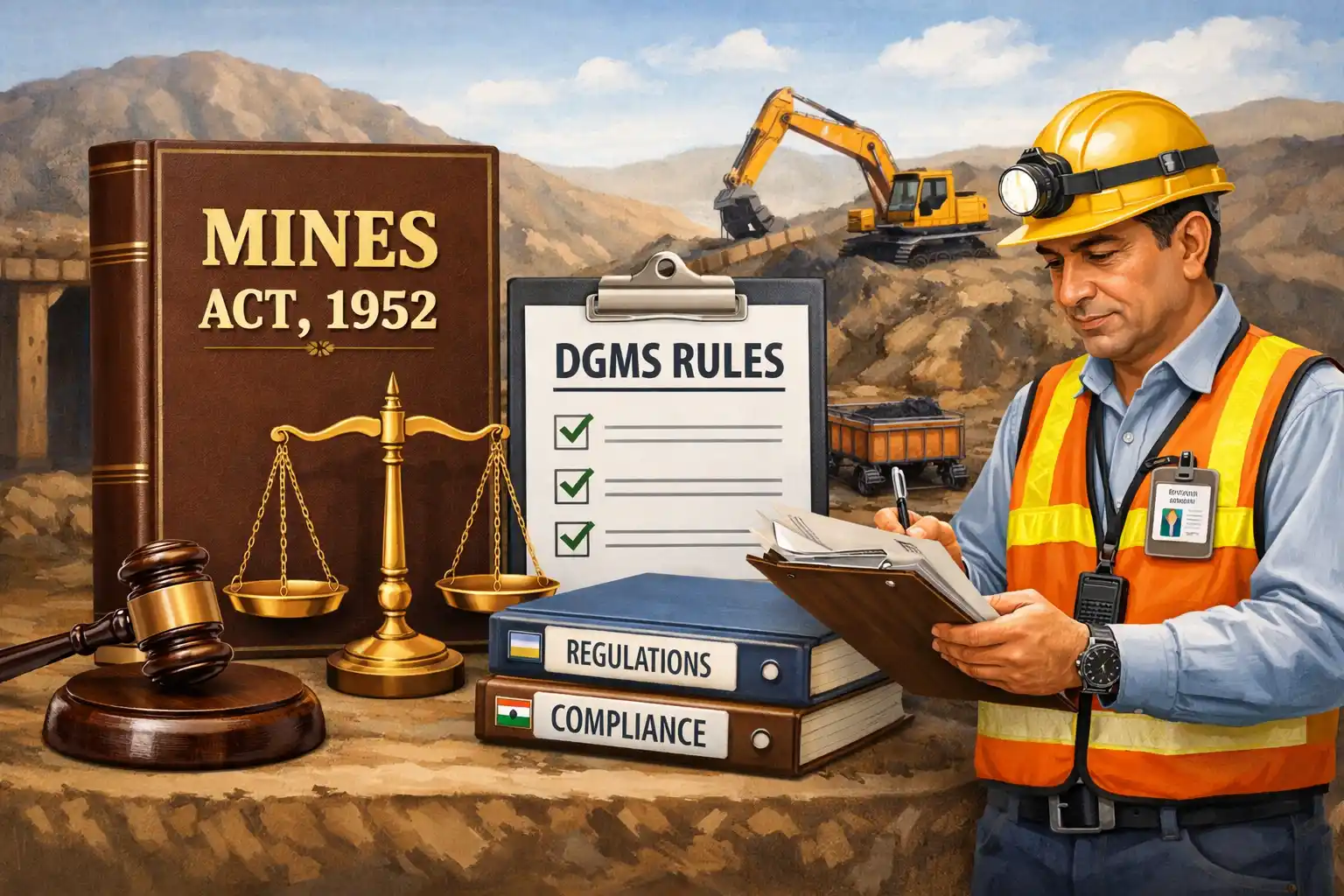
DGMS rules and regulations derive their authority primarily from the Mines Act, 1952 . The Act empowers the Central Government to frame detailed safety rules and appoint DGMS as the statutory enforcement body. DGMS inspectors and officers are legally authorized to enter mines, conduct inspections, issue notices, suspend operations, and prosecute violations when safety norms are ignored.
The regulatory framework is not limited to one type of mine. DGMS rules apply to coal mines, metalliferous mines, oil mines, and even certain construction activities connected to mining operations. The intent is uniform: prevention of accidents, protection of life, and promotion of scientific mining practices.
Mines Act, 1952: Foundation of DGMS Rules
The Mines Act, 1952 acts as the constitutional document of mine safety law in India. It defines what constitutes a mine, who qualifies as an owner, agent, or manager, and establishes the responsibilities of each role. DGMS rules are framed under different sections of this Act and provide operational-level clarity.
| Aspect | Coverage under Mines Act, 1952 |
|---|---|
| Safety authority | DGMS empowered to enforce rules |
| Applicability | Coal, metalliferous, oil mines |
| Employer responsibility | Owner, agent, manager defined |
| Worker protection | Health, welfare, working hours |
| Penalties | Fines, imprisonment, mine closure |
Without the Mines Act, DGMS rules would have no enforcement power. This is why DGMS questions in exams often link rules directly to specific sections of the Act.
DGMS Rules PDF – Official Documents and Structure
DGMS rules PDF is the most commonly searched format by students and professionals because it provides consolidated, official access to safety regulations. These PDFs are structured chapter-wise and include rules, schedules, annexures, and prescribed formats.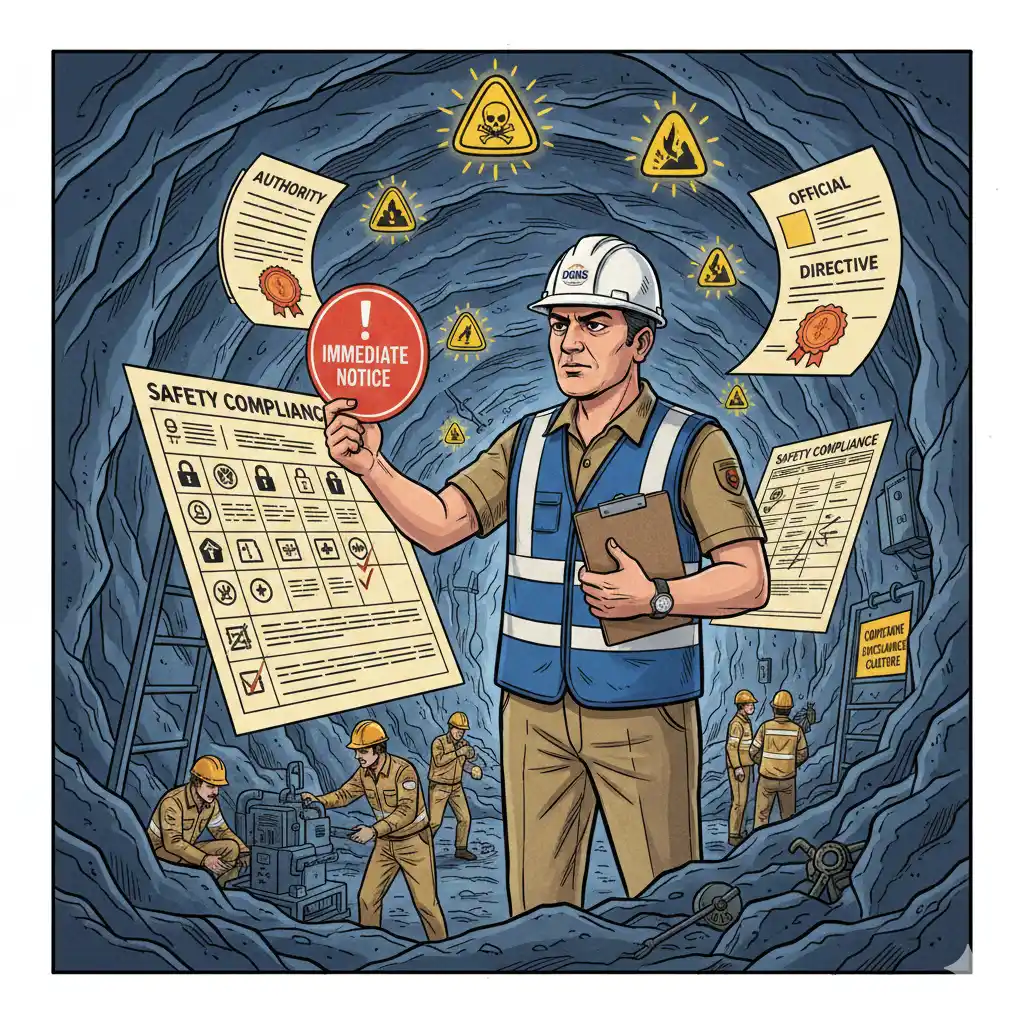
A DGMS rules PDF is not merely a reading document. It is designed as a compliance manual. Each rule is written in mandatory language, clearly stating what must be done, who is responsible, and under what conditions operations can continue.
DGMS Rules Book vs DGMS Rules PDF
Many professionals still rely on printed DGMS rules books, while aspirants increasingly prefer digital PDFs. Both serve the same legal purpose but differ in usability.
| Parameter | DGMS Rules Book | DGMS Rules PDF |
|---|---|---|
| Updates | Manual replacement needed | Easily updated |
| Accessibility | Physical copy required | Mobile and desktop access |
| Exam preparation | Useful for deep study | Preferred for quick revision |
| Searchability | Limited | Keyword searchable |
For competitive exams, DGMS rules PDF offers a significant advantage due to fast navigation and cross-referencing.
DGMS Rules for Open Cast Mines
DGMS rules for opencast mines are designed to control large-scale surface operations where heavy machinery, blasting, and slope stability are major risk factors. Unlike underground mines, opencast mines expose workers to hazards such as highwall failures, dump slides, equipment collisions, and fly rock during blasting.

DGMS rules mandate strict controls on bench height, bench width, slope angles, haul road gradients, and dump design. These parameters are not optional recommendations; deviation without approval can lead to immediate stoppage of operations.
| Opencast Activity | DGMS Safety Requirement |
|---|---|
| Bench formation | Approved height and width |
| Blasting | Controlled blasting plan |
| Haul roads | Gradient and berm standards |
| Dumping | Stability and drainage norms |
| Heavy machinery | Operator certification |
In mining exams, questions on DGMS rules for opencast mines often test numerical limits, responsibility hierarchy, and accident case studies.
DGMS Rules for Coal Mines
DGMS rules for coal mines are more stringent due to the inherent dangers of gas, fire, explosions, and roof falls. Coal mines, especially underground, present unique hazards that require specialized ventilation, gas monitoring, and emergency preparedness systems.
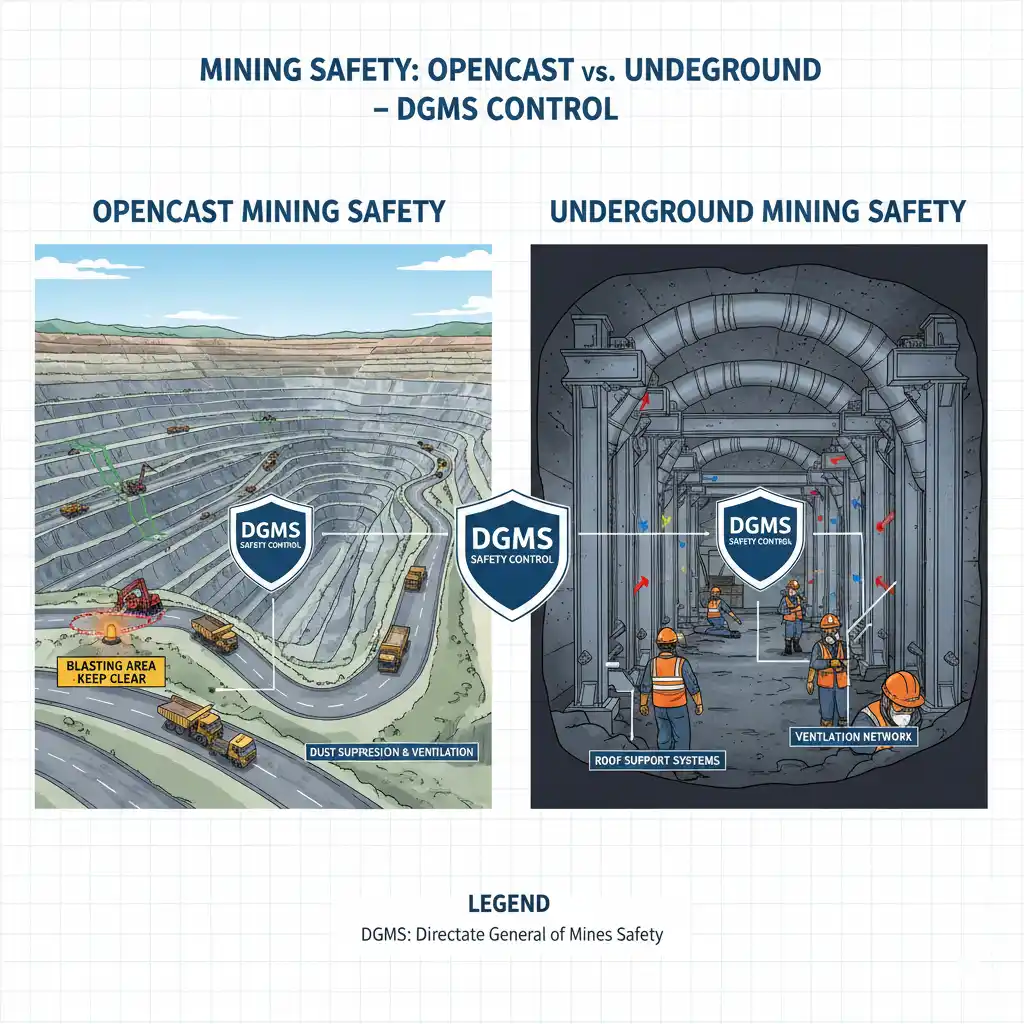
Coal mine regulations emphasize methane management, coal dust suppression, fire prevention, and emergency response planning. DGMS inspectors closely monitor these aspects, and non-compliance is treated as a serious offense.
| Coal Mine Hazard | DGMS Regulatory Control |
|---|---|
| Methane gas | Continuous gas monitoring |
| Roof fall | Systematic roof support |
| Fire | Fire fighting and sealing plans |
| Explosion | Stone dusting standards |
| Ventilation | Mandatory airflow quantities |
Understanding coal-specific DGMS rules is critical for candidates appearing in Mining Sirdar, Overman, and Mine Manager examinations.
DGMS Rules for Electrical Installations in Mines
Electrical safety in mines is governed by dedicated DGMS rules because electricity combined with explosive atmospheres can be fatal. DGMS regulations specify standards for flameproof equipment, earthing systems, cable management, and electrical inspections.
Only certified electrical supervisors are permitted to handle mine electrical systems. DGMS rules clearly define voltage limits, protective devices, and testing intervals.
| Electrical Component | DGMS Compliance Requirement |
|---|---|
| Switchgear | Flameproof certification |
| Cables | Mechanical and insulation protection |
| Earthing | Resistance limits defined |
| Inspections | Periodic testing mandatory |
| Personnel | Licensed electrical staff |
Electrical DGMS rules are commonly asked in departmental promotions and statutory exams.
DGMS Rules 2021 – Amendments and Impact
DGMS rules 2021 introduced several important updates aimed at modernizing mine safety and improving accountability. These changes reflected lessons learned from past accidents and technological advancements in mining.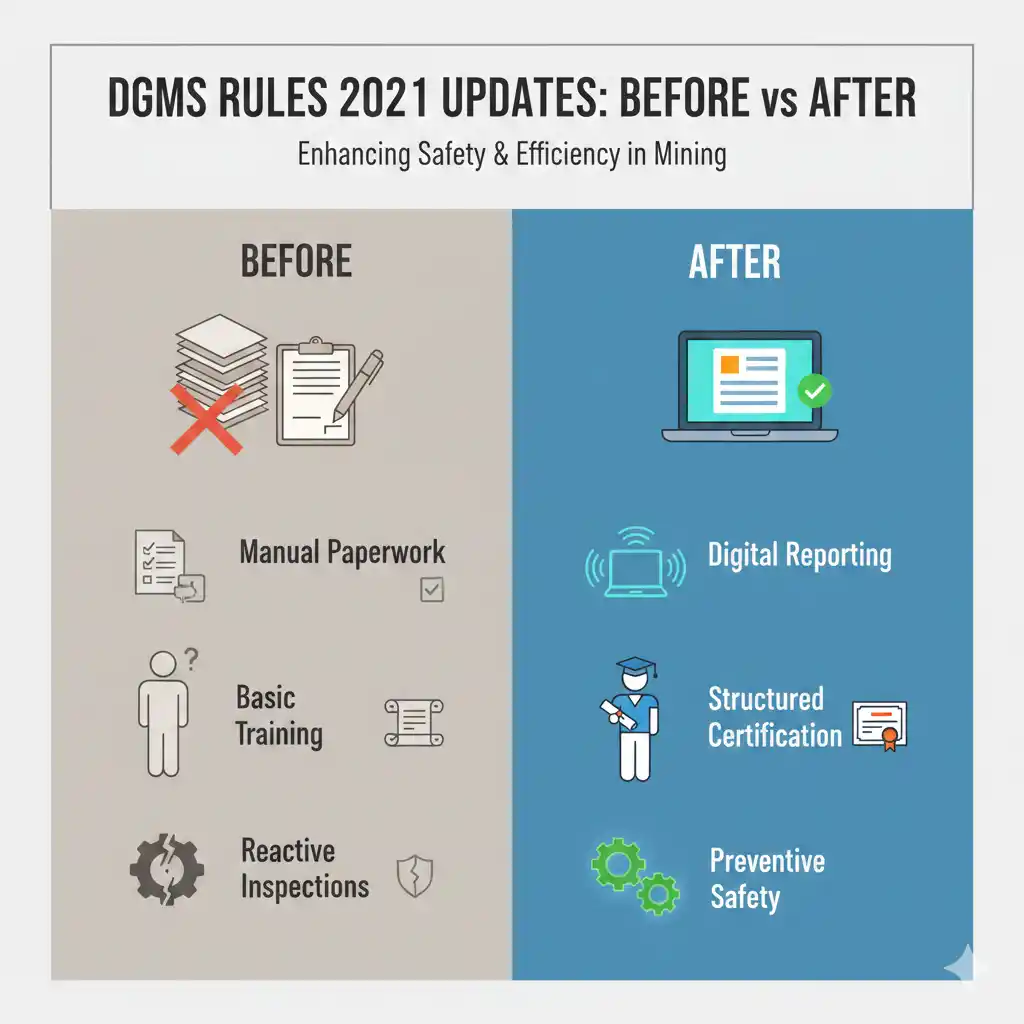
Digital record keeping, enhanced training requirements, and stricter accident reporting timelines were among the key changes. These amendments strengthened DGMS’s enforcement capabilities and reduced ambiguity in responsibility allocation.
| Area | Pre-2021 | DGMS Rules 2021 |
|---|---|---|
| Reporting | Manual records | Digital submission |
| Training | Periodic | Structured certification |
| Accountability | General | Role-specific |
| Inspections | Reactive | Preventive focus |
Exam questions increasingly reference DGMS rules 2021 due to their relevance.
DGMS Circulars – Instructions Beyond the Rulebook
DGMS circulars are official instructions issued to clarify, supplement, or temporarily modify the application of existing rules. While circulars do not replace rules, they carry mandatory authority and must be followed.
Circulars often address emerging risks, accident trends, or procedural clarifications. Ignoring DGMS circulars can result in penalties similar to rule violations.
| Circular Type | Practical Impact |
|---|---|
| Safety alerts | Immediate operational changes |
| Clarifications | Uniform rule interpretation |
| Accident analysis | Preventive guidance |
| Training advisories | Skill enhancement mandates |
Professionals are expected to stay updated with the latest DGMS circulars.
Mining Rules and Regulations PDF – DGMS in the Bigger Picture
DGMS rules operate alongside other mining-related laws such as the MMDR Act, environmental regulations, and explosives rules. Mining rules and regulations PDFs often compile these interconnected laws for holistic understanding.
DGMS ensures that safety regulations align with environmental and operational standards, creating a unified regulatory environment.
DGMS Rules for Mining Exams (MOIL, CIL, Sirdar, Overman)
DGMS rules form a core syllabus component for almost all mining recruitment exams. Questions are designed to test practical understanding rather than rote memorization. Candidates who study DGMS rules with real-world application consistently outperform others.
| Examination | DGMS Rule Weightage |
|---|---|
| Mining Sirdar | High |
| Overman | Very High |
| Mine Manager | Critical |
| MOIL Technical | Moderate to High |
| CIL MT | Conceptual Focus |
Understanding the intent behind each rule is key to scoring well.
Why DGMS Rules Are Critical for Mine Safety and Careers
DGMS rules are not barriers to productivity; they are safeguards that protect lives and careers. Most major mining accidents in India have been linked to violations or ignorance of DGMS rules.
For professionals, compliance ensures legal protection. For aspirants, mastery of DGMS rules signals readiness for responsibility.
Frequently Asked Questions on DGMS Rules and Regulations
What is DGMS rules and regulations PDF?
DGMS rules and regulations PDF is the official digital compilation of statutory safety rules issued under the Mines Act, 1952 and enforced by the Directorate General of Mines Safety. This PDF contains legally binding provisions related to mine safety, worker health, machinery standards, electrical installations, ventilation, blasting operations, accident reporting, and managerial responsibilities. Mining professionals and exam aspirants rely on the DGMS rules PDF because it presents authenticated, government-approved content that is accepted during inspections, audits, and competitive examinations.
What is the full form of DGMS in mining?
The full form of DGMS in mining is Directorate General of Mines Safety. DGMS is a statutory authority under the Ministry of Labour and Employment, Government of India. Its primary role is to enforce safety legislation in mines, oil fields, and allied industries. DGMS derives its powers from the Mines Act, 1952 and is responsible for framing safety rules, issuing technical circulars, conducting inspections, investigating mine accidents, and ensuring compliance across all mining operations in India.
What is the role of DGMS in Indian mining?
The role of DGMS in Indian mining is to regulate and enforce safety standards across coal, metalliferous, and oil mines. DGMS ensures that mines operate within legally defined safety parameters and that risks to human life are minimized through preventive regulation. Its functions include approval of mine plans from a safety perspective, inspection of working conditions, certification of mining professionals, investigation of accidents, and issuance of mandatory safety directives. DGMS also advises the government on policy improvements based on accident analysis and field observations.
What are DGMS safety rules?
DGMS safety rules are statutory regulations designed to prevent accidents, occupational diseases, and unsafe working conditions in mines. These rules govern critical aspects such as ventilation, roof and side support, electrical installations, blasting operations, use of machinery, emergency preparedness, and worker training. DGMS safety rules clearly define the duties of owners, agents, managers, and supervisory staff, making safety a shared legal responsibility rather than an optional practice.
Are DGMS rules applicable to all mines in India?
Yes, DGMS rules are applicable to all mines operating in India, irrespective of whether they are government-owned or privately operated. This includes coal mines, metalliferous mines, oil mines, and certain excavation activities notified under the Mines Act. Compliance with DGMS rules is mandatory, and violations can result in penalties, suspension of operations, or legal prosecution.
Why are DGMS rules important for mining exams?
DGMS rules are important for mining exams because they test a candidate’s understanding of real-world safety responsibilities and legal accountability. Examinations for Mining Sirdar, Overman, Mine Manager, MOIL, and Coal India posts frequently include direct and case-based questions from DGMS rules. Candidates who understand the intent and application of these rules perform better than those who rely on rote memorization.
What is the difference between DGMS rules and DGMS circulars?
DGMS rules are permanent statutory regulations framed under the Mines Act, whereas DGMS circulars are official instructions issued to clarify, supplement, or reinforce specific safety practices. While rules define the legal framework, circulars address practical implementation, emerging risks, and lessons learned from accidents. Both are mandatory, and non-compliance with either can attract legal action.
Who enforces DGMS rules at mine sites?
DGMS rules are enforced by DGMS officers, including inspectors and directors, who are authorized to conduct mine inspections, issue notices, and order suspension of unsafe operations. At the mine level, enforcement responsibility also lies with the owner, agent, and manager, who are legally accountable for ensuring compliance with all DGMS safety rules.
Are DGMS rules updated regularly?
Yes, DGMS rules are periodically reviewed and updated to reflect technological advancements, accident trends, and international best practices. Amendments, notifications, and circulars are issued to strengthen safety enforcement and remove ambiguities. Mining professionals and aspirants are expected to stay updated with the latest DGMS guidelines.
Can a mine be closed for violating DGMS safety rules?
Yes, DGMS has the authority to order partial or complete closure of a mine if serious safety violations are observed. Such action is taken when continued operation poses a threat to human life. Closure orders remain in force until corrective measures are implemented and verified by DGMS officials.
Conclusion: DGMS Rules Are the Backbone of Safe Mining in India
DGMS rules and regulations are the foundation on which India’s mining safety framework stands. They reflect decades of operational experience, accident analysis, and technological evolution. Whether you are a student, aspirant, or seasoned professional, understanding DGMS rules is not optional. It is a professional obligation and a career necessity.




5 Responses