
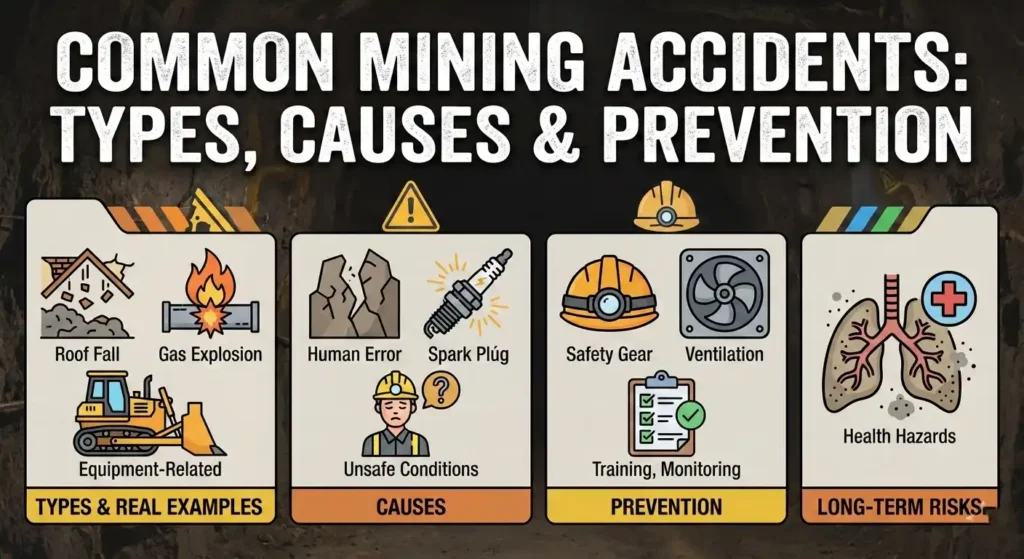
Despite safety laws, training programs, and modern equipment, mining accidents still occur due to human error , poor planning, unsafe practices, and natural underground conditions. Understanding the types of mining accidents, how they occur, and learning from real examples is essential to improve worker safety and reduce future risks.
Roof Fall and Ground Collapse Accidents
Roof fall accidents are among the most fatal mining accidents, especially in underground coal mines. These accidents occur when the rock or coal layer above the working area collapses suddenly, trapping or crushing workers.
The main reason behind roof falls is weak geological structure combined with inadequate roof support systems. In many cases, warning signs such as cracks, unusual sounds, or roof deformation are ignored due to work pressure or lack of supervision.
| Factor | Details |
|---|---|
| Accident Type | Roof fall / ground collapse |
| Common Location | Underground coal mines |
| Primary Cause | Weak strata, poor roof support |
| Impact | Fatal injuries, trapping of workers |
| Preventability | High with proper planning |
Proper geological surveys, continuous monitoring of strata behavior, and timely installation of roof supports significantly reduce roof fall accidents. Worker training to identify early warning signs also plays a crucial role in prevention.
Gas Explosion Accidents in Mines
Gas explosions are one of the most devastating mining accidents and are mainly associated with underground coal mines. Methane gas is naturally released during coal extraction and becomes extremely dangerous when it accumulates in confined spaces.
Poor ventilation systems allow methane to build up, and a single spark from electrical equipment or machinery can trigger a massive explosion. These accidents often result in multiple fatalities and long-term mine closures.
| Aspect | Description |
|---|---|
| Main Gas Involved | Methane |
| Trigger | Spark, heat, electrical fault |
| Risk Level | Extremely high |
| Typical Damage | Explosions, fires, fatalities |
| Key Prevention | Ventilation and gas monitoring |
Modern mines use automatic gas detectors connected to power cut-off systems. Regular ventilation audits and strict safety compliance are essential to prevent gas-related disasters.
Mine Fire Accidents
Mine fires can occur due to spontaneous combustion of coal, electrical faults, frictional heat from machinery, or as a result of explosions. These fires are difficult to control because they occur underground and may continue burning for years.

Mine fires reduce oxygen levels, release toxic gases, and make rescue operations extremely dangerous. In many cases, mines must be sealed permanently to control the fire.
| Cause | Effect |
|---|---|
| Spontaneous coal heating | Long-term underground fire |
| Electrical faults | Rapid fire spread |
| Poor isolation | Fire re-ignition |
| Delayed action | Mine abandonment |
Regular temperature monitoring , controlled mining methods, and proper sealing techniques are critical to minimizing fire risks.
Machinery and Equipment-Related Accidents
Mining operations rely heavily on large machines such as dumpers, loaders, drilling rigs , conveyors, and crushers. Accidents occur when equipment is poorly maintained or operated without proper training.
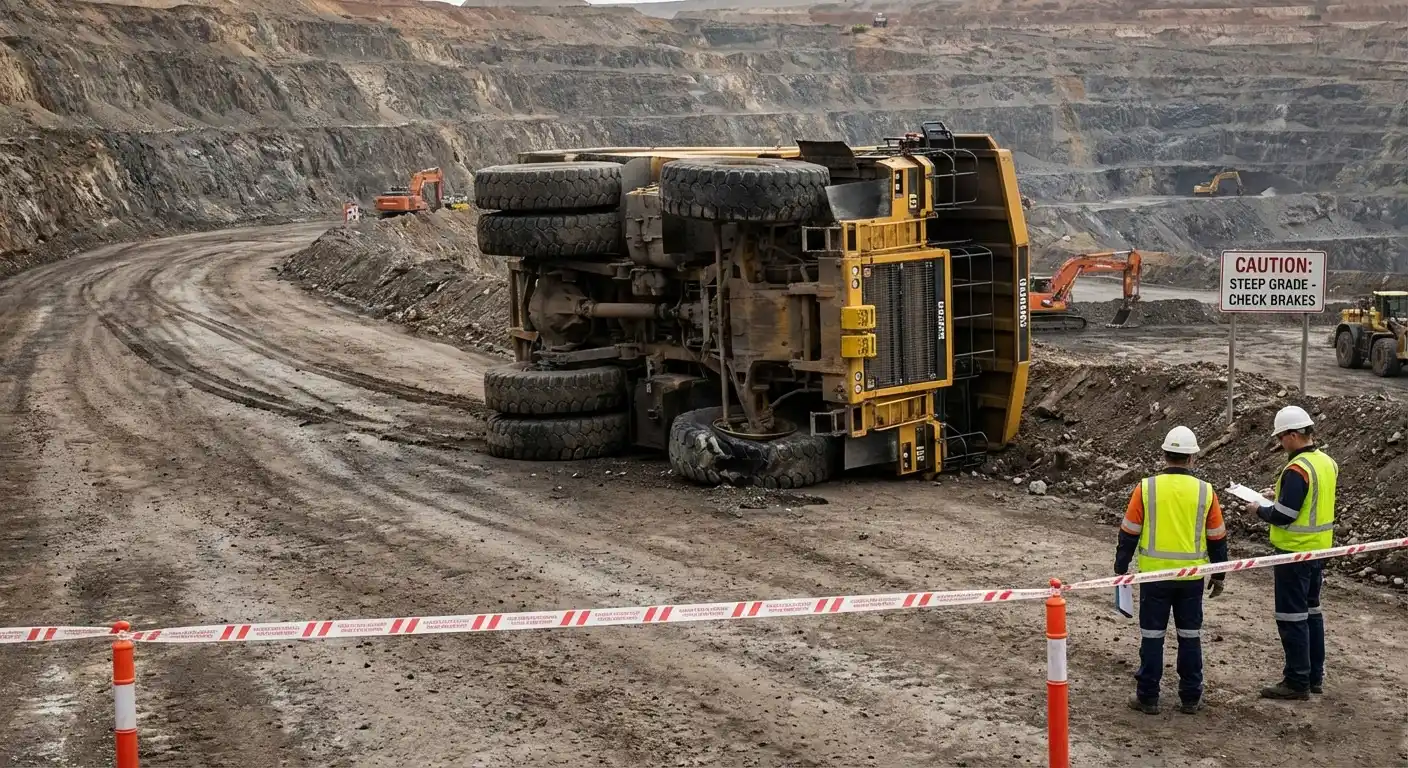
In open-cast mines, dumper accidents are particularly common due to over-speeding, brake failure, or poor road conditions. In one reported incident, a dumper overturned after brake failure, killing the operator. Maintenance logs later showed skipped inspections and excessive working hours.
| Equipment | Common Accident Type |
|---|---|
| Dumper | Collision,️ / overturning |
| Conveyor | Entanglement |
| Drilling machine | Crushing injuries |
| Loader | Visibility-related accidents |
Strict maintenance schedules, operator rest policies, and modern safety features such as collision warning systems can significantly reduce such accidents.
Blasting Accidents in Mining
Blasting is an essential but highly dangerous operation in mining. Accidents can occur during explosive storage, charging, detonation, or due to misfires.
Blasting accidents usually result from human error rather than technical failure, making training and discipline extremely important.
| Issue | Result |
|---|---|
| Improper storage | Accidental detonation |
| Misfire handling | Sudden explosion |
| Poor clearance | Worker injuries |
| Untrained staff | Fatal mistakes |
Only certified blasting officers should handle explosives, and strict re-entry protocols must be followed without exception.
Electrical Accidents in Mines
Electrical accidents include electrocution, short circuits, and fire hazards. Mines are especially dangerous environments due to moisture, dust, and confined spaces.
In one underground mine incident, a worker was electrocuted after touching an exposed cable in a water-logged tunnel. Investigation revealed damaged insulation and lack of regular inspection.
| Hazard | Risk |
|---|---|
| Exposed cables | Electrocution |
| Water presence | Short circuits |
| Poor earthing | Fatal shocks |
| Unauthorized repairs | Fire hazards |
Using flameproof equipment , regular inspections, and proper grounding systems are essential safety measures.
Transportation and Haulage Accidents
Transportation systems inside mines include dumpers, conveyors, rail tracks, and man-riding systems. Accidents occur due to overloading, poor road design, lack of signaling, and human negligence.
| System | Common Risk |
|---|---|
| Conveyor belts | Entanglement |
| Mine roads | Vehicle collision |
| Rail systems | Runaway wagons |
| Man-riding | Falls |
Well-designed traffic management plans and proper guarding of moving parts greatly reduce haulage-related injuries.
Occupational Health and Long-Term Mining Hazards
Not all mining accidents are sudden. Many workers suffer long-term health damage due to continuous exposure to dust, noise, heat, and toxic substances.
Diseases such as silicosis and coal workers’ pneumoconiosis develop slowly and often appear after years of service. Several retired miners have been diagnosed with irreversible lung diseases due to prolonged dust exposure and poor ventilation.| Exposure | Health Impact |
|---|---|
| Coal dust | Lung disease |
| Silica dust | Silicosis |
| Noise | Hearing loss |
| Heat | Heat stress |
Regular medical checkups, dust suppression systems , and proper PPE are critical for long-term worker health.
Conclusion
Common mining accidents occur due to a combination of unsafe conditions, human error, poor supervision, and inadequate safety culture. Roof falls, gas explosions, fires, machinery accidents, and health hazards continue to threaten mining workers worldwide.
Learning from real incidents, enforcing strict safety standards, and prioritizing worker well-being over production targets are the only sustainable ways to reduce mining accidents and save lives.
FAQs
What is the most common cause of mining accidents?
The most common cause of mining accidents is human error combined with unsafe working conditions. This includes ignoring safety procedures, improper use of machinery, lack of supervision, and working under pressure to meet production targets.
In many mines, accidents occur not because of equipment failure alone, but because safety rules are bypassed or warning signs are overlooked during routine operations.
What are the accidents of mining?
Mining accidents refer to unexpected incidents that cause injury, death, or property damage during mining operations. These accidents can occur in underground mines, open-cast mines, and processing plants.
Common mining accidents include roof falls, gas explosions, mine fires, machinery accidents, blasting mishaps, electrical shocks, transportation collisions, and health-related incidents caused by dust and toxic exposure.
What are the 10 causes of accidents in mining?
Mining accidents are caused by multiple factors working together rather than a single reason. The most frequent causes include unsafe work practices, poor maintenance of equipment, inadequate training, lack of ventilation, weak ground support, faulty electrical systems, improper blasting methods, fatigue due to long working hours, poor communication, and absence of safety monitoring systems.
When these factors combine, the risk of serious accidents increases significantly.
What are the 7 environmental impacts of mining?
Mining has several environmental impacts that affect land, water, air, and ecosystems. These include land degradation due to excavation, deforestation, air pollution from dust and emissions, water contamination from mine waste, soil erosion, loss of biodiversity, and long-term ground subsidence.
Unscientific mining practices worsen these impacts and create long-lasting environmental damage even after mining operations stop.
What are the 4 causes of accidents?
The four primary causes of accidents in mining are human factors, machine-related issues, environmental conditions, and management failures.
Human factors include negligence and lack of training, machine-related issues involve faulty or poorly maintained equipment, environmental conditions include unstable ground or gas presence, and management failures involve poor planning and weak safety enforcement.
What are the 4 types of mining?
The four main types of mining are surface mining, underground mining, placer mining, and in-situ mining.
Surface mining includes open-cast operations, underground mining involves deep tunnels, placer mining extracts minerals from riverbeds, and in-situ mining recovers minerals through chemical solutions without large-scale excavation.
What are the 4 main hazards in mining?
The four main hazards in mining are ground instability, toxic gases, heavy machinery, and explosives.
Ground instability can cause roof falls, toxic gases can lead to suffocation or explosions, machinery poses risks of crushing or collisions, and explosives can cause fatal accidents if mishandled.
What is the biggest mine accident in India?
One of the biggest mine accidents in India is the Chasnala Mining Disaster of 1975 in Jharkhand. In this tragedy, sudden flooding from an adjacent abandoned mine drowned 372 miners, making it one of the deadliest mining disasters in the world.
The disaster highlighted serious lapses in mine planning and safety management.
What are the three main causes of accidents?
The three main causes of accidents are unsafe acts, unsafe conditions, and lack of safety management.
Unsafe acts include ignoring rules, unsafe conditions involve hazardous environments, and poor safety management leads to inadequate training, supervision, and enforcement of safety standards.
What are the 5 negative effects of mining?
Mining negatively affects both people and the environment. The five major negative effects are air pollution, water pollution, land degradation, health problems among workers, and displacement of local communities.
If mining activities are not properly regulated, these impacts can persist for decades.
What are the three types of accidents?
Accidents are generally classified into minor accidents, major accidents, and fatal accidents.
Minor accidents cause small injuries, major accidents result in serious injuries or large damage, and fatal accidents lead to loss of life.
What is the biggest problem in mining?
The biggest problem in mining is maintaining safety while meeting production demands.
Pressure to increase output often leads to shortcuts, reduced safety checks, and worker fatigue, which significantly increases accident risks.
What is the major cause of most accidents?
The major cause of most accidents is non-compliance with safety procedures.
Even when safety rules and equipment are available, failure to follow standard operating procedures remains the leading reason behind mining accidents worldwide.



One Response