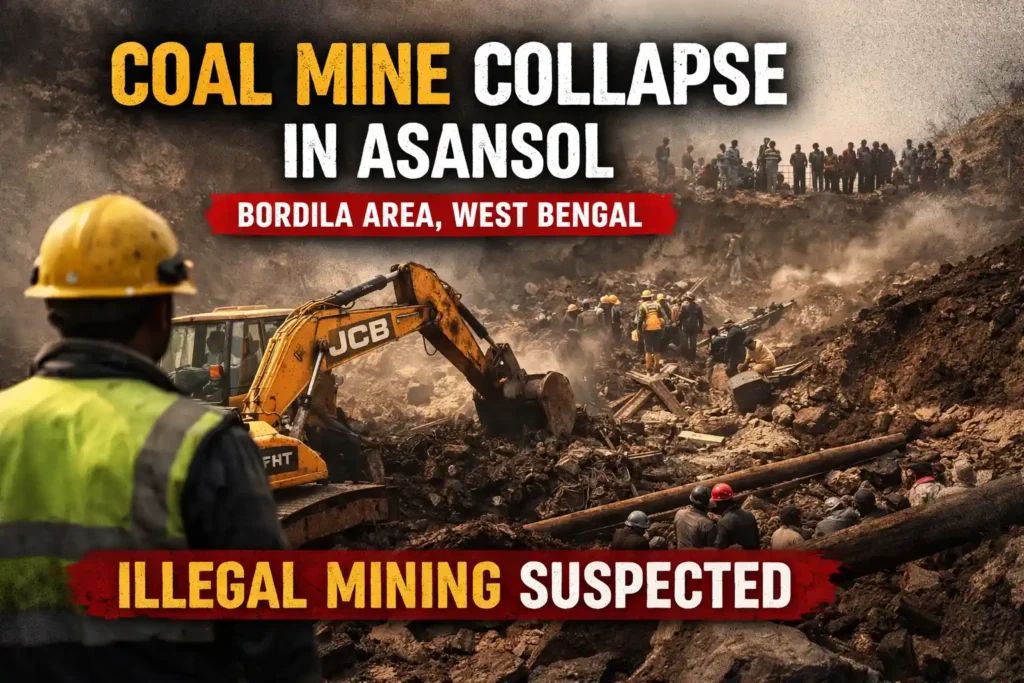
A coal mine collapse was reported in the Bordila area under Kulti police station in Asansol, West Bengal , on Tuesday, January 13. The incident reportedly occurred during illegal coal extraction activities, raising serious concerns about mine safety, unauthorized mining operations, and enforcement of mining laws in the region. Several people were feared trapped and injured after debris suddenly fell inside the mine, prompting immediate rescue operations by local authorities.
According to initial information, the collapse happened in a coal-bearing zone where mining activity was allegedly being carried out without proper authorization. The sudden failure of the mine structure led to panic in the area, as local residents and workers rushed to the site. Police and emergency teams were alerted and reached the location soon after the incident was reported.
What Happened at the Bordila Coal Mine?
The coal mine collapse took place in the Bordila area, which falls under the jurisdiction of Kulti police station in Asansol. Reports suggest that the mine collapsed while coal extraction was ongoing, causing a large volume of debris to fall into the working area. Due to the unplanned nature of the operation, it was feared that several workers were inside the mine at the time of the collapse.
Initial Reports and BCCL Ownership Confusion
In the early hours following the incident, some reports described the collapsed site as an open-cast coal mine operated by Bharat Coking Coal Ltd (BCCL), a subsidiary of Coal India Limited. Police officials also stated that BCCL teams were conducting rescue operations using heavy machinery such as JCB machines to remove debris.
However, BCCL later issued a clarification to certain media outlets, stating that the mine where the collapse occurred does not belong to the company. This clarification created confusion regarding the ownership and legal status of the mine. With BCCL distancing itself from the site, suspicion grew stronger that the collapse may be linked to illegal coal mining rather than authorized operations.
At the time of reporting, the ownership of the mine remained unconfirmed, and authorities indicated that a detailed investigation would be required to determine responsibility.
Illegal Coal Mining: A Persistent Risk
Illegal coal mining has long been a serious issue in several coal-rich regions of India, including parts of West Bengal, Jharkhand, and Odisha. Such activities are typically carried out without valid mining leases, geological surveys, or safety approvals from regulatory authorities. Workers involved in illegal mining often operate in hazardous conditions, without protective equipment or trained supervision.
In illegal mines, there is usually:
- no proper mine design,
- no roof support system, and
- no compliance with safety guidelines issued by the Directorate General of Mines Safety (DGMS).
This significantly increases the risk of mine collapses, suffocation due to poor ventilation, and fatal accidents. The Asansol coal mine collapse once again highlights the human cost of illegal mining. While coal extraction provides short-term income for those involved, it exposes workers and nearby communities to life-threatening dangers.
Rescue Operations and Local Tension
Following the collapse, rescue operations were immediately launched by police and emergency teams. Heavy machinery was deployed to clear debris, while officials attempted to assess the stability of the remaining mine structure. Rescue work in such conditions is extremely challenging, as further collapses can occur at any moment.
The incident led to tension in the area as local residents gathered near the site. Families of suspected trapped workers demanded quick rescue efforts and clarity about the situation. Police were deployed to manage the crowd and ensure that rescue operations could continue without obstruction.
Authorities stated that more information would be available once rescue operations were completed and a preliminary investigation was conducted.
Why Mine Collapses Are Common in Illegal Mining Areas
Mine collapses are more frequent in illegal mining zones due to several critical factors:
- First, there is no scientific assessment of the geological condition of the area before excavation begins.
- Second, illegal miners often remove coal pillars that are meant to support the roof, weakening the structure of the mine.
- Third, there is no regular inspection or monitoring of ground movement, gas levels, or water seepage.
In authorized coal mines, safety protocols, trained officials, and regular inspections help reduce risks. In contrast, illegal mining operations ignore these safeguards, making accidents almost inevitable over time.
Need for Stronger Enforcement and Awareness
The Asansol mine collapse underscores the urgent need for stronger enforcement of mining laws and stricter action against illegal coal extraction. Regulatory authorities must ensure regular surveillance of coal-bearing areas and take preventive measures before accidents occur.
Mining Gyan Insight
Mining Gyan emphasizes that incidents like the Bordila coal mine collapse are not isolated accidents but symptoms of a larger problem. Illegal mining thrives where regulation is weak and awareness is low. Preventing such tragedies requires a combination of strict law enforcement, transparent investigations, and public education about mine safety. Every mine collapse is a reminder that coal extraction without proper planning and safety measures puts lives at risk. Addressing illegal mining is not just a legal necessity but a moral responsibility to protect workers and communities in mining regions.